In Japan, coming home has its own words. You call out “tadaima,” or “I’ve returned,” and someone answers back, “Okaerinasai,”—“Welcome home.” It’s a short verbal ritual, a basic call-and-response that happens every day in apartments, offices, and hotels across Japan. However, when comedian Atsuko Okatsuka evoked “tadaima” during her first live show in her homeland of Japan, the experience was anything but ordinary.
It went like this: a woman strolled onto stage, the house lights still half-up. Below her sat a room full of strangers waiting to see if she’s as funny as she is online. Before her first joke, she greeted the audience saying, “Tadaima.” “I’m home.”
It was a throwaway line, unscripted and not even played for laughs. She was ready to start the show, but then hundreds of people answered back at once, without missing a beat, “Okaerinasai.” Welcome home.
That moment—returning home and being welcomed onstage by her country, her audience—brought Okatsuka to tears. And understandably so. She recounted the story on Trevor Noah’s podcast, What Now? If you’ve seen the clip, you know it’s the kind of thing that leaves you a little misty-eyed.
Let’s breakdown what happened, and why that moment landed the way it did.
The two-month ‘vacation’ to the U.S.
To understand her emotions onstage, we must first return to Atsuko’s childhood. When she was eight, Okatsuka’s grandmother told her to pack her bags: they were leaving for a two-month vacation to the United States. In reality, they were moving. The trip marked the beginning of a painful, permanent relocation for Okatsuka, as she, her grandmother, and her mom flew from Japan to Los Angeles, embarking on a vacation without a return date. As months turned into years and her family’s visas expired—rendering them void—it began to dawn on Okatsuka that she never got to say goodbye to her friends, or even her father.
In the years since, she’s described her early experience as a “kidnapping” carried out by her grandmother, who subsequently forced them into “hiding”: three generations of women stashed above an uncle’s garage in Los Angeles, living undocumented and with very few resources, for seven years.
“All I knew was that I was living in Japan, and suddenly I wasn’t,” Okatsuka said on a 2023 episode of This American Life titled “The One Place I Can’t Go.” It was the first time she spoke publicly about what happened in her youth. “I was forced to go to school in America, learn English and start a new life,” she continues. “I went by ‘Stacey’ for two months. It was jarring and confusing.”
Today, Okatsuka uses her comedy as a way to work through the deep, emotional turmoil she experienced as a child. Her grief—and all the complicated emotions that accompany it—is examined in her 2025 Hulu special, Father, which centers around reconciling with her dad in Japan, years later.
What ‘tadaima’ actually means
In Japanese homes, coming and going—the act of departure and return—holds significance, and, therefore, a small ritual has been built into the language. On the way out, you say “ittekimasu” (“I’m heading out”), and whoever’s staying behind replies “itterasshai” (“Go and come back safely”). When you return, you say “tadaima,” and the other person replies, “okaerinasai.”
It’s more than mere manners. That simple call-and-response carries a promise: you left, but we held your space. To enter a home, to cross its threshold, signals a retreat from public life as you reenter a private, safe space. The words—tadaima, okaerinasai—are simply a way to put that transition into words.
They said it back
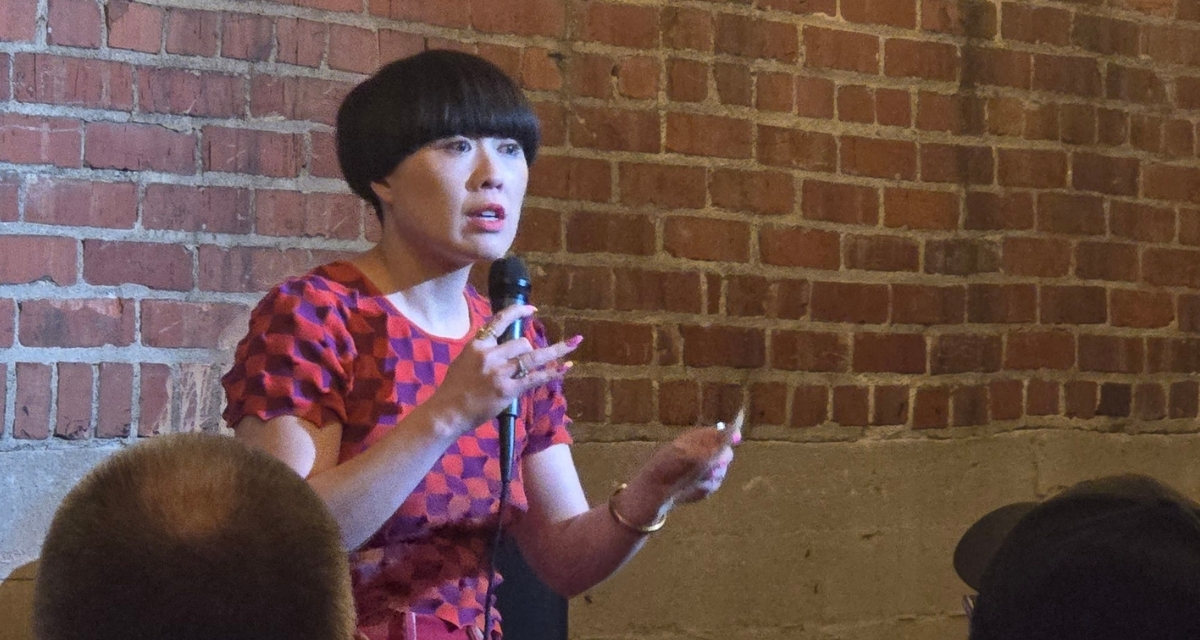
Cut to 2024. It’s Atsuko’s first time touring Japan as a comedian. That night, the room is packed with Japanese fans. She strolls onto the stage, rocking her signature bowl cut, bright-green pants, and platform red shoes. “I felt like layers of my Japanese identity were ripped away,” Okatsuka recounts to Trevor Noah. “So I really wanted to do well on my Japanese shows and to prove that I am home.”
Instead of opening with a joke, she begins with a word. “Nice to meet you, I’m Atsuko,” she says while looking at the crowd, waving. Then it happens. “I decided to say to the audience, tadaima,” she told Noah. “And thousands of them all said back to me, ‘Welcome home’ in Japanese.”
Someone recorded the interaction between Atsuko and her Japanese crowd that night. For a split second, after thousands of voices came back at once, you can see how it hits her.
“Oh my god, I got so teary-eyed,” she said. Noah’s reaction was just as quick: “I just got goosebumps,” he replied.
The grief that has no end
The kind of grief Okatsuka carried since that fateful plane ride when she was 8 years old has a name: ambiguous loss. It’s the ache of losing something (a home, a goodbye, a version of yourself), but with no clear ending to point to. But sometimes, closure is a thing you craft yourself. That’s what happened on that stage in Tokyo. Okatsuka faced the room and announced she was home. And thousands of voices reassured her that yes, she was.
It’s also worth noting that her grandmother’s reasons for the “kidnapping” weren’t cruel. After a lot of investigating—much of it her own—Okatsuka learned that, at the time, her mom’s schizophrenia was intensifying, and her grandmother no longer felt Japan was safe for a child.
Yep, this one sticks with you
We don’t usually get to watch someone find closure in real time. That stuff usually happens off camera, in slow, messy, and non-linear ways. But in those videos, both from the actual night and Okatsuka’s later conversation with Trevor Noah, you can see how one exchange in front of thousands changed one person’s life.
Everyone carries their own version of an unfinished goodbye: a friendship that crumbled for no good reason, a childhood home that’s been sold, a hometown left for good without meaning to. But Okatsuka’s story reminds us that we don’t need to wait around for closure to find us. Sometimes, a room full of strangers willing to say the right word at the right time is enough.