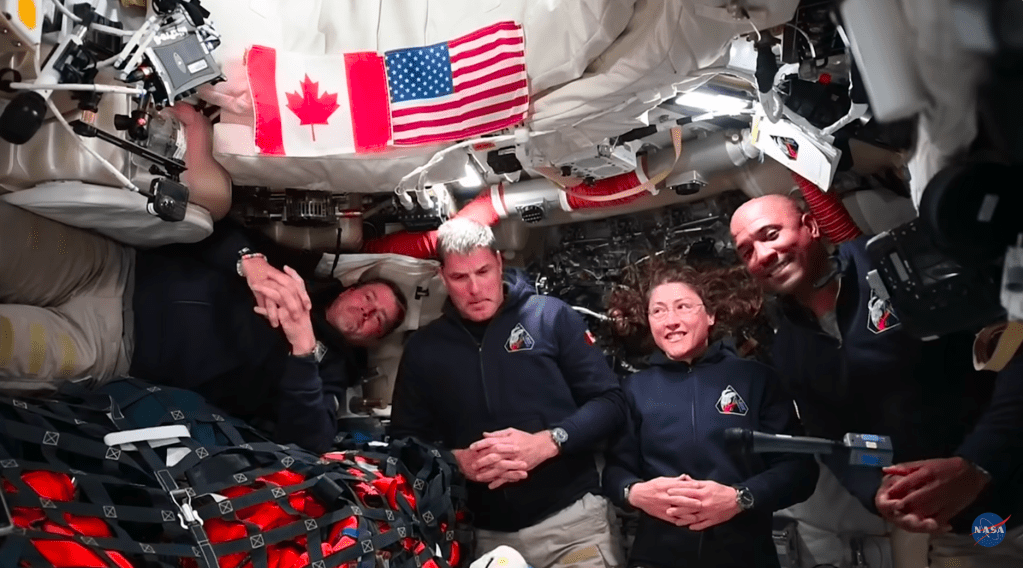
The four astronauts on the Artemis II NASA mission have broken a 55-year-old record, traveling farther into space than any human has gone before. Every human milestone is significant, and an Easter message from the mission’s pilot, Victor Glover, reminds us why.
Speaking with the astronauts, a CBS News reporter noted that the Apollo 8 crew delivered a Christmas Eve message during their 1968 mission. He asked whether the Artemis II crew had a message to share for Easter. When the microphone floated to Glover, he said he hadn’t prepared anything, but offered some impromptu thoughts:
“We are the same thing”
“I think these observances are important, as we are so far from Earth and looking back at the beauty of creation. I think for me, one of the really important personal perspectives that I have up here is I can really see Earth as one thing.
And you know, when I read the Bible, and I look at all of the amazing things that were done for us, who we’re created, it’s…you have this amazing place, this spaceship. You guys are talking to us because we’re in a spaceship really far from Earth. But you’re on a spaceship called Earth that was created to give us a place to live in the universe, in the cosmos.
Maybe the distance we are from you makes you think what we’re doing is special. But we’re the same distance from you, and I’m trying to tell you—just trust me—you are special. In all of this emptiness—this is a whole bunch of nothing, this thing we call the universe—you have this oasis, this beautiful place that we get to exist together.
I think as we go into Easter Sunday, thinking about all the cultures all around the world, whether you celebrate it or not, whether you believe in God or not, this is an opportunity for us to remember where we are, who we are, and that we are the same thing, and that we got to get through this together.”
People of all faiths—and no faith—appreciated the message
Commenters appreciated Glover’s perspective as he looked out at all 8 billion of us on our beautiful “pale blue dot.”
“One of the most beautiful perspectives I’ve ever heard on this topic. Thank you Victor.”
“Beautiful unifying message.”
“I am not a religious person at all but this speech made me cry.”
“It gave me chills. What a beautiful message.”
“As someone who’s not religious this is the perfect message conveyed by someone of faith without feeling unwarranted or preaching in a way that doesn’t land. Delivered perfectly and I respect him for that.”
“What a beautiful sentiment we all so desperately need to hear.”
Glover’s remarks reflect what others who have viewed Earth from space have said. The emotional experience of that perspective, known as the “overview effect,” often results in a profound awareness of humanity’s place in the universe.
The “overview effect” is a common experience for people who see Earth from space
For Star Trek actor William Shatner, who went to space at age 90 in 2021, that awareness gave him a surprising feeling of deep grief.
“It was the death that I saw in space and the lifeforce that I saw coming from the planet — the blue, the beige and the white,” he said. “And I realized one was death and the other was life.”
Earth and life are “so fragile,” Shatner said. “We hang by a thread…we’re just dangling.” Seeing humanity from that distance put conflicts between humans into perspective. “We’re entangled with each other,” he said. “We have a war…the stupidity of it all is so obvious.”
Frank White, the space philosopher who coined the term “overview effect” in his 1987 book of the same name, wrote that astronauts who leave Earth generally come back with “a greater distaste for war and violence, and a desire to do something to improve life back on the surface, because they’ve seen the truth of our situation.”
Space travel highlights our shared humanity
When Glover referred to Earth as a spaceship, he wasn’t just being metaphorical. Our planet is a self-contained, closed-loop system, meaning its resources are produced and recycled here. And we are hurtling through space at about 67,100 miles per hour—much faster than any spacecraft we’ve sent into space. For all intents and purposes, we are traveling together on a giant, round spaceship.
The universe is vast, yet it’s so easy to get wrapped up in the little details of life on our planetary ship. Zooming out—seeing Earth from a distance—can help us view ourselves and our lives in a different light. Seeing our home, our people, our lives as one has the power to change something within us. It’s a potent reminder that, for all our uniqueness, we really are one.
Watch the highlights from Day 4 of the Artemis II mission: