A plaque addressed 'to the future' marks Iceland's first glacier lost to the climate crisis
"We know what is happening..."

A plaque marking the death of a glacier comes with a haunting message to future generations.
The former Okjökull glacier in western Iceland is the first to lose its status as a glacier due to climate change. Known now as simply "Ok," the once sprawling ice sheet has melted to about seven percent of what it was a century ago and was declared no longer a glacier in 2014.
Scientists predict that in the next 200 years, if the climate crisis is not mitigated, the rest of Iceland's 400 glaciers will meet the same fate.
Next month, the land that Ok once covered will be marked with a memorial plaque. Researchers from Rice University in Houston, Texas, Icelandic author Andri Snær Magnason, and geologist Oddur Sigurðsson—who first declared the glacier's lost status—will unveil the plaque in a public ceremony on August 18.
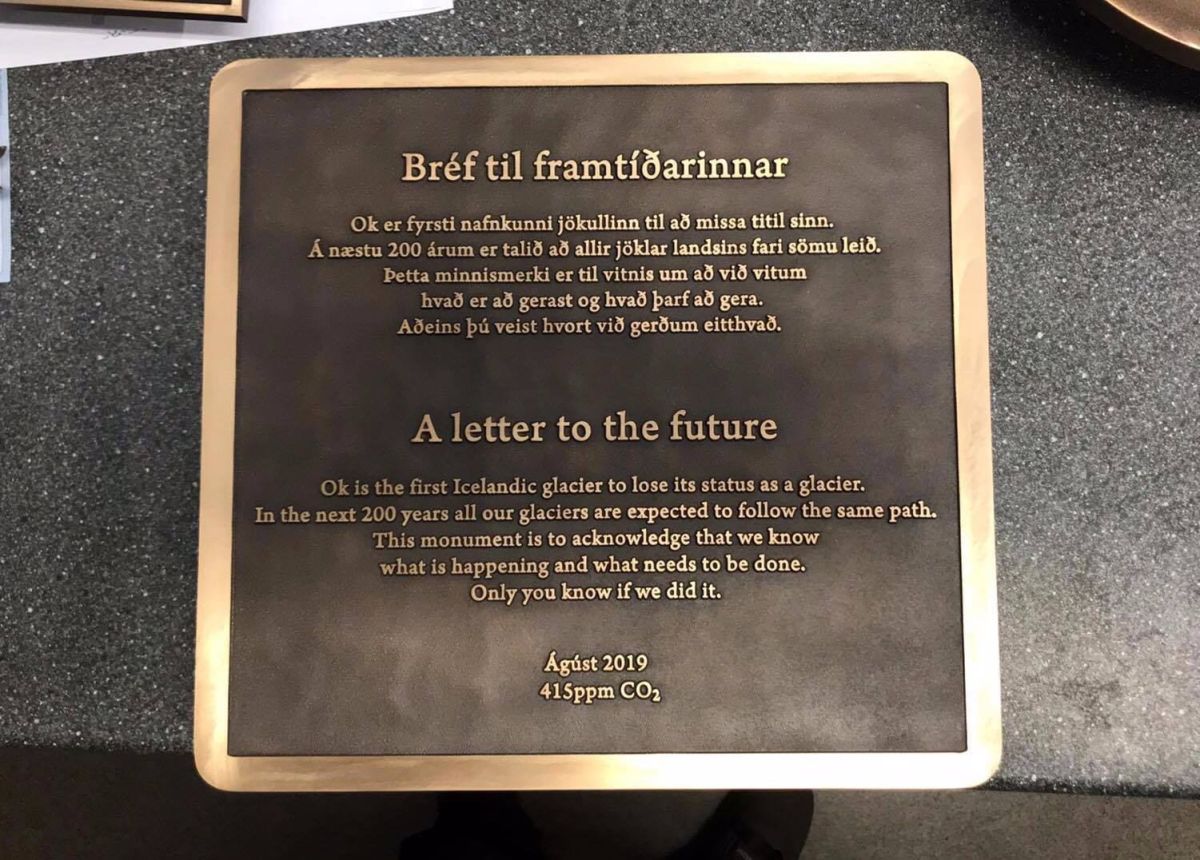
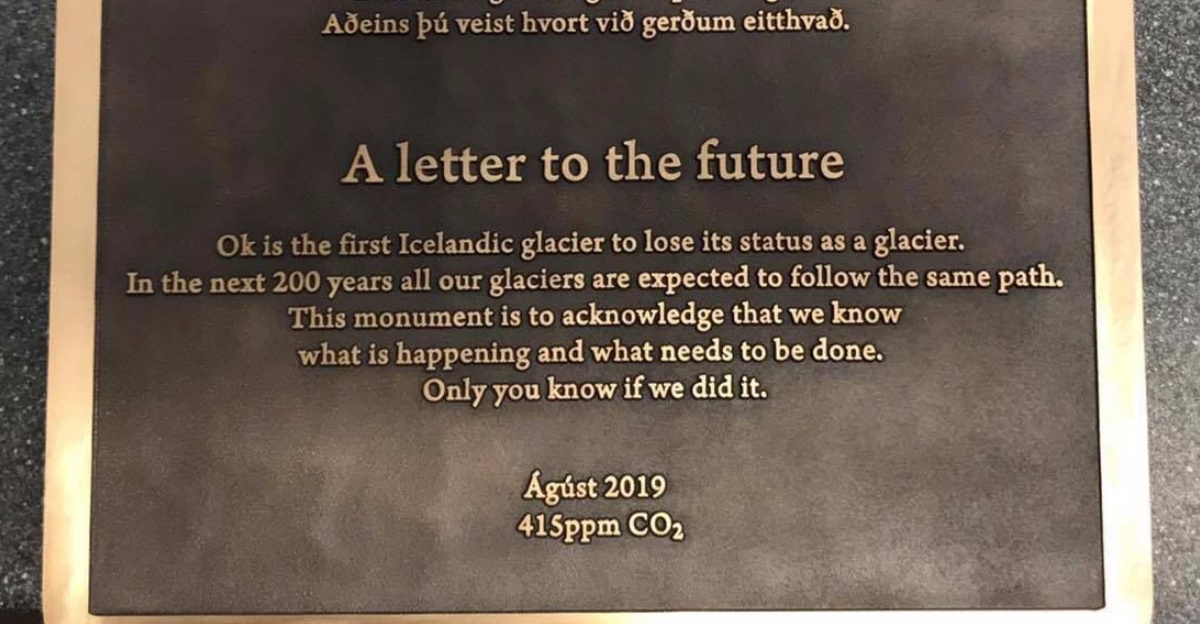
The plaque's text begins, "A letter to the future," then reads:
"Ok is the first glacier to lose its status as a glacier. In the next 200 years, all our glaciers are expected to follow the same path. This monument is to acknowledge that we know what is happening and what needs to be done. Only you know if we did it. Ágúst 2019, 415ppm CO2"

The message is simple, to the point, and a warning to us all. The "415ppm CO2" refers to the current carbon dioxide levels in the atmosphere, which are now the highest in human history. Climate scientists around the world have been sounding the alarm for years, but political and economic interests—as well as a slew of conspiracy theories—have far too many people believing the climate crisis is a hoax.
Climate change is not a partisan issue. No seriously, it isn't
Anthropologists Cymene Howe and Dominic Boyer of Rice University, who produced a film about Ok in 2018, hope the memorial will raise awareness about Iceland's glaciers and the impact climate change is having on the planet.
"This will be the first monument to a glacier lost to climate change anywhere in the world," Howe said. "By marking Ok's passing, we hope to draw attention to what is being lost as Earth's glaciers expire. These bodies of ice are the largest freshwater reserves on the planet and frozen within them are histories of the atmosphere. They are also often important cultural forms that are full of significance."
"One of our Icelandic colleagues put it very wisely when he said, 'Memorials are not for the dead; they are for the living,'" Howe added. "With this memorial, we want to underscore that it is up to us, the living, to collectively respond to the rapid loss of glaciers and the ongoing impacts of climate change. For Ok glacier it is already too late; it is now what scientists call 'dead ice.'"
Look at the photos and videos of thousands of youth demanding climate change action NOW
Boyer drove home the ultimate point—we must act now.
"We wanted to create a lasting memorial to Ok, a small glacier that has a big story to tell," he said. "Ok was the first named Icelandic glacier to melt because of how humans have transformed the planet's atmosphere. Its fate will be shared by all of Iceland's glaciers unless we act now to radically curtail greenhouse gas emissions."
- Iceland ad pokes fun of Mark Zuckerberg and the metaverse - Upworthy ›
- The introvert-friendly Icelandic tradition of Jólabókaflóð - Upworthy ›
- A glacier the size of Philadelphia just did something scientists have never seen. They're alarmed. - Upworthy ›
- Icelandic woman demonstrates speaking while inhaling - Upworthy ›


Student smiling in a classroom, working on a laptop.
Students focused and ready to learn in the classroom.
Fish find shelter for spawning in the nooks and crannies of wood.
Many of these streams are now unreachable by road, which is why helicopters are used.
Tribal leaders gathered by the Little Naches River for a ceremony and prayer.

Communications expert shares the perfect way to gracefully shut down rude comments
Taking the high ground never felt so good.
A woman is insulted at her job.
It came out of nowhere. A coworker made a rude comment that caught you off guard. The hair on the back of your neck stands up, and you want to put them in their place, but you have to stay tactful because you're in a professional setting. Plus, you don't want to stoop to their level.
In situations like these, it helps to have a comeback ready so you can stand up for yourself while making making sure they don't disrespect you again.
Vince Xu, who goes by Lawyer Vince on TikTok, is a personal injury attorney based in Torrance, California, where he shares the communication tips he's learned with his followers. Xu says there are three questions you can ask someone who is being rude that will put them in their place and give you the high ground:
Question 1: "Sorry, can you say that again?"
"This will either make them have to awkwardly say the disrespectful remark one more time, or it'll actually help them clarify what they said and retract their statement," Xu shares.
Question 2: "Did you mean that to be hurtful?"
The next step is to determine if they will repeat the disrespectful comment. "This calls out their disrespect and allows you to learn whether they're trying to be disrespectful or if there's a misunderstanding," Xu continues.
Question 3: "Are you okay?"
"What this does, is actually put you on higher ground, and it's showing empathy for the other person," Xu adds. "It's showing that you care about them genuinely, and this is gonna diffuse any type of disrespect or negative energy coming from them."
The interesting thing about Xu's three-step strategy is that by gracefully handling the situation, it puts you in a better position than before the insult. The rude coworker is likely to feel diminished after owning up to what they said, and you get to show them confidence and strength, as well as empathy. This will go a lot further than insulting them back and making the situation even worse.
Xu's technique is similar to that of Amy Gallo, a Harvard University communications expert. She says that you should call out what they just said, but make sure it comes out of their mouth. "You might even ask the person to simply repeat what they said, which may prompt them to think through what they meant and how their words might sound to others," she writes in the Harvard Business Review.
More of Gallo's suggested comebacks:
“Did I hear you correctly? I think you said…”
“What was your intention when you said…?”
“What specifically did you mean by that? I'm not sure I understood.”
“Could you say more about what you mean by that?”
Ultimately, Xu and Gallo's advice is invaluable because it allows you to overcome a negative comment without stooping to the other person's level. Instead, it elevates you above them without having to resort to name-calling or admitting they got on your nerves. That's the mark of someone confident and composed, even when others are trying to take them down.