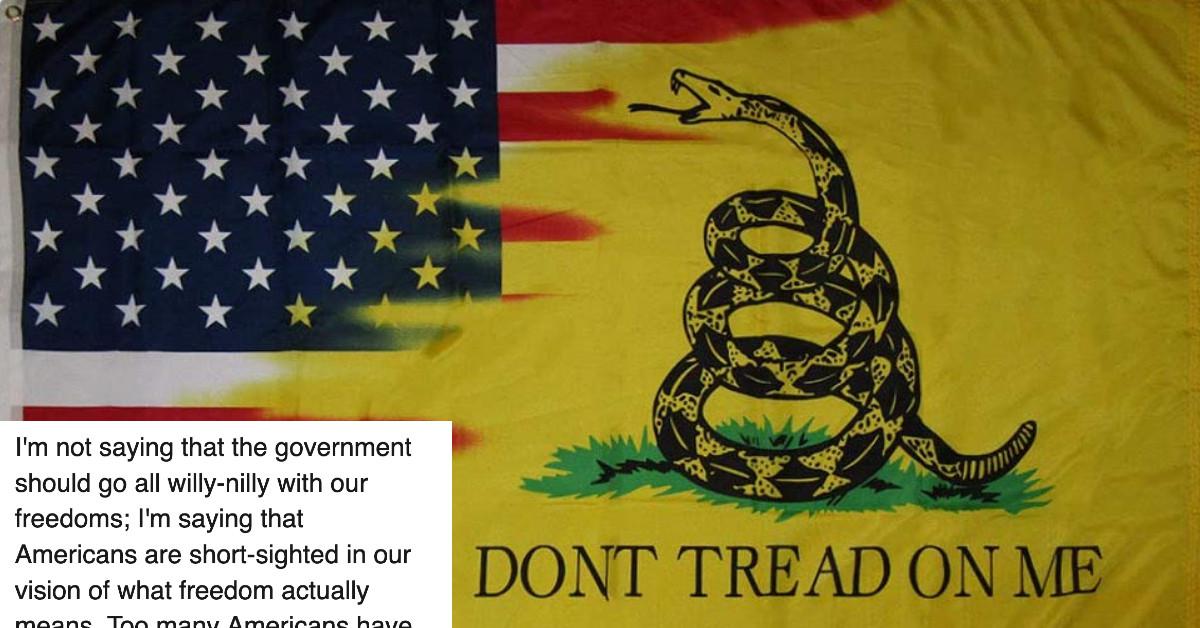
Americans’ short-sighted focus on ‘personal liberty’ ended up limiting another type of freedom

As the U.S. crosses the 300,000 COVID-19 deaths milestone, let’s take a step back and look at what got us here. But first, let’s tip our hat to those who aren’t where we are—to the countries that took swift, decisive action, got the population on the same page about what needed to be done, and…

Array
Photo credit: ArrayArray

As the U.S. crosses the 300,000 COVID-19 deaths milestone, let’s take a step back and look at what got us here.

But first, let’s tip our hat to those who aren’t where we are—to the countries that took swift, decisive action, got the population on the same page about what needed to be done, and kicked pandemic ass. The countries that not only have a tiny fraction of our death toll, but who also have been able to resume normal life in all its glory.

While mandatory quarantines for travelers and contact tracing systems for any cases that slip through the cracks are still in place, countries like Australia, New Zealand, Vietnam, Thailand, and Taiwan are experiencing a level of collective and individual freedom that America—and much of Europe—simply does not have right now. People are attending concerts, plays, sporting events, weddings, etc. without masks or social distancing. People can hug one another without worrying about killing someone. It’s literally like a whole other world.

Sure, some of those countries are islands and they all have smaller populations than we do. But the U.S. is bordered by just two countries. Thailand borders four and Vietnam borders three, including China—and our not controlling the coronavirus spread has nothing to do with people crossing our physical borders. And as far as population goes, our large size accounts for raw numbers, but not deaths proportional to population.

Check out the deaths per million statistics among these countries:

Australia: 35

New Zealand: 5

Vietnam: 0.4

Thailand: 0.9

Taiwan: 0.3

United States: 924

We currently have the 12th highest deaths-per-million rate in the world. So much winning, we’re sick of winning, right?

It’s been said a million times that it didn’t have to be this way, and it didn’t. But while our government has been blamed for its abysmal response to the pandemic—and while those criticisms are legitimate—that’s not the whole problem. It’s nice to think that if we had a president that listened to public health officials and provided coherent guidance, we’d be in better shape, and we probably would be to some degree. But a big part of the problem is the American people ourselves.

I love us, but a huge key to controlling a pandemic is getting a population on the same page and getting people to make personal sacrifices for the greater good. It requires a collective commitment, and I’m just not convinced the U.S. is capable of that without a serious rethinking of what our core national value actually means.


The world knows—because we really, really like to shout it from the rooftops—that the U.S. is all about freedom. It’s what we were founded on, what we take pride in, and what we cling to as our highest ideal. And we most often define freedom in terms of personal liberty—the right to live our lives the way we choose.

But in a pandemic, personal liberty can be problematic. I know that’s hard for some Americans to hear, but it’s true. If we all just do whatever we please, we end up right where we are—with an out of control virus killing a 9/11’s worth of Americans every day, ten months in, and the ongoing economic hardship that goes along with a half-assed, incohesive attempt to maybe save businesses or maybe save lives. We’ve ended up with the worst of both worlds—mass death and economic demise—largely due to Americans’ insistence upon personal freedom to the deadly and devastating exclusion of everything else.

Let’s be clear about the fact that the federal government has not established any mandates or restrictions that violate American freedoms during the pandemic. Decisions about mitigation measures have been left to the states, which is both good and bad. The United States is huge, and logistically it makes more sense for local conditions to guide local responses. However, our borders between counties and states are imaginary lines with no checkpoints or restrictions for travel, which makes for a lot of holes in our collective pandemic control.

I’m not saying that the government should go all willy-nilly with our freedoms; I’m saying that Americans are short-sighted in our vision of what freedom actually means. Too many Americans have exercised their personal liberty in a way that limits our collective freedom (because it leads to out-of-control viral spread) and also ends up limiting personal liberty anyway (because out-of-control viral spread means having to take measures to keep our healthcare system from getting overwhelmed).

I know some people say “collective freedom” isn’t a thing, please see the difference between daily life in the U.S. and daily life in Australia right now. Our Aussie friends are living a far freer life than we are, both individually and collectively, because they chose to sacrifice individually so that the whole society could be free from the virus. That’s what collective freedom looks like, and they didn’t succumb to tyranny to get it. That could have been us, if we stopped seeing everything that isn’t “go ahead and do whatever you want” as tyranny.

In a viral pandemic like this one, doing whatever we want is inconducive to true freedom. We’re watching this play out in states that were reticent to implement restrictions until now, as hospitals spill over and mandates become necessary for public safety. People exercising their personal freedoms with no regard for public health guidelines results in out-of-control viral spread, which results in social and economic devastation as huge numbers of people get sick and die.

Exercising personal liberty without personal responsibility in a viral pandemic leads to limited freedom for longer, with a lot more pain and suffering, than using our liberty to do what needs to be done to prevent that.

I can already see people bringing up Benjamin Franklin’s quote—”Those who would give up essential Liberty, to purchase a little temporary safety, deserve neither liberty nor safety.” Some version of it comes up any time the government tries to enact anything Americans view as limiting their freedoms, but there are a couple of problems with bringing it up now. Franklin, as it turns out, was specifically talking about a dispute over taxes to fund securing the frontier, not public health in a pandemic. (And despite what people might assume, his quote was actually pro-taxation.) While that quote pushes all the right “my personal freedom” buttons, I’m quite sure that Ben Franklin would be losing his mind over Americans rejecting public health guidelines in the name of “I do what I want” if he were here today.

As an American, I appreciate our nation’s commitment to personal liberty. I really do. But we seem to have forgotten that the founding premise of our republic wasn’t just an inalienable right to liberty, but to “life, liberty, and the pursuit of happiness.” When exercising personal liberty costs another American their life, then our national values are in conflict. “Give me liberty or give me death” is great when we’re not in a viral pandemic, but “Give me liberty and I will give you death” is what we’re currently experiencing.

Freedom can’t be merely seen as an end, but as a means. In the next pandemic, I hope my fellow Americans will use their personal liberty to choose do what needs to be done to help us reach collective and individual freedom, rather than cutting off our nose to spite our face by insisting on a puerile version of freedom that only leads to all of us losing both.

  • Gen Xers share 17 nostalgic dishes they ate growing up—and still make for dinner
    Photo credit: Image via RedditA family enjoys dinner during the 1970s.

    Generation X (those born between 1965-1980) grew up eating classic Americana meals. During the 1970s, comfort meals like tuna casserole and salmon roquettes were popular meals.

    Gen X also grew up eating some pretty unhinged (but all the more yummy) sandwiches. These meals are steeped in childhood nostalgia.

    And to this day, Gen Xers are still fond of their favorite dishes they grew up eating. Together, they discussed on Reddit their most-loved home-cooked dishes that they still whip up, starting with sloppy joes.

    Here are 17 iconic Gen X comfort meals to keep in mind the next time you make dinner:

    “Breakfast. We will have a ‘breakfast for dinner’ at least a couple times a month. Yum!” – fadeanddecayed, KddKc

    “Pizza bread! My mom would cut Italian bread into pieces, put butter and garlic salt on them, then pour some spaghetti sauce on them, cover with mozzarella cheese, and broil for like ten or fifteen minutes. Super easy and quick to make and so tasty. I’m sure my mom loved that I was so into something that took roughly zero effort for her to make.” – hornybutired

    “Grilled cheese and soup.” – reincarnateme

    Meat loaf. I use 2 pounds ground beef, replace bread crumbs with minute rice, add 1 pkg beef soup flavoring, chop an entire onion for it, and mix BBQ sauce into mixture. Oh, important: do not overmix! Place all ingredients into bowl, then mix quickly 10 or 12 swirls of a large spoon. Grease loaf pan, carefully place mixture in, pat down & bake about an hour. (Extra info: for even better flavor, mix the night before, pat into loaf pan, cover with plastic, put into fridge overnight. Remove from fridge about an hour before baking. BE SURE TO REMOVE PLASTIC WRAP! [Esp. If in Pyrex glass loaf pan])” – jehardt, AbbyM1968

    “White guy tacos.” – najing_ftw

    “Skillet dinner. Kielbasa, bell pepper, onion, spuds in a cast iron pan. One dish. Easy peasy.” – UnimportantOutcome67

    “Chicken pot pie or chicken ala king.” – sattersnaps

    “Fried catfish, greens, and red beans and rice.” – User Unknown

    “Shepherds pie, technically cottage pie if it’s ground beef. Homemade enchiladas, usually made as a layered casserole instead because I don’t have time to roll them. Pork chops with mashed potatoes and veggies.” – XerTrekker

    “Fried rice with chicken or pork leftovers.” – AlternativeResort181

    “Hot hamburgers: hamburger patty open face on Texas toast thickness bread, cover with fries then cover that with brown gravy. Wife’s variation is hamburger patty over rice with brown gravy.” – EnricoMatassaEsq

    “Stuffed peppers. I make it much more easily by cooking it all in one large frying pan ‘deconstructed’. Sauté onions garlic and ground beef, add cut up peppers, tomatoes or tomato sauce, sometimes a little spinach, then add separately cooked rice, salt and pepper and serve. It comes together pretty quickly and tastes just as good as stuffing and baking peppers in the oven.” – Affectionate-Map2583

    “Macaroni and cheese with cut up hot dogs. Seriously, that’s what I ate tonight.” – Dazzling-Walrus9673

    “Homemade Stroganoff casserole. Ridiculously easy to make. Ingredients:

    1.25-1.5 lbs. Ground Beef
    1 each of large white onion, green pepper, and red pepper
    1 can mushroom pieces, drained and rinsed
    12 oz. Bag of wide egg noodles
    1 can cream of mushroom soup
    16 oz. Sour cream
    Worcestershire Sauce
    Louisiana Hot Sauce
    White or Black Pepper
    Panko bread crumbs

    To Make: Preheat oven to 360 degrees. Worcestershire, hot sauce, garlic powder, and pepper are all to taste, depending on how much flavor and punch you want it to have. Cook noodles per instructions. Drain. Peel and slice onion (not diced), core and cut peppers into strips Brown meat, onions and peppers along with liberal amount of Worcestershire; garlic, pepper, and hot sauce. Add mushrooms. Cook until meat is fully brown, onions are translucent and peppers are tender. Drain. Combine drained meat, etc. with whole can of soup, half of the sour cream. Gradually add noodles into the mix. Add sour cream as needed to maintain consistency. Add Worcestershire, hot sauce, and pepper to taste. Dump into large, deep Corning dish or whatever. Cover too with bread crumbs. Cover and bake for forty minutes.” – CynfullyDelicious

    This article originally appeared last year. It has been updated.

    This article originally appeared last year. It has been updated.

  • Heckler flirts with comedian on stage and it turns into a surprise masterclass on romantic chemistry
    Photo credit: CanvaFemale comedian (left) Male audience member (right)

    Dealing with hecklers just comes with the territory of being a comedian. But flirting with them? That wasn’t something Rebecca Reingold had prepared for. 

    On March 11, the New York City-based stand-up comic uploaded a recent set to her Instagram aptly captioned “We found love in a hopeless place (a comedy club).”

    In the now-viral clip, Reingold shared a bit about not being “good” at flirting with men, saying that she would inadvertently “be mean” to them “because they liked it.”

    Playful roasting turns into something more

    rebecca reingold, comedy, stand-up comedy
    Microphone against a blurry backdrop Photo credit: Canva

    Then, during the set, someone from the crowd must have been talking too enthusiastically, because Reingold playfully called them out for being loud. This someone, a man, responded that he was with his parents at the show, to which Reingold quipped, “You look bad. Your parents look a lot younger than you.”

    Without missing a beat, the man in the audience responded that, given the logic she gave just moments earlier, she must like him, since she was throwing shots at him. 

    “Oh yeah, you’re right! That does mean I like you! You were listening. Oh my god, I’m in love,” said Reingold, blushing. “You’re so annoying but so loveable so its so tough, you know what I mean?”

    The Internet wastes no time weighing in

    Over 16 million viewers later, and people were applauding both Reingold’s ability to go with the flow, and this mysterious man’s mad game. Many were hoping that this became an actual meet-cute. 

    “Damn she really turned red when she realised he listened.”

    “You handled this so well 👏🙌”

    “… and, that is how I met your mother.”

    “The fact that he did not drop the ‘I’ll shut up in exchange for your number’ line is mind boggling to me.”

    “So when’s the wedding. Lol”

    Romantic antagonism IRL

    Perhaps people were rallying for this interaction to lead to romantic entanglement because it resembles the ever-popular enemies-to-lovers trope found in countless rom-coms and romantasies. This dynamic of building attraction through animosity and tension makes for great entertainment…but does it make for healthy relationships in real life? The annoying but accurate answer is, of course: it depends.

    Primarily, it depends on a) whether both partners are enjoying the teasing and b) whether the jokes are landing in sensitive territory. If both those parameters are met, it can become its own love language. If not, then it can foster resentment. 

    This can obviously become even more complicated when it comes to flirting, since there is already a lot of indirect language happening between strangers. But at least in this case it looked like everyone was having a good time.

    Sadly, it has yet to be revealed whether or not Reingold and this heckler ever did connect after the show. We’ll just have to wait and see. In the meantime, be sure to give her a follow on Instagram to stay tuned on both her comedy stylings and, perhaps, her love life.  

  • 40-something woman who grew up in foster care beats the odds in college graduation video
    Photo credit: CanvaA woman in her cap and gown for graduation.
    ,

    40-something woman who grew up in foster care beats the odds in college graduation video

    Less than 5 percent of people in foster care go on to get a bachelor’s degree.

    Jade Tompkins, who goes by @Craftyhag on social media, made a simple video on TikTok. In a moment of pure vulnerability, she humbly shared her story. What she might have felt was merely a cool accomplishment feels, to many of us watching, like a triumph.

    In the clip, she sits at a table in a simple gray sweater with yellow flowers, holding colorful ropes. Looking straight into the camera, she asks, “You guys wanna see something cool? I don’t have a lot of friends, or at least people who can be proud of me, I guess. I’m 40-something, and I get to graduate with a bachelor’s degree in a few weeks or a month, I guess.”

    Beating the odds

    Tompkins takes a slight pause and adds, “I grew up in foster care, and a lot of people might not know this. But people in foster care–like less than 2 percent of them, I looked it up–of people in foster care go on to get a bachelor’s degree. I don’t know, maybe it’s just because I’m older.”

    And Tompkins is right. The numbers for people who experience life in foster care are extremely challenging. More recent numbers say only about 3-4% of people with a background in foster care end up graduating with a bachelor’s degree, compared with more than 30% of the general population, according to research.

    She takes a breath, seemingly letting the information she just shared sink in, even for herself. “Anyway, I just wanted to show you guys. I don’t even know if I’m gonna go to graduation, but I still got the stuff just in case.” She holds up a red, satin-looking sash. “This is my stole thing. And I got all these cords. And if I do go, I don’t know if I’m gonna wear them or not.”

    Her achievements are nothing short of incredible. “My grades are really good. I have almost a 3.9. And I’ve worked full time since I’ve been doing it, so that feels like a big accomplishment. And I joined student associations and stuff.”

    “You’re never too old to set another goal”

    Picking up her graduation hat, she shows off the colorful writing on top. “So this is my graduation hat. I had it made. It says, ‘You’re never too old to set another goal or to dream a new dream.’ So I thought that was kind of appropriate. And I already got accepted to a Master’s program, so I think that’s kind of cool.”

    She ends the video as humbly as she began it. “Anyway, I just wanted to share because I don’t really have a lot of people to share it with. And I guess if anyone sees it and thinks, ‘Hey, I should go back to school,’ and you have the means or the dream or wish to do it and think you can, whatever. I don’t know. Just thought I’d share.”

    “Walk for all of us!”

    Her story was exactly what a lot of people needed to hear. On TikTok alone, she has nearly 850,000 likes and almost 70,000 comments.

    “Foster kid to foster kid, please walk,” one person shared. “Walk for all of us! Walk for those of us that are still trying to find out confidence. Walk for those of us that are not sure if we should dream. Walk for those of us that want to see our own kind SHINE. Your shine will help to light another’s pathway. I can say that the Class of Foster Kids, we are proud of you! Keep going.”

    Even some corporations, like Hilton (and many others), jumped into the chat. They sent her a little gift, writing, “Jade, milestones like this deserve to be celebrated. DMing you as we’d like to send something sweet your way.”

    This TikToker might have summed up what so many seem to think: “1. You’re f-ing awesome! 2. That cap is f-ing awesome. 3. Damn, that’s a lot of cords. 4. Your TikTok friends are f-ing proud of you!”

    According to an update posted just under a month later, Tompkins did attend and “walk” at graduation. Chyroned over a meme, she writes, “Me deciding to go to graduation because 700,000 people convinced me to go.”

  • She got fired from her bank job on the way home, sat on the train, said a prayer. Her phone rang 15 seconds later.
    Photo credit: CanvaA recently-fired woman holds a box of her belongings from work.

    She had just been let go from her job as a bank teller. The mistake was an $800 error she couldn’t fix, and when she came back to work her manager told her she was done. She got on the train home feeling “so sad,” as she put it, and cried.

    Then, instead of sitting with the loss, she prayed. Not a prayer asking for something, but one offering thanks. “God, thank you so much for allowing me to have this job for so long,” she said quietly. She put on a worship song.

    Fifteen seconds later, her phone rang.

    faith, job loss, viral, inspiration, TikTok
    A woman looks at her cell phone. Photo credit: Canva

    The man on the other end had a cheerful voice. His sister, he explained, had worked with her at the bank and spoken highly of her, perticularly her kindness and her service. Based on that, he thought she’d be a good fit for his company. She got the job that same day.

    The woman, who shares the story on TikTok under the handle @ashp_tv, posted about it in March and it spread quickly. The timing is the part that gets people because it’s not just that something good followed something hard, but how fast it happened, and that the call came specifically because someone had noticed how she’d treated people at the job she’d just lost.

    @ashp_tv

    Mustard seed faith STILL moves mountains. 🤍 #fyp #god #testimony #faith

    ♬ original sound – ASH P TV

    “All you need is faith,” she said. Whether you take that literally or as shorthand for something more like trust and openness, the story holds up either way.

    For more lifestyle content follow @ashp_tv on TikTok.

  • Tenant got a $2,500 check in the mail from an ex-landlord who sold the house.The note that came with it is something else.
    Photo credit: CanvaTwo women react to message with surprise.
    ,

    Tenant got a $2,500 check in the mail from an ex-landlord who sold the house.The note that came with it is something else.

    A former landlord tracked down every tenant they’d ever had after selling their house and mailed them each a check.

    Chris Robarge had rented a house after his divorce, his first place on his own during a hard stretch of his life. He paid his rent, eventually moved on, and didn’t think much more about it.

    Then, years later, his former landlord reached out asking for his current address. A day later, a check for $2,500 arrived in the mail with a handwritten note.

    The landlord had sold the house. And before keeping the profit, they tracked down every tenant who had ever lived there because, as the note explained, those monthly rent payments had helped pay off the mortgage. The tenants had contributed to the equity. It only seemed right to give some of it back.

    “While it’s not much, it’s yours,” the letter read. “It was a great house, and I’m glad that I was able to share it with you.”

    Chris posted about it on Facebook, where it spread quickly partly because people were so unused to a landlord story going this direction. He wrote that there’s a difference between people who talk about their values and people who actually live them, and that this was the clearest example of the latter he’d ever seen personally. “Do it off the clock, do it when no one is watching, do it always,” he wrote.

    kindness, housing, landlords, pay it forward, viral
    A man hands out cash to someone. Photo credit: Canva

    He kept $500 to fix his car. The rest he gave away to Black and Pink Massachusetts, to free fridges in Worcester, to OurStory Edutainment, and directly to people on the street who needed it. He turned an unexpected windfall into a chain of smaller ones.

    One Facebook commenter said she’d started reading the post braced for bad news like a surprise bill or some old debt being called in, and was so conditioned to that outcome that the actual ending genuinely shocked her. Which is maybe the most telling part of the whole story.

    You can follow Chris Robarge on Facebook.

  • Anne Hathaway praised after casually dropping Arabic phrase in interview
    Photo credit: Wikimedia CommonsHands writing in Arabic, left, and Anne Hathaway.

    During an interview with People promoting the upcoming The Devil Wears Prada 2, Anne Hathaway was asked how she navigates growing older. She noted the importance of taking self-care seriously, remaining curious, and appreciating being in a place where you can assess decisions made earlier in life.

    But it was what she said next, almost as an afterthought, that really got folks talking. 

    “I wanna have a long, healthy life. Inshallah, I hope so,” she casually but sincerely told her interviewer. The phrase, also spelled “insh’Allah,” translates to “if God wills” or “God willing,” and is deeply rooted in Islam.

    @people

    #AnneHathaway is embracing aging on her own terms and not getting swept up in the noise along the way. #WorldsMostBeautiful

    ♬ original sound – People Magazine

    However, it is also part of Arab culture in general. Religious or otherwise, people use it to convey resolute hope for the future while acknowledging that life follows its own plan.

    Bridge-building moment

    This ignited a positive frenzy online among Muslim and Arabic viewers, who were not only thrilled to hear the term used, but to hear it used correctly.

    Rather than being seen as performative, the overall consensus was that this was a refreshing, bridge-building moment across cultures.

    “Use it the way Anne Hathaway used it—honestly, humbly, in a moment when you genuinely want something good and know that wanting is only the beginning,” praised author Qasim Rashid. 

    Perhaps the timing of this interview has also contributed to its virality. Just weeks ago at Coachella, Sabrina Carpenter received backlash for her “this is weird” reaction when fans began engaging in the Zaghrouta, a celebratory, high-pitched ululation traditionally used in Arab cultures.

    So, for someone equally high-profile to actually promote rather than seemingly reject a piece of Arab culture has been viewed as a kind of karmic recompense.

    As HuffPost contributor Syeda Khaula Saad put it, “It just feels nice to be represented in mainstream media in an accepting, inclusive light. I hope that we get to see much more, insha’Allah.”

    And as she pointed out, recently another Arabic word was brought into the mainstream when Muslim Egyptian American actor Ramy Youssef taught Elmo to say “habibi” (meaning “my love” or “my friend”) on an episode of Sesame Street.

    This seemed to have a similarly profound impact. 

    “We have been dehumanized, portrayed in the worst way by the media for years.. I swear to GOD elmo saying ‘habibi’ made me teary and somehow healed the inner child that has been called the worst things for being different growing up,” one viewer wrote on Instagram. 

    It goes to show that when it comes to respecting other cultures, it doesn’t take a grand gesture. Even a word, when said correctly and with genuine intent, can extend an olive branch.

    Perhaps this wisdom can be especially applied to mainstream media, where negative stereotypes run rampant alongside baffling overcorrections. Sometimes, it really is as simple as making space for what exists beyond your own lived experience and engaging with it.

    Whether or not you agree that Hathaway executed this perfectly, may we all agree that the world could use more people looking to build bridges rather than reject what’s unfamiliar. 

  • A Gen Z passenger demanded his delayed flight take off immediately. When the gate agent heard why, he bought the man a ticket on a different airline.
    Photo credit: Canva(L) A man walking through an airport; (R) a plane take off in cold weather.
    ,

    A Gen Z passenger demanded his delayed flight take off immediately. When the gate agent heard why, he bought the man a ticket on a different airline.

    A gate agent who assumed the worst about an angry young passenger ended up spending $450 of his own money to get him home.

    A gate agent at an airport had a young man screaming at him that his flight needed to take off. The flight had been delayed due to weather. The agent gave his practiced apology and explained the situation. The young man kept pushing.

    The agent, who shares the story on Instagram Threads as @mr.freak_22_, had been doing this job long enough to develop a thick skin. He’d heard every version of the entitled passenger routine. He was preparing to hold the line.

    Then the young man told him why.

    A traveller delayed at an airport. Photo credit: Canva

    “You don’t understand. My mom is in hospice. The nurse just called. She has maybe hours left. I just need to hold her hand one last time.”

    The agent’s entire calculation changed. His own airline had nothing available. He pulled out his personal phone and started searching competitor flights. He found one for $450, leaving from another terminal. He looked at the young man, who was hyperventilating, and didn’t ask him for the money. He just bought the ticket.

    “I printed the boarding pass, shoved it into his hand, and said, ‘Run to Terminal B. Gate 12. Go.’”

    Man runs through an airport. Photo credit: Canva

    The young man ran.

    Two days later he called back and left a message. He’d made it in time.

    The agent posted about it because he wanted to push back on something he’d been thinking about. People assume gate agents are cold and robotic, just like people assume young men demanding things at airport counters are being entitled. Neither assumption held up that day. “Sometimes the rules don’t matter nearly as much as the reasons,” he wrote.

    You can follow the gate agent on Threads.

  • 12 years ago, Kenan Thompson told ‘SNL’ he’d never perform in drag again. It launched careers.
    Photo credit: @SaturdayNightLive on YouTubeSaying no said "yes" for several comedy stars.
    ,

    12 years ago, Kenan Thompson told ‘SNL’ he’d never perform in drag again. It launched careers.

    A refusal to portray women was the career nexus point of many Black women comedians.

    Since childhood, Kenan Thompson has practiced his craft as a comedic actor and sketch performer. As an adult, he’s been making audiences laugh at Saturday Night Live since 2003. During his tenure, he had been in drag lampooning Maya Angelou, Jennifer Hudson, and other Black women who were public figures. In 2013, he refused to portray a woman ever again on SNL. That line in the sand ended up launching many comedy careers.

    At the time, out of the 16 SNL cast members, there were only two other persons of color: Black comedian and actor Jay Pharoah, and Iranian-born American actress, Nasim Pedrad. This meant that either Thompson or Pharoah would have to don a wig and a dress if the show was spoofing a Black woman celebrity. As the longest running cast member on SNL, Thompson felt comfortable to publicly state that he wouldn’t portray a woman ever again. Pharoah backed him up and even pitched potential Black women comedians and producers.

    The audition that launched a new wave of comedians

    The move forced the producers to conduct a search for at least one Black female cast member by January 2014. The search led to Sasheer Zamata, who joined the cast until 2017. Since then, she’s gone on to other opportunities as a stand-up comedian and actress. Some of her roles include movies such as 2021’s The Mitchells vs. the Machines and Marvel and Disney+’s 2024 series Agatha All Along

    Even though Zamata claimed the spot on SNL, many of her fellow auditioners were noticed for other comedy jobs. After Zamata’s casting had been announced, the runner-up, Amber Ruffin, was almost immediately staffed as a writer for Late Night with Seth Meyers. Ruffin still currently works as a writer on the show while also getting other opportunities. She wrote her own sitcom, hosted her own comedy talk show, and participates as a talking head on Have I Got News For You.

    There was another future SNL all-star who wasn’t immediately cast, but hired on as a writer. However, she was promoted to a full cast member before the end of 2014. That person? Leslie Jones, who has since launched into film and television superstardom.

    Even though they didn’t get the job, many other funny Black women broke out at that audition. Tiffany Haddish would get recurring roles in TV shows like The Carmichael Show and star in the ultra-popular film, Girls Trip. Nicole Byer would have several live-action and voice-over roles while also hosting reality shows like Nailed It. In fact, Byer co-hosts a podcast with Zamata called Best Friends.

    It should be noted that these women likely would have found success without this SNL audition. Kenan Thompson would not and is not taking credit for their success. However, it is funny how refusing to wear a dress was one small push that created momentum in several different directions for so many talented people.

Health

Strong 71-year-old woman is showing that heavy weightlifting is for seniors. Doctors agree.

Skills

Philosopher Socrates offered the perfect advice for anyone struggling with self-identity

Culture

Heckler flirts with comedian on stage and it turns into a surprise masterclass on romantic chemistry

Family

Man strokes strange woman’s hair as she slept in hilariously embarrassing mixup