The Twilight Zone television series made its mark by prompting audiences to examine controversial social issues through the backdoor of science fiction and mystery. One of the most compelling examples, which remains perfectly relevant today, is the 1960 classic “Eye of the Beholder.”
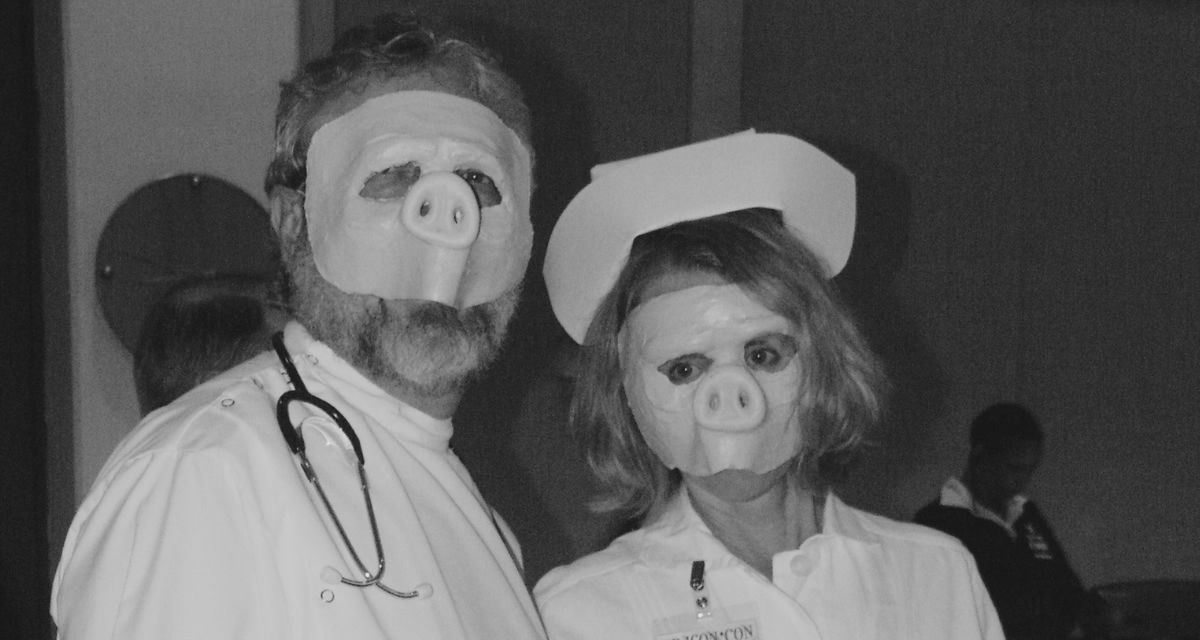
The episode features a woman with her head wrapped in gauze who has undergone her eleventh surgery for her “deformed” face—the final surgery allowed by the totalitarian government. If the surgery is deemed unsuccessful, she will be banished to a ghetto for people with similar deformities. The gauze removal reveals a classically beautiful woman, but the surgery is declared unsuccessful. Then we see that everyone around her—doctors, nurses, government agents—all have deformed pig faces.
Here’s the big reveal:
The pressure to conform to a uniform standard of ‘beauty’
The woman was beautiful by human standards, but she didn’t conform to pig-face standards, so she was considered hideous and banished. The audience watches this woman who believes she’s ugly because she should have a deformed pig face. She believes it. They believe it. Everyone believes it.
Everyone except the audience. It’s been 66 years, and the core message still hits home: beauty standards are subjective and arbitrary. Societal messaging inevitably determines how we feel about our appearance. Striving to achieve a specific standard is both ridiculous and a losing battle.
We may not live in a totalitarian state like the one depicted in the show, but the pressure to conform to certain beauty standards can still feel oppressive. But because conformity is not literally forced on us, the pressures we face are more insidious. In The Twilight Zone, the people who didn’t fit the standard had no choice but to try to change their faces. In our own reality, people choose it willingly, if unwittingly.
‘The death of unique beauty’
Beauty standards are certainly nothing new, but they were qualitatively different in the past. What was considered beautiful varied widely among regions and cultures. Magazine models were airbrushed, but there was a clearer delineation between the perfection in those images and what the average person tried to achieve. Plastic surgery and other extreme cosmetic procedures were the domain of the rich and famous only. No highly specific combination of features dominated the beauty landscape.
Something has shifted in recent years. YouTube creator Laura Jane Atelier’s video, “Why Everyone Looks the Same Now: The Death of Unique Beauty,” dives into the “Instagram face” phenomenon and breaks down its elements.
Atelier explains how a combination of factors has homogenized beauty. Social media face filters, celebrity influence, access to cosmetic procedures, globalized beauty trends, AI, and more overlap and blend to create the “ideal” face. Instead of enhancing or highlighting unique features, the ultimate beauty goal appears to be achieving a specifically sculpted face.
More and more, we see people’s faces morphing into the same shapes and features, from jawline to nose to lips to eyebrows, and even eyelids. And it’s not just women. London plastic surgeon Paul Tully shares that upper blepharoplasty, a surgical procedure involving the removal of skin, fat, and sometimes muscle around the eyes, has risen in popularity for both men and women.
Is this a problem? That’s what we have to decide.
The benefit to brands when we all want the same look
As we explore that question, we can’t ignore the money element in all of this. Beauty is an over-$700-billion industry, after all.
Atelier explains the marketing benefits of this phenomenon for brands:
“Social media has replaced TV and magazines as the main source of beauty inspiration, but instead of showcasing diverse ideals, these platforms amplify a single universal aesthetic. Whether you’re in New York, Seoul, or Brazil, chances are you’re seeing the same contouring tutorials, lip filler transformations, and glass skin routines, and, as a result, a homogenized beauty standard that prioritizes symmetry, flawless skin, and exaggerated features. It’s efficient for beauty brands to Market one aesthetic globally; after all, it’s easier to sell products that promise to achieve a single perfect look.”
In a response video, plastic surgeon Dr. Gary Linkov nods along as Atelier explains this and adds his own commentary about seeing these trends in his own practice. However, chasing a specific standard is a losing battle.
“As far as conforming to some general beauty standard, I think it’s always best for people to focus more on what makes them special and unique,” Linkov says. “And if there’s something that’s specifically been bothering them for a long time, maybe at some point getting that addressed, if they understand the true pros and cons of those procedures, rather than seeing some famous person and saying, ‘Hey, I want to look like them.’ I think that can lead people down a dangerous road where they might never be fully satisfied with how they look.”
Recalibrating to find a balance in all the noise
Is it wrong to want to feel beautiful? No. Are cosmetic procedures inherently bad? Of course not. But where is the line between making some effort to highlight or enhance our natural beauty and going to extremes to achieve a universal, uniform look?
Atelier suggests reflecting on how beauty was viewed in generations past as a way to recalibrate. Not that there weren’t issues with beauty standards back then (as evidenced by the “Eye of the Beholder” episode), but we did see more variety in what was considered beautiful.
“The beauty of the past feels more relatable because it reflects humanity in all its raw, imperfect glory,” Atelier says. “It wasn’t about looking perfect; it was about feeling something. A photo or a face told a story. Today, it almost feels like we’ve lost that emotional connection in our pursuit for the ideal. Individual beauty is captivating because it’s real, draws you in, and makes you want to know more about the person behind the face.”
It really boils down to remembering who we are. We are not AI-generated models and shouldn’t try to be. We are beautifully unique humans; the only AI “look” we should be striving for is Authentic Individuality. Leave uniformity to the pig-faced fascists. That’s not us and (hopefully) never will be.