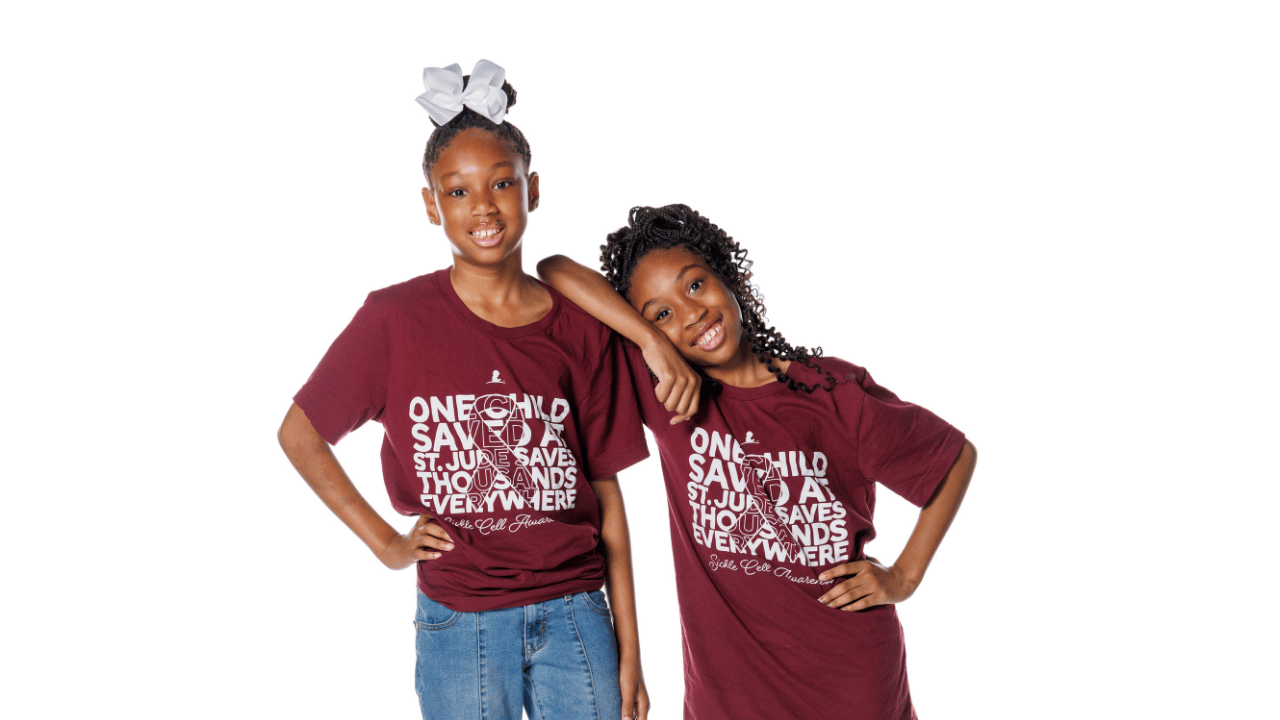
On any given day, you might find 11-year-old Ari’Yanna on the basketball court, while her 9-year-old sister, Ariyah, is at Majorettes practice or sprinting down the track. The girls are social, active, and quick to laugh. In school they seem like any other kids their age…
Which is why people are usually surprised to learn they both have sickle cell disease, a rare inherited blood disorder that can cause episodes of severe pain crises, chronic fatigue, and other serious complications. When friends hear about their diagnosis, or the fact that they receive treatment at St. Jude Children’s Research Hospital, their reaction is usually the same: “You don’t seem sick.” That’s because sickle cell disease is often invisible except to the people living with it. For this reason, the girls keep a close eye on each other throughout the school day, instinctively seeking each other out and somehow knowing when the other is in pain. When one sister senses a pain crisis coming on, she alerts a teacher, making sure the other gets help as quickly as possible. The crises can be severe.
“I have sickle cell,” Ari’Yanna says. “But sickle cell doesn’t have me.”
Finding answers, getting support
While the sisters are bold and outspoken, sickle cell moves much more quietly, revealing itself when a pain crisis strikes.
Sickle cell causes red blood cells to harden, stiffen, and take on a “c” shape, which can make them difficult to move through blood vessels. Sometimes, these sickled cells become trapped, blocking blood flow and oxygen to major organs. This triggers a pain crisis so painful that Ari’Yanna once described it as a fire deep in her bones. Sickle cell disease affects about 100,000 people in the United States, and is most common among people of African descent. Around the world, more than 8 million people have sickle cell disease and 500,000 babies are born with it every year.
D’Yana, the girls’ mother, has been dealing with the reality of the disease for more than a decade after both of her girls were diagnosed after birth. Ariyah’s disease was especially aggressive: She experienced her first pain crisis at just three months old, and had her spleen removed due to complications from sickle cell before her first birthday.
“I didn’t know how to care for two sick kids with the same disease [that] I had never heard of,” D’Yana remembers. “As a parent, you just have to keep going. I don’t know where I’d be without St. Jude.”
A path forward
Since the girls were small, D’Yana has looked to the care team at St. Jude to help her navigate sickle cell and all its challenges.
“[St. Jude] took me step by step every day to get me comfortable to ask, ‘I don’t understand this,’ or ‘I don’t know this word,’ or ‘I don’t know what this means,’” D’Yana says. “St. Jude has been the encouragement we need no matter what we’re going through. They make it better for you.”
The first grant the research hospital in Memphis ever received was for the study of sickle cell disease in 1958, and today, St. Jude has one of the largest sickle cell programs in the country, serving about 850 patients . St. Jude has been part of major advances in sickle cell disease treatment over the last 60 years and continues to explore new cutting-edge curative therapies for the disease.
That kind of progress is the reason Ari’Yanna and Ariyah can focus on sports and school, while continuing to live like regular kids. While pain crises still occur, the girls make it through by supporting each other. At home, Ari’Yanna will wrap Ariyah’s legs in warm blankets. Ariyah will apply pressure to her sister’s arms when the pain is bad. With each other’s support, and the support of the St. Jude care team, the girls continue to pursue the things that make them who they are: students, performers, athletes, and children who refuse to let their diagnosis define them.
Learn more about St. Jude and how it is advancing sickle cell disease research here.