Do you ever pause to appreciate how incredible it is that we have clean water flowing into our homes? Or how amazing it is that we can sit in our living room and listen to virtually any piece of music that’s ever been recorded? Or the everyday miracle of ice cubes pouring out of a refrigerator?
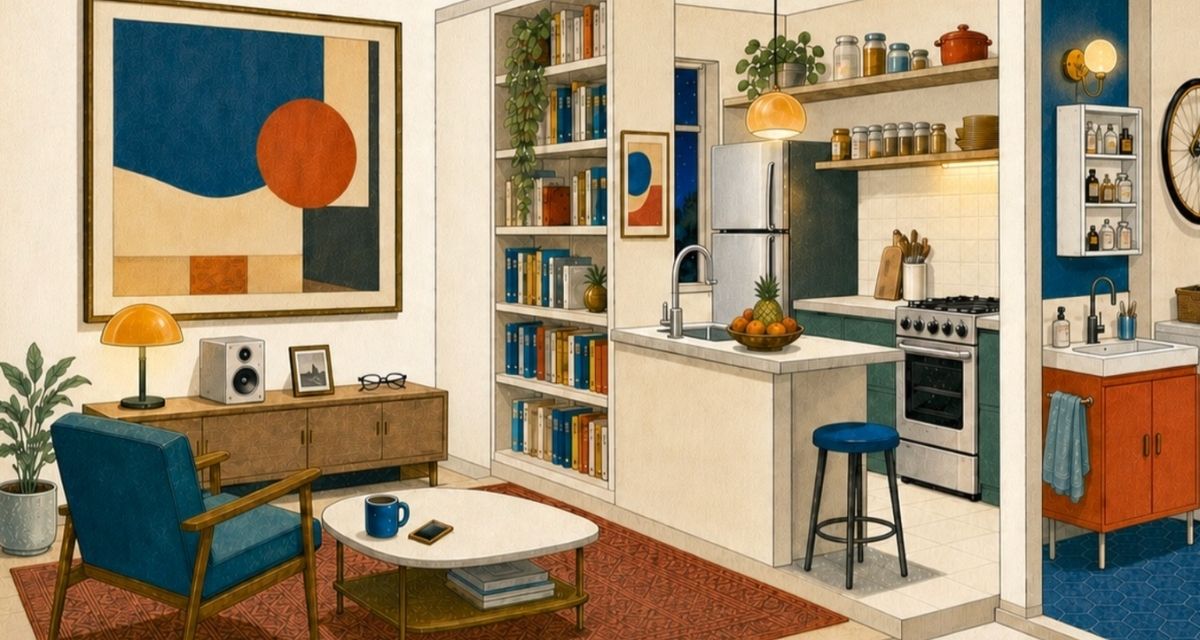
A simple yet powerful website invites us to tour a virtual modern apartment, but view it through the lens of the past. As you scroll, various items are spotlighted with a quote that shows how our ancestors viewed that item when it was either brand-new or still just a dream.
Our lives through the eyes of our ancestors
The Ordinary Abundance website begins by setting the scene: “It’s eight o’clock. The apartment is quiet, aside from the music playing softly over the speaker. It’s a playlist your friend made for you years ago. You send them a text to check in, then pick up a book, flick on the lamp, and settle into the chair to read.”
It’s an average evening that an average American might spend in their average apartment, but what comes next illustrates how the average used to be considered extraordinary. We all know times change and what was once innovative becomes ordinary over time. Nevertheless, seeing quotes from the past drives home how truly miraculous the basics in our lives truly are.
For instance, being able to listen to music at will has become commonplace, but it’s truly an incredible innovation.
After all, in 1888, Edward Bellamy mused, “If we could have devised an arrangement for providing everybody with music in their homes, perfect in quality, unlimited in quantity, suited to every mood, and beginning and ceasing at will, we should have considered the limit of human felicity already attained.”
Not just “wouldn’t it be nice to be able to listen to whatever music we want”? Bellamy literally thought we would never be able to top the happiness that music-on-demand in our homes would bring us. Imagine telling him about Spotify on smartphones. Imagine describing car stereo systems. Earbuds on airplanes. The list goes on.

From lamps to running water to printed books to ibuprofen
The spotlight moves to a lamp. With the flip of a switch, we can fill a room with light. No candles or gas lamps. No fire needed at all.
A witness to the electric lights being turned on in the Wabash, Illinois, Court House square in 1880 remarked:
“The people, almost with bated breath, stood overwhelmed with awe, as if in the presence of the supernatural. The strange, weird light, exceeded in power only by the sun, yet mild as moonlight, rendered the Court House square as light as midday.”
Even things we don’t think of as modern technology are things previous generations only dreamt of. Art reproductions on our walls, for instance. Today, people hang prints of famous artwork in their homes. Prior to reliable reproduction, people had to visit churches, collections, or art museums to see known artists’ work.
That’s why a painting hanging on the wall of the virtual apartment comes with this 1947 quote from André Malnaux: “A museum without walls has been opened to us, and it will carry infinitely farther that limited revelation of the world of art which the real museums offer us within their walls.”
The tour continues through the apartment, spotlighting a photograph, a pair of glasses, a book, the kitchen sink, a bowl of fruit, the freezer, a spice rack, a medicine cabinet, a bicycle, a washing machine, a sewing machine, a mini-split air conditioner/heater, and an airplane flying by outside the window.
Remaining restless while recapturing awe
After going through over a dozen modern miracles, the site brings the day to a close:
“At eleven, you switch off the lights, silence your phone, and lie down to sleep. As your head hits the pillow, you idly wonder what people slept on before mattresses.”
It’s an invitation to reflect, to pause and consider the wonders we no longer see as extraordinary. It is not a sales pitch, nor is it an admonition. There’s no preaching here, just a gentle reminder.
What’s fascinating about the website is that it’s literally just the experience. There’s no menu, no About page, nothing other than a source list for the quotes and a small “Built by Jordan Dworkin” in gray lettering if you scroll all the way to the end. I reached out to Dworkin, who is a grantmaker at Coefficient Giving focused on improving innovation. He responded with a kind email, graciously declining to answer any questions about the project.
So all we have are the final words on the site to glean the point of all of this:
“All the items in this room were once out of reach; some not yet invented, others too rare or costly for the vast majority of people. Today, most of us lucky enough to live with them walk past without a second thought.
“It is to humanity’s credit that we remain restless in the midst of all of this progress. We continue to look forward, pushing the frontier further with new treatments, new tools, and new institutions that will help future generations in ways we can’t even picture yet.
“But our lives today are a gallery of past generations’ heroic efforts to do the same. It serves us, and honors them, to recapture whenever possible the old sense of awe at these wonders that have long since become commonplace.”
Go to ordinaryabundance.com for the full experience.