You know the feeling. You’re boarding a plane, your toddler is already squirming in your arms, and somewhere in your bag is the tablet you swore you wouldn’t use until you absolutely had to. The seatbelt sign dings. The cabin door thuds shut. And the math starts running in your head: two hours, one tiny human, and zero escape routes.
The stress starts to climb. Suddenly, you’re hyperaware of everything around you. If things go completely off the rails and my kid starts wailing, how will the person next to me react? Will they judge me for pulling out the iPad?
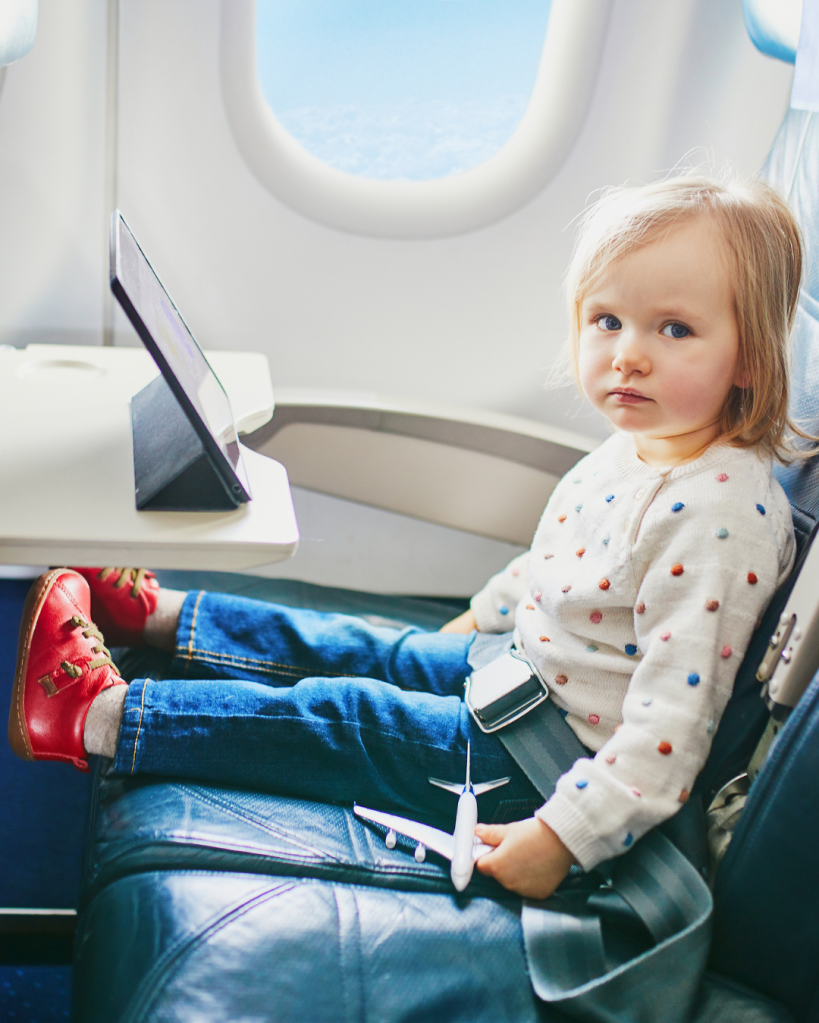
Screens, in their many forms, are an inevitable part of modern life, even for young children. Everywhere you go—restaurants, malls, airports—you’ll see kids eagerly reaching for phones and tablets, their faces lit by tech’s blue-light glow. No matter how you feel about this trend, the decision of whether to give your child access to a smart device should always feel like a choice, not obligatory. But what other options are there, really?
So, up in the air, trapped on a two-hour flight with a toddler, one mom decided to find out what would happen if she didn’t reach for the screen.
One flight, timed by the minute
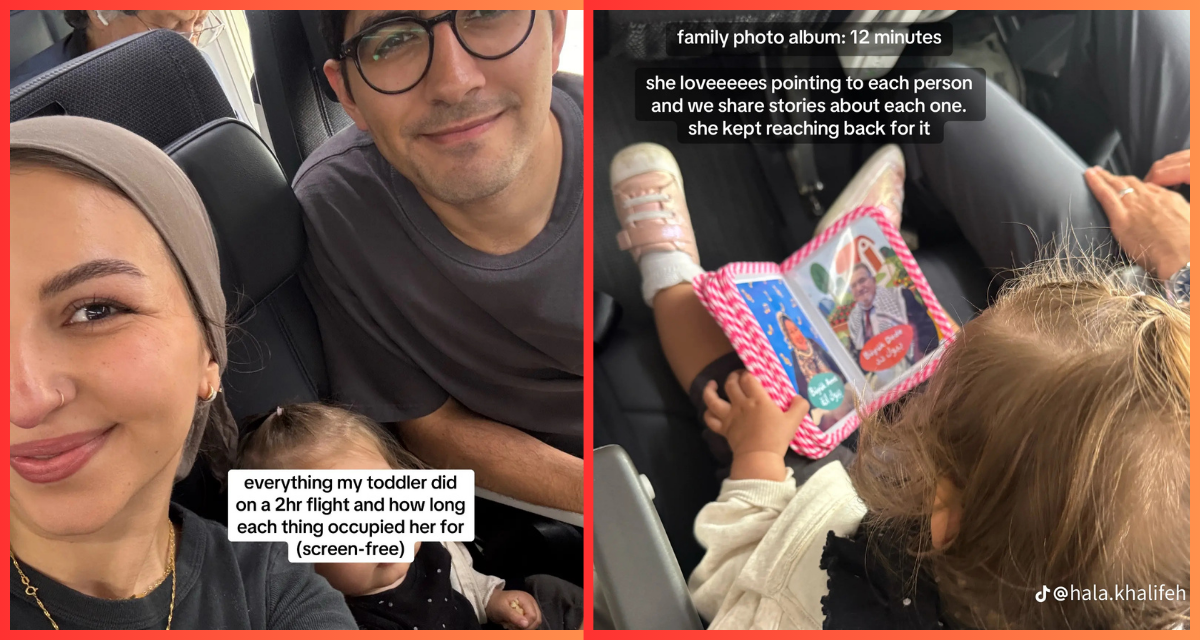
TikTok creator Hala (@hala.khalifeh) posted a video titled “everything my toddler did on a 2-hour flight and how long each thing occupied her for (screen-free),” and it’s exactly as delightful as it sounds.
No vague advice here. Instead, she gave us the play-by-play, timed down to the minute, listing each activity and how many minutes it bought her. No rounding up, no pretending. Just an honest stopwatch running on her toddler’s attention.
Some were surprise winners. A toy giraffe with bendy stretchy arms that stuck to the window? Eighteen minutes, and Hala’s daughter kept reaching back for it long after. “I didn’t think she would care for these, but she loved stretching the arms out and sticking them to the window,” she writes. A family photo album, which prompted pointing and little stories about each person, kept her daughter entertained for twelve minutes. An Arabic picture book with real photographs—not illustrations—held her for fourteen.
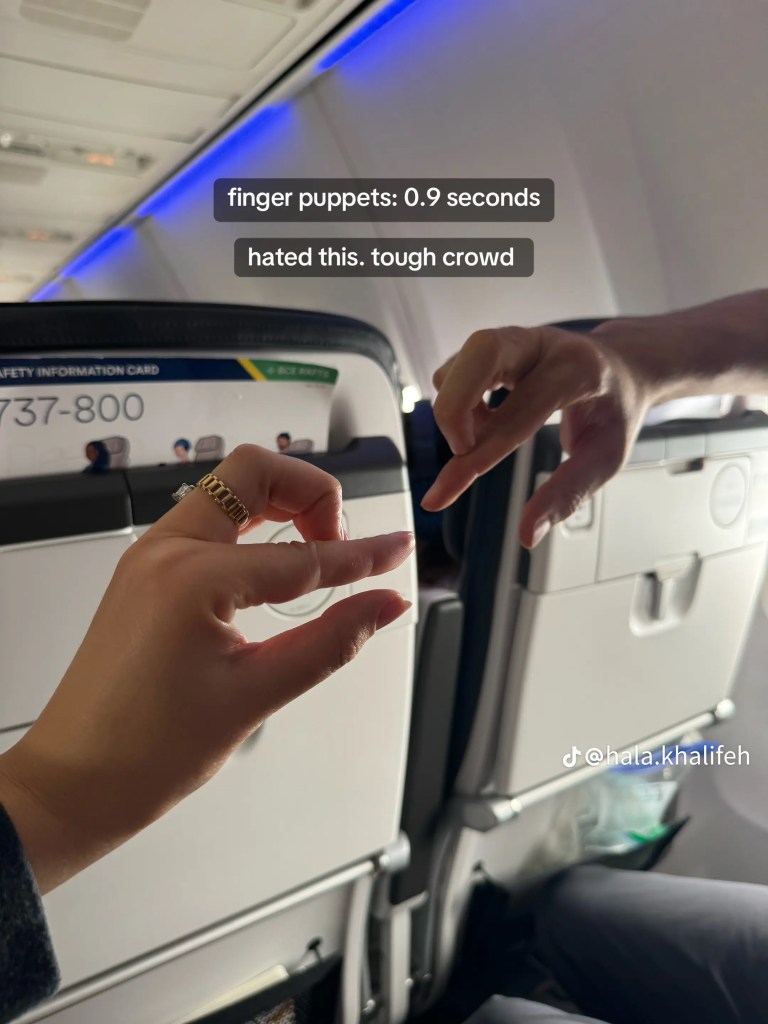
And of course, there were also flops. Finger puppets lasted, in Hala’s words, “.9 seconds.” Why? Her daughter wasn’t a fan. “Hated this,” she continues. “Tough crowd.”
Fidget squares earned a whopping two minutes, followed by frustration. A rainbow fidget toy fell flat until the parents started playing with it themselves. Suddenly, it was interesting after all.
That mix of wins and losses is exactly why the Internet fell for the video. “Using ‘tough crowd’ when a baby is unimpressed is the funniest thing ever,” one commenter wrote. Another offered a tip from the trenches: a toddler once sat beside them on the plane and happily played with tape—normal Scotch tape—for 90 minutes, writing “she was happy, and her parents were eternally grateful.”
It’s the rare parenting post that feels like a friend texting you, not an influencer selling you something.
The biggest hits weren’t toys
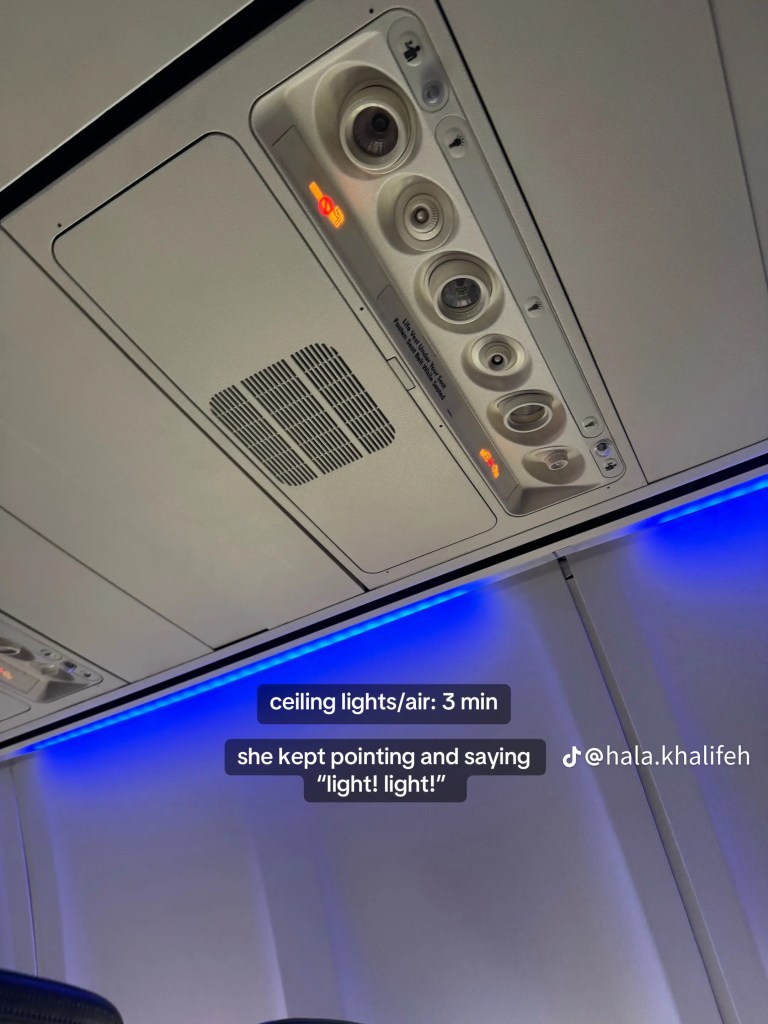
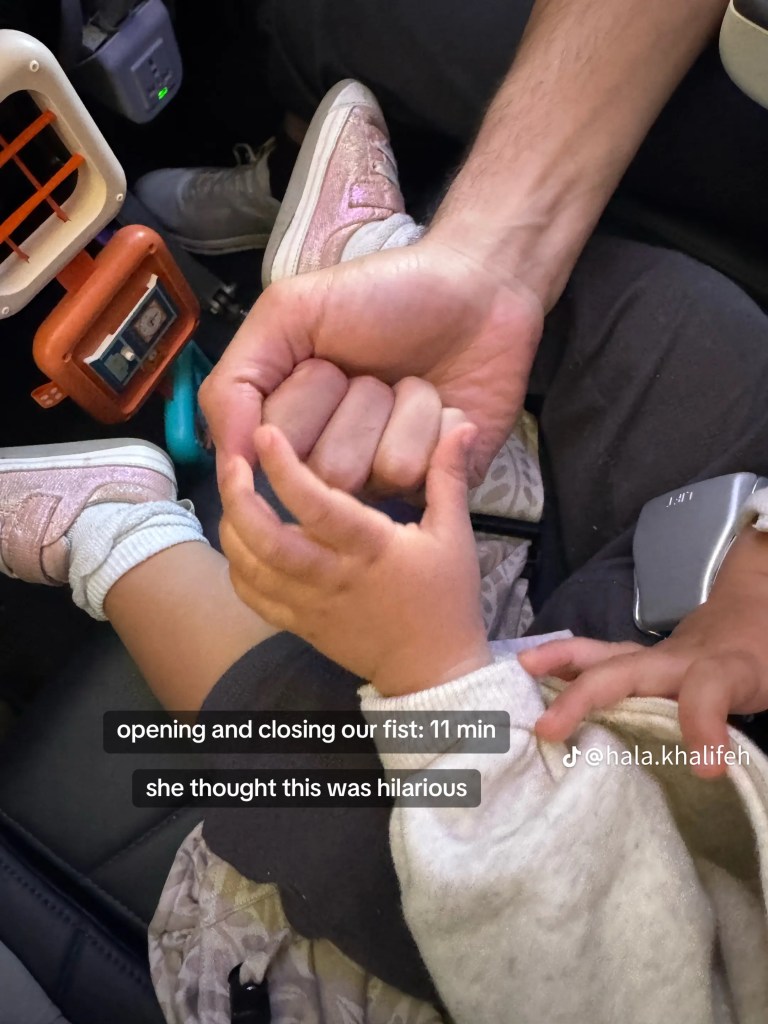
Look closely at Hala’s video, and a pattern jumps right out: her daughter’s longest, happiest stretches weren’t because of toys at all. Watching her parents open and close their fists together? Eleven minutes of pure elation. Looking at Dad’s phone background—a photo of Mom—achieved twelve minutes of “MAMA!” and laughing. Pointing out the window at the mountains during landing, giggling at the turbulence, held her for another eleven. Even the ceiling lights and air vents got a delighted, “Light! Light!” for three minutes.
Notice the through-line. The fidget toy only worked once the parents pretended to care about it first. The second time, they hung it up so it swayed in the air, and it became a 16-minute winner, because now it was moving and invited her in. The activities that lasted longest were the ones where a grown-up joined in on the fun.
The active ingredient wasn’t the giraffe or the fidget square. It was a parent engaging with their child. The toys were just the excuse for connection, props in a two-hour conversation between a kid and the people she loves most.
Why a little boredom is magic
So why do the homemade, low-tech objects so often beat the high-tech gadgets?
For very young kids, “nothing to do” is exactly where the magic happens. A screen hands a toddler a finished experience—bright, fast, and complete. There’s nothing left for them to build. An empty moment does the opposite and hands them a job. “Figure out how to fill it,” it says.
When a toddler isn’t being entertained, they start doing the inventing themselves: pointing, narrating, turning a closed fist into a guessing game, deciding a stretchy giraffe arm belongs on the window.
That invention is the brain developing. Researchers who study early childhood have linked unstructured, child-led play with stronger creativity, problem-solving, patience, and self-regulation—the very skills a screen tends to replace.
“The brain is at its most rapidly developing state during the first five years,” explains Dr. John Hutton of Cincinnati’s Children Hospital. “This is when the brain is highly adaptable…screen time may be too passive for optimal brain development.”
Boredom itself is a feature, not a bug. Some researchers argue that a child’s inability to sit with boredom—not toys—is what predicts trouble down the road, including weaker creativity and more difficulty focusing. The psychologist Peter Gray has made the case that the time he had as a child “to be bored and figure out how to overcome boredom” taught him more than school. In other words, that squirmy, restless stretch before your toddler invents a new game isn’t the problem. The issue lies with tech’s new escape route.
Letting boredom do its job
Hala’s video is enchanting the Internet because of this notion: we can find new, creative ways to entertain our kids without screens. In the 21st century, that looks like fidget toys and personalized objects—not leaving them to stare off into space, necessarily. Those eleven minutes of opening and closing fists weren’t trivial. That’s boredom doing its job, as a toddler and her parents invented fun out of thin air.
The major health groups back the instinct to go easy on screens early. The World Health Organization suggests no screen time for babies under 1, and no more than an hour a day for ages 2 to 4. The American Academy of Pediatrics advises skipping screen media—beyond a video chat with Grandma—before 18 months, and urges parents to think about what screens crowd out: sleep, play, and back-and-forth interaction. But the more interesting takeaway isn’t what to avoid. It’s what you gain. The thing that fills the space, it turns out, is you.
And here’s the best part: this isn’t just a flight trick. The same thing that buys you eleven quiet minutes at 30,000 feet works in a doctor’s waiting room, a long car ride, or a restaurant where the food is taking forever. Boredom is portable, and so is the fix.
Steal these screen-free tips
If Hala’s video has inspired you to travel without screens, here are a few ideas that consistently work with toddlers.
- Pack novelty, not volume. A few new-to-them objects beat a giant pile of familiar toys. Rotate them every 15–20 minutes, so each one feels like a small event.
- Bring real-photo books. Hala noticed that picture books with real images held her daughter far longer than cartoons or illustrations. Real faces and animals invite real conversation.
- Use the plane itself. Window shades, ceiling lights, air vents, and the view outside are free and endlessly fascinating to a child seeing them for the first time.
- Let snacks be an activity. Slow, fiddly snacks buy time and double as a calm-down tool. Hala’s daughter had a “death grip” on her pancakes for five minutes. “We left early, so this was her breakfast. Snacks are always a win,” she wrote.
- Try painter’s tape. Cheap, mess-free, leaves no residue, and toddler-approved, per that grateful seatmate’s comment.
- Narrate everything. Half the magic is your voice. Name the mountains, count the seats, point at the clouds. Your attention is the toy they never get tired of.
Next time you’re airborne…
So if you’re dreading an upcoming flight with a young child, remember Hala’s giraffe: sometimes the thing that buys you eighteen minutes is the one you almost left at home. A screen-free flight with a toddler isn’t about being a perfect parent. It’s about being present and discovering that your kid would rather have you than the screen anyway.