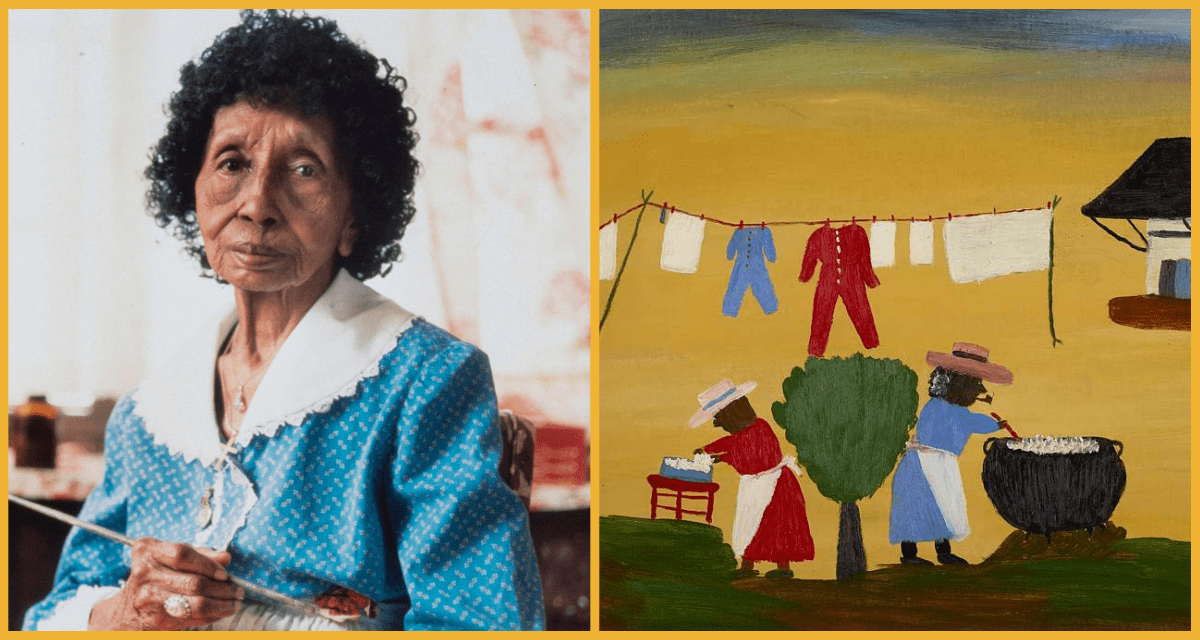
“I tell my stories by making pictures… I paint the story of my people. The things that happened to me and the ones I know. My paintings tell how we worked, played, and prayed.”
— Clementine Hunter, American folk artist
.jpg?maxwidth=3030&maxheight=1950)
Many people figure that when they reach their late fifties, the party’s pretty much over. Your quirks and idiosyncrasies have hardened into permanent fixtures of your personality. Going to bed before 8 p.m. on a Friday night sounds like heaven. And at any given time, either you or someone very close to you will be actively training for some sort of mid-life-crisis battle of physical endurance: marathons, half-marathons, overly aggressive cycling, hikes across state lines, and whatever a “Red Bull Gym Clash” is.
But for Clementine Hunter, entering her mid-fifties unlocked a whole new part of herself that she’d never even considered could exist. During this magical decade, a swirl of destiny, opportunity, and God-given talent arrived on her doorstep. And before she knew it, everything began clicking into place. Things were just getting started for her, but Hunter never had a clue.
.jpg?mode=max)
Life in the Jim Crow South
Born in the late 1880s, she had spent decades picking cotton under that hot Louisiana sun, raising children in a one-room cabin, and cooking and cleaning for the family who owned the plantation where she lived. Her grandmother had been enslaved. She’d never learned how to read or write. She went to school for a matter of days. At age eight, she joined her father in the fields and began picking cotton. Work was all Clementine Hunter knew.
Then, in her fifties, Hunter found a few tubes of paint and leftover brushes in the house she’d cleaned for decades, left behind by a visiting artist from New Orleans. By this point, she’d been married twice, raised a dozen children, and had become a grandmother. She’d never held a paintbrush in her life. But that night, working by the light of a kerosene lamp, Hunter pulled down a canvas window shade and started painting a river baptism she remembered seeing on the Cane River.
A direct line to God
From then on, she never stopped. “God put those pictures in my head, and I put them on canvas, like he wants me to,” Hunter said once in an interview. “I used to pick up little pieces of board and all kinds of little pieces of paper,” she shared in another. “Painted on everything. I didn’t know if I was doing right or wrong, but I was painting. And I gave it all away. I liked what I was painting.”
By the time she died in 1988 at age 101, Hunter had become one of the country’s essential artists: a self-taught painter whose surreal, deeply personal scenes of the Jim Crow South also made her one of its important social and cultural historians.
And when the President of the United States invited her to the White House in the late 1970s, she had, very politely, said no thanks. She’d rather he come to her, replying: “If Jimmy Carter wants to see me, he knows where I am.”
A life measured in cotton
Clementine Reuben Hunter was born at the Hidden Hill plantation (also called Little Eva Plantation) near Cloutierville in Natchitoches Parish, Louisiana. No one knows her exact birth date, but it was likely sometime between December 1886 and early January 1887. As a girl, she went by “Clemence.” She was the eldest of seven children born to Mary Antoinette Adams and Javier “John” Reuben, alongside siblings Maria, Ida, Rosa, Edward, Simon, and John.
Following a short stint in elementary school, by the time she was eight, Clementine was picking cotton beside her father.
Born in slavery’s long shadow
For a Louisiana Creole family in the Jim Crow South, slavery wasn’t a distant memory. Hunter was born about two decades after emancipation, but slavery still showed up in almost every part of her life. Her maternal grandmother, Ida, was born into slavery in Virginia, like other family members before her. Both of Hunter’s parents worked as field hands at Hidden Hill, where the cotton economy kept chugging along, stronger than ever.
The rules had changed a little in those two decades, but not much. “Free” Black families came back to the same white-owned plantations, now, supposedly, for pay. But not in real money. No, that would be too fair, too morally just. Instead, workers received token wages called “scrip”: fake vouchers that might as well have been Monopoly money, I.O.U.s practically stamped with “just kidding” on the back, and worthless metal coins that could only be spent at the employer’s own store. It was a closed loop dressed up as freedom.
“Why do people make art in the first place? Because there’s something inside of them. They have something they need to convey, and for Clementine, it was about her life and documenting the things that went on around her, whether it was a wedding or a funeral or something else.”— Elizabeth Weinstein, Baton Rouge museum curator and consultant
The work that nearly broke her
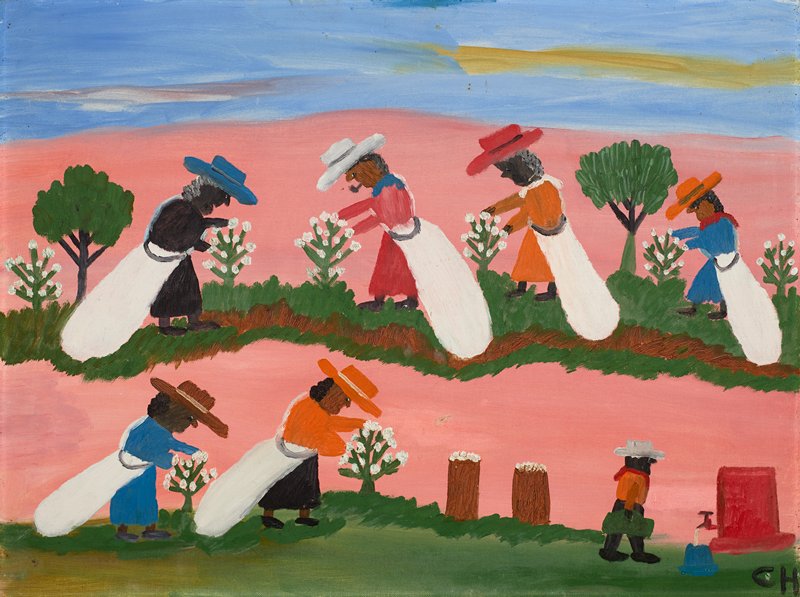
When she was a teenager, Hunter’s family moved to Melrose Plantation along the Cane River. Here, the work was even more punishing. At fifteen, she was put straight into the fields, picking cotton and harvesting crops—quotas hovered around 150 to 200 pounds a day—for pennies. Her body ached from the constant stooping, reaching, twisting, and hauling. Her fingertips were swollen and raw; a single sharp boll could tear the skin right off.
One morning, while pregnant with one of her children, Hunter picked 78 pounds of cotton before realizing something was wrong. She hurried home and called for the midwife. A few days later, she was back in the fields.
She’d stay in those fields for another 26 years.
The glorious paint that changed everything
Despite the backbreaking labor it depended on for centuries and its deeply unethical profit model, by the 1920s the owners of Melrose Plantation were feeling… inspired. Over the next decade, owner Carmelite “Cammie” Garrett Henry turned the place into a gathering spot for artists and writers where they could sit back, dip their toes in the winding river, and focus on creation. On the surface, it sounds almost bohemian. A co-op where hygiene is optional comes to mind, as does Shakespeare and Company, the Paris bookstore where famous writers used to haunt (and, occasionally, even sleep).
But don’t forget where we are: a plantation in the American South. So while literary figures like Lyle Saxon and William Faulkner did drift in, allegedly, the line was clear. White guests were at the plantation to create. Clementine cooked their meals and washed their linens.
Around 1939, the stars must have aligned just so, because, after her stay at Melrose, a New Orleans painter named Alberta Kinsey left behind some of her brushes and paint. Instructed to toss them, Hunter instead swiped the supplies and started to “mark a picture” on the back of an old window shade. She’d say the paints found her by accident. Then she didn’t let go for nearly 50 years.

She painted through the night, completely unaware of the moment’s immense gravity. This was that seminal spark, the birth of a generational artist who went on to deliver one of the most important bodies of work in American folk art. Her scenes of everyday life—bold, vivid pictures of long days in the field, church processions, Saturday-night dances, baseball games, and the plantation itself—would forever change the way Americans remember the Jim Crow South.
A first she wasn’t allowed to see
In 1955, her first solo show debuted at the New Orleans Museum of Art (known at the time as the Delgado Museum), making Hunter the first Black artist to exhibit there. Turns out, progressivism can only go so far in the Jim Crow South, as Hunter was not permitted to enter the museum during public hours due to segregation. To view her own exhibition, she was forced to wait until the gallery was closed and its white patrons left before slipping in.
The fame and awards kept coming anyway. A 1953 feature in Look magazine made Hunter a household name. She received an honorary doctorate from Northwestern State University in 1986. And in 2019, Louisiana legislators officially declared October 1st as Clementine Hunter Day.
The record Clementine Hunter left behind
Over her lifetime, Hunter is thought to have made somewhere between 5,000 and 10,000 paintings. Together they read like a visual diary, a record of rural plantation life in the late 1800s and early 1900s, observed through the eyes of one remarkably perceptive, spiritual soul. “Because the originality of Clementine Hunter’s vision was spiritually grounded in her daily life,” writes James Romaine for ArtWay, “her art evidences a seamless harmony between the sacred and the ordinary.” Throughout her career, Hunter toyed with the line between what is sacred and everyday life, so much so that it seemed almost inevitable for mundanity and divinity to become one.
Painting from memory
Part of what makes Clementine Hunter’s art so striking is how she approached the work. She never painted from life. Everything came from her mind and the hallways of memories that live there. “The only thing I can paint is just what crosses my mind,” she once said. “I don’t want to paint what everyone has already painted. I want to paint something that nobody has.”
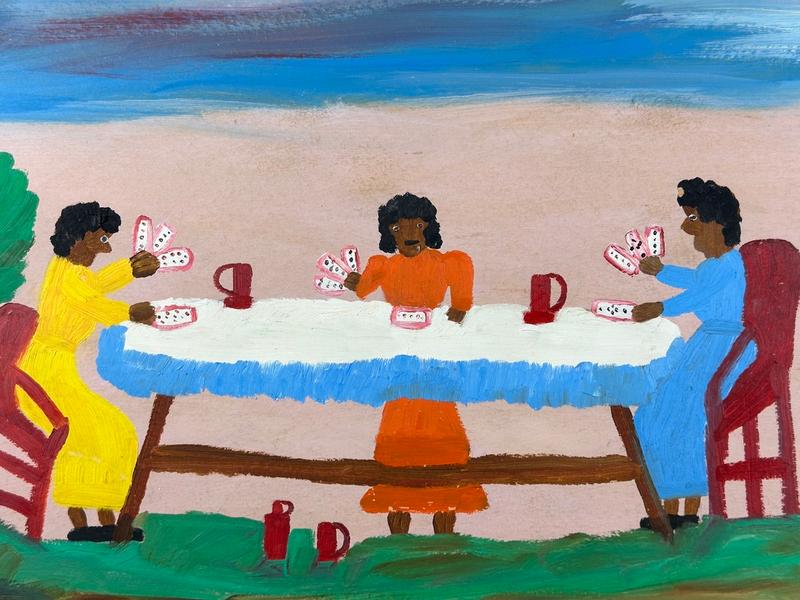
Critics call Hunter a “memory painter.” Her subjects were the world she knew: cotton picking, pecan harvests, weddings, baptisms, funeral processions, Sunday church, the pleasure of cooking outside, and Black women sitting around a table enjoying each other’s company. Curators note the importance of Clementine Hunter’s paintings, ranking her among the most important visual chroniclers of a world that was disappearing.
Zero perspective? Or a much deeper meaning?
If there are academic rules for “how to make art,” Hunter broke most of them. She used flat, bold colors and shapes with no perspective. Her goal wasn’t realism. It was feeling conveyed through the choices she made in composition. Subjects are sized by importance, by how prominent they appear in her mind, ruled not by the banality of real-life dimensions. In Harvesting Gourds near the African House, she captures the cyclical, unequal nature of life in the South: large white fences, framed by a border of gourds and vines, suggest both openness and limits.

“These slashes of earth capture the rhythm and flow of the plantation and also hint at the broader structural and spatial limitations that defined plantation life,” writes curator Katie A. Pfohl in an analysis on the New Orleans Museum of Art website. She adds: “Throughout the painting, subtle rhythms and compositional echoes, such as the exact rhyming of the horse whip and the vine at the painting’s lower right, speak to Hunter’s nuanced approach to form and composition.”
“Even her funeral scenes convey a positive and optimistic tone with their vibrant colors,” notes Virginia-based author JAMA on her blog, Jama’s Alphabet Soup.
.jpg?mode=max)
Why her funerals glow
Perhaps another way to approach Clementine Hunter’s paintings, which often evoke both nostalgia and unsentimentality, is to check in with yourself and consider your own reaction to the work. What emotions are present?
There’s something genuinely sweet and beautiful at the core of Hunter’s artwork. Despite a lifetime of painful memories, she chooses to depict Black Southern life in warm, luscious tones. Awe, respect, tenderness, and rapture seem to serve as frequent muses, and curiosity is often paired with mysticism when Hunter paints images from the past.
“What people love about Hunter is her simple desire to create,” explains Cara Zimmerman, a specialist in Outsider Art at Christie’s in New York. “It was just her own way of making sense of her life.”
.jpg?mode=max)
When you have a chance, check out Clementine Hunter’s oeuvre: Going to Church. Wash Day. Funeral at St. Augustine. Playing Baseball. Picking Cotton. The glory of Baptismal Scene. Take note of what you feel. Perhaps your body tingles. Giddy adoration might warm your face. This is art we’re talking about. Isn’t it supposed to remind us, at times, that we’re alive and grateful?