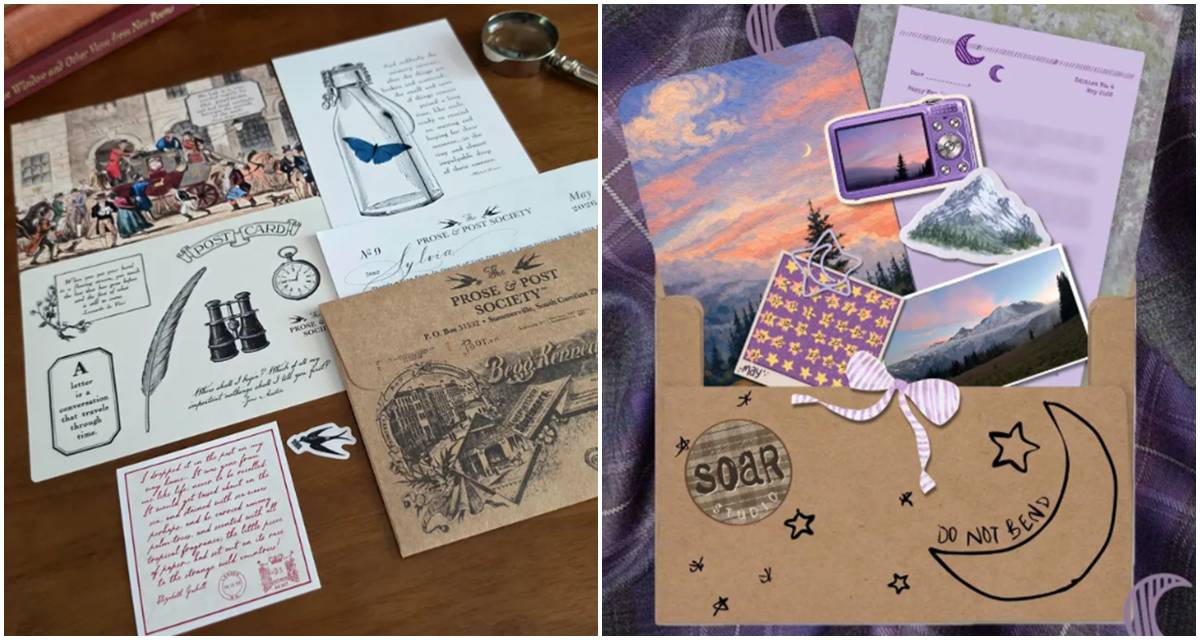
Before the digital revolution’s ruthless efficiency, there were things in life that we delighted in waiting for through the mail. There were quarterly fan club letters you got from your favorite band or sci-fi franchise. There were magazine subscriptions or the occasional letter from your pen pal overseas. People also used to have LP subscriptions with Columbia House, in which they would receive new music in the mail every few weeks.
Before the turn of the century, the mail wasn’t always bills, advertisements, and the occasional catalog. Every day, there was a chance that something magical could show up.
Gen Zers are making mailboxes fun again
Gen Zers are bringing back the joy of receiving something in the mail through snail mail clubs, monthly subscriptions that cost around $8 a month for artists who send stickers, illustrations, newsletters, horoscopes, recipes, bookmarks, and whatever else can fit into a standard-sized envelope. The artwork and stories are usually whimsical and tend to appeal to women.
The mailings are a wonderful way for subscribers to feel the joy of receiving something in the mail and a message from a creator they love, instead of disposable content made of pixels and delivered through algorithms. “Physical mail creates a pause,” Jaylan Birdsong, the artist behind the Perch Post mailer, told Dazed. “It asks you to slow down, touch paper, sit with an image, flip through a zine, tape it to a wall, or tuck it into a journal.”
When people receive something tangible, they tend to relish it more than digital artwork. It’s a big reason why people have physical media, like LPs and CDs, because they allow you to really experience the artwork.
Snail mail clubs aren’t just about getting a surprise in your mailbox; they are about creating a tangible connection between creators and their audience. “Social media sort of feels like driving by a billboard—where people might come across me and say, ‘Oh, that’s nice’, and then they keep going—whereas someone subscribing to my mail club feels like we’re sitting down and sharing a meal together; it’s a much deeper, more intimate way of connecting with somebody,” Christine Tyler Hill, founder of The Coud Hill Report snail mail club, told Creative Lives in Progress.
Snail mail clubs are a great way for artists to make extra money
The subscription-based business is also great for creators to make some considerable side money. Kiki Klassen, the creator behind Lucky Duck Mail Club, told CNBC that she is able to bring in around $4,385 a month in subscription revenue, with a profit margin of about 70%. The artistic endeavor has “definitely created a cushiony security I didn’t have before,” Klassen told CNBC’s Make It. “It’s been nice not to think about [expenses] paycheck to paycheck anymore.”
The one drawback is that creators have to get really good at stuffing envelopes. Unless they have help on the side, a popular creator could have to stuff hundreds, if not thousands, of envelopes a month.
Snail mail clubs are a wonderful example: once we think technology has robbed us of certain joys, some reach back in time and bring them back. There’s nothing wrong with email or snail mail; the cool thing is that we can enjoy both these days.