A healthy and supportive marriage is a gift during tough times to provide support and lift each other up. A 2025 Pew Research Center study found that 74% of Americans “would be extremely or very likely to turn to their spouse or partner if they needed emotional support.”
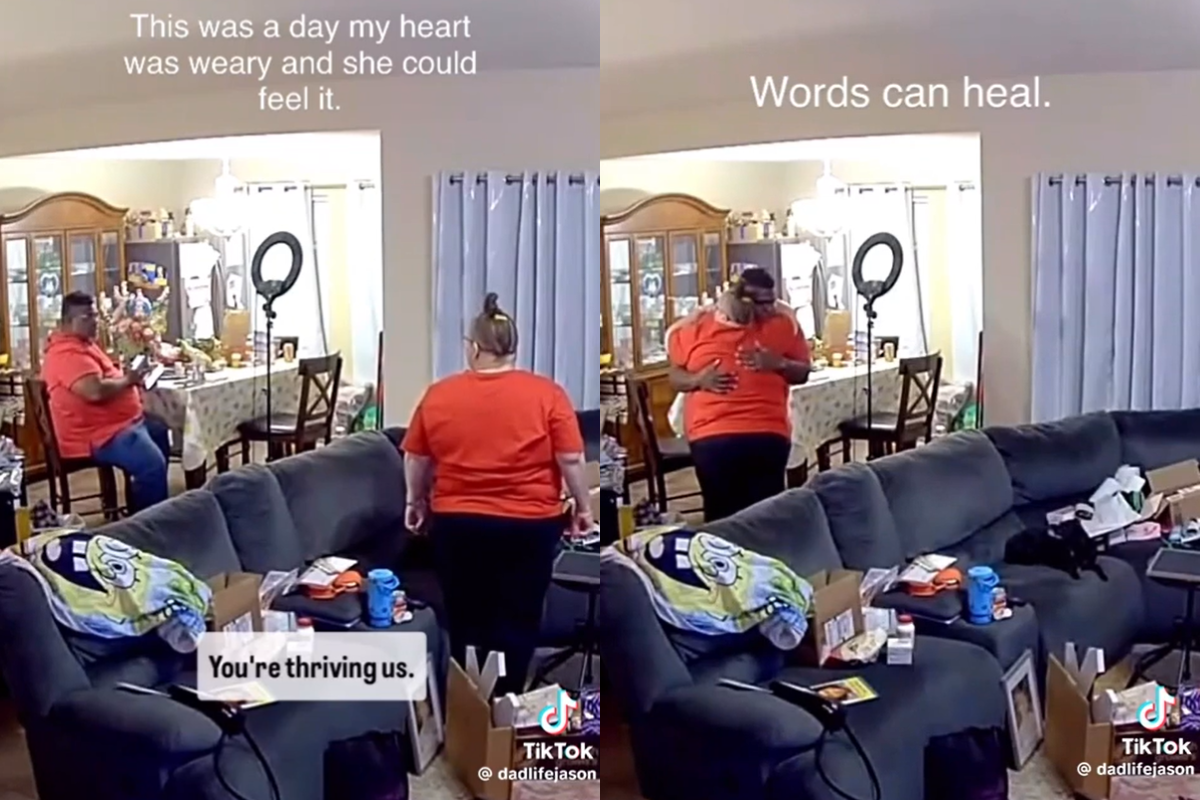
And for husband Jason (@dadlifejason), his wife Patience provided him with the love and encouraging words he needed on a hard day. “This was a day my heart was weary and she could feel it,” he explained in the video’s overlay about their marriage.
“This was a day when I felt like the whole world was on my shoulders and she could sense it,” he wrote in the video’s caption.
In the video, the couple are sitting near each other in their home’s living room and kitchen. Patience stands up and delivers a 90-second speech to Jason that he will never forget. “We’re thriving because of you,” she says. “Like, I’m able to get a new phone because of you. I’m able to go get my tests and get new glasses because of you. I’m able to have somebody come in here and clean because of you.”
She continues, “I’m able to make a meal for not just our family but Crystal and Brett because of you. You’re not just keeping us afloat—you’re thriving us. And I appreciate you so much. The way you lavish your love on us is insane. You take such good care of us. You are such an incredible provider. And I don’t just mean financially—you’re incredible for our family.”

Patience concluded her speech: “Like I had expectations of what you’re going to be like, and you have far surpassed them. I am overwhelmed with what a great provider you are for our family. I am so blessed and I’m so grateful that you’re my husband. I just want you to know that. Okay?”
Then she walks over to give Jason a big, long hug. They both spend a few quiet moments in their embrace. “I just love you so much,” she says, and Jason says, “I love you, too.”
Jason adds in the video’s overlay, “I needed this more than even I knew. Words heal,” he wrote.

The touching video got an emotional response from viewers, who noted Jason is the “richest man on Earth.” “Her 90 seconds will motivate that man for decades. F*cking BRAVO to that woman for lifting up her man. And BRAVO to that man for busting his ass for the family he loves,” one viewer wrote. Another added, “Tell me you’re rich without telling me you’re rich. what a great support system he has.” Another viewer commented, “She spoke life into that man.”
Others opened up and shared that they longed for the same support from their spouse. “God this is all I want from my wife. It’ll never come though. Nothing worse than feeling alone in a relationship and having to stay for the kids benefit,” one wrote. Another shared, “This is what all men want.”

In a small village in Pwani, a district on Tanzania’s coast, a massive dance party is coming to a close. For the past two hours, locals have paraded through the village streets, singing and beating ngombe drums; now, in a large clearing, a woman named Sheilla motions for everyone to sit facing a large projector screen. A film premiere is about to begin.
It’s an unusual way to kick off a film about gender bias, inequality, early marriage, and other barriers that prevent girls from accessing education in Tanzania. But in Pwani and beyond, local organizations supported by Malala Fund and funded by Pura are finding creative, culturally relevant ways like this one to capture people’s interest.
The film ends and Sheilla, the Communications and Partnership Lead for Media for Development and Advocacy (MEDEA), stands in front of the crowd once again, asking the audience to reflect: What did you think about the film? How did it relate to your own experience? What can we learn?
Sheilla explains that, once the community sees the film, “It brings out conversations within themselves, reflective conversations.” The resonance and immediate action create a ripple effect of change.
MEDEA Screening Audience in Tanzania. Captured by James Roh for Pura
Across Tanzania, gender-based violence often forces adolescent girls out of the classroom. This and other barriers — including child marriage, poverty, conflict, and discrimination — prevent girls from completing their education around the world.
Sheilla and her team are using film and radio programs to address the challenges girls face in their communities. MEDEA’s ultimate goal is to affirm education as a fundamental right for everyone, and to ensure that every member of a community understands how girls’ education contributes to a stronger whole and how to be an ally for their sisters, daughters, granddaughters, friends, nieces, and girlfriends.
Sheilla’s story is one of many that inspired Heart on Fire, a new fragrance from the Pura x Malala Fund Collection that blends the warm, earthy spices of Tanzania with a playful, joyful twist. Here’s how Pura is using scent as a tool to connect the world and inspire action.
A partnership focused on local impact, on a global mission
Pura, a fragrance company that recognizes education as both freedom and a human right, has partnered with Malala Fund since 2022. In order to defend every girl’s right to access and complete 12 years of education, Malala Fund partners with local organizations in countries where the educational barriers are the greatest. They invest in locally-led solutions because they know that those who are closest to the problems are best equipped to solve and build durable solutions, like MEDEA, which works with communities to challenge discrimination against girls and change beliefs about their education.
But local initiatives can thrive and scale more powerfully with global support, which is why Pura is using their own superpower, the power of scent, to connect people around the world with the women and girls in these local communities.
The Pura x Malala Fund Collection incorporates ingredients naturally found in Tanzania, Nigeria, Pakistan, and Brazil: countries where Malala Fund operates to address systemic education barriers. Eight percent of net revenue from the Pura x Malala Fund Collection will be donated to Malala Fund directly, but beyond financial support, the Collection is also a love letter to each unique community, blending notes like lemon, jasmine, cedarwood, and clove to transport people, ignite their senses, and help them draw inspiration and hope from the global movement for girls’ education. Through scent, people can connect to the courage, joy, and tenacity of girls and local leaders, all while uniting in a shared commitment to education: the belief that supporting girls’ rights in one community benefits all of us, everywhere.
You’ve already met Sheilla. Now see how Naiara and Mama Habiba are building unique solutions to ensure every girl can learn freely and dare to dream.
Naiara Leite is reimagining what’s possible in Brazil
Julia with Odara in Brazil. Captured by Luisa Dorr for Pura
In Brazil, where pear trees and coconut plantations cover the Northeastern Coast, girls like ten-year-old Julia experience a different kind of educational barrier than girls in Tanzania. Too often, racial discrimination contributes to high dropout rates among Black, quilombola and Indigenous girls in the country.
“In the logic of Brazilian society, Black people don’t need to study,” says Naiara Leite, Executive Coordinator of Odara, a women-led organization and Malala Fund partner. Bahia, the state where Odara is based, was once one of the largest slave-receiving territories in the Americas, and because of that history, deeply-ingrained, anti-Black prejudice is still widespread. “Our role and the image constructed around us is one of manual labor,” Naiara says.
But education can change that. In 2020, with assistance from a Malala Fund grant, Odara launched its first initiative for improving school completion rates among Black, quilombola, and Indigenous girls: “Ayomidê Odara”. The young girls mentored under the program, including Julia, are known as the Ayomidês. And like the Pura x Malala Fund Collection’s Brazil: Breath of Courage scent, the Ayomidês are fierce, determined, and bursting with energy.
Ayomidês with Odara in Brazil. Captured by Luisa Dorr for Pura
Ayomidês take part in weekly educational sessions where they explore subjects like education and ethnic-racial relations. The girls are encouraged to find their own voices by producing Instagram lives, social media videos, and by participating in public panels. Already, the Ayomidês are rewriting the narrative on what’s possible for Afro-Brazilian girls to achieve. One of the earliest Ayomidês, a young woman named Debora, is now a communications intern. Another former Ayomidê, Francine, works at UNICEF, helping train the next generation of adolescent leaders. And Julia has already set her sights on becoming a math teacher or a model.
“These are generations of Black women who did not have access to a school,” Naiara says. “These are generations of Black women robbed daily of their dreams. And we’re telling them that they could be the generation in their family to write a new story.”
Mama Habiba is reframing the conversation in Nigeria
Centre for Girls' Education, Nigeria. Captured by James Roh for Pura
In Mama Habiba’s home country of Nigeria, the scents of starfruit, ylang ylang and pineapple, all incorporated into the Pura x Malala Collection’s “Nigeria: Hope for Tomorrow,” can be found throughout the vibrant markets. Like these native scents, Mama Habiba says that the Nigerian girls are also bright and passionate, but too often they are forced to leave school long before their potential fully blooms.
“Some of these schools are very far, and there is an issue of quality, too,” Mama Habiba says. “Most parents find out when their children are in school, the girls are not learning. So why allow them to continue?”
When girls drop out of secondary school, marriage is often the alternative. In Nigeria, one in three girls is married before the age of 18. When this happens, girls are unable to fulfill their potential, and their families and communities lose out on the social, health and economic benefits.
Completing secondary school delays marriage, and according to UNESCO, educated girls become women who raise healthier children, lift their families out of poverty and contribute to more peaceful, resilient communities.
Centre for Girls’ Education, Nigeria. Captured by James Roh for Pura
To encourage young girls to stay in school, the Centre for Girls’ Education, a nonprofit in Nigeria founded by Mama Habiba and supported by Malala Fund and Pura, has pioneered an initiative that’s similar to the Ayomidê workshops in Brazil: safe spaces. Here, girls meet regularly to learn literacy, numeracy, and other issues like reproductive health. These safe spaces also provide an opportunity for the girls to role-play and learn to advocate for themselves, develop their self-image, and practice conversations with others about their values, education being one of them. In safe spaces, Mama Habiba says, girls start to understand “who she is, and that she is a girl who has value. She has the right to negotiate with her parents on what she really feels or wants.”
“When girls are educated, they can unlock so many opportunities,” Mama Habiba says. “It will help the economy of the country. It will boost so many opportunities for the country. If they are given the opportunity, I think the sky is not the limit. It is the starting point for every girl.”
From parades, film screenings to safe spaces and educational programs, girls and local leaders are working hard to strengthen the quality, safety and accessibility of education and overcome systemic challenges. They are encouraging courageous behavior and reminding us all that education is freedom.
Experience the Pura x Malala Fund Collection here, and connect with the stories of real girls leading change across the globe.
The number of older drivers in the United States continues to grow. According to data reported by NPR from the Federal Highway Administration, the number of drivers ages 65 and older increased by 88% from 2003 to 2023.
As Americans live longer than previous generations, many continue to drive, leading to an increase in car accidents and related deaths. The Centers for Disease Control and Prevention reports that in 2022, about 9,100 older adults were killed in traffic crashes, and more than 270,000 were treated in emergency departments for crash-related injuries.
Many states place restrictions on older drivers once they reach a certain age or require additional testing to maintain a driver’s license. But it often falls to adult children to decide whether their parents can continue driving.
Deciding to take car keys away
According to a 2026 survey from Pew Research Center, 10% of adults in the U.S. report being caregivers for a parent age 65 or older. As their parents age, many adult children find themselves responsible for making tough decisions about their driving abilities.
It’s a delicate situation that many American families struggle to navigate.
A 2013 survey from Liberty Mutual found that 55% of adult children with older parents were concerned about their parents’ ability to drive safely. The same survey found that only 23% brought up the issue, while 29% chose not to have the conversation at all.
People share how they took car keys away
On Reddit, people with aging parents sharedreal-life stories of how they took car keys away from their loved ones to help others facing the same challenge. Here are seven examples of how they did it:
“We asked his doctor to officially declare him as unfit to drive so he heard it from someone else. This was reported to the DMV and his license was revoked. Then we took all the keys to our house and hid them there. Shortly after, we sold the car.” – Illustrious-Shirt569
“When my mom ended up with Alzheimer’s and she got to the point that she was no longer safe on the road, my husband and I removed the distributor cap on the car. We told her that her car was inoperable and that we would get it to the shop ‘soon’. Then we managed to sneak her keys out whilst someone else distracted her. Anytime she asked about the car, we just told her we made an appointment with the repair shop for ‘next week’. Shortly after we took the car away, her cognitive abilities declined sharply. We ended up having to put her in a memory care facility. It was the best thing for everyone because trained people could watch her 24/7.” – suzanious
“My 84 year old mom’s license came up for renewal this year and in our state eye exams are required past 80. She was stressing about having to go do that, where and when. So I said ‘Well I guess you’re not required to renew it. You could retire from driving with a perfect record’ which is true, she was always a safe driver. She liked that idea a lot and admitted I was driving her everywhere anyway. Very relieved it won’t be a battle later on.” – Laura1615
“My Mom turned 80 and the DMV wanted her to take a written test and an eye exam. I gave her the online practice tests and told her to do her best. When we got there for her appointment, she looked at the clerk and said I don’t want to drive, I just need an ID. The clerk happily processed the ID request and told mom that if she didn’t like the picture, she could come back anytime and take another one.” – Jettcat-
“We lived in a small town and we asked the police to come to the house and talk and take them away. Especially if you have a doctors note. Or even two notes.” – Reckless_Fever
“My father still has a license and is still insured. I mulled over taking the key for 6 months before doing so. First I got an insurance app that tracked his trips and locations. Then I bought a dash cam. Finally, I took my dad’s keys. Now I don’t let him drive unless I am present. This way he doesn’t go out unless necessary and if he gets tired I can take over. He hasn’t given up asking for the key, but I pushback by saying ‘I am the key, bring me with you.’ We have a schedule now when we go to the store together, so he doesn’t really have a reason to go by himself. He prefers to let me drive now.” – daydream-interpreter
“My mother’s car stopped working while she was in rehab after breaking her hip. The car was on its last legs anyway. I went to the shop and told them they needed to take the car away, examine it and determine that it couldn’t be fixed. The lady agreed. It was not the first time she had heard this. I signed over the title and they took it for junk value. Had it been worth anything I would probably have had them sell it, or donate it. My mother, who had insisted it could be fixed, took their word for it and that was the end of it. Later on, when she asked to borrow my car, I told her I could drive her anywhere, but if she wanted to drive she would have to get herself into the car herself. As she couldn’t walk by then, that was the end of that.” -FranceBrun
It’s hard to believe now, but communicating via the written word used to be a gigantic deal. Long before texting, social media, quick emails, or even short postcards, one of the only ways people could communicate across space and time was by writing long letters.
The 18th century is considered by some to be the peak of the Golden Age of letter writing. It was a key element of education for people wealthy enough to receive one, and it was incredibly important: business was conducted via handwritten letters, love was declared, and new introductions were made.
It was crucial, then, to choose your words extremely carefully. This was especially true in and around the Victorian Era in England, roughly between 1820 and 1914.
Victorian-era translations of everyday sayings
An English teacher from the United Kingdom has been delighting followers with Victorian-era translations of everyday sayings.
Abram Elenin runs Berber English, where he says, “I help professionals master British English… and communicate more effectively.”
He also likes to have a little fun with his work as a linguistics expert and accent coach. In a wildly popular series of Instagram Reels, he performs “tiered” translations of common phrases, transforming them into increasingly formal variations. Victorian English is usually the final resting point and comedic punchline.
In one popular video, “I’m burnt out” becomes “I’m entirely depleted” in formal English, and “I have been worked to the very marrow” in gentlemanly English.
But Victorian English, the age of beautiful if long-winded novels like Great Expectations and Jane Eyre, takes the cake: “Where to begin, for my faculties have been exhausted by perpetual toil, and incessant application has so stripped me of vitality that I am scarcely able to summon the strength requisite for the smallest effort.”
In another Reel, “I’m poor” becomes “I find myself in a precarious financial position,” and finally:
“It is with no small measure of affliction that I acknowledge my fortunes to be sadly diminished, my purse exhausted, and my station reduced to one of grievous penury, such that I find myself abandoned to the stern tutelage of want, the harshest master to which mankind is ever subject.”
It just sounds so much better that way. Can’t you just hear Moira Rose from Schitt’s Creek saying that?
Elenin’s videos have reached millions of viewers worldwide, helping them gain a greater appreciation for Victorian-era English and language more broadly.
“‘My faculties have been exhausted by perpetual toil’ goes hard,” one Facebook commenter notes.
“Gonna use Victorian for my essays now,” someone says on Instagram.
“I just love listening to you saying these things,” adds another.
A few brave commenters tried writing their own Victorian-style passages, but it’s really a job best left to the pros, like Elenin.
Why the language died out
This gorgeous, verbose style of language unfortunately faded as literacy rates climbed and the written word became more commonplace.
However, letter writing was still commonly practiced until the telephone became a major part of everyday life in the early 1900s.
Early phonograph recordings from the late 1800s offer some of our only glimpses into what people in the Victorian era actually sounded like. Though their conversations are less flowery and long-winded than their writing, they still stand in stark contrast to casual conversation today.
While it’s a little sad for those who appreciate language that this kind of prose is mostly extinct, there is some good news: letter writing is making a comeback. As people grow weary of screens and impersonal digital communication, the trusty pen and paper are experiencing a much-needed revival.
Maybe now is the perfect time to brush up on your Victorian English, or at least take some inspiration from the way they could make anything sound interesting or profound.
Job interviews can be equal parts anxiety-inducing and exciting. A new opportunity, and possibly a different future, can await. Then, after the interview, you check your inbox: “We regret to inform you…” “Unfortunately, while your qualifications were impressive…” “We’ve decided to go in another direction at this time.” Rejection after an interview can feel defeating. However, there are ways (and reasons) to feel like you’ve won anyway.
Several career experts and job search professionals spoke to Upworthy to share their advice on managing the emotions that come with job rejection. They also offered tips and data to boost your confidence and help you return to the job search feeling like a winner. Here are five of their recommendations.
1. Feel the feelings
“Give yourself permission to feel how you feel,” said career coach Dante Rosh. “If you’re feeling rejected, feel rejected. Acknowledge the feeling, but don’t allow yourself to sit in it too long. Put a timer on your pity party. This may sound like, ‘I’m going to feel bad for the rest of today, but tomorrow is a new day and I’m going to continue my search.’”
“Rejection after a job interview can be challenging, but the most important thing you can do is protect your mindset,” said Jasmine Escalera, a career expert for LiveCareer. “Take a moment to pause, breathe, and step away instead of rushing right back into applications. So many candidates push through without processing it, but giving yourself that space supports your mental and emotional health. And when you do that, you come back stronger, more grounded, and more resilient for the remainder of your search.”
2. Know that you aren’t alone, and that there will likely be many rejections before a “yes”
Ellen Raim, a former chief human resources officer turned career advisor, said the job market is difficult. She shared data showing that it can take 50 applications to get a job interview and 200 interviews to land a job. She encouraged new job seekers to keep going.
“In today’s market looking for a job is like being in sales. Good salespeople know they won’t close every deal,” said Raim. “On the hard days, remember: every effort you have made counts; you’re closer than you were yesterday. You have a great product. You will make the sale; keep going.”
“Rejection has a finite time frame,” said Lacey Kaelani, CEO of job search engine Metaintro. “According to our data, the average number of applications received for any position is in the approximate excess of over 250. Reaching the interview stage could mean that an applicant is in the top 2% of all applications. That in itself is a win.”
You can still land jobs at companies who have rejected you in the job search. If you went through their hiring process, that means you have good skills and are compatible with the team, just the timing or role wasn’t quite right. So many of my clients land jobs at companies who once rejected them by using Job Shopping strategies. You can do this too! Don’t let these relationships go to waste. Follow for more! #jobsearch#jobtips#hiring#business#worklife#careercoach#jobmarket
3. Reframe and redirect negative thoughts and rumination
“Reframe your negative thoughts,” said Rosh. “While we can’t always control what thoughts pop into our heads, we can control the power and energy we give them. Instead of accepting ‘I’m unhireable’ as fact, try reframing it. ‘My mind is telling me I’m unhireable and I’m working on not buying into that.’”
Peter Franks, a former executive search firm headhunter who’s currently the editor at No Latency, said to focus on the facts of the situation rather than ruminate on the rejection.
“As humans, we’re naturally competitive and want to succeed,” said Franks. “Being rejected hurts our pride but it’s worth remembering that only one person can win any recruitment process. If you apply for a role and get invited for an interview, you’ve already beaten 80%+ of the market. If you make it to the second or third interview, you’ve probably surpassed 90% of the candidate pool.”
In short, if you don’t get a job offer after a third interview, you didn’t lose 0-1—you won 2-1. This reframing could lead to a 3-0 win in the future.
4. Write down what went right and what you learned
Lucas Botzen, a human resources manager and CEO of Rivermate, recommended writing down three moments in which candidates felt confident, thoughtful, or had a strong rapport with the interviewer. Botzen said this shifts the focus from what could have gone wrong to what went right. He also recommended keeping a log after every interview.
“Write a skills success log for each interview,” Botzen said. “This is a log that should record not only what worked but also what [the interviewee] learned about themselves and their skills.”
Writing down what you did right helps you see the wins you’ve achieved and offset any feelings of loss.
5. Send a thank-you note to the interviewer for your own confidence
“After being rejected for a job, the best thing you can do is send the hiring manager a brief thank you note with a question about how you can improve your resume or skills to ‘hopefully’ land a job at that company one day,” said Kaelani. “You might end up receiving an answer that provides insight.”
While this advice is typically recommended as a courtesy, it’s not just about professionalism. It also allows you to get the last word.
“By sending a thank you note to the interviewer in which you reference an idea that you discussed during the interview, you are taking control of the situation,” added Botzen. “This gives you a sense of power and professionalism, even if the company decided to go in another direction.”
Rejection is common. While it hurts, these insights can help job seekers feel better, knowing that landing a job is not a question of “if,” but “when.”
Sometimes our coping mechanisms are found where we least expect them. Such was the case for a woman named Ruby Gregory, who went through a breakup so difficult she completely lost her appetite. (It happens to the best of us.) That is, until she discovered her love of boiled peanuts.
Gregory took to Instagram to publicly express her gratitude for a company called Peanut Patch Boiled Peanuts. (They, of course, make the boiled peanuts.) Before reading her heartfelt letter, she made it clear in the post that she was not sponsored by the company.
She also clarified that she has eaten a lot of boiled peanuts. “I have consumed well over 100 cans of Peanut Patch Boiled Peanuts after my wife left me back in September.”
“Hello. My name is Ruby. And I’m writing today to express my appreciation and gratitude for your product. Back in September, my wife came home, told me she cheated on me with someone in her nursing program, and left. I was so sad. I could hardly eat for about a month. I lost 30 pounds in 30 days. Yikes.”
A delicious craving
But suddenly, she began to crave them. She continued:
“Then one day I got a craving for boiled peanuts, the ones you’d see being sold on the side of the road on game days growing up. Since I had that craving back in November, I have consumed approximately 5-10 cans of Peanut Patch boiled peanuts per week. Usually the standard size, but I’ve since discovered the giant cans sold at Sam’s Club. If you do the math, I have consumed well over 100 cans of Peanut Patch Boiled Peanuts since my wife left me.”
But here’s where the wonderful news comes in:
“I am doing much better now. This has been the hardest and best thing that has ever happened to me.
I have learned so much about my resiliency and strength and am genuinely excited for what my future holds. More importantly, I have learned that real love is consistent, dependable, and nourishing, just like Peanut Patch cans of boiled peanuts.
In the coming weeks, my divorce will be finalized, and I will be able to officially and legally move forward with my life, but I will always remember that when things got hard and money got tight, I could always count on my Peanut Patch cans of boiled peanuts to keep me going no matter what the next day brought. Thank you for your product. Thank you for listening. And I hope this email finds you well.”
The company responds
Peanut Patch Boiled Peanuts responded in kind, writing in an Instagram message, “Hey there Ruby! Just wanted to let you know that there are some boiled peanuts heading your way, but we are also putting together another care package for ya, that’ll take a little longer. Didn’t want you to think we forgot about ya or anything!”
The comment section came alive, proving that an online community can truly deliver.
One person joked, “Have you thought about maybe seeking a therapist?” Gregory responded, “My therapist is aware and has cried over said boiled peanuts with me.”
Others were merely supportive of her heartbreak. “I have never felt more seen. Boiled peanuts heal the soul!” one person said. Another shared, “Facing heartbreak and life hardship, but hitting your protein every day despite it all… a true icon!”
Another agreed, “Wow. I’ve never been so emotionally touched by a video about boiled peanuts and divorce, which outwardly has no correlation. I hope life continues to treat you and your boiled peanuts well.”
This person summed up what many might be thinking: “Romance is temporary, boiled peanuts are forever.” Gregory replied, “You get it.”
Upworthy spoke with Gregory, who said the company sent an initial giant care package and is sending another one soon. “I don’t know what will be in it! By this time next week, I’ll also be a single woman!” she said.
She’s also overjoyed by the response, saying, “I’m just so overwhelmed with the support and community of people there who have bonded over this regional delicacy. Shout out to Badass Tally Peanuts and Peanut Patch. They have both been supportive. Badass Peanuts is local to Tallahassee and is Black-owned, LGBT friendly, and a family business.”
Debates about homework are nothing new, but the ability of parents to find support for homework woes from thousands of other parents is a fairly recent phenomenon. A mom named Cassi Nelson shared a post about her first grader’s homework and it quickly went viral. Nelson shared that her son had come home from his second day of school with four pages of homework, which she showed him tearfully working on at their kitchen counter.
“He already doesn’t get home from school until 4 pm,” she wrote. “Then he had to sit still for another hour plus to complete more work. I had to clear out the kitchen so he could focus. His little legs kept bouncing up and down, he was bursting with so much energy just wanting to go play. Then he broke my heart when he looked up at me with his big teary doe eyes and asked…. ‘Mommy when you were little did you get distracted a lot too?!’ Yes sweet baby, mommy sure did too! I don’t know how ppl expect little children to sit at school all day long and then ALSO come home to sit and do MORE work too….”
Nelson tells Upworthy that she felt “shocked” that kindergarteners and first graders have homework, much less the amount expected of them. “We didn’t have homework like this when we were in these younger grades.”
With that as a guide, a first grader shouldn’t have more than 10 minutes of homework on any given school day, but it’s not unusual for young kids to have two or three times the recommended limit of homework. That can be stressful for both kids and parents, cutting into valuable family time and limiting kids’ time to decompress, play and freely engage in imaginative activity.
Kids working on their homework. Photo credit: Canva
As Nelson concluded, “It’s breaking their spirit and it robs them of what little fun and family time they have when they come home after a long day of school.”
Most parents and even most teachers in the comments agreed with her that four pages of homework is too much for a first grader, especially on only the second day of school:
“Poor little man. Children below a certain grade should not be given homework! Small children have a hard time sitting still for a long period of time yet alone expected to sit and do hours of homework, for what??? They are SMALL CHILDREN! Let them snack, play, laugh and all the other fun things when they get home. You are only a child once, they don’t need that taken away from them. Let them embrace their inner creativity, imagination, recipes, etc.”
“This breaks my spirit. Our schools are huge scams. You’re exactly right Cassi. Homework is ridiculous. Kids til the age of 10 primarily learn through real life situations and play scenarios.”
“I hate that for him! My little one has ADHD and doing homework after sitting in class all day is very stressful to him and makes him hate school. They are in school for 7 hours they shouldn’t have homework. That definitely takes away any kind of family time and that’s why kids never spend time with parents anymore because they have all this homework to do after being gone all day. I feel that if it can’t be done in the 7 hours they have the kids then it should wait until the next school day.”
“I don’t make them do homework at home when they are that little. It’s not fair!They are at school allllll day! And it’s already sooooo much for their little bodies and brains! I’ve never had a teacher upset about it either.. and even if I did oh well!”
“That breaks my heart. 4 pages is absolutely ridiculous for young kids. My daughter is going into 2nd grade next month, the 2 years in school it was always 1 page of homework sometimes back and front if it was math. And to read.”
“I don’t send homework home with my students , 8 hours a day is enough for little minds to be going . They need and deserve a break,” a teacher wrote. “As a second grade teacher, I don’t believe in sending homework home. I do send a reading log home and ask that they complete an hour of reading for the entire month, but I understand they are just kids and need to be kids!” another added.
“I was in this boat with my son…conversation with the principal and teachers helped dramatically!! It’s too much and we have to advocate for them.”
The response to her post, which Facebook users shared over 90,000 times, blew Nelson away. “I NEVER thought me sharing my thoughts openly about how my heart hurt watching my little guy struggle would connect to so many others worldwide going through the same thing,” she says.
Many parents shared that excessive homework led them to the decision to homeschool their children, which Nelson took to heart. The week after sharing her viral homework post, she shared that they had had their first day of homeschooling. It was “A HUGE SUCCESS!!!!” she wrote, with her son getting far more work done in a far shorter amount of time, sitting for classes for just 1 hour and 45 minutes total.
Nelson tells Upworthy she felt totally intimidated to try homeschooling. “I seriously thought there was no way,” she says. “But I knew I had to set my fear aside and just take the leap for my kids. I told myself I’d figure it out one way or another. And here we are three days in and it’s been the easiest and best choice I’ve ever made.”
Homeschooling is not the right solution for every family, however, so the question of homework remains an important issue for kids, parents, teachers, and schools to work out.
Our understanding of ADHD has come a long way in just a few short years. Though it wasn’t even formally recognized as a medical condition until the 1960s, by the time the 90s rolled around, diagnoses and stimulant prescriptions were extremely prevalent. (Raise your hand if you grew up in the era of “Anyone who struggles in school gets Ritalin!”) Today, diagnoses and treatment are a lot more thoughtful and individualized, and there are more options for treatment and therapy including but not limited to stimulants like the well-known Ritalin. Even with all these advancements, though, we still have more to learn.
A new long-term study published in the Journal of Clinical Psychiatry has proven to be an excellent next step in getting a better understanding of the disorder, showing that a lot of what’s commonly believed or assumed about ADHD is incomplete or just flat-out wrong.
Researchers studied 483 participants who were diagnosed with ADHD in childhood and continued to assess them for a period of 16 years. The study’s authors wanted to get a sense of how ADHD symptoms might change over time.
What the researchers found surprised them. In most participants, symptoms of ADHD fluctuated greatly over the years rather than staying consistent. What surprised them even more were the environmental factors that seemed to play a role in those fluctuations.
Researchers expected that greater life demands—like more responsibility at work, a heavier workload at school, major life changes, etc.—would exacerbate ADHD symptoms. What they found was the opposite.
It makes sense that a person that struggles with inattention or hyperactivity might have more trouble focusing when they have more “going on” and more distractions to pull them in different directions. It was a huge surprise to the researchers that, actually, people’s ADHD symptoms seemed to ease up when life got hectic.
“We expected the relationship between environmental demands and ADHD symptoms to be the opposite of what we found,” study author, professor, and clinical psychologist Margaret H. Sibley explained. “We hypothesized that when life demands and responsibilities increased, this might exacerbate people’s ADHD, making it more severe. In fact, it was the opposite. The higher the demands and responsibilities one was experiencing, the milder their ADHD.”
I have a 4-year-old with ADHD and the findings totally track for me based on what I’ve witnessed in our own life.
We find it’s actually easier to be in perpetual motion sometimes (out running errands, doing activities, visiting friends and family) versus staying put too long. When we’re just relaxing at home, that’s when she tends to start bouncing off the walls! Her ADHD tendencies come out strong in these quiet periods, including what we sometimes playfully refer to as her “hoarding” dozens of coloring sheets or surrounding herself in giant piles of toys, blankets, and stuffed animals; thereby making a huge mess in the house.
Doing nothing or doing very little is not often a restful state for people with ADHD. Typically, people with ADHD experience more background noise than neurotypical brains, so a quiet, seemingly restful environment can sometimes amplify racing thoughts, negative self-talk, and impulsive behavior versus dampening it. You know how kids sometimes act out in school not because they’re not smart, but because the material is actually too easy for them and they’re bored? Something similar is at play in both of these scenarios.
Of course, as always in science, you have to be careful assuming causation from the findings.
It’s important to note that the results of the study don’t definitively prove that being busy causes a decrease in ADHD symptoms.
“This might mean that people with ADHD perform their best in more demanding environments (perhaps environments that have stronger immediate consequences, like needing to put food on the table for a family or pay rent monthly). It also might mean that people with ADHD take more on their plate when their symptoms are relatively at bay,” Sibley says. Either way, the correlation is certainly strong and worthy of more study.
In the meantime, the study’s authors think the results could be viewed in a hopeful light for people just learning to manage their ADHD. “If you’re a doctor talking with a patient who is first getting diagnosed with ADHD, it’s a huge help for that person to hear the message that, ‘You’re going to have good years and not-so-good years, but things can go really well for you if you can get the right factors in place,’” Sibley said. As a parent, I can imagine how reassuring that would have been to hear early on in our own process.
With ADHD diagnoses on the rise, more and more research is being conducted. For example, a recent long-term study out of Sweden was just published linking use of ADHD medication with a reduction in traffic crashes, general injuries, and criminal behavior. That’s a strong argument for continuing to hone in on accurate diagnoses and treatment for people who need it, as it clearly benefits society as a whole when done properly!
We’re learning more and more about what the factors that affect positive ADHD outcomes are, like what might exacerbate symptoms and what types of things can help, and we’re starting to get a clearer picture of how people can manage this challenging disorder.
Psychologists say one of the best ways to get a child to open up is not to ask direct questions, which may put them on their heels, but to play a game with them.
“Research demonstrates that parent and child brains ‘sync up’ during play and that they literally become ‘on the same wavelength’ as they play,” Robyn Koslowitz, PhD, writes at Psychology Today. “This makes it much easier for the child to feel comfortable expressing their feelings.”
Research shows that play brings young children and parents together. Alyson, a mom who works in sports marketing, says it’s a total game-changer—and “the secret”—to getting her angsty 14-year-old daughter to share what’s really happening in her life.
“I revived a fun way to defuse the teen-angst vibe and connect to our girls,” Alyson writes in a TikTok post. “Used it when my kids were little simply to entertain and now use it to joke her out of the teen-funk we all know and love.”
Teen Girl Mamas: I revived a fun way to defuse the teen-angst-vibe and connect to our girls. Used it when my kids were little simply to entertain and now use it to joke her out of the teen-funk we all know and love. Here’s to raising the vibe and trying to keep the peace! #mom#teenmom#parenting#parentinghack#connection#playing#fyp#girlmom#silly#family
Mom says playing with her teenage daughter helps her open up
Alyson realized the power of play when her daughter had a total meltdown over not having anything to wear on Christmas Eve. So, she took on the role of a high-end fashion shopkeeper.
“I brought her into my closet, and I did this whole big, ‘Oh, are you shopping with us today? Please, let me get you a treat,’” she says. “And I gave her a chocolate, and I gave her a beautiful flute of apple cider or something. And I was like, ‘Let me show you some pieces. I have a few pieces to show you today.’ And her attitude went from ‘I hate my life, I don’t like what I’m wearing’ to, like, ‘Oh, this is kind of fun.’”
The same technique worked when Alyson pretended to take her daughter to a fancy spa.
“I will go upstairs now, and I will blow out her hair, and she will spill the tea, just like you do in the salon,” she says. “So while she’s snacking and noshing and feeling like she’s being pampered and taken care of, we can have an interaction that’s kinder, softer, gentler than our typical, like, ‘Oh my God, you’re so annoying. Why do you keep asking me these questions?’ kind of situation.”
Commenters loved Alyson’s method for getting her daughter to talk
“These are the things that when she gets older, she will look back and think, my mom didn’t just love me, she also liked me,” a commenter writes.
“I think they still like to ‘play’ and nobody realizes it, it just has to fit their age! This makes so much sense,” another adds. “When I was her age, I had much younger siblings, and as a teenager, I loved getting to still do ‘kid stuff’ with them! So this is kind of connecting the dots for me.”
Teenagers want to be close to their parents, but they’re also at a stage where they need to find independence, which can put them in a real bind. In her video, Alyson shows that with a little extra effort and cleverness, parents can break down barriers and make a meaningful connection with their teens.
In the Internet age, our relationship with ads has gotten a little…well, weird. Traditional television commercials still exist, of course, but it feels like their quality has been circling the drain for a while. (Looking at you, Super Bowl LX.) Truly clever or emotionally moving ads feel rarer and rarer.
And yet, here we are, witnessing people cry real tears over an advertising idea. Not an actual advertisement, mind you—just a verbaldescription of a hypotheticalcommercial. It starts with a mom named Kelsey Pomeroy stepping on a piece of Pirate’s Booty at Target and ends with thousands of people needing a moment to collect themselves.
From the get-go, Pomeroy could barely keep it together as she shared the Pirate’s Booty ad idea that hit her while she was shopping.
“I have the best ad idea for Pirate’s Booty,” she said, wiping her eyes, “’cause I just lived it.”
She explained that she was shopping by herself at Target while her kids were in school when she heard a crunch. “I looked down and I’d stepped on a piece of Pirate’s Booty,” she said. “And I immediately get emotional because every mom knows what that means.”
(If you’re not a mom or don’t know what that means, a dropped piece of booty likely means a mom had been giving her little one Pirate’s Booty to keep them occupied while she shopped.)
Props to the Pirate's Booty guys for never futzing with the branding. Lesser companies would have had several modernizations. But you stick to something that long? You've earned it. It's like new companies asking designers for a Nike Swoosh. That's not how it works brutha. pic.twitter.com/uSiQTzoScC
“So here’s the ad,” Pomeroy continued. “A mom is shopping in a store, and she steps on a piece of Pirate’s Booty that’s been dropped. And immediately, she’s kind of emotional, and she has these flashbacks of pushing her little toddler or younger preschooler in the cart at the store, entertaining them and trying to distract them with the Pirate’s Booty to just bargain for one more aisle. It flashes back to the present and the screen widens a little bit, and you can see that she’s with the older version of her kid. He’s in some sort of sports gear, right? And he’s like, ‘Hey Mom, we needed to get some snacks for the game,’ and she goes over and she picks up a box of Pirate’s Booty, and she puts it in the cart.”
“On the way out of the store with her older son,” Pomeroy continued, “she passes the mom who’s got the toddler and the Pirate’s Booty in the cart. And they just kind of lock eyes with each other. And it says something like, ‘Pirate’s Booty: with you for every version of them’ or something.”
Then she lost it again, saying, “I just can’t.”
Yeah, nobody can, apparently. The comments are filled with people’s lip-quivers and full-on tears:
“Did not expect to cry about @piratesbooty today but it was worth it 😭 I see my son in that sports gear! Can’t wait to watch the actual ad one day 👏”
“Before watching: why is she crying over a hypothetical ad for a pirates booty?? After watching: WE BOTH CRYING OVER THIS HYPOTHETICAL AD NOW😭😭😭😭😭😭”
“Sobbing thinking of how my 3 year old won’t call it ‘booty pirates’ forever 🥲🥲🥲”
“Husband- ‘why are you crying’ ‘Someone on the internet had an idea about pirates booty.’ 😭😭”
“I’m too pregnant to hear this 🥲.”
“Hi. Don’t have children and I’m crying. 😭”
“I’m crying. I’m in the teenager stage and toddler stage of parenting. It hits hard.”
“So we’re all collectively crying about pirates booty now, right?”
The years of shopping with a little one are challenging but fleeting. Photo credit: Canva
Even the Pirate’s Booty account responded, “I think I got some sand in my eyes 🥲.”
People are clamoring for Pirate’s Booty to make the ad a reality and pay Pomeroy for her clearly effective idea. Target thought it was a great idea, too.
What hits home about this ad concept is that it’s so very real. Pirate’s Booty is beloved by kids of all ages. Moms are well aware of this. So it’s perfectly natural to tie the product to the emotional experience of watching your kids grow. Tapping into a flashback or time-jump moment that moms experience is a powerful and brilliant way of showcasing the product. It doesn’t feel forced. We’d all know it’s an ad, but people appreciate ads that reflect our lived reality.
For moms, feeling wistful about time going too fast with our kids is real. The fact that Pirate’s Booty spans all ages is real. (My kids are young adults and still love it.) Everything Pomeroy described feels real. And now the brand has people begging them to make this ad. How often does that happen?
Do the right thing, Pirate’s Booty. Bring this heart-tugging ad to life—the idea quite literally fell at your feet like a dropped snack.