7 things that are labeled ‘bad habits’ but are actually proven to be good for you

In moderation, of course.

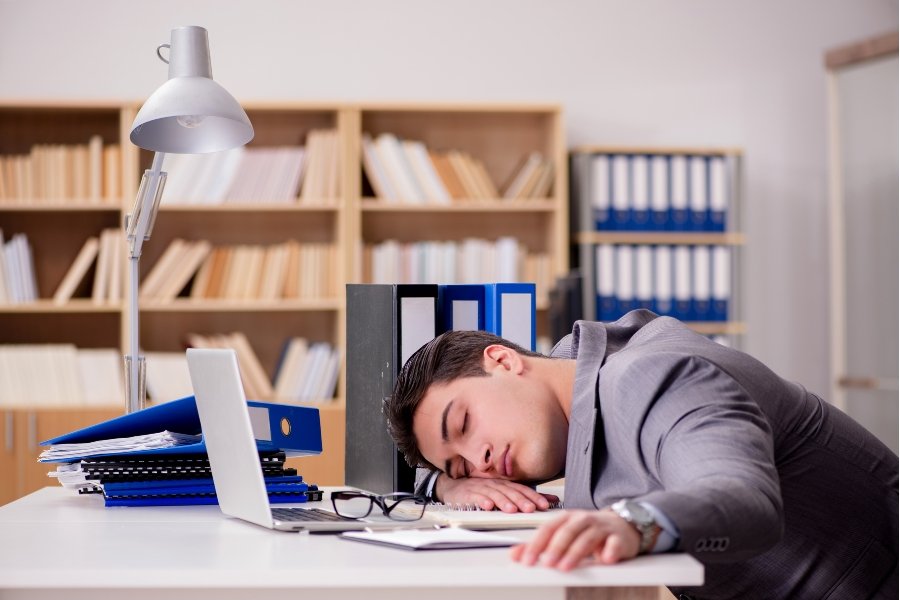
man asleep at his desk
Photo credit: CanvaWork naps? Not a bad habit.

The success of “Atomic Habits” and a million other books about forming good habits or breaking bad ones should tell us something about how much humans think about our habits. We all have things we wish we did more or wish we did less, but what if some of our notions of good habits vs. bad are just…off?

Some things that are traditionally labeled as bad habits can actually be good for you, but they’ve gotten a bad rap for some reason. So when someone asked Reddit for examples of habits that are counted as “bad” but are actually good, people delivered.

Here are 7 of the most popular answers:


Fidgeting

How many kids were forced to sit still in school, internalizing the message that shaking your leg or foot or fidgeting in their seat was a bad habit? Turns out, movement like that is actually good for you. We’ve all heard that sitting is the new smoking, and tapping your toes or rocking in your chair helps keep your blood moving and protect your arteries from some of the harms posed by being too sedentary.
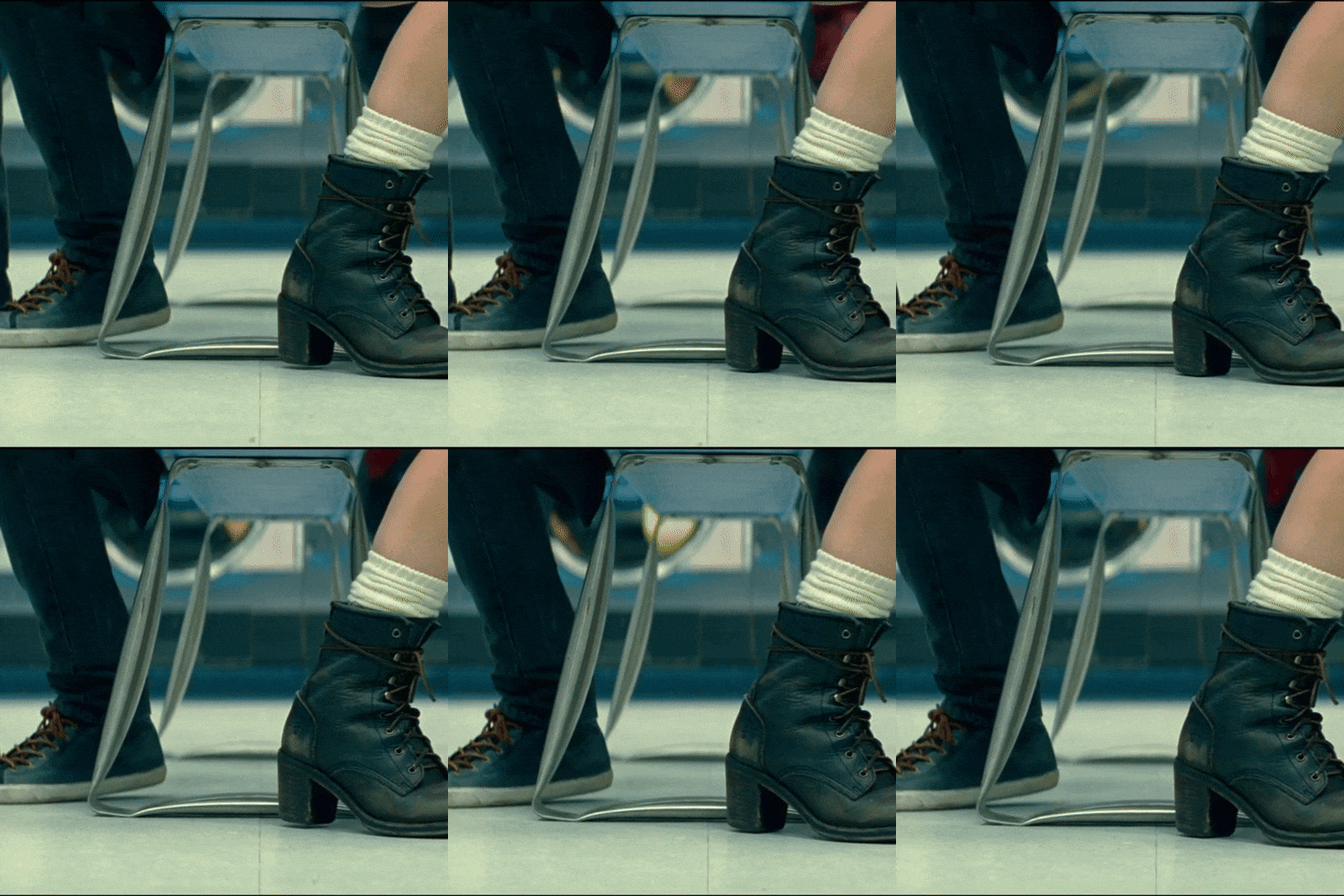
“Shaking/vibrating your leg when you have to be sitting for a long time, gets the blood moving, better than being completely stationary for hours.”

“It’s also useful when my toddler wants to be bounced. I just put him on my already shaking leg and it keeps going.”

“As someone with ADHD, this is good news!”

“As a wise man once said, ‘Motion is lotion.’”

“I have two relatives who are doctors. They both did an elder-care rotation and said ‘Motion is lotion: you stop moving, you die’ really resonated with their patients.”

Crying

How many children heard “Big boys don’t cry” or “Stop that crying or I’ll give you something to cry about?” growing up? Much like “stop fidgeting,” those admonitions weren’t just unkind or unrealistic, they were also wrong. Crying can be beneficial, helping to relieve stress and restore emotional balance.

“Crying actually helps ease pain, physically and emotionally.”

“Yes and I heard our tears actually contain stress hormones, so it’s literally helping our body reduce cortisol! That’s why we ‘feel better after a good cry.’”

“We evolved to both sweat and cry in order to survive in the world. Our bodies use both to keep us alive and biologically calibrated. Sweating and crying helped us outperform and outrun our predators and prey, and helped us build cohesive bonds, work as units, and build civilizations.

As a US Marine, this information is literally the difference between life and death not just in ourselves, but the life and death of others too.”

Napping at work

Okay, not necessary at work, though that would be good, too. But at during a work break, a short nap can revive and refresh you. According to the Mayo Clinic, a short nap in the early afternoon is the best nap for getting the benefits of napping without messing with your nighttime sleep.
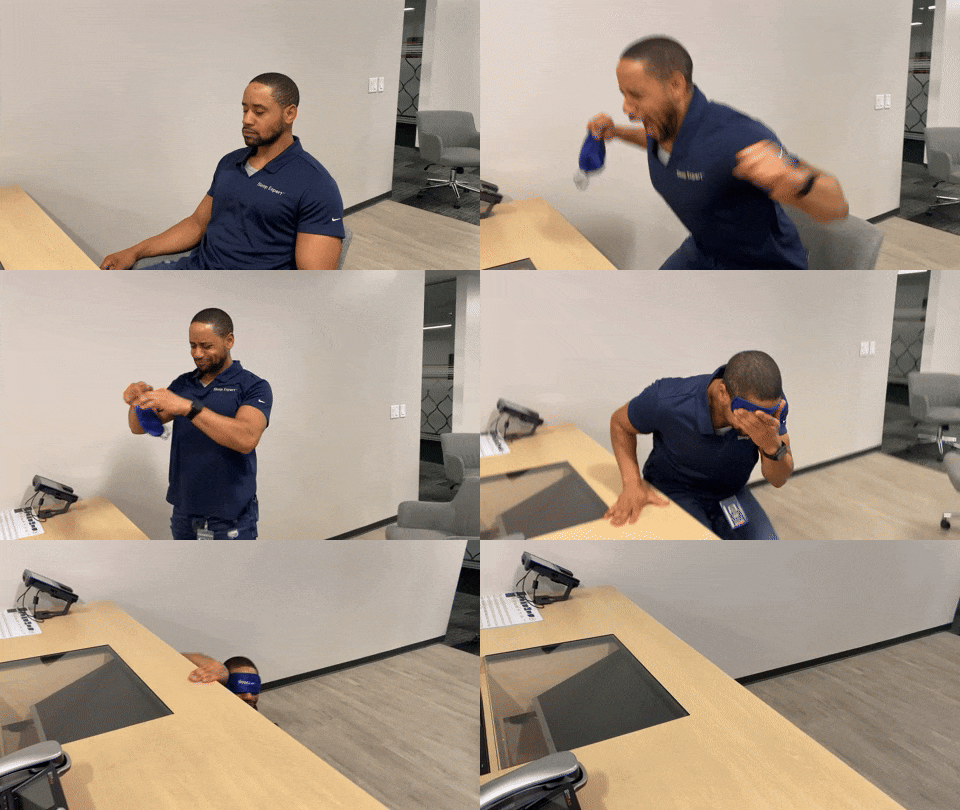
“Taking a nap during lunch breaks. Some look down on it but I get a lot of energy from it.”

“Sometimes its not really about falling asleep. Just closing your eyes, laying back and purging any thoughts from your mind is enough.”

“All of Asia has done this forever. You ever spend time at an office in China? It’s almost eerie how quiet and dark it gets at lunch time, dudes roll out cots from under their desk and zonk out for a solid hour.”

“At work we have these privacy pod things in our cafeteria that are super comfortable, so I take a nap there most days. Definitely needed haha.”

Being lazy

Doing nothing all the time is definitely not healthy, but in our go, go, go society that places enormous value on “productivity,” carving out some “do nothing” time is actually beneficial. Rest and relaxation are an important part of a balanced life, and there are genuine health benefits to doing nothing.

“Being lazy from time to time. Sleeping in. Just doing nothing. There are so many ‘hustle’ adds and posters everywhere. My GF and some of my friends fill so much their schedule that there is barely any time for rest or enjoying a book or a game or smth. Me, having pretty busy everyday life I always make sure to have at least 10 or more hours a week to do nothing productive. Enjoy life, nature, friends, alone time, watch stupid videos, play games.”

“It’s funny, when I was younger I had a ton of free time, and always felt like it was important to be productive and make use of it. Often a bit of guilt if I sat around for hours. Now my days and weekends are filled with responsibilities and events and things going on without me even explicitly trying to fill them, and I find that anytime I have nothing to do feels amazing. If I happen to get a day where I’m totally by myself and nothing is planned I will happily play 8 hours of video games and not feel like a moment was wasted.”

“Near my house, there’s a small meadow sourrounded by trees, where you can’t hear any sounds from the nearby village and road. In summer it’s just leaves rustling and insects buzzing. I go there every now and then, kick off my shoes, lie on a blanket in the shade and think of nothing.

My wife and kids don’t get how I can just doze off and spend an entire sunny summer afternoon just being at ease with myself, but it recharges my batteries like nothing else does.”

Talking to yourself

Traditionally speaking, talking to yourself in public has been seen as an oddity at best and a sign of a mental disorder at worst. But research shows that talking out loud to yourself can actually help with organization, focus and attention, emotional regulation and more.
“Talking to yourself, although it can be taken as a sign of loneliness, also helps you concentrate and organize ideas, of course, without overdoing it.”

“Ppl call me crazy for it but this is what gets me clarity so f them lol. Talking to ourselves is one of the best ways to understand the situation/idea/whatever it is as much as it helps us to understand our own selves and well,who wouldn’t want to have a good relationship with their own selves?”

“I do this when driving alone! Helps me process my emotions and thoughts.”

“Talking to yourself! People think it’s weird or a sign of being scatterbrained, but honestly, it’s super helpful. Whether I’m working through a problem, organizing my thoughts, or just giving myself a pep talk, it makes things clearer. Saying things out loud helps me process info better and stay focused. Plus, it’s like having a personal brainstorming session. So yeah, if you catch me chatting with myself, just know I’m getting stuff done!”

Staying up late

Ben Franklin famously said, “Early to bed, early to rise makes a man healthy, wealthy and wise,” and people have run with that for centuries. But there’s no inherent virtue in going to bed early and waking up early, and some people’s natural rhythms put them on a later cycle. Not only that, but some research shows that night owls have superior cognitive function compared to early birds. (Don’t worry, morning larks. You’re still awesome.)
“Staying up late. Some people have different circadian rhythms and it makes evolutionary sense that in order for a population to thrive you couldn’t all be asleep at once.”

“Took me a life time to figure this out. Growing up I always struggled to make it to school without having a disgusting lack of sleep. Often I’d be in bed at 1230-1 am and have to be up at 6.

That habit made its way into adult life when I graduated college and got myself a 9-5. I remember having the worst anxiety on Sunday because Friday/saturday I was actually able to sleep from 2 am till 9 am, but Sunday I’d have to try and force myself back to sleep early.

Then five years ago I got a bartending job. At first I worked from 9 pm till 2 am, but going to bed at 3-4 am wasn’t optimal. Eventually I found work where I was leaving work at 930-10 pm. Perfect. Now I have time before and after work to relax, I go in for six hours, make $200-300 and come home.

Work has never been more relaxing. And I’ll never sacrifice my sleep for the sake of working “normal” hours.”

“There’s also the fact that prior to the industrial revolution, most cultures had two sleeps technically. You would wake up for 1-3 hours in the middle of the night, they called it “the watch”. We spent eons sleeping and waking this way, only stopped about 130 years ago. The negative effects are showing.”

Gaming

Back in the 80s and 90s, grownups were convinced that video games were going to be the downfall of the world. The research is always evolving on this front, but what we have learned is that moderate video game playing can actually have some benefits. For instance, one study of nearly 2,000 kids found that playing video games for three hours a day was correlated with better performance on cognitive skills tests involving impulse control and working memory than never playing video games. All things in moderation, of course, but gaming itself isn’t the boogeyman it was made out to be.

“Gaming (in moderation). Studies have shown it improves problem solving, critical thinking, multi tasking, decision making, hand-eye coordination, spatial awareness, memory, and concentration.”

“Video games. Proven to relieve stress and tension, and is an acceptable outlet for your emotions which doesn’t hurt any real people.”

“Most ppl who criticise games who play you much would then go on to scroll Instagram brain rot for just as much time per day. Out of the two, excessive gaming is much better than excessive social feed.”

Gaming is healthy – so long as it doesn’t prevent you from a variety of other healthy activities!”

Maybe it’s time to rethink a lot of our behaviors that have been labeled as bad habits but might actually be good.

  • The 4 brain chemicals that make you feel amazing, and simple ways you can trigger each one
    Photo credit: Canva PhotosHow to activate your brain's internal "happy pharmacy" to feel great.

    There are simple things we know to be true about happiness: Going for a walk in the sunshine just feels good. So does a hug, or hearing your favorite song. Petting a dog puts most of us in a better mood. And so does a little bit of intense exercise. Maybe not during, but definitely after, when we’re basking in the afterglow of our effort.

    The science behind life’s simple pleasures is where things start to get really interesting. Happiness isn’t just one feeling, it’s a collection of several different feelings, and many of them come from our brain’s internal pharmacy of “feel good” chemicals, or neurochemicals. They’re known as the four happy hormones: Oxytocin, serotonin, dopamine, and endorphins.

    The big questions of existence like finding our purpose, doing work that matters, and finding love aside, it’s really the little things that send our brain happiness signals throughout the day. And these feelings are really easy to trigger intentionally, once you know how.

    Oxytocin—Love, Bonding & Connection

    Oxytocin is known as the “love hormone,” and is most famous for playing a big role during childbirth. No wonder it’s highly associated with deep feelings of love, connection, belonging, bonding, and more. In short, it feels incredible, and a burst of oxytocin can be a overwhelmingly positive and life-affirming feeling.

    But you don’t have to give birth or go on a romantic date to activate this neurochemical. Here are few things you can do to release oxytocin each and every day. Some of them might surprise you:

    Any kind of physical human touch can do the trick. A long hug with someone you care about is ideal, but the touch doesn’t have to be associated with love, affection, or sex by any means. The professional, friendly touch from a massage or haircut can do wonders for your brain. Hair, especially, is inherently emotional for a lot of people—in addition to the light human touch, a fresh look boosts self-esteem, mood, and more.

    In the absence of touch, prolonged eye contact can be just as powerful at helping your brain release oxytocin. If there aren’t any people you love around, try your dog: Veterinarian Dr. Julie Hunt at Embrace Pet Insurance tells Upworthy, “Research suggests that more oxytocin is produced when humans have prolonged eye contact with their dogs than any other common type of interaction.”

    You don’t necessarily need a willing partner to touch you or stare into your eyes, whether they have two legs or four. Dr. Clint Salo from The Grove Recovery tells Upworthy that giving someone—even a stranger—a genuine compliment can have a powerful and positive effect on us. “Giving a genuine compliment can increase oxytocin by creating a brief moment of social connection,” he says.

    Taking all of those positive feelings and writing them down is another technique that yields terrific results. As cheesy as it might feel, writing a line or two of gratitude in a journal has been shown to boost oxytocin. Chelsea Pottenger, author and founder of EQ Minds, suggests another method: “Write a letter to someone you love, even if you never send it. Just by writing it, it gives an oxytocin hit.”

    Finally, if all else fails, give yourself a hug. It’s both important and effective.

    Serotonin—Positive Mood & Euphoria

    Serotonin is an absolutely crucial piece of “feeling happy.” People who suffer from depression are shown to have low serotonin levels, and SSRIs—one of the main treatments for depression—primarily work to correct that. That tells you almost everything you need to know about the importance of this neurochemical for our overall mood, demeanor, and wellbeing. It’s a natural mood stabilizer, helps regulate our sleep cycles, promotes learning and memory, and helps arousal and libido.

    There are a few simple and surprising ways you can get a serotonin boost during the day and feel better almost instantly:

    Even if you don’t have Seasonal Affective Disorder, almost everyone reports feeling a little cheerier on a bright sunny day versus a rainy one. It turns out, sunlight is absolutely crucial to our serotonin levels. Dr. Sam Zand, CEO and psychiatrist at Anywhere Clinic, tells Upworthy that a few minutes of sunshine first thing in the day does wonders: “Serotonin is highly affected by light and rhythm. Getting bright natural light during the first hour of the day will really help you maintain good moods.”

    Because serotonin plays such a crucial role in memory, accessing positive memories can put us in a much better mood. Lisa Chen, LMFT and founder of Lisa Chen & Associates Therapy, tells Upworthy that one of the most powerful links to memory is actually our sense of smell, and we can use that to our advantage: “Smell something tied to a happy memory, like cinnamon. Scent has a straight line to emotional memory centers and can quickly shift our moods.”

    Random acts of kindness make us feel great, and now we know why: It’s the serotonin. Pottenger tells Upworthy: “Do something for a stranger without expecting anything back. When you perform a random act of kindness with no strings attached, your brain releases serotonin.”

    Finally, here’s a little trick that makes good use of our anatomy. Research suggests the vagus nerve is key to triggering the release and transport of serotonin. Intentional breathwork and even light humming or singing can stimulate that nerve and give us a little extra boost.

    One thing that gets in the way of serotonin is stress, and its primary neurochemical, cortisol. Anything you can do to lower stress will improve your serotonin levels, like taking a few minutes for yoga, meditation, or just practicing better mindfulness.

    Dopamine—Reward, Pleasure & Motivation

    We get a rush of dopamine in our brains whenever we feel pleasure or reward—whether it’s ultimately good or bad for us. Sex, sweets, drugs, gambling, flirting, achieving a goal. They all give us some form of pleasure or satisfaction, and they’re driven by this very specific (and feel-good) neurochemical.

    That makes dopamine a tricky one to navigate. Chasing it can be destructive, but luckily, there are plenty of natural and healthy ways to get the same pleasurable result:

    Achieving a goal, even a small one, gives us a dopamine boost. This can be as simple as checking something off your To-Do list. Zand tells Upworthy that dopamine is “very responsive to ‘micro-completions’—meaning you can get a little shot of dopamine by completing small tasks like sending a text or cleaning one area of the house.”

    Believe it or not, dopamine also responds positively to novelty. Changing even small things in our daily routine can give us a lovely little tingle of pleasure: Chen suggests things “like taking a new route or trying a new coffee flavor,” while Dr. Michael Valdez, Medical Director at Detox California, says it can be as simple as moving to another room to reset attention and focus.

    Dopamine loves a reward, but it also loves the anticipation of a reward. Kelly Whaling, Licensed Clinical Psychologist at Prosper Health, tells Upworthy “Anticipating a positive experience or even vividly picturing it—like planning a vacation—can trigger dopamine because your brain begins predicting a reward.”

    On a more physical level, a shock of cold water can trigger a substantial surge in dopamine. Research shows that a cold plunge can cause a 250% increase in dopamine and an elevated mood that lasts several hours. In the absence of a giant tub full of ice, a 30-second burst of cold water at the end of your shower can have a similar effect.

    Dopamine, however, can be a double-edged sword. We technically get a small hit of dopamine every time we log into social media and see something interesting, or when we get a notification on our phones. This constant drip overstimulates our brain’s reward center and can fry our circuitry, making us less motivated to achieve goals and finish tasks. That’s why some people advocate for a “dopamine reset.”

    Eli Elad Cohen, Co-Founder and Co-CEO at MediTailor, recommends something called Non-Sleep Deep Rest. It’s a sort of guided meditation and breathwork practice that lowers stress and anxiety and helps us feel recharged when tired. “[Research from Denmark] found it increases striatal dopamine reserves by up to 65%. Better than a nap for restoring motivation.”

    If that sounds too complicated, try going one hour without your phone in nature or focusing on a single task to get a similar effect.

    Endorphins—Stress Relief, Pain Relief & Overall Wellbeing

    In the famous words of Elle Woods from Legally Blonde, “Exercise gives you endorphins. Endorphins make you happy. Happy people just don’t shoot their husbands, they just don’t!

    She’s not wrong. Harvard Health writes that endorphins are “the body’s natural painkillers,” and help relieve stress and promote an overall feeling of well-being. They most famously come from exercise—i.e. the “runner’s high”—but there are many other ways of activating them.

    Endorphins respond well to the arts. Listening to music or creating art of any kind is a great way to promote that feel-good sensation in your body. Bonus points if the song you listen to gives you the “chills.”

    Eating spicy foods, while sometimes challenging, can also work. “[It] activates the body’s natural pain-relief and pleasure systems,” and releases endorphins, similar to a good workout, says Kelly Whaling.

    Steven Sultanoff, Adjunct Professor of Psychology at Pepperdine University, suggests laughter. If you’re feeling down, try listening to some stand-up comedy or putting on an old favorite sitcom episode. “Laughter results in the secretion of endorphins. Humor also relaxes the brain by generating perspective and shifting negative thinking to realistic thinking,” he says.

    Here’s a tip you might recognize: Humming or singing quietly, stimulating the vagus nerve, can also produce endorphins.

    Fascinatingly, exercise doesn’t release endorphins simply to reward you for a job well done. It does so in response to physical exertion, pain, and stress. So the rule with endorphins is that sometimes, we have to feel a little bad before we can feel good.

    Dr. Michael Drzewiecki, Director of Clinical Neuroscience at The Neurologic Wellness Institute puts it this way: “Doing hard things for short periods of time releases ‘feel bad’ chemicals called dynorphin, which leads to an upregulation of endorphin receptors. Essentially, to get a greater release of ‘feel good’ chemicals, it’s best to do something hard enough to trigger a short duration of ‘feel bad’ chemical release.”

    Take this as a sign to finally have that tough conversation, tackle that home project, or challenge yourself physically and mentally.

    Stacking the four for the best results

    The four “happy brain chemicals” don’t always work alone. Many times, they operate in tandem.

    There are many different dietary strategies and theories out there about how to optimize your brain health, but there does seem to be at least one “super food,” when it comes to feeling happy: Dark chocolate. Research shows that dark chocolate, ideally 70% cocoa or higher, can release oxytocin, serotonin, endorphins, and dopamine all at once.

    But if you’re not a fan, don’t worry. Many of the tips and activities recommended by experts serve many purposes at once. Going for a walk in the sunshine with your dog can give you a rush of serotonin and oxytocin. Pairing breathwork and meditation before or after a workout can give you endorphins and serotonin. “Romantic time” with a partner can give you all four simultaneously.

    We have more control over how we feel than we might think. While petting a dog or having a nibble of dark chocolate can’t account for your overall satisfaction and contentment with life and existence, these little daily things can bring us substantial joy in the moment. When we stack them consistently, we’re bound to feel pretty damn happy most of the time.

  • Humans used to have a ‘first sleep’ and ‘second sleep’ at night. Here’s why that changed.
    Photo credit: Fritz Zuber-Buhler/Wikimedia CommonsA painting of a woman waking up.
    ,

    Humans used to have a ‘first sleep’ and ‘second sleep’ at night. Here’s why that changed.

    People relished having an extra two hours in the middle of the night to do chores, pray, or hang out with their loved ones.

    One of the unquestioned pieces of health advice we’ve heard for decades is to get eight hours of sleep every night, with the assumption that it should be as close to consecutive as possible. However, a fascinating discovery by historian Roger Ekirch in the early 1990s found that, as far back as recorded history and up until the Industrial Revolution, human beings slept in two distinct phases every night: “first sleep” and “second sleep.”

    The wild thing about Ekirch’s study was that the evidence of biphasic sleep was staring us in the face the whole time; we just turned and looked the other way. Ekirch was researching a book on human nighttime behavior when he came across a 1697 legal document in a London record office. In a deposition by a nine-year-old girl, she revealed that her mother left the house after “first sleep” and was later found dead.

    woamn sleeping, sleep, sleep mask, bed,
    A woman sleeping. Photo credit: Canva

    The first glimpse at “first sleep”

    “I had never heard the expression, and it was expressed in such a way that it seemed perfectly normal,” Ekirch told CNN. “I then began to come across subsequent references in these legal depositions, but also in other sources.”

    Further research revealed that first and second sleep routines date back as far as the 8th century B.C.E.

    Historically, humans flopped onto their beds sometime between 9 p.m. and 11 p.m. and slept until around 1 a.m., followed by a period of wakefulness known as “the watch,” which was an incredibly productive time.

    “[The records] describe how people did just about anything and everything after they awakened from their first sleep,” Ekirch told the BBC.

    What you did during the watch depended a lot on your social status. Peasants would take the time to tend to their livestock or perform domestic chores. Religious people took the time to pray and practice their faith, as they would face fewer distractions than during daylight hours. The watch was also a great time for people to relax and talk to one another; for couples, it was the perfect time for intimacy. 

    Two sleeps a night is completely natural

    A 1992 study by Thomas Wehr from the National Institute of Mental Health took a group of volunteers and removed all natural light from their lives so they could live like humans before the discovery of fire. Within weeks, every participant settled into a biphasic sleep pattern. Wehr measured their hormones during the wakeful period in the night and found that the participants produced elevated levels of prolactin, the same hormone released during meditation and after orgasm. This wakeful period wasn’t just a change in their sleep-wake cycle, but it was another state of consciousness altogether.

    Why did human sleep patterns change?

    So what happened? How did we switch from centuries of biphasic sleeping to sleeping in one long, uninterrupted chunk (unless, of course, you have insomnia)? One reason was that in major cities of the industrialized world, street lamps and other lights began to be installed in the 1700s to improve public safety, encouraging people to stay out later at night.

    street lights, germany, lampost, sunset, birds
    Lanterns on the forecourt of a pier at sunset in Germany. Photo credit: Dietmar Rabich/Wikimedia Commons

    The Industrial Revolution also brought about changes in modern work schedules.

    “The answer is really to follow the money,” Ben Reiss, author of Wild Nights: How Taming Sleep Created Our Restless World, told CNN. “Changes in economic organization, when it became more efficient to routinize work and have large numbers of people showing up on factory floors, at the same time and doing as much work in as concentrated fashion as possible.”

    The invention of the alarm clock in 1787 also had a big effect on the average worker’s sleep schedule.

    Ultimately, the history of biphasic sleep shows how much of humanity’s natural patterns have been disrupted by modern technology. One wonders what would happen to our collective mental and physical health if we returned to the way we slept before the Industrial Revolution.

  • ‘Social prescribing’ has doctors writing scripts for nature walks and art classes. It’s working.
    Photo credit: Canva PhotosDoctors are doing more and more "social prescribing," trading medicine for walks, art, and nature.

    The loneliness epidemic has reached a critical mass, with the Surgeon General warning that social isolation can have dire health consequences. Tons of research backs it up: Being lonely can make us sick.

    For many years, patients have been screened for loneliness and offered only a few limited options: Therapy and medications that treat symptoms of loneliness like insomnia, depression, or heart problems.

    But recently, doctors have been taking a far more radical approach: What if they actually treated the loneliness itself?

    “Social prescribing” trend takes off

    Doctors cant befriend their patients, but more and more they’ve been leaning on a concept called “social prescribing.” It’s a way of treating the whole patient and not just the symptoms.

    How? By writing prescriptions for things like nature walks, art classes, book clubs, singing lessons, and more. All of these activities are shown to boost mental health, decrease loneliness, and create a domino effect of positive health outcomes.

    It’s not just loneliness that can be treated by social prescribing. Depression, anxiety, and chronic pain can all benefit from community-based, real-world activities.

    How social prescribing works

    A person dealing with loneliness might be asked to take part in a community class, volunteer, or even use a service that helps them make friends.

    Depression patients might be asked to spend more time in nature through a birdwatching group or nature-walk group They may also be enrolled in art classes.

    Doctors frequently tell people to exercise more, but social prescribing sees them direct chronic pain patients, for example, to specific group exercise classes.

    social prescribing, medicine, healthcare, wellness, mental health, physical health, wellbeing, nature, walking, community, friendship, psychology
    Prescriptions for art classes can really make a difference. Photo Credit: Canva Photos

    It can be even simpler than that, too. Someone who’s isolated because they’re a caretaker for a family member might be asked to simply go to a coffee shop a few times per week. A person who’s feeling down and disconnected due to remote work might get a social prescription for joining a group or social club. Someone who’s dealing with stress and anxiety related to finances might be assigned to meet with a debt management specialist.

    How it works from a logistical standpoint depends on the doctor and where you live. In the UK, social prescribing has officially been adopted by the NHS. Patients in need will be referred by their doctor to a “link worker” whose sole job is to connect them to the right community resource.

    In America, social prescribing is still in more of a fledgling state. Fortunately, though, more and more local pilot programs are popping up around the country to provide the same support. Experts believe that even in the United States’ heavily privatized model, it can still be effective.

    Social prescribing actually works

    Going for weekly nature walks to help depression and loneliness is a cute idea, but is it actually effective?

    A majority of research says Yes. One study found that patients who received a social prescription were less likely to visit their doctor for other consultations or go to the emergency room. Participants showed not only reductions in anxiety and depression, but major boosts to self-confidence, self-esteem, and overall wellbeing.

    Beyond what’s reflected in the numbers and studies, doctors who practice social prescribing say they’ve seen the impact it can have firsthand.

    Scientific American writes, “The most memorable gains from social prescribing come through in its before-and-after stories. Whether its patients sharing how social prescriptions have provided a ‘reason to wake up in the morning,’ or doctors sharing how it feels like ‘prescribing beauty in someone’s life,’ social prescribing just feels right.”

    The practice is not without its critics, though. Some researchers say that the positive gains from social prescribing only last as long as a healthcare worker is facilitating the activities, but fade away quickly when patients are left to their own devices. They argue that the root causes of loneliness, depression, and anxiety run far deeper in our cultures and require more precise intervention.

    Still, it’s hard to argue with the idea behind social prescribing. Therapy and medications have their place, but human beings have always needed community, connection, and time spent in nature. What’s most surprising about the trend is that it took us this long to give it a try.

  • A 21-year-old kept her symptoms secret out of embarrassment and it led to a life-changing diagnosis
    Photo credit: CanvaGirl in stomach pain and doctors performing surgery
    ,

    A 21-year-old kept her symptoms secret out of embarrassment and it led to a life-changing diagnosis

    “I think I would have gone a little longer without losing my bowel had I gone to the doctor earlier.”

    Alex Lyons is on a mission to make sure no one else suffers in silence. The 21-year-old from Armagh, Northern Ireland, spent months hiding a secret that she feared was too “gross” or “humiliating” to share with her friends and family. But as the BBC reported, that silence nearly cost her everything.

    @alex.lyonss

    What is a stoma? I hope I answered that clearly enough in this video! Thank you all for all of your questions I will answer all of them shortly!

    ♬ original sound – Alex Lyons

    The health costs of staying silent with IBD

    Lyons first noticed she was having frequent, urgent bowel movements and spotted blood in her stool. Instead of seeking help, she ignored the signs, hoping they would simply go away. Her hesitation was rooted in a deep sense of embarrassment and a desire to protect her family. Her twin brother, Joe, had recently undergone bowel removal surgery due to a chronic condition, and Alex didn’t want to put her parents through that trauma a second time.

    @alex.lyonss

    IM GOING HOME!! Thank you thank you thank you for all of the kindess and support you have all shown me I am beyond grateful! Wow! I love you all!

    ♬ original sound – Alex Lyons

    Unfortunately, the symptoms of inflammatory bowel disease (IBD) do not wait for a convenient time to be addressed. By the time Alex finally disclosed her struggle, her condition had progressed to a life-threatening level. She was diagnosed with ulcerative colitis, a form of IBD that causes chronic inflammation and ulcers in the lining of the colon. According to the Cleveland Clinic, these symptoms are often caused by an overactive immune response, and as seen in the case of Alex and her brother, genetic factors often play a significant role.

    The inflammation was so aggressive that standard treatments could no longer save her bowel. She was rushed into emergency surgery, a procedure that saved her life but changed it forever. “I think I would have gone a little longer without losing my bowel had I gone to the doctor earlier,” Alex told the BBC.

    From ambulance to advocacy

    Now, Alex is using her voice to dismantle the stigma that kept her silent. She has become a viral advocate on TikTok, documenting her life with a stoma bag and showing her followers that a medical diagnosis doesn’t mean the end of a vibrant life. She refuses to let her condition stop her from wearing her favorite clothes or going out with friends.

    @alex.lyonss

    My first shower in 7 weeks!! Kinda crazy lol. When you’re on deaths door a shower is the least of your worries trust me! This disease has taken alot from me but it won’t take my pamper days! #stoma #ulcerativecolitis #recovery #pamper

    ♬ original sound – Alex Lyons

    Speaking out about Ulcerative Colitis

    The lesson Alex wants to share is simple but vital: speaking up sooner matters more than avoiding a few minutes of discomfort. What might seem like a minor, embarrassing issue can develop into a serious health crisis if left unaddressed. As Alex and her brother continue their healing journey together, they are proving that there is no room for shame when it comes to saving your own life.

    Follow Alex Lyons (@alex.lyonss) on TikTok for more content on health and lifestyle. 

  • His mysterious toe pain lasted five years. The scan that finally caught it gave him four days to live.
    Photo credit: CanvaA doctor examines a patent's leg.

    Richard Bernstein walked around barefoot a lot at home, so when his right toe started hurting in 2017, he assumed he’d stubbed it. A visit to his podiatrist confirmed nothing was broken and nothing was wrong. He moved on.

    But the pain didn’t.

    Five years of pain that no one could explain

    Over the next few years it crept upward from his toe to his ankle, then to his knee. A sports medicine doctor suggested stenosis and recommended physical therapy. That didn’t help either. Walking became gradually harder. On a trip to Greece, Bernstein had to sit out while his friends climbed to hilltop monasteries. He took his dog to the park less and less.

    In March 2022, his right leg swelled noticeably. His doctor ordered an abdominal scan. What it found changed everything.

    What they found when they finally looked

    Bernstein had a massive cancerous kidney tumor that had grown into his vena cava, the main vein that returns blood from the lower body to the heart. The tumor and tumor thrombus were a foot long and weighed around two and a half pounds. Because the vena cava was almost completely blocked, blood was backing up in his lower extremities, which explained the years of unexplained pain creeping up his right side. His two main coronary arteries had also been compromised, with 99 percent of their function lost.

    He was referred to Dr. Michael Grasso, chair of urology at Phelps Hospital. Grasso’s assessment was direct. “He told me I had four days to live,” Bernstein said.

    A 12-hour surgery, three specialists, one chance

    The surgery required three specialists working simultaneously over 12 hours at Lenox Hill Hospital in New York City. Dr. Grasso handled the kidney and tumor removal. Cardiothoracic surgeon Dr. Jonathan Hemli performed a double bypass on the coronary arteries, which had been discovered only once Bernstein was already admitted, an unexpected complication that Hemli said they couldn’t ignore. “It would have been really disappointing to cure him of his kidney cancer only to learn in six months, nine months, a year that the poor man had a heart attack and didn’t survive,” Hemli told TODAY. Vascular surgeon Dr. Alfio Carroccio opened the vena cava to remove the tumor thrombus, which extended all the way into the heart.

    To do the work safely, the team had to cool Bernstein’s body, stop his heart, and run him on a heart-lung bypass machine while they operated. Then they slowly warmed him back up and restarted his heart.

    Bernstein spent three days sedated afterward, a week in intensive care, and nearly three weeks in cardiac rehab relearning to walk. He lost around 30 pounds. He gained it back.

    He’s now on ongoing immunotherapy and doing twice-yearly scans. Dr. Grasso’s update: “The cancer hasn’t spread anywhere else, which is amazing, considering where he came from.”

    Bernstein’s own assessment of how he got through it: “My attitude is ‘it is what it is, and there’s not much we can do about it.’ That got me through.” His advice for anyone else in a similar situation: “If something is wrong and they can’t find it, don’t give up looking. Trust your feelings about your own body.”

    And on the swollen leg that finally triggered the scan that saved him: “If my whole leg hadn’t swollen up, I would have dropped dead.”

  • Can you tell someone will die months before it happens? A hospice nurse shares the clues.
    Photo credit: CanvaA nurse comforts a hospital patient.

    Death is a mystery in so many ways, despite the fact that we all know for sure it’s going to happen. We don’t know when we will go and can’t really be sure of what comes next, so whether we’re thinking about ourselves or a loved one, there’s understandably a lot of fear and uncertainty around death.

    That’s why Julie McFadden’s work is so important. As a palliative care nurse in the Los Angeles area, who has seen over a hundred people die, her videos shed light on the process to make us all a bit more comfortable with the inevitable. McFadden is also the author of the bestseller, “Nothing to Fear.” The nurse’s experience helping people in their final stages has given her a unique perspective on the process.

    In one video, she shared how she can see the first symptoms that someone is going to die a natural death about 6 months before they finally do. In other words, she can determine that someone only has half a year left to live when most of us have no idea they have entered the final stages of life.

    @hospicenursejulie

    Replying to @Mariah educating yourself about scary topics will help decrease fear. ✨Nothing to Fear ✨- my book- out june 11th #hospicenursejulie #hospicenurse #caregiversoftiktok #medicaltiktok #learnontiktok #nothingtofearbook

    ♬ original sound – ? Hospice nurse Julie ?

    What are the signs a person is dying at the 6-month mark?

    McFadden says that people who are dying are usually placed in hospice care when the symptoms begin to appear around the 6-month mark.

    “You will have very generalized symptoms. Those symptoms will usually be, one, you will be less social. So you’ll be more introverted than extroverted,” McFadden said. “Two, you will be sleeping a lot more. And three, you will be eating and drinking a lot less. Literally, everyone on hospice, I see this happen to.”

    death, dying, afterlife, hospice, signs of dying
    A heavenly view of the sky. Photo credit: PIxbay/Pexels

    What are the signs a person is dying at the 3-month mark?

    You are going to notice more debility,” McFadden continues. “They will be staying in their house most of the time. It’s going to be difficult getting up and just going to the bathroom. Again, sleeping a lot more and eating and drinking a lot less.”

    What are the signs a person is dying at the 1-month mark?

    Something usually begins to happen in the final month of someone’s life. They start to believe they are in contact with others they have lost. It’s like they are there to make the dying person feel comfortable with their final transition.

    “Usually around the one month mark is when people will start seeing ‘the unseen’, they have the visioning. They’ll be seeing dead relatives, dead loved ones, dead pets, old friends who have died,” McFadden said. “Again, not everyone — but many, many people will start seeing these things at around one month.”

    Angela Morrow, a registered nurse at Verywell Health, agrees that people in the final stage of life often hear from those who have passed before them. Morrow says we should refrain from correcting the patients when they share their stories of talking to people and pets who have died. “You might feel frustrated because you can’t know for sure whether they’re hallucinating, having a spiritual experience, or just getting confused. The uncertainty can be unsettling, but it’s part of the process,” Morrow writes.

    At the end of the video, McFadden says that the most important factors palliative care nurses look at to determine the stage of death are eating, drinking and sleeping. “Most people, a few weeks out from death, will be sleeping more than they are awake. And they will be barely eating and barely drinking,” McFadden said.

    In the end, hospice nurses “allow the body to be the guide” as they help their patients transition from life to death.

    McFadden’s work has brought a lot of peace to her followers as they go through trying times. “My mom is in hospice right now and she’s currently, I think, hours or days from death. YourTikToks have helped me out tremendously,” Deb wrote. “My grandma passed away in February, and she experienced all of this. this page brings me peace knowing everything she went through was natural,” Jaida added.

    “Thanks, Julie. I volunteer in a hospice end-of-life facility, and this helps educate the families. Your posts are wonderful,” Grandma Nita wrote.

    One of the things that makes death so scary is the number of unknowns surrounding the process, so it’s important that McFadden shares her stories of helping people to the next side. She shows that death is a natural process and that hospice nurses are here to help make the transition as peaceful as possible.

    This article originally appeared two years ago. It has been updated.

  • Guy hilariously shows how his perimenopausal wife has transformed into a scent detective
    Photo credit: Matt Hyams/InstagramA comedian’s reenactments of his wife’s perimenopause symptoms are hilarious and enlightening.

    Perimenopause is certainly having a moment. This set of transition symptoms that appear before menopause was first identified in the 1970s and more firmly documented in the 1980s. However, Google Trends shows a massive spike in interest over the past few years. Now, it seems like everywhere you look, people are talking about perimenopause.

    After decades of relative silence, social media has given millions of women a platform to finally share what they’ve been going through.

    It has also, funnily enough, given a platform to the husbands who support them through these challenging times.

    Comedian shares reality with the world

    Matt Hyams struck a nerve in late 2025 when he posted his first video about what he affectionately calls his “perimenopausal wife.”

    “If your wife is entering perimenopause, I’m going to give you some tips I wish someone had given me at the beginning,” he said in the video. “Number one, stop chewing your food, okay? Just swallow it whole … Maybe you’re thinking, ‘But I might choke and die.’ Good. Even better.”

    The joke was a hit and quickly went viral, inspiring him to keep digging for humor. Soon, he was back with a brilliant reenactment of “how my perimenopausal wife looks at me when I’m eating cereal and clearing my throat.” The hilarious skit references how perimenopause can cause sensory overload, or even misophonia—a rage-inducing response to chewing, breathing, or tapping.

    Perhaps Hyams’ best, and most accurate, work is his reenactment of his wife’s newfound—and frighteningly precise—sense of smell. Dressed in what has become his trademark wig, he demonstrates how she can identify extremely specific odors thanks to perimenopausal changes to her senses:

    Women chime in and applaud the accuracy

    Perimenopause can affect a woman’s sense of taste and smell. In some, these senses fade or even seem to disappear. In others, it can cause “olfactory hallucinations.” And in still others, people can detect real, powerful smells that others barely notice.

    “If you ask a Harvard researcher, they’re going to say, ‘We don’t have enough data to support that.’ If you ask someone that talks to women every single day, they’re going to say, ‘Absolutely,’” Atlanta-based nurse practitioner Daniela Ezratty told Gloria.

    The comments section under Hyams’ video proves the point perfectly:

    “I’ve always had a heightened sense of smell but now I can smell things from the future”

    “I found a gas leak at work. Apparently it was such a small leak that no one else could smell it and they had to bring in a gas detector to find the source.”

    “I can smell what they had for dinner 3 days ago, 4 houses away.”

    “I can’t smell anything except the huge imaginary cigarette that gets blown in my face and wakes me out of a blackout sleep at 3am.”

    “COFFEE!! IT DOES SMELL LIKE TUNA and it makes me emotional”

    Coffee that smells like tuna is a common complaint, and it’s not an olfactory hallucination. Certain chemical reactions during the roasting process can produce oils that smell fishy, especially to people with heightened senses of smell.

    Hyams’ other videos use comedic reenactment to show how perimenopause can cause overwhelming mental load, fatigue, brain fog, hot flashes, and more—and they’re far more entertaining than reading WebMD.

    Skits help women—and even men—feel seen

    “I seem to have hit the perimenopause train at the right time, with the right tone, and the right amount of respect for the struggle,” Hyams told Upworthy. “I’m coming at it from my wife’s perspective, validating her opinions and her reality. So I think women, which make up 88% of my followers, were so happy to see and hear it.”

    It’s an accessible and fun way for women to gently teach their partners what they’re going through. Hyams said women tell him all the time that they send the videos to their partners, and those conversations often improve their relationships.

    But it’s not just women who appreciate his handling of a sensitive topic. Even OB-GYNs say supporting a partner through perimenopause isn’t easy—it takes a lot of love, patience, and self-education.

    “I also get messages from men thanking me for making them feel less alone,” Hyams said.

    As for the real wife behind the wig, Hyams said she likes the videos and gives final approval before he posts anything. That’s definitely the right call.

  • Dermatologist explains why you absolutely must wash new clothes before wearing them
    Photo credit: CancaDermatologist explains why you absolutely must wash new clothes before wearing them
    ,

    Dermatologist explains why you absolutely must wash new clothes before wearing them

    Only 22% of Americans say they always wash new clothes before wearing them.

    It is not unheard of for someone to grab something off the rack to wear immediately after purchasing. In fact, this is a fairly common occurrence in the United States. But a dermatologist warns that this behavior could be damaging to your skin.

    Cleveland Clinic dermatologist Dr. Shilpi Khetarpal tells WDIV 4 that she recommends everyone wash their clothes before wearing them. “There’s a few reasons why. The first is that many bright colors can bleed onto skin or other fabrics before the first wash. So when you wash them at home first before wearing them, you’re preventing that from transferring onto your skin,” she tells the outlet.

    washing new clothes, new clothes, washing clothes, science, culture
    Two women shopping. Canva Photos

    Anyone who has purchased dark blue or black jeans knows just how annoying it is when the ink bleeds onto other clothing, furniture, and skin. This isn’t new information for most people, and those with very sensitive skin are likely more apt to pre-wash new clothes to avoid skin irritation. Those without hypersensitive skin may feel more inclined to keep yanking those tags off and stepping into unwashed new clothing.

    Khetarpal and other dermatologists say, not so fast. Skin irritation doesn’t only occur because someone has sensitive skin. Still, a recent survey conducted by Tommy John reveals that only 22% of Americans always wash new clothes before wearing them. Other things are going on in the construction and packaging of new clothing that might give others pause.

    According to Dr. Khetarpal, some manufacturers add formaldehyde and other chemicals to keep clothes from wrinkling or molding when shipping. There’s also the concern of fungus, bacteria, and other things lingering on clothing from people handling the items or trying them on.

    “You never know who tried on the garment before you bought it, so you don’t know about germs on their skin, nose, mouth. In fact, a few studies have been done looking at bacteria and viruses lingering on clothes after they have been tried on—fecal bacteria and nasal viruses were commonly found. Lice, scabies, and even bed bugs can also live on clothing for a few days,” Dr. Jami L. Miller, Associate Professor of Dermatology at Vanderbilt Health and Medical Director of the Dermatology Clinic at Vanderbilt Health One Hundred Oaks, tells Southern Living.

    washing new clothes, new clothes, washing clothes, science, culture
    Woman shopping for clothes. Canva Photos

    A 2014 study completed by Stockholm University in Sweden tested 31 different clothing items. The scientists found “Quinoline and ten quinoline derivatives were determined in 31 textile samples. The clothing samples, diverse in color, material, brand, country of manufacture, and price, and intended for a broad market, were purchased from different shops in Stockholm, Sweden. Quinoline, a possible human carcinogen, was found to be the most abundant compound present in almost all of the samples investigated.”

    Quinoline was classified as a “possible human carcinogen” in 2016 by the Environmental Protection Agency, linking it to “tumor-initiating activity on the skin” of female mice. The agency points out that while it is listed as a possible carcinogen for humans, it is used in medicine safely. One study shows the compound works well as an antiviral without the adverse effects mentioned above.

    washing new clothes, new clothes, washing clothes, science, culture
    Woman loading washing machine. Canva Photos

    While it all sounds very scary, Dr. David C. Gaston, Assistant Professor of Pathology, Microbiology, and Immunology at Vanderbilt Health, tells Southern Living, “The risk of obtaining a communicable disease from clothing in a retail store after being tried on by another person is vanishingly small and essentially non-existent if the clothing is new.”

    The scientific consensus is to wash new clothes just to be on the safe side, but if you don’t have sensitive skin, you’re most likely fine-ish.

Family

At her dad’s wedding, a teen’s toast turned out to be for someone else entirely and made the whole room cry

Culture

A hot air balloonist revealed man’s ‘secret’ forest he created as a tribute to his wife

Family

Grandma realized her granddaughter didn’t look like her siblings so she got secret DNA test

Culture

Woman cleverly track downs the name and address of the person who stole her credit card