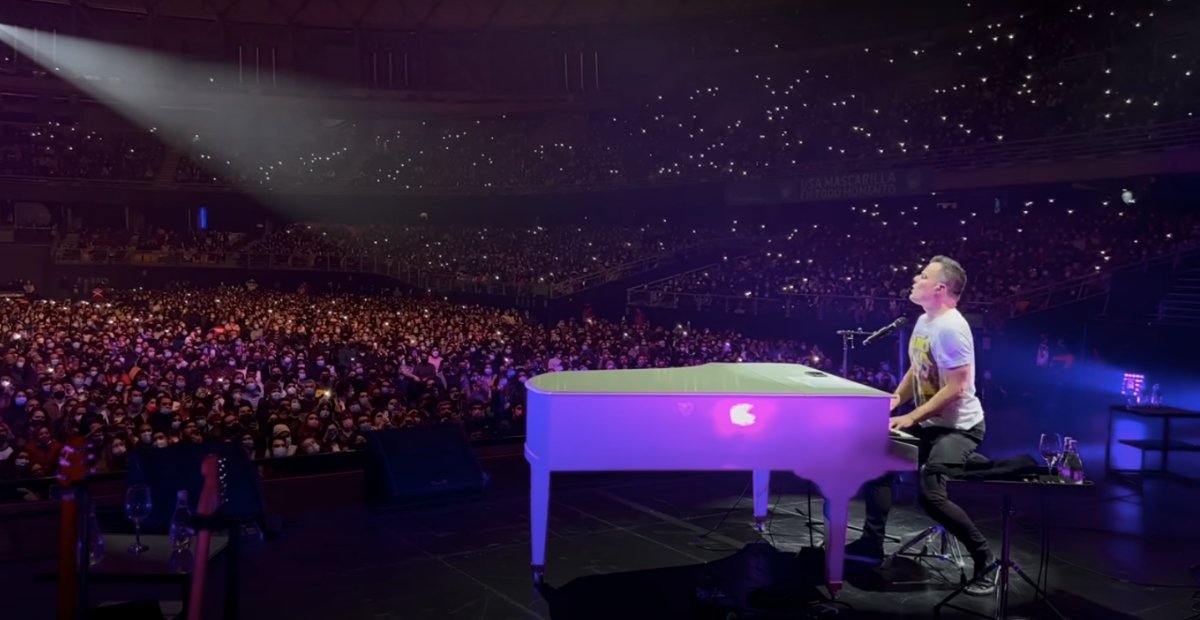
Freddie Mercury was known for many things—his dramatic showmanship, his larger-than-life personality, and his untimely death during the peak of the AIDS epidemic—but he is most remembered for his clear, powerful voice, ranging from rich bass notes to impressive soprano coloratura.
It’s hard to do Freddie’s voice justice, but Marc Martel has managed to wow millions with his impersonations of the Queen lead singer. If you close your eyes and listen, there are seconds when you might swear you were hearing Freddie himself singing again. Martel’s cover of “Bohemian Rhapsody” has been viewed 56 million times on YouTube. And another of his videos showcases Martel’s ability to captivate an audience with his—or Freddie’s—voice.
At a concert in Santiago, Chile, in 2022, Martel began playing the piano intro to “Love of My Life,” one of Queen’s simplest and most sentimental ballads. As soon as he opened his mouth to sing, the audience did the same—10,000 people all singing along in unison—and it’s just beautiful.
Watch:
Love Of My Life – Live from Santiago, Chile (Marc Martel)
Queen fans not only loved the sing-a-long but they were also blown away by how close Martel came to channeling Freddie Mercury with his vocals:
“I’m 63. Heard Queen from the start. This man is unbelievable. Why Queen didn’t grab him is unbelievable, beyond belief.”
“For those of us who love the Mercury timbre, Martel is a blessing.”
“The part “you’ve hurt me” sounds exactly like Freddie. I also love the fact that people are singing too, it gives me Queen concerts vibes :)”
“When the crowd started singing, it genuinely gave me goosebumps. It was like he was singing with a choir. Some great voices in the audience! Well mixed too. Incredible as always!”
“Never mind the vocal inflections, he plays piano outstandingly. Freddie’s voice was so unique and original, it’s unbelievable how close Marc is.”
And if you want to see Martel’s “Bohemian Rhapsody” video with 56 million views, here it is. Enjoy:
Find more of Marc Martel’s Freddie Mercury magic on YouTube.
A single door can open up a world of endless possibilities. For homeowners, the front door of their house is a gateway to financial stability, job security, and better health. Yet for many, that door remains closed. Due to the rising costs of housing, 1 in 3 people around the world wake up without the security of safe, affordable housing.
Since 1976, Habitat for Humanity has made it their mission to unlock and open the door to opportunity for families everywhere, and their efforts have paid off in a big way. Through their work over the past 50 years, more than 65 million people have gained access to new or improved housing, and the movement continues to gain momentum. Since 2011 alone, Habitat for Humanity has expanded access to affordable housing by a hundredfold.
A world where everyone has access to a decent home is becoming a reality, but there’s still much to do. As they celebrate 50 years of building, Habitat for Humanity is inviting people of all backgrounds and talents to be part of what comes next through Let’s Open the Door, a global campaign that builds on this momentum and encourages people everywhere to help expand access to safe, affordable housing for those who need it most. Here’s how the foundation to a better world starts with housing, and how everyone can pitch in to make it happen.
Volunteers raise a wall for the framework of a new home during the first day of building at Habitat for Humanity’s 2025 Carter Work Project.
Globally, almost 3 billion people, including 1 in 6 U.S. families, struggle with high costs and other challenges related to housing. A crisis in itself, this also creates larger problems that affect families and communities in unexpected ways. People who lack affordable, stable housing are also more likely to experience financial hardship in other areas of their lives, since a larger share of their income often goes toward rent, utilities, and frequent moves. They are also more likely to experience health problems due to chronic stress or environmental factors, such as mold. Housing insecurity also goes hand-in-hand with unstable employment, since people may need to move further from their jobs or switch jobs altogether to offset the cost of housing.
Affordable homeownership creates a stable foundation for families to thrive, reducing stress and increasing the likelihood for good health and stable employment. Habitat for Humanity builds and repairs homes with individual families, but it also strengthens entire communities as well. The MicroBuild® Initiative, for example, strengthens communities by increasing access to loans for low-income families seeking to build or repair their homes. Habitat ReStore locations provide affordable appliances and building materials to local communities, in addition to creating job and volunteer opportunities that support neighborhood growth.
Marsha and her son pose for a photo while building their future home with Southern Crescent Habitat for Humanity in Georgia.
Everyone can play a part in the fight for housing equity and the pursuit of a better world. Over the past 50 years, Habitat for Humanity has become a leader in global housing thanks to an engaged network of volunteers—but you don’t need to be skilled with a hammer to make a meaningful impact. Building an equitable future means calling on a wide range of people and talents.
Here’s how you can get involved in the global housing movement:
Speaking up on social media about the growing housing crisis
Volunteering on a Habitat for Humanity build in your local community
Travel and build with Habitat in the U.S. or in one of 60+ countries where we work around the globe
Join the Let’s Open the Door movement and, when you donate, you can create your own personalized door
Every action, big and small, drives a global movement toward a better future. A safe home unlocks opportunity for families and communities alike, but it’s volunteers and other supporters, working together with a shared vision, who can open the door for everyone.
Many of us feel invincible when we are young, believing we can control the aging process so that we’ll always stay forever young, as Bob Dylan once sang. But there’s a moment when everyone realizes aging is an inevitable process and that, eventually, we will have to deal with a slow decline in our physical and, quite possibly, mental capabilities.
This realization and understanding that we won’t be here forever can profoundly change one’s perspective on life. Even though aging is inevitable, studies show how we think about the process can significantly impact our longevity. People with a positive view of aging live an average of 7.5 years longer than those without.
When the reality of aging sets in
Things happen as we age that are impossible to describe to younger people. However, a group of Redditors did an excellent job of explaining the truths about aging that they were not “prepared” for in a recent thread that made a lot of people feel seen. A user named sofiagympixie asked the AskReddit forum, “What’s a truth about aging that no one prepared you for?” and it received thousands responses.
A big takeaway is that many people feel like they stop mentally aging at a certain point, usually in their late 20s. Still, the continued physical aging they experience makes them feel like they cannot relate to the person in the mirror.
Here are 17 of the most profound responses to the question: What’s a truth about aging that no one prepared you for?
1. There is an end
“You start to realize the older you get that the end is closer than the beginning and you still feel like you have so much more to do.”
“That moment where you start to get a sense that there is an end.“
2. It takes energy to keep everything afloat
“No one prepared me for how much energy and time it takes to maintain everything—like health, relationships, and just staying organized. It’s way more work than I expected!“
3. Mind/body detachment
“How your mind stays young while your body starts to slow down. You still feel like the same person you’ve always been, but suddenly you notice little things changing.“
“This was such a surprise to me. I really expected to feel psychologically older as I aged. But physically, oh my body has betrayed me… Eyes… hair (gray, but at least I still have it)… back… knees… hips… prostate.“
4. The past feels closer than it is
“When you get a flashback of a good memory and you realize that was over 10 years ago.“
“When I told my daughter about something I did 24 years ago, I had to pause for a moment.”
“I’m 61, and sometimes I feel like this world is not for me anymore. I feel almost like an imposter. For example, I can’t find clothes I like that fit correctly, TV is abhorrent, only old music sounds pleasant, shoes are uncomfortable, I don’t recognize most celebrities or famous people in the news or tabloids, and I don’t understand the need for most new and supposedly exciting products. I’m an educated person, I still work and have an active life. I’m not a recluse. But a little at a time, I feel the world is moving on without me. I finally understand why, in her final years, my mother only watched movies from the 1950s and reminisced about the past more than she talked about the present. Her world was long gone.“
When the people and world around you start to change
6. You lose friends
“If you choose not to have kids, you may end up losing your friends. I turn 40 this year, and my partner and I don’t see many folks these days. Parents like to hang out with other parents. And I don’t have a grudge, I totally see the value for playdates, etc. But it can be a little lonely.”
“To be fair, I have 2 kids and lost a lot of friends because we simply don’t have the time/energy to connect regularly enough to maintain a healthy friendship. It instead falls into an awkward acquaintance stage where enough time passes between communication, and you’re not sure if reaching out to connect comes across weird.”
“I feel this. Lost my mom 2 weeks before my 21st birthday. 40 now with 2 kids. I get angry/sad at a lot of milestones like my wedding and kids’ stuff ‘cause my mom was robbed of them, and I was robbed of her.”
8. Time wasted caring about other people’s opinions
“It’s so freeing when that old twinge of ‘why don’t they like me’ pops up, and then I remember that I can not be bothered by that anymore, and magically, I don’t care!”
“Just wasting time in general. No thanks. I want to do as many things as possible!”
9. Your friends die
“Your friends start to die. It’s something I never thought about.”
10. Time flies
“Man. I don’t even feel like the days are long anymore. I just keep blinking and the weeks go by.”
“Yup, wake up, eat breakfast, do a couple things. Wait, it’s lunch already? Eat lunch, do a couple more things, time to prep dinner. Eat dinner, clean up, fix a few things, it’s 9 pm. I guess it’s almost time to get ready for bed? This times 10,000 for me.”
11. The monotony sets in
“You will realize that you hate planning meals and making food every single day. It’s boring, and it’s too easy to fall into monotony. But you have to make lunch again and then plan for dinner again then make dinner again and what do you want to eat tomorrow so you plan for breakfast tomorrow and get up and make breakfast again and then plan for lunch again….”
12. You become invisible to much of society
“I wondered what felt off the last year. Gen Z is everywhere now, and I’m still asking myself when that happened.”
“When you’re a kid, you can’t wait to ‘grow up,’ and then you do, and you’re still you, just older. That voice inside your head doesn’t change, but what you see in the mirror does. Only now you’re just older and saddled with bills and stress and all of life’s ‘surprises.’ On top of this, everyone is winging it. Absolutely everyone. Because the idea of order and a civilized society is an illusion. We’re all playing by made up rules and making imaginary money and all the rest of it. A one-dollar bill costs just as much to print as a hundred-dollar bill.”
14. Priorities change
“Things that seemed so important when you were younger, really are not important.”
15. Younger people’s reverence
“I’m middle-aged, and a funny thing is how younger people get self-conscious or apologize when there is no need. For example, they will apologize for swearing around me or mentioning something like (gasp) drinking, or drugs, or sleeping around. I think it’s funny. Why would being on earth longer make me easier to scandalize? I’ve seen and done things that would shock them, lol, but to them I’m a very proper-looking classy older lady.”
16. Ageism
“Doors start closing once you reach a certain age.”
“Ageism is real. I just turned 50 and am in a young person’s career (software development). I feel how hiring managers look at me when asked to turn my camera on, during an interview that was going very well and suddenly it’s ‘we’ll get back to you.’”
17. It all catches up
“Things like drinking, eating unhealthily, smoking, spending … they will catch up. When you’re young you think you’re different, or you think that when it does catch up you’ll be old so who cares, I won’t care when I’m old anyway. You will care, though. You’ll still be you. Those things won’t seem like an issue right up to the moment they are. And then it’s too late to take them back.”
The bottom line is that aging is a part of life, and while sometimes it is easy to get wrapped up in the negative, there is still plenty of positive to focus on. Because everyone gets old. Even Bob Dylan.
This article originally appeared two years ago. It has been updated.

Photo credit: via Andrea Piacquadio/Pexels and Ethan Brooke/Pexels – A woman is shocked to learn that her name means something totally different in Australia.
When people move abroad, it’s normal to experience serious culture shock. Culture shock is a feeling of being disoriented or confused by a different way of life and set of norms than you’re used to. You’d think moving from America to another English speaking country wouldn’t be so jarring, but you might actually be surprised at how different things can really be even when the bulk of the language and customs overlap nicely.
Devyn Hales, 22, from California, recently moved to Sydney, Australia, on a one-year working visa and quickly found out that she had a lot to learn about her new home.
The first thing that made her feel out of place? Believe it or not, her name. It wasn’t going to work Down Under. It all started when a group of men made fun of her on St. Patrick’s Day.
Why her name became a problem the moment she landed
After she introduced herself as Devyn, the men laughed at her. “They burst out laughing, and when I asked them why, they told me devon is processed lunch meat,” she told The Daily Mail. It’s similar to baloney, so I introduce myself as Dev now,” she said in a viral TikTok video with over 1.7 million views.
For those who have never been to Australia, Devon is a processed meat product usually cut into slices and served on sandwiches. It is usually made up of pork, basic spices, and a binder. Devon is affordable because people buy it in bulk and it’s often fed to children. Australians also enjoy eating it fried, like spam. It is also known by other names such as fritz, circle meat, Berlina and polony, depending on where one lives on the continent. It’s like in America, where people refer to cola as pop, soda, or Coke, depending on where they live in the country.
So, one can easily see why a young woman wouldn’t want to refer to herself as a processed meat product that can be likened to baloney or spam.
“Wow, love that for us,” another woman named Devyn wrote in the comments. “Tell me the name thing isn’t true,” a woman called Devon added.
For Devyn, it could have been worse, as her name was easily shortened to Dev. She could have been named Sheila, which is a slang term for women or girls that also carries slightly derogatory undertones.
Besides changing her name, Dev shared some other differences between living in Australia and her home country.
“So everyone wears slides. I feel like I’m the only one with ‘thongs’—flip-flops—that have the little thing in the middle of your big toe. Everyone wears slides,” she said. “Everyone wears shorts that go down to your knees and that’s a big thing here.”
Dev also noted that there are a lot of guys in Australia named Lachlan, Felix and Jack. (Oliver, Noah, and Henry have topped the charts in recent years, with Leo and William also consistently near the top.)
She was also thrown off by the sound of the plentiful magpies in Australia. According to Dev, they sound a lot like crying children with throat infections. “The birds threw me off,” she said before making an impression that many people in the comments thought was close to perfect.
“The birds is so spot on,” a user named Jess wrote. “The birds, I will truly never get used to it,” Marissa added.
One issue that many Americans face when moving to Australia is that it is more expensive than the United States. However, many Americans who move to Australia love the work-life balance. Brooke Laven, a brand strategist in the fitness industry who moved there from the U.S., says that Aussies have the “perfect work-life balance” and that they are “hard-working” but “know where to draw the line.”
Despite the initial cultural shocks, Devyn is embracing her new life in Australia with a positive outlook. In a follow-up video, she mentions she hasn’t even had many run-ins with Australia’s infamous and dangerous creatures like giant spiders and man-eating sharks. There are other perks to living there, as well.
“The coffee is a lot better in Australia, too,” she added with a smile, inspiring others to see the bright side of cultural differences.
This article originally appeared two years ago. It has been updated.

This article originally appeared 7 months ago. It has been updated.
Photo credit: Photo by lil artsy/Pexels – Older people are sharing memories of wild behaviors and norms that would be considered "boundary crossing" today
How many times have you looked back to things you thought were “normal” from your childhood and thought “Huh, that was actually kinda weird in hindsight”? Times change, and what’s considered “normal and acceptable” change with them. That’s not automatically good or bad, necessarily, but hopefully humanity is evolving such that we learn from our mistakes and recognize room for improvement.
Culture, social progress, and technology all play a role in how our behaviors evolve. We hope our behavior changes for the better, and sometimes it does, but some folks might disagree and think things were better back in simpler times.
In that vein, someone asked Gen Xers and Boomers on Reddit, “What are some things that would be considered rude or boundary crossing today but were perfectly normal and acceptable when you were growing up?” and the answers reveal how much has shifted in the past handful of decades.
If you’re over 40, enjoy this slightly disturbing trip down memory lane. If you’re under 40, yes, all of these things really happened on a regular basis.
Scolding other people’s kids (even strangers)
Raising a child was seen as more of a community effort than it is today, which resulted in perfect strangers doling out discipline.
“Scolding someone else’s child. I remember getting corrected by strangers.”
“Those were the lessons that stuck the most too for me. When a family friend or stranger corrected me I knew without doubt I done f’d up. I didn’t like the trend during the late 80’s into 90’s of everyone telling each other to mind their own business and not correct a child that wasn’t theirs ~ horrible logic that I feel totally contributed to where we are at today with nobody considering other peoples opinions on things.”
“OMG yes! in my neighborhood, whoever’s house you were at, if you acted up, their mom was expected to let you know, and even send you home! it’s just how things were.”
“Kids were basically community property.”
People are split on whether this development is ultimately good or bad.
Showing up or dropping by unannounced
Before cell phones, people didn’t always call or text before going to someone’s house. Company could just show up at any time. People had snacks on hand specifically for unexpected guests. It was a thing.
“Possibly stopping in at a friend’s house unannounced. That used to be fairly common when everyone didn’t have a phone in his or her pocket.”
“You never knew who, or how many, would show up at our house on a Friday night for a game of penny ante poker or Yahtzee in the 60’s and 70’s.”
“I do miss that. We always had extra snacks for guests available because we never knew when someone might just show up.”
“We always had a Pepperidge Farms Coconut cake in the freezer. My mother would take it out to thaw as soon as company showed up.”
“A corollary of this was that you were also expected to have your clothes on and be somewhat presentable while you were at home, since you never know who would be dropping by.”
“Hell, me and my friends would just walk into each other’s house like we lived there. None of the parents seemed to mind either. I often ended up eating meals at their homes and them at mine.”
People still show up out of nowhere in movies and TV shows, though. Probably because texting isn’t quite as cinematic!
Birthday spankings
Okay, yeah, this one is weird. It was a tradition to get a spanking for every year of your life on your birthday, and it wasn’t even just parents who did this. Teachers, your parents’ friends, etc.
“All my parents’ friends used to give me a spanking for each year on my birthday. Does anyone else remember this? Birthday spankings? So weird.”
“And a pinch to grow an inch.”
“My 4th grade teacher did this to all of us in front of the whole class. She ended it with a “pinch to grow on” and literally pinched our butts. This was around 2001 in Indianapolis. I don’t recall anyone ever having an issue with it at the time, but looking back it was definitely odd. She was a great teacher and I have nothing bad to say about her at all. It was just a different time.”
“Yessssss! I’m in MD and was in elementary school in the 80’s. If it was our birthday we would pick another kid to spank us in front of the whole grade, so if turning 9 you would get 9 smacks on your butt and all the kids would shout “ONE! TWO!…” I can’t imagine that happening now!”
“Oh god! In a school club we would all line up and the birthday girl to crawl between all our legs as we spanked her on birthdays. What a crazy tradition!”
“The spanking machine! Kids would line up in a row, legs open, and you would crawl through, while kids slapped your butt. Sometimes singing ‘today is spankin’ day!’”
Later, the birthday spankings evolved in birthday arm punches — again, one for every year. It’s really hard to imagine anyone getting away with this today.
Actual spankings. With a paddle. At school.
School principals, vice principals and sometimes teachers kept a paddle at their desk, which would be used to whack kids who misbehaved. Corporal punishment was the gold standard for behavior modification. Hacking, whacking, paddling—so many names for this woefully outdated practice.
“The big paddle that one of the teachers would possess that would be used on your hind quarters at their whim. No parent permission needed.”
“The (completely backward) school I attended in 7th grade in 1999-2000 still spanked kids. My math teacher spanked a kid in class at least once a week. This was the deep south and very different from other schools I went to, it was quite the culture shock.”
“I would get the paddle or else my desk kicked over while I was in it, my head would hit that floor HARD! I don’t know which was worse.”
“In 1987 my mom walked me into the school office and told everyone including the principle that under NO circumstances is anyone to paddle or spank me for discipline and if I misbehaved they were to simply call her about it. Their jaws dropped. That would not have happened anyways because I was a very well behaved and respectful child.”
“I definitely got the big paddle in the vice principal’s office.”
It’s impossible to explain to young people today how ubiquitous smoking used to be. Like, it was considered rude not to have ashtrays in your home. High schools had smoking areas. Restaurants, airplanes, waiting rooms—people smoked everywhere.
“I can recall the nurses at the triage in the hospital in my home town, smoking away while working. The 80s man, crazy time.”
“I was born in 82, there’s a picture of my mother holding me shortly after I was born, laying in a hospital bed, and on her bedside table is a pack of reds and an ashtray.”
“And on airplanes and trains. I remember riding the L in Chicago with people smoking on the cars.”
“Smoking in class at college.”
“Smoking in grocery stores and putting out butts on the floor.
Teachers with ash trays on their desks smoking during class.”
“My parents didn’t smoke, but they (1970s) kept a guest ashtray in the house in case a visitor wanted to light up. Complained endlessly about the smoke smell once the person was gone, but it would have been rude to tell them to take it outside or wait.”
The first question a restaurant hostess used to ask you was “Smoking or non-smoking?” if you can believe it.
Sexual harassment
A man exhibiting inappropriate behavior in the workplace. Photo credit: Canva
Not that this was ever normal or acceptable, but it was tolerated to a disturbing level.
“Until Anita Hill, I had never even heard the term Sexual Harassment. I literally had no idea it was a thing. You were female, you were employed, men could make insistent advances with zero repercussions. One of my co-workers finally slept with the boss just to try to get him to leave her alone. This was NORMAL. We expected it to happen and accepted that it would, we just had to deal with it.”
“I was told to lighten up because it was a compliment.”
” I got my first job in 1973 when I was 15. I worked in the restaurant business and waited tables all through college. It was pervasive and customers (men) would say many unwanted things as well. My first adult job was selling pharmaceuticals in 1984 and the first thing my regional manager told me during orientation was if a doctor did or said anything inappropriate handle it anyway you saw fit and then call and tell me about. He made it clear we didn’t have to put up with any BS and were free to slap anyone if we needed to. By the nineties sexual harassment wasn’t gone but was getting called out in a big way. Until there was a name for sexual harassment we knew we were uncomfortable but didn’t really have a way to express it in a meaningful and united manner.”
“My friends and I were grabbed constantly in middle school by boys in early 90s. It never occurred to us to tell anyone and I honestly don’t think they would have cared. We just shared our shame amongst ourselves.”
“Men would randomly grab and touch women all the time when I was growing up. Boomers were the worst about it, but I’m GenX and even we had it somewhat normalized. We’d gotten a clue that it wasn’t great, but we hadn’t yet realized it was actually sexual assault when someone would fondle your butt or breasts unbidden. Or when someone would grab you and kiss you. If you complained you were told to lighten up.”
Watching old films and TV shows can be a bit cringeworthy for this exact reason. Inappropriate comments and contact at work was often seen as a joke and “just good fun.”
Woman holding up a sign saying “Stop harassment.” Photo credit: Canva
The drastic policing of what women wore under their clothes
Imagine having all the girls line up in gym class while the teacher runs his finger down each girl’s back to make sure she was wearing a bra. Imagine it being unheard of to not wear pantyhose and show bare skin on your legs while wearing a skirt. We still police what women and girls wear in some places, but it’s not as bad as it used to be.
“I’ve been told that women were expected to wear ‘foundation garments’ at work, and if they didn’t, then they might get reprimanded. I’m talking about longline bras and girdles.”
“In the 80s, one of my friends got sent to the office for not wearing a bra to high school.”
“Until 1999, I was required to wear pantyhose at work. Nuts! And they dictated ‘suntan’ color!”
“Not sure what I spent more $ on – pantyhose or clear nail polish to stop the runs.”
“I remember being a kid in the 90s my mom going from store to store looking for slips to put under my dresses, she had a whole section of her closet devoted to them. I hated them and didn’t understand their purpose. Still don’t. I’m so glad those are in the past.”
People shared other things as well, such as how common it was to touch total strangers or to cut through people’s yards to get to where you were going, and it’s a wild ride through shifting social norms. Some things are definitely best left in the past, but some lend themselves to a stronger sense of community and might be worth revisiting. It does make you wonder what things from today will show up on a list like this decades from now.
You can see more on the r/AskOldPeople thread here.
This article originally appeared two years ago. It has been updated.

When a woman stopped to pump gas in Folsom, California, she noticed a 62-year-old man standing on the nearby street corner holding a sign. He wasn’t asking for money. He was handing out resumes.
She offered him cash anyway. He declined and handed her a copy of his resume instead.
“My heart sunk,” she later wrote. She went home and posted his story, along with his resume, to a private Facebook group called Folsom Chat. Within 24 hours, as CBS Sacramento reported, George Silvey had a job.
Sacramento veteran’s determination pays off
Silvey was a Vietnam veteran who had spent six years standing on street corners trying to find work the old-fashioned way. He’d had careers in maintenance, heavy equipment operation, painting, and in-home healthcare. He wasn’t looking for charity. He was looking for someone to take a chance on him.
“I know that once I get my foot in the door, I can make a lot of money real fast,” he told reporters. “All I need is the opportunity.”
This veteran’s job search was over
The Facebook post did what six years of sidewalk networking hadn’t. Summer Gonzalez, co-owner of KiKi’s Chicken in Rancho Cordova, saw it and called. The next day Silvey was washing dishes and taking out trash. He showed up early.
“How many people are really asking to earn their money when you see them out on the street?” Gonzalez said. “And how can you say no to someone that actually wants to take the initiative to take care of himself?”
She didn’t say no. Neither did Silvey when his roommate’s phone started ringing off the hook with offers after the post went up. “It threw me for a loop because I didn’t expect this to happen so fast,” he said.
On his first day he put on his uniform shirt and got straight to work. Gonzalez watched and said simply: “He’s a great guy.”
The importance of community
Silvey called it a lucky day. But the luck was mostly the woman at the gas station who saw someone doing exactly what she would have wanted someone to do — refusing to beg, asking instead to be given a shot — and decided she was going to make sure he got one.
“Never give up, never give up hope,” Silvey said afterward. “It can happen and it will happen.”
When a coworker emailed the whole team a link to her self-published book, the Reddit user who goes by u/Halo9_Spectra did something most people wouldn’t: they actually read it.
They didn’t love it. The book struck them as generic, lacking originality, going through familiar motions without much of a distinct voice. So at 11 p.m., in a mood they describe as “mild annoyance,” they wrote an honest Goodreads review. Not cruel, they say, but not soft either. They assumed that was the end of it.
The review came up in the workplace
Two months later they were sitting in a work meeting when their coworker — the author — brought up the review. She read it aloud, verbatim. She called it “really challenging feedback.” She said it had been the most helpful thing she’d ever heard, that it had compelled her to completely rethink her approach for her next project.
The anonymous reviewer sat there making what they hoped was an expression that read as “hm, interesting.”
“I make a face that I hope reads as ‘hm, interesting’ and not ‘that was me,’” they wrote on Reddit.
Since then, the coworker has cited the anonymous review four more times across different meetings, each time framing it as “brutally honest in the best way.” The reviewer continues to attend these meetings. They have not said anything. They have no intention of doing so.
“I am never telling her,” they concluded.
The reviewer has no plans to come forward
The Reddit thread was predictably divided on whether the coworker’s response was genuine or strategic — some suspected she was fishing to draw out the critic, others thought the gratitude was real. One commenter suggested she might be “pretending to sus out who did it before she kills them.” Another simply said it was “an amazing compliment. Good for both of you.”
The most interesting part of the story isn’t really the review or even the meeting — it’s the thing it accidentally illustrates about criticism. A genuinely honest negative response, delivered anonymously and without any agenda, turned out to be more useful to the author than whatever supportive replies she’d gotten from colleagues who knew her. The reviewer didn’t pull their punches because they had no reason to. And that, apparently, was exactly what she needed.
Before Jewel sold 30 million albums and earned four Grammy nominations, she was sleeping in her car in San Diego. She hadn’t chosen the situation romantically — she’d been fired after refusing her boss’s sexual advances, lost her paycheck, and couldn’t make rent. Then the car was stolen, leaving her fully homeless. She was 19.
It was in the middle of all of this that the music industry came looking for her.
Jewel had found a coffee shop that was going out of business and struck a deal with the owner: she’d bring people in, and she’d keep the door money. She started playing five-hour sets of original material on Thursday nights. Four people became twelve, became twenty, became fifty. A bootleg recording ended up on the radio. Record labels started showing up.
A bidding war broke out. The biggest offer on the table included a $1 million signing bonus.
She said no.
Before making that decision, she did something practical and slightly remarkable: she went to the library and read a book about the music business. What she learned changed everything. “I learned that you owe that money back,” she explained in an interview on ABC’s No Limits with Rebecca Jarvis. “If my record wasn’t successful within a year, I would have been dropped. I would have ended up homeless again. I would have had to make a record that was guaranteed to be a hit, which I didn’t know how to do. I was a folk singer at the height of grunge.”
In other words: the million dollars wasn’t a gift. It was a loan with conditions attached, and the conditions were essentially designed for her to fail.
She recently revisited the decision in a conversation with entrepreneur Blake Mycoskie, posted March 30. In it she described the guiding principle she had formed for herself, even without words for it at the time. “I made myself a promise that my number one job in life would be to learn. I called it being a ‘happy whole human,’ not a human full of holes.” She wanted to be an artist more than she wanted to be famous — and she’d learned enough about the industry to know those weren’t the same thing.
“Do I want to be famous and rich, or do I want to be an artist?” she told ABC. “I used that as my road map.”
Instead of taking the advance, she negotiated a deal structured around the back end — one that gave her room to build a fan base slowly and stay true to her music. Her debut album, Pieces of You, came out in 1995. It eventually sold more than 12 million copies in the United States alone.
She has since become a bestselling author, a producer, and an advocate for mental health and emotional resilience. Her motto, which she’s repeated across decades of interviews: “Hardwood grows slowly.”
“If you can emotionally connect with a human being and cause them to emotionally invest with you, you have something,” she said. “Then you just have to go about it the old-fashioned way.”
Ms. B, a 42-year-old teacher in Minnesota, left school on a Friday for a weekend trip to Mexico. When she got back she found emails from some of her students’ parents waiting for her. She wasn’t expecting much. She posted a video reading them on her Instagram page, @tlcwithmsb, and it has since been viewed more than 2 million times.
Minnesota teacher is not so vanilla
The first one started warmly — “I hope you are having a great time relaxing, you deserve it” — and then pivoted to business. The parent had heard Ms. B was in Mexico and had one request: real vanilla. Not the kind you get in Minnesota. The good stuff. She offered to Venmo her for the trouble.
Ms. B couldn’t fulfill the order. Her school district had blocked her email access during the vacation, so she didn’t see the message until she was already home.
The second email was from a parent concerned about sunburns. She had a home remedy, she explained. She would make it herself. Ms. B just had to come pick it up. “That’s seriously so sweet… I might actually try it,” Ms. B said in her video.
Parents made sure she wasn’t stranded
The third came after Ms. B had posted a separate video in a mild panic. She’d accidentally booked her return flight for Monday instead of Sunday and couldn’t easily afford to rebook. A parent watched it and immediately emailed with a solution: Ms. B was welcome to stay at her second cousin’s uncle’s place.
Ms. B said in her video that parents like these don’t get enough credit. The comment section agreed, filling up with people who said the emails were a perfect picture of what the right kind of school community actually looks like — the kind where the parents are as invested in their teacher as they are in their kids.
The vanilla, for what it’s worth, remains undelivered.
In recent years, baby boomers have often been the target of criticism from younger generations (by now you’ve definitely heard the dismissive OK, boomer catchphrase). The most common accusations are that boomers are selfish and don’t care about leaving ample resources (whether financial or environmental) to subsequent generations. They also come under fire for not being able to acknowledge that it was easier for people of their generation to come of age when things were more affordable and life was a lot less competitive.
However, we should also understand that many of today’s problems are not the boomers’ doing, especially when it comes to the issues that stem from entitled children and technology run amok. In hindsight, there’s something to be said about the importance boomers placed on self-reliance, letting kids be kids, and having a healthy skepticism towards technology.
In other words, the baby boomers were right! Well, about some things, anyway. In the end, each generation contributes to the tapestry of society in its unique way, whether good or bad, even baby boomers.
This became evident after a Reddit user asked the AskReddit subforum: ‘What is something you can say ‘I’m with the boomers on this one’ about?”
Thousands of people responded to the prompt, and the most prevalent problems mentioned by the younger generations were over-reliance on technology, the modern world’s lack of human touch, and how Gen Xers and millennials have raised their children.
Here are 17 things that younger people are “with the boomers” about.
1. Public filming
Public filming has, unquestionably, become a problem. From shaming random folks in the gym to humiliating people dancing at concerts (not to mention catching cheaters), fear of being filmed without your knowledge or consent in public is a real thing people suffer from. The boomers were definitely wise to be wary of cell phone cameras!
“Just because I’m in public doesn’t mean I want to be filmed. Yeah, I know legally you can, but common courtesy people.” – Jayne_of_Canton
2. Customer service
In the age of AI chatbots that are, more often than not, completely useless, I think we can all agree with this one:
“I want to talk to a person in customer service, not a machine.” – lumpy_space_queenie
“And also a person that actually works at the company I bought the product from, not a teenager at an outsourced call center with a script to follow and who answers calls for 15 different companies on the same day.” – Loive
3. Turn up the dialogue
“For the love of all that is holy, can we fix the audio in movies so that the music and sound FX aren’t drowning out the dialogue?” – Caloso
“And the action sequences don’t burst your eardrums or the dialogue is whispers.” – Whynottry-again
Younger generations are on board with this, too. They’re all about subtitles, all the time.
4. Bring back buttons
“No, I don’t need everything in my car to be electronic. Some stuff needs buttons.” – LamborghiniHEAT
“This was the big thing for me in my last car – trying to adjust volume or change songs while driving is way more dangerous when it’s all touch screen. Thankfully my current car has physical knobs for everything.” – GeekdomCentral
This is another one where the boomers were right all along. Car manufacturers are even listening and making a big push to bring back physical buttons.
5. App overload
“Every store/service does not need an app.” – BigDigger324
“I was standing at a car rental counter at an airport (boomer here) to rent a car. My daughter’s car broke down on the way to pick me up. While standing at the counter, with a customer service rep right there and not busy, I had to log in to their site, create an account, and reserve a car. It seemed ridiculous and it took a long time, filling in my license information and all that. This was last September.” – Cleanslate
Yep, the boomers were definitely right here. The more apps you have on your phone, the more likely some obscure security vulnerability will end up with your data getting leaked.
6. Bring back DIY
“Learning DIY skills is crucial. I had basically zero DIY skills when I bought my house because I had lived in apartments for so long and I’ve had to learn a lot. YouTube tutorials are absolutely clutch.” – JingleJongleBongle
7. Turn off the speakerphone
“I hated this when I worked at Walmart. So many of my coworkers would talk on speaker or watch TikTok at full volume. It’s just trashy imo, nobody wants to hear your media.” – WhiteGuy1x
“I work at an emergency medical office and holy sh*t the amount of people that sit in a quiet, peaceful lobby and just have the LOUDEST conversations on their phone…. Speaker or otherwise. Not to mention the people that still watch sh*t without headphones. Like do you not see the plethora of other people around you that you’re disturbing?” – Cinderpuppins
8. Ban QR code menus
“I think menus should be tangible.” – Limp-Management9684
“QR codes kill the vibe. We’re all on our phones constantly throughout the day and then when you go to spend some quality time with someone, it’s another excuse to whip out the phone and stare at it. There’s an intimacy to a physical menu. You’re looking at what the other person is reading, you’re each pointing to parts of the menu. You’re noticing the lighting of the restaurant. QR codes feel chintzy and kill the ambiance completely.” – VapeDerp420
We get it, these are for sure a byproduct of the COVID-19 pandemic. But it’s beyond time to bring back the bulky, laminated menus we all know and love.
9. Stop subscriptions
“When I was your age, you only had to pay for a video game once to own it.” – CattonCruthby
Can you imagine a world where you could just buy Microsoft Word and not get charged every year for it? Yeah, that world used to exist. Even some cars are charging drivers subscriptions to “activate” certain features. Seriously.
10. Free the children
“A kid should have the same freedom to exist unsupervised and move about their community independently as a boomer did growing up.” – PixelatedFish
“The world is safer than it’s ever been and people are more scared than ever. I blame true crime and local news.” – Unhappyhippo142
This is an idea that’s been gaining a lot of steam in popular culture, and the boomers were at the forefront. Perhaps kids aren’t too anxious to walk to school alone; they’re anxious because we don’t let them walk to school alone.
11. Kids need to touch grass
“Kids shouldn’t be on phones or iPads all the time. It makes them weird.” – Ubstantial_Part_952
“The same could be said about most adults.” – DrunkOctopus
12. Stop being so sensitive
“People in our generation are far, far too sensitive. Don’t get it twisted; empathy is, by and large, a good thing and it takes some serious doing for me to say it’s gone too far. But collectively, we’ve become people willing to throw every last bit of energy fighting against every slight and making sure our pet cause gets top billing to the point of fighting amongst each other even if we’re in almost complete agreement otherwise. Emotional energy – like any other kind of energy – is very much a finite resource. Whereas boomers could at least generally agree to disagree and get on with things (obvious cross-wielding exceptions doth apply). Culturally, we’ve lost sight of the adage of ‘winning the battle, losing the war.’” – almighty_smiley
Agreeing to disagree, to a certain acceptable extent, is a lost art. The way we’re all disagreeing now is completely exhausting.
13. Stop delivery
“Food delivery services are a complete ripoff; if you use them regularly, you’re terrible with money. Get off my lawn.” – VapeDerp420
14. Parking meters
“So rather than throwing a few coins in your meter, you have to now get your license plate #, get your meter number, go to the meter station, stand in line with everyone waiting to pay their meter, then you’re set. It’s an unnecessary amount of extra steps. I don’t carry cash much anymore, but I can hide a small amount of coin in my car to quickly pay a meter.” – Luke5119
Even better is when you have to download a Parking app so you can pay the city money to park! The boomers love that one, and so do the rest of us.
15. Kids should know their place
“Not letting your children rule the roost. When did it become acceptable to let your kids back-talk to you, slap you, climb all over sh*t in public places? As we’ve raised ours, I’ve witnessed so many parents around us just let these behaviors slide. It’s kind of sad when I’m the one saying things like, “Did I just hear you just say that to your mom?!?!?!?! That is not ok. You go and apologize right now!!”. Then I get this stunned “deer in headlights” look back that tells me they aren’t used to someone calling them out on their behavior.” – Cobblestone-Villain
Gentle parenting definitely has its merits and benefits, but the boomers were right to be a little bit skeptical: In the wrong hands, it can backfire tremendously.
16. Pride in ownership
“Seems that a lot of boomers have pride of ownership and enjoy maintaining what they have.” – Awkward_Bench123
17. Don’t follow leaders
“My dad (a solid boomer) has been saying that ALL politicians are crooks since he became disenchanted with politics around the Nixon era. He was starry-eyed before that, trying to make social change, yada yada. He still votes, but holds his nose. Can’t say I disagree with him.” – Thin_white_duchess
This article originally appeared two years ago. It has been updated.