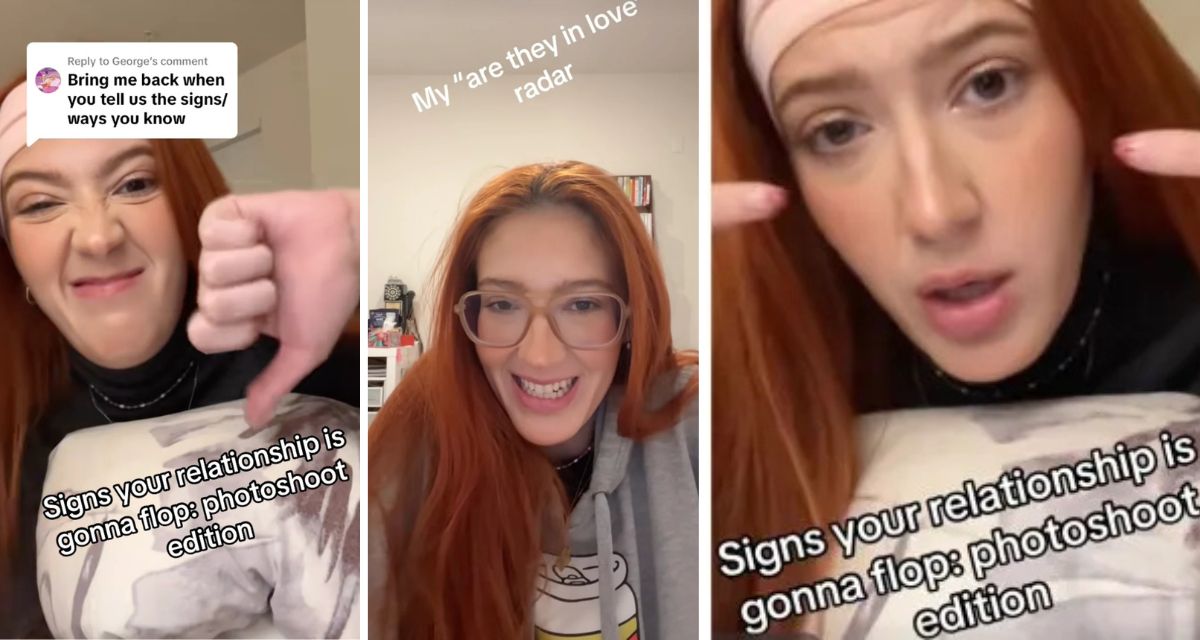
After years of photographing soon-to-be-marriedcouples, wedding photographer Ona Vicente says she can spot the “surefire” signs a relationship won’t last simply by going off the “vibes” of the photoshoot.
“You spend enough time with couples, you develop a spidey-sense,” she says in a TikTok video.
These red flags include: being dressed to go to “two completely different places,” when one spouse refuses to take off a piece of clothing (a coat, for example) for at least one shot, having constant arguments over “small stuff,” making fun of each other “in a mean way,” and getting verbally or physically aggressive.
What do these “red flags”mean?
All of these signs point to an unhealthy communication dynamic, which can undermine one of the most important keys to a lasting relationship: healthy communication. After all, Dr. John Gottman, a renowned relationship researcher, has famously said he can predict with over 90% accuracy whether couples will stay together or divorce simply by analyzing their communication patterns.
As psychotherapist Eliza Davis explains, couples who have healthy communication can “navigate misunderstandings” and high-pressure situations, such as a wedding shoot, because they know how to “repair” after conflict. In one of Vicente’s scenarios, that might look like instantly knowing to apologize and reset the tone after saying something snippy.
Cheryl Groskopf, an anxiety and trauma therapist, points out that even healthy couples may find themselves acting more hostile toward one another in “emotionally loaded environments.”
“Stress isn’t personal,” she tells Upworthy. “When people are overwhelmed, the brain shifts into survival mode. The prefrontal cortex, aka the part responsible for patience and thoughtful communication, gets quieter, while the threat-detection system gets louder. That’s why someone might sound sharper than usual or seem short-tempered. It’s often physiology, not intention.”
That said, couples can help mitigate these tiffs by building in “small regulation moments,” suggests Groskopf.
“When the schedule is packed, people forget to pause,” she adds. “Even something as simple as stepping aside together for a few breaths, holding hands for a moment, or sharing a quick joke can reset the nervous system. These micropauses help your body move out of stress mode and back toward connection.”
In a subsequent video, Vicente shares that she’s seen plenty of “green flags” during her shoots as well, like reassuring one another during bouts of awkwardness, expressing the same level of enthusiasm while sharing their love story, being able to laugh with one another, and generally being on the “same page.”
Vicente says couples who don’t display these traits shouldn’t consider themselves doomed; she was merely reflecting on patterns she’s witnessed. This is also reflected in how experts assess the health of a relationship—by looking at what patterns emerge. How often do bids for connection get recognized? What is the positivity-to-negativity ratio? Does feedback tend to result in curiosity or contempt?
Moral of the story
No two people are perfect, and therefore no relationship is going to be perfect. But what really matters is how the two prioritize their connection with one another throughout all the inevitable twists and turns of life.

A single door can open up a world of endless possibilities. For homeowners, the front door of their house is a gateway to financial stability, job security, and better health. Yet for many, that door remains closed. Due to the rising costs of housing, 1 in 3 people around the world wake up without the security of safe, affordable housing.
Since 1976, Habitat for Humanity has made it their mission to unlock and open the door to opportunity for families everywhere, and their efforts have paid off in a big way. Through their work over the past 50 years, more than 65 million people have gained access to new or improved housing, and the movement continues to gain momentum. Since 2011 alone, Habitat for Humanity has expanded access to affordable housing by a hundredfold.
A world where everyone has access to a decent home is becoming a reality, but there’s still much to do. As they celebrate 50 years of building, Habitat for Humanity is inviting people of all backgrounds and talents to be part of what comes next through Let’s Open the Door, a global campaign that builds on this momentum and encourages people everywhere to help expand access to safe, affordable housing for those who need it most. Here’s how the foundation to a better world starts with housing, and how everyone can pitch in to make it happen.
Volunteers raise a wall for the framework of a new home during the first day of building at Habitat for Humanity’s 2025 Carter Work Project.
Globally, almost 3 billion people, including 1 in 6 U.S. families, struggle with high costs and other challenges related to housing. A crisis in itself, this also creates larger problems that affect families and communities in unexpected ways. People who lack affordable, stable housing are also more likely to experience financial hardship in other areas of their lives, since a larger share of their income often goes toward rent, utilities, and frequent moves. They are also more likely to experience health problems due to chronic stress or environmental factors, such as mold. Housing insecurity also goes hand-in-hand with unstable employment, since people may need to move further from their jobs or switch jobs altogether to offset the cost of housing.
Affordable homeownership creates a stable foundation for families to thrive, reducing stress and increasing the likelihood for good health and stable employment. Habitat for Humanity builds and repairs homes with individual families, but it also strengthens entire communities as well. The MicroBuild® Initiative, for example, strengthens communities by increasing access to loans for low-income families seeking to build or repair their homes. Habitat ReStore locations provide affordable appliances and building materials to local communities, in addition to creating job and volunteer opportunities that support neighborhood growth.
Marsha and her son pose for a photo while building their future home with Southern Crescent Habitat for Humanity in Georgia.
Everyone can play a part in the fight for housing equity and the pursuit of a better world. Over the past 50 years, Habitat for Humanity has become a leader in global housing thanks to an engaged network of volunteers—but you don’t need to be skilled with a hammer to make a meaningful impact. Building an equitable future means calling on a wide range of people and talents.
Here’s how you can get involved in the global housing movement:
Speaking up on social media about the growing housing crisis
Volunteering on a Habitat for Humanity build in your local community
Travel and build with Habitat in the U.S. or in one of 60+ countries where we work around the globe
Join the Let’s Open the Door movement and, when you donate, you can create your own personalized door
Every action, big and small, drives a global movement toward a better future. A safe home unlocks opportunity for families and communities alike, but it’s volunteers and other supporters, working together with a shared vision, who can open the door for everyone.
A cartoonist sent his wife a love letter in 1913. It wasn’t just a note, it unfolded into a tiny art gallery he built to prepare her for a Paris exhibition.
In 1913, American cartoonist Alfred Joseph Frueh sat down to write his wife a love letter. What he actually made was something else entirely.
The letter, which Frueh sent to his wife Giuliette Fanciulli, unfolds into an L-shaped miniature art gallery. There are tiny paintings on the walls, cursive text scrolled across the surfaces, and a coat check station at the entrance with a sign reading: “Leave your hats and umbrellas at home. I ain’t got time to check them.” Above a cut-out door trimmed in black: “This way in.”
The reason for all this was practical, in the most romantic way possible. Frueh was preparing his wife for an upcoming gallery marathon in Paris, and he built her a small preview of the space so she wouldn’t feel lost or overwhelmed when she arrived. He used collage, geometric folds, and careful cuts to simulate the experience of actually being in the gallery.
Frueh was already known for working drawings and creative elements into his personal correspondence as he contributed to the New York World and later The New Yorker, and also made children’s furniture, pop-up cards, and cutouts. But this letter, originally a private thing between two people, is now preserved in the Smithsonian’s Archives of American Art.
It’s worth sitting with the gesture for a moment. Not just the craft involved, but the attentiveness behind it. He knew his wife well enough to anticipate that a big Paris gallery marathon might be overwhelming, and instead of just saying “you’ll be fine,” he built her a map.
That’s the whole love letter. It’s just that the love letter happens to be a museum.
There’s a particular kind of clarity that comes after leaving a bad relationship. Things that seemed explainable at the time suddenly line up into an obvious pattern. The warning was always there. It just didn’t look like a warning yet.
Across social media thousands of people have shared the specific ‘red flag‘ moments they noticed early on but later regretting ignoring.
The “jokes” that weren’t jokes
“Constantly ‘joking’ about other people being better looking or smarter,” wrote one person on Reddit. “At first, I brushed it off as humor, but over time it became clear that those ‘jokes’ were actually digs at my self-esteem. Should’ve realized earlier that a relationship where someone makes you feel less than isn’t healthy.” The camouflage of humor is one of the most common delivery mechanisms for contempt, it gives the person plausible deniability while the cumulative damage adds up.
The tip thief
“When we first started dating, we went to a restaurant, and he spotted the server’s tip on the table and pocketed the money with a smug look on his face,” one person shared with BuzzFeed. “He proceeded to do it to two of her tables.” She stayed. He turned out to be “broke, lazy, and entitled.” How someone treats a stranger, especially one who can’t push back, tends to be a more reliable window into their character than how they treat you when they’re trying to impress you.
The convenient indifference
“Being indifferent to everything,” wrote another Reddit user. “They do not want to give an opinion on anything or be a part of decision-making, no matter how major it is.” It can feel easygoing at first, low-maintenance, drama-free. What it often turns out to be is a way of remaining unaccountable. You can’t be blamed for outcomes you never weighed in on.
When the weirdness gets explained away
“His ex-wife showed up at one of our first dates and made a big scene,” shared one person on BuzzFeed. “He kept assuring me she was just having a hard time moving on.” She interrupted more dates, pranked the writer at work, and broke into their car. “He dumped me to go back to her. As people say, if it feels weird, IT IS WEIRD.”
The target of unspecified anger
From Bored Panda: “She was always angry with me about something. Some way that she felt mistreated, unseen, etc. It was so consistent that I realized it had nothing to do with me. She just needed someone to be the target of her anger, and I wasn’t interested in being that someone.” Chronic, diffuse anger that lands on you regardless of what you do isn’t about you, but staying in it is a choice that gets harder to reverse the longer you make it.
The gaslighting that didn’t look like gaslighting yet
“She would say that I was yelling when I wasn’t,” shared one person. “She would say I had said hurtful things and that I ‘don’t even realize what I was saying.’ I ended up seeing a psychiatrist at her suggestion and was put on medication for seven years.” The insidious thing about gaslighting is that it works precisely because the person experiencing it assumes the confusion is their fault. If you find yourself constantly questioning your own memory of conversations, that’s worth examining.
The love-bombing
Psychology Today notes that a 2021 Reddit survey on early warning signs of abusive relationships repeatedly surfaced one pattern: intensity that arrives too soon. “You’re the only one who understands me. I never met anyone like you before.” A whirlwind of attention and validation (like constant messages and declarations of connection after a few weeks) can feel like finally being truly seen. It can also be a way of establishing emotional debt before the dynamic shifts.
What people notice after
The most common thread across thousands of these accounts isn’t that the red flags were invisible. It’s that they were visible and felt in real time, but were talked out of taking them seriously by the other person and by the relationship’s good moments, or by the internal voice that says you’re being too sensitive, too suspicious, too demanding.
“If it feels weird, it is weird” is not a perfect heuristic. But checking in with that feeling, rather than immediately explaining it away, appears to be one of the more consistent pieces of advice from people who wish they’d done it sooner.
Russian writer and philosopher Leo Tolstoy created many literary masterpieces during his lifetime, including Anna Karenina and War and Peace. Works of love and tragedy, Tolstoy’s real life mirrored the full spectrum of the human experience—including in his marriage.
Tolstoy married his wife Sophia Bers (also ‘Sofia’ and ‘Sofya’, as well as ‘Sonya‘, which is the common Russian diminutive for Sofya), in 1862. He was 34, she was 18. Her father was a successful doctor in Moscow. Their marriage was famously tumultuous, but lasted 48 years.
Tolstoy shared his insights into marriage, summing up his wisdom in a single sentence that holds true in modern day life:
“What counts in making a happy marriage is not how compatible you are but how you deal with incompatibility.”
Despite their differences, Tolstoy and his wife put his advice into practice.
Leo Tolstoy’s marriage
Tolstoy’s marriage to Sophia began like many: happy. Leah Bendavid-Val, author of Song Without Words: The Photographs and Diaries of Countess Sophia Tolstoy, told NPR that, “They were madly in love when they got married in 1862, and they shared everything, including their diaries. They used their diaries to talk to each other.”
The couple had 13 children together, with eight making it into adulthood. Sofia was an asset to Tolstoy’s writing.
“She copied his manuscripts and he listened to her opinions, which was very gratifying to her,” Bendavid-Val said.
However, their relationship evolved into one described as “love-hate.” Bendavid-Val explained that their relationship was “very emotional, very passionate, and their love was full and passionate and deep and rich—and so was their hatred. And unfortunately, the hatred seems to have won out in the end.”
According to The New York Times, Sophia served as “secretary, copy editor and financial manager” for her husband. In 1869, she copied the manuscript for War and Peace by hand eight times for him.
A devoted wife, she struggled to meet Tolstoy’s demands and principles. She honestly journaled about her feelings, and many have been translated.
“All the things that he preaches for the happiness of humanity only complicate life to the point where it becomes harder and harder for me to live,” she wrote in a diary in 1865, per The Guardian. “His vegetarian diet means the complication of preparing two dinners, which means twice the expense and twice the work. His sermons on love and goodness have made him indifferent to his family, and mean the intrusion of all kinds of riff-raff into our family life. And his (purely verbal) renunciation of worldly goods has made him endlessly critical and disapproving of others.”
Toward the end of his life, an argument over Leo’s will resulted in him leaving their family home called Yasnaya Polyana. Although their relationship had its challenges, the couple did remain married until her husband’s death shortly after he left their home in 1910.
“They needed each other. Neither of them could have lived as full and rich a life without the other,” Bendavid-Val said.
Here’s something nobody warns you about adulthood: staying connected to your friends requires actual effort. Everyone’s busy. Everyone’s tired. And between work, family obligations, and that never-ending to-do list that lives in your notes app, the idea of hosting a get-together can start to feel less like something you want to do and more like something you’d need to recover from.
But what if hosting didn’t have to be such a production?
The less you have to do alone, the more fun everyone has together. Canva
These six party ideas are built around a beautifully simple premise: community. The less you have to do alone, the more fun everyone has together. So, no five-course meals. No obsessive cleaning. Just good people, a loose theme, and, if all goes well, the kind of easy laughter that reminds you why you love these people in the first place.
The Sandwich Party
The genius of this party lies in its simplicity. You supply the bread, your wonderful guests bring everything else. Deli meats, cheeses, roasted vegetables, the pesto from Costco that you’re convinced wipes the floor with every other brand, and whatever else they feel like contributing. Maybe you throw in some plates and napkins, too. Then everyone gathers around the table and builds their perfect sandwich. It’s like Subway… but this time, you’re the sandwich artist. Everyone is.
This genius idea comes from Michaela (@luckylamb420 on Twitter/X), who posted:
Because who wouldn’t want to get involved in a sandwich party? It’s interactive, requires approximately zero cooking skills, and for some reason, making a delicious little sandwich with good company is just wholesome and sweet.
Pro tip: Experiment with new flavor combinations. Interesting condiments work great here, like truffle mustard, spicy fig jam, or a good pesto (I hear Costco carries a great one…). Suddenly, your sandwich party has a proper spread. Tada!
The Swap Party
The one thing that unites us all? We have things sitting in random drawers or cabinets that we’ve never used. Never touched, really. A candle, still in the box. A skirt from a brand you no longer adore. A kitchen gadget (unused) that was purchased with the best of intentions. A swap party gives it all a second life.
Photo credit: Canva – We have things sitting in random drawers or cabinets that we’ve never used.
Here’s how it works: Everyone brings a handful of high-quality unused (or, in the case of clothes, gently used) items, and you trade them for something new to you. Think of it like free shopping with your favorite humans and no evil parking structures involved.
Pro tip: Curate the perfect shopping experience with a nice playlist bumping in the background (may I suggest one hour of Iranian jazz?), a delightful beverage option (perhaps aperol spritzes or chilled limeade?), and plenty of bags for your partygoers’ “purchases.” Also, whatever doesn’t get claimed at the end of the party? Box it up for a local charity that could put it to use.
The Productivity Party
This one sounds like it shouldn’t work, but it does. Imagine all the tasks you’ve been putting off: clearing out your inbox, paying a bill, and finally scheduling that routine dentist appointment. A productivity, or “forcing,” party gathers friends together with their laptops and their most dreaded to-do bullet points. As it turns out, working alongside other people makes the boring stuff more manageable. There’s even a name for it: body doubling. Psychologists say just being in the presence of others helps people focus and follow through.
Pro tip: Ask guests to bring something achievable—not their tax returns from three years ago (no judgment)—and realistic, something they can actually finish in an evening.
The PowerPoint Party
If you haven’t been to a PowerPoint party yet, here’s your invitation to host one. Each guest prepares a short, completely self-chosen slideshow on a topic they care deeply about or find deeply hilarious. Here are some ideas to get your creative juices flowing:
“Why [INSERT FAMOUS SINGER HERE] is overrated
Similar-looking celebrities
Things you’ve learned from watching TikTok videos
What I would do if there were no consequences for 24 hours
How everyone’s exes would fare in a zombie apocalypse
Our 2nd annual Power appoint Presentation Party and what we learned ✨ Not shown is Alex’s presentation on Money Trees and the propagations she gave everyone And Melanie’s presentation on the Real Fun Kamp!! #fyp#powerpoint#powerpointnight @Heather @Kelsey Leigh @Ash @NotEarlHickey @Tráshmañ @idesignawesome
The result? You’ll get someone earnestly arguing that a specific cartoon character is underrated, and someone else presenting a very detailed case for why their coffee order is objectively correct. It’s funny, it’s revealing, and it brings out sides of people you don’t always see.
Pro tip: The weirder the topic, the better the night. Encourage guests to go specific and strange.
The Candy Salad Party
Every so often, you need a party with exactly zero agenda other than joy…and maybe a sugar rush. That’s where the candy salad party comes into play. Ask each guest to bring a bag of candy. Dump it all into one big bowl. Eat it. That’s it. The mix of sweet, sour, fruity, and chocolatey is weirdly satisfying, and there’s something about the whole thing that just loosens people up immediately. And it’s a fun excuse to hang out.
Pro tip: Speaking of chocolate…fruity and sour candies tend to play better in the mix than chocolate. Think gummies, Sour Patch, mini Starburst. Chopped up SweeTarts Ropes… Though honestly, there are no rules.
The Potato Party
Some ideas are great precisely because they’re a little ridiculous. The potato party is spudtastic; a full commitment to a theme. Guests each bring a potato dish—fries, twice-baked, mashed, latkes, whatever speaks to them—and if anyone wants to show up in a potato-inspired costume, go ahead! You encourage it. Throw in a round of potato trivia if the mood strikes. It’s the kind of night you’ll reference for years: “Remember the potato party?”
Photo credit: Reddit – Thanks for the potato idea, Reddit!
Pro tip: Learn from a famous Bad Bunny song and lean all the way in on the décor. Take pictures. Lots of them.
Connection, that’s what we’re after
At the end of the day, these party ideas share something in common: they shift the weight of hosting from one person onto everyone, which means you actually get to enjoy your own party. Your friends leave having contributed something, made something, swapped something, or, at the very least, eaten a truly chaotic bowl of candy together.
That’s connection, baby. And it turns out you don’t need a perfect house or a spotless kitchen to make it happen. You just need to send the text.
It happens to the best of us. Sometimes we mark down important dates in our calendars only to completely space out and oops, the day has come and gone. That’s, seemingly, exactly what happened to Redditor Sure_Count_3890, a 31-year-old male who accidentally forgot his girlfriend’s birthday.
On a Reddit post entitled “Forgot my GF’s birthday and she wanted me to sign this,” he shares what looks like a performance improvement plan, not unlike one someone might get at a job review.
He further explains, “Obviously, I signed it but I feel weird about it. She (28F) hasn’t done something like this before and was kind of laughing, but when I asked if she was serious, she said she expected me to take it seriously. Note that we did have a make-up bday night already, I said sorry a lot, and I took her out for a movie and really nice dinner. She told me to post it bc she ‘knows people will back her up.’” And wow, did they ever!
Performance Improvement Plan for boyfriend, Photo Credit: Sure_Count_3890
The contract
At the top of the “contract,” it reads, “Performance Improvement Plan,” with the department listed as “Romance and Affection.” Michael (last name redacted) has the position of “boyfriend,” with Katherine as his “manager.”
The contract is pretty cut and dry. She includes a “target area,” wherein she describes the issue. “A failure to deploy date-keeping, foresight, and thoughtfulness leading to forgetting to plan, provide gifts for, and summarily plan my birthday.”
She then helpfully lays out the “employee standard.” “The employee is expected to plan events, gifts, and curate a minimum of a 1-day-long experience to facilitate celebration of their partner’s annual trip around the sun.”
The good news is she has a plan. In her idea for “Improvement Actions,” she suggests that Michael keep a record. “Employee will agree to keep redundant, numerous, and multifaceted planning tools; no reminders will be forthcoming.”
And finally, she offers a “Training and Support plan,” should Michael need assistance. “Employee has been provided with a calendar and sticky notes.”
Reddit weighs in
The Reddit comments did not disappoint. At over 34,000 upvotes, nearly 7,000 people weighed in with their thoughts. One seemed to believe that the performance review itself was in good fun, but the importance behind it was dead serious. “Sounds like she was joking about the document but said she was serious about remembering your girlfriend’s damn birthday. Remember your damn girlfriend’s birthday.”
And though quite a few were slightly tough on the lad, they noted that his girlfriend’s ability to be clear with her feelings, but in a fun, lighthearted way, was a wonderful reflection on her character. “Forgetting your partner’s birthday is a huge f#$-up at a fundamental level of a relationship. Making sure that never happens again is not a joke. The pretend ‘PIP’ and her laughing while giving it is her effort to find a way to tell him it matters, but break up the tension a bit. That’s part of the ‘joke’.”
Another Redditor simply raved about her. “Honestly, I think the whole situation is absolutely fantastic on her part. She’s giving an incredibly hurtful situation some levity to show him that she’s upset, but not furious at him, and is willing to give him a chance to make it up to her by being more thoughtful in the future. All while being hilarious.”
A learning experience
As for the OP, this comment advises them to learn from the unfortunate situation: “OP, YTA, but only because you missed her birthday in the first place. Take the L here and actually remember her birthday next time. In fact, most of what’s in this PIP is actually good advice for planning an important long-term date.”
And this commenter could totally relate to the situation: “In these days of constant phones-in-our-hands and electronic calendars, it’s not that hard to set up recurring reminders in your phone.
After my first Christmas with my boyfriend passed and he didn’t buy me anything (he’s not a gift giver, but neither am I, so no major judgment), I put a reminder in his phone for two weeks before Christmas to remember to buy his girlfriend something for Christmas. 10 years later, the ‘buy your girlfriend something for Christmas’ reminder still pops up every year, and we both have a good laugh about it because I’m his wife now. He remembers, though.”
The term “gaslighting” has become a popular, everyday term, but there’s still some confusion about what it means. Part of the reason is that the word has been misused so many times that the definition has become fuzzier. But another reason is that gaslighting itself is confusing for the person on the receiving end. Even if you know what gaslighting is, it’s not always clear when or if it’s happening to you.
To provide a brief explanation, gaslighting is a manipulation technique in which someone purposefully and maliciously makes someone question their reality. Abusers and narcissists will often use gaslighting to wear down their victims’ sense of self as a means of establishing and maintaining control over them.
In a relationship, gaslighting can look like denying that something happened and telling the person they’re crazy for how they’re remembering it. It can look like flat-out lying about something the victim knows for sure to be true. It can look like invalidating someone’s feelings and telling them they’re overreacting. It can look like being cruel and then claiming it was just a joke or making the victim believe they’re at fault for something the perpetrator did.
Woman looking tired and confused. Photo credit: Canva
Sometimes, however, people use gaslighting to describe basic disagreements or arguing from different perspectives, like simply saying, “That’s not what happened,” or “That’s not how I remember it.” Actual gaslighting is intentional in its impact on the victim. People can have different memories of how something happened and disagree vehemently, but if a person isn’t purposely trying to alter someone’s sense of reality, it’s not gaslighting.
Similarly, telling someone to calm down and not take things personally may not be a sensitive way to respond to a person who’s upset, but it doesn’t automatically equate to gaslighting, either. Gaslighting requires a malicious intent to manipulate and control.
“Gaslighting is a form of emotional abuse where one person’s psychological manipulation causes another person to question their reality. Gaslighting can happen between two people in any relationship. A gaslighter preserves his or her sense of self and power over the gaslightee, who adopts the gaslighter’s version of reality over their own.”
Gaslighting also isn’t confined to a one-time event, but is more a pattern of behavior. The gaslighter’s repeated distortions and denials wear the victim down over time, making them doubt themselves and question their reality. That’s part of what makes it hard to spot from the inside, since someone being gaslit is likely to question whether it’s really happening.
If you detect an unhealthy dynamic in your relationship, it’s important to seek professional help from therapist, especially if you suspect gaslighting may be at play. But having a tool to clarify what you’re experiencing and help determine what kind of help is needed can be useful.
Psychology Today offers a 20-question online self-test to help you assess whether gaslighting might be a problem in your relationship. The test takes about three minutes and includes statements like “This person makes me feel like I’m unstable,” “This person tells me that other people are not trustworthy,” and “I choose my words carefully when I’m with this person.” After responding to each statement with one of five answers ranging from Always to Never, the test tells you how likely it is that gaslighting is an issue in that relationship based on your answers. Possible outcomes include no signs, few signs, some signs, strong signs or very strong signs of gaslighting.
The test results page also provides more detail about what gaslighting is, things to watch out for so you can spot it, and tips for what to do if you are being gaslit in you relationship.
“The healthiest course of action, in most cases, is to end the relationship or significantly reduce contact,” the site states. “Leaving a gaslighting relationship is challenging but possible. Confrontation is rarely effective; instead, trust your instincts, gather evidence, reduce or cut off contact, and seek help from friends, family, or a therapist.”
Find the Psychology Today gaslighting self-test here. (And if you need a therapist to help you with your relationship struggles, you can search by location, insurance, and specialty on the website’s “Find a Therapist” database of providers here.)
This article originally appeared two years ago. It has been updated.
According to the authors, the key to happiness isn’t just love itself—it’s about “feeling loved.”
“I do know people who are happy, and I know people who are unhappy, and I can tell you the main difference between them: Happy people feel loved,” Reis said in a recent interview.
However, they explain that many people don’t know the difference between “being loved” and “feeling loved.”
“Being loved” vs. “feeling loved”
The difference between the two is key to true happiness.
“Many of us are actually loved by other people, and yet we don’t feel it,” said Reis. “Many people believe that in order to feel love, they need to make themselves more lovable.”
Reis and Lyubomirsky explain that people often try to attain love through performance, such as being impressive, attractive, or successful. But “feeling loved” comes down to vulnerability.
“To feel that the people in your life truly get you, value you, and love you is what makes life worth living,” they wrote in the book. “This is what makes people happy.”
To feel loved, you have to be known.
“Truly being seen and heard is what creates that deep sense of security about feeling loved,” Lyubomirsky said in an interview. “It doesn’t mean you need to overshare or unload your burdens on someone in the first 10 minutes of meeting them; it’s about progressively revealing what really matters to you.”
How to “feel” loved
The “relationship sea-saw” is a tool that Reis and Lyubomirsky created to represent how connection works, and why it’s key to feeling loved. The relationship sea-saw mirrors a seesaw on a children’s playground, but on water. As each side dips into the water, it becomes “hidden”—an allusion to feeling hidden in relationships.
“When we lift up the other person, it’s as if we lift them above the waterline,” Reis explained. “All of a sudden, parts that were previously hidden are now visible.”
Two things lift a person in a relationship out of the water: paying attention and showing care. Reis and Lyubomirsky believe that showing more love in these ways can create a cycle of reciprocation.
“Most of who we are is hidden beneath the surface, and we usually only show that highlight reel,” Lyubomirsky said. “When I show warmth, curiosity, and acceptance toward you, I help lift you up out of the water. As I listen carefully, you’re able to share more of your full self. Then, the idea is that you will reciprocate, showing interest in my inner life and helping to lift me out of the water in return.”
She had a rule about meeting men from the internet: full CIA mode before any date. Look up the name, run it through public records, confirm the person is who they say they are. She’d done it enough times that it was second nature.
This time, she was running late.
In a TikTok that has been circulating widely, @maddybingbong walked through what happened when she skipped her usual process and nearly paid for it. She’d matched with a guy on Facebook Dating, they’d exchanged a few messages, and when he asked if she was free that evening she said sure. She got ready, got in the car, and started the 30-minute drive to meet him for dinner.
Her mom, feeling uneasy, started digging while her daughter was on the road.
There had been one small thing that hadn’t quite registered. When she’d asked the man for his full name, the screenshot from his Facebook profile showed his last name spelled backward. She ran a quick search, found only minor traffic violations, and kept driving. What she hadn’t done was search his actual name.
Her mom did. Using MyCase.gov, Indiana’s public court records database, she looked him up with the correct spelling and found several charges: battery, strangulation, and multiple counts of breach of privacy.
The call came just as the daughter was pulling into the parking lot. “Do not go inside,” her mom told her.
She didn’t. Instead, she called the man directly. She told him her mom had looked him up and found some things. He confirmed the charges were real but tried to minimize them, telling her it wasn’t as serious as it sounded and that she had nothing to worry about. She told him she didn’t know him personally and couldn’t take that on faith. “I’m going home,” she said. “I can’t make that risk.”
As the Daily Dot reported, she later said in a DM: “All I can say is that it definitely was an eye-opening experience to never let my guard down.”
Back home, she blocked him on every platform. In the video she pushed back on anyone tempted to frame what she did as standing someone up. She was clear: you don’t owe a stranger your time, your presence, or an explanation. The plans were made, the information changed, and she made a different call.
The comments filled up with people sharing their own versions of the story and swapping safety tips. Several pointed to public court records databases as an underused resource, and a few others noted that a name spelled backward on a dating profile is itself worth a second look.
For more dating videos, follow @maddybingbong on TikTok.
This article originally appeared earlier this year.