upworthy
Add Upworthy to your Google News feed.
Google News Button
Education

Mom explains why her 1st grader's second-day of school homework already crushed his spirit

"He already doesn’t get home from school until 4 pm. Then he had to sit still for another hour plus to complete more work."

crying child, homework, first grade, school, elementary school, young boy
Photo credit: Cassi Nelson/Facebook

How much homework is too much homework?

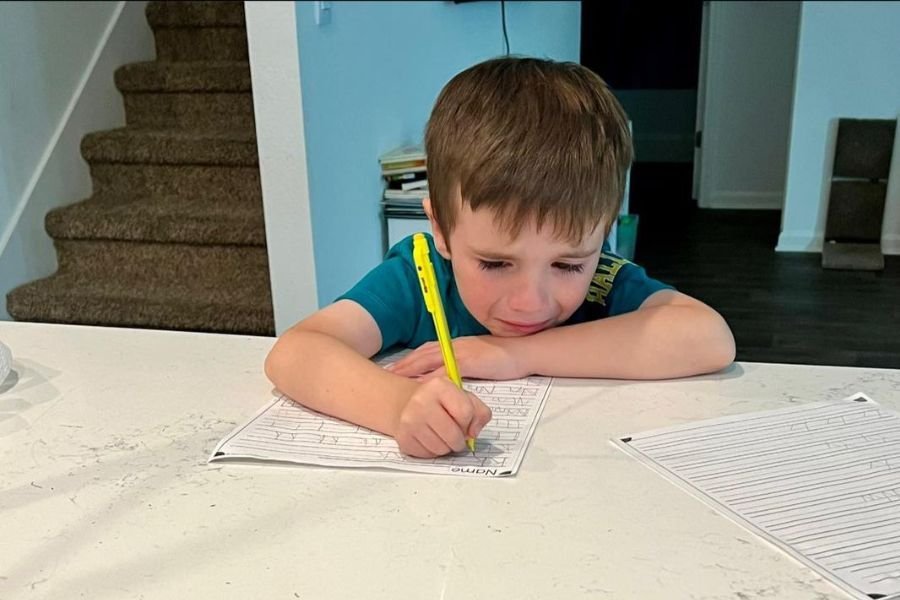
Debates about homework are nothing new, but the ability of parents to find support for homework woes from thousands of other parents is a fairly recent phenomenon. A mom named Cassi Nelson shared a post about her first grader's homework and it quickly went viral. Nelson shared that her son had come home from his second day of school with four pages of homework, which she showed him tearfully working on at their kitchen counter.

"He already doesn’t get home from school until 4 pm," she wrote. "Then he had to sit still for another hour plus to complete more work. I had to clear out the kitchen so he could focus. His little legs kept bouncing up and down, he was bursting with so much energy just wanting to go play. Then he broke my heart when he looked up at me with his big teary doe eyes and asked…. 'Mommy when you were little did you get distracted a lot too?!' Yes sweet baby, mommy sure did too! I don’t know how ppl expect little children to sit at school all day long and then ALSO come home to sit and do MORE work too…."


Nelson tells Upworthy that she was "shocked" that kindergarteners and first graders have homework, much less the amount they were expected to do. "We didn't have homework like this when we were in these younger grades."

Expert opinion and research is somewhat mixed on the homework front, but there isn't any conclusive evidence that homework is universally beneficial for students and too much homework can actually be harmful. As a standard, the National Education Association (NEA) and the National Parent Teacher Association (NPTA) support a limit on homework of “10 minutes of homework per grade level."

With that as a guide, a first grader shouldn't have more than 10 minutes of homework on any given school day, but it's not unusual for young kids to have two or three times the recommended limit of homework. That can be stressful for both kids and parents, cutting into valuable family time and limiting kids' time to decompress, play and freely engage in imaginative activity.

homework, students, elementary school kids, pens, pencils, Kids working on their homework. via Canva/Photos

As Nelson concluded, "It’s breaking their spirit and it robs them of what little fun and family time they have when they come home after a long day of school."

Most parents and even most teachers in the comments agreed with her that four pages of homework is too much for a first grader, especially on only the second day of school:

"Poor little man. Children below a certain grade should not be given homework! Small children have a hard time sitting still for a long period of time yet alone expected to sit and do hours of homework, for what??? They are SMALL CHILDREN! Let them snack, play, laugh and all the other fun things when they get home. You are only a child once, they don't need that taken away from them. Let them embrace their inner creativity, imagination, recipes, etc."

"This breaks my spirit. Our schools are huge scams. You're exactly right Cassi. Homework is ridiculous. Kids til the age of 10 primarily learn through real life situations and play scenarios."

"I hate that for him! My little one has ADHD and doing homework after sitting in class all day is very stressful to him and makes him hate school. They are in school for 7 hours they shouldn’t have homework. That definitely takes away any kind of family time and that’s why kids never spend time with parents anymore because they have all this homework to do after being gone all day.I feel that if it can’t be done in the 7 hours they have the kids then it should wait until the next school day."

"I don’t make them do homework at home when they are that little. It’s not fair!They are at school allllll day! And it’s already sooooo much for their little bodies and brains! I’ve never had a teacher upset about it either.. and even if I did oh well!"

"That breaks my heart. 4 pages is absolutely ridiculous for young kids. My daughter is going into 2nd grade next month, the 2 years in school it was always 1 page of homework sometimes back and front if it was math. And to read."

"I don’t send homework home with my students , 8 hours a day is enough for little minds to be going . They need and deserve a break," a teacher wrote. "As a second grade teacher, I don’t believe in sending homework home. I do send a reading log home and ask that they complete an hour of reading for the entire month, but I understand they are just kids and need to be kids!" another added.

"I was in this boat with my son…conversation with the principal and teachers helped dramatically!! It’s too much and we have to advocate for them."

Nelson was blown away by the response to her post, which has been shared on Facebook over 89,000 times. "I NEVER thought me sharing my thoughts openly about how my heart hurt watching my little guy struggle would connect to so many others worldwide going through the same thing," she says.

Many parents shared that excessive homework is one of the reasons they decided to homeschool their children, which Nelson took to heart. The week after sharing her viral homework post, she shared that they had had their first day of homeschooling. It was "A HUGE SUCCESS!!!!" she wrote, with her son getting far more work done in a far shorter amount of time, sitting for classes for just 1 hour and 45 minutes total.

Nelson tells Upworthy she was totally intimidated to try homeschooling. "I seriously thought there was no way," she says. "But I knew I had to set my fear aside and just take the leap for my kids. I told myself I'd figure it out one way or another. And here we are three days in and it's been the easiest and best choice I've ever made."


Homeschooling is not the right solution for every family, however, so the question of homework remains an important issue for kids, parents, teachers, and schools to work out.

This article originally appeared last year.

ups, ups driver, delivery driver, ups deliveries, cookout, family, food, hospitality, kindness
Relaxed008/YouTube
UPS driver invited to family's cookout.

UPS drivers are always on the grind delivering packages around the clock—even on holidays. And one family took notice of the hard-working UPS driver in their neighborhood who had his nose to the grindstone as they enjoyed a cookout together. Rather than simply let him pass by, they decided to flag him down and extend an invite to join them in a move that proved community and hospitality are still alive and well.

TikToker @1fanto shared a touching video with his followers from Easter weekend where his family invited a UPS driver making rounds in their neighborhood to come to their cookout and 'make a plate.'


"Everybody family around here 😭," he captioned the video. "Everybody invited to the cookout.😂"

@1fanto

Everybody family around here 😭 #easter #cookout #wherethefunction

In the video, the UPS driver is seen standing in the family's driveway, and a group of cookout attendees warmly welcome him to join them. The uncle of @1fanto says to the driver, "You've been working hard all day man, you can go on in there!" He calls out for a woman named Stephanie to "take care of him!"

The UPS driver walks up the driveway, and they encourage him to go inside and get his fill as he enters the garage. After securing a plate of food and a drink, the driver walks back outside to mingle with guests, shaking hands with the uncle who invited him.

"You good?" the uncle asks, and the driver responds, "Yeah I'm good. They hooked me up. Thank you so much. Appreciate y'all for inviting me out." On his way back to his truck, the uncle encourages the driver to invite other workers to stop by as well.

- YouTube www.youtube.com

In a follow up video, @1fanto explained more about how the invite went down. He shares that the UPS driver was driving by the family's house on the Saturday before Easter, and at the time the family was enjoying a big fish fry cookout together. His uncle flagged the driver down, and he pulled over.

He shares that his uncle told the driver, "Go inside and get you a plate!" The driver asked him, "Are you sure?" But he reassured him, adding that the family made sure to ask the driver what he wanted and didn't want on his plate to "make sure he was good and got everything he needed".

"I saw it had a positive impact. That's what my family do. That's not something that we just do for social media," @1fanto shared. "That's something that we do on a regular basis that doesn't just happen when the camera's on. It happens when the camera's off, too. We're all equal. We all bleed the same."

ups, ups truck, united parcel service, ups delivery, ups deliveries, ups driver A UPS truck with package deliveries.Image via Wikipedia

Viewers had lots of positive things to say in the comment section.

"I am a UPS driver and that makes our day. People showing love to us"

"Your family represents the best of America🫶🏼 Your uncle is now all of our uncle."

"Working the holidays suck. But they made that man’s entire day. Love it."

"I love when people are nice for no reason. You’re so real ♥️thank you for being so kind."

"Being a delivery driver is grueling, often thankless work. It's awesome to see a family that remembers those hardworking folks are essential parts of our communities."

This article appeared last year. It has been updated.

cher, david letterman, late night, late night show, tv, celebrities, sexism, women, hollywood
Renan Katayama/Wikimedia Commons & Gotfryd, Bernard/Wikimedia Commons

David Letterman and Cher.

Cher had accomplished a laundry list of amazing feats by the time the 1980s rolled around. She'd hit number one on the Billboard Hot 100, had international number-one hits, starred on television and on Broadway, and established herself as an acclaimed actress. In 1988, she even won an Oscar for Best Actress for her role in Moonstruck.

But as of 1986, there was still one major thing she hadn't done: appear on Late Night with David Letterman.


It wasn't for lack of trying on Letterman's part. He'd been trying to get Cher on his show for years and, with the help of a hefty appearance fee, sealed the deal in 1986. The audience was excited. Letterman was excited. But when Cher finally walked out onstage, things didn't get off to the smoothest start.


cher, david letterman, late night, late night show, tv, celebrities, sexism, women, hollywood Cher was the biggest phenomenon on the planet for the better part of the '70s and '80s.Casblanca Records/Wikimedia Commons

After Letterman complimented how she smelled, Cher crossed her arms and deadpanned, "Is this as good as it gets?"

Letterman and the audience laughed it off, but the vibe was clearly tense from the get-go.

"I know you didn't want to come on here, so why, finally... did you decide to come on?" he asked

Cher laughed and joked that she only came on so she could pay an expensive hotel bill. "No, I don't know, because I thought that I would never want to do this show with you," she added.

"Why?" Letterman asked. "Because you thought I was a..."

"An a**hole," Cher bluntly said.

After Letterman riffed briefly on the audience reaction, Cher elaborated: "It was frightening because I see how you deal with your guests and sometimes it's really great and you seem to like them, but if you don't like them, you might as well take a picnic lunch."

From there, Letterman pivoted: "You look great... How many tattoos do you have?"

The interaction has since become an iconic moment, rewatched again and again over the past several decades. The official YouTube clip of the interview currently has more than three million views.

- YouTube www.youtube.com

Though beloved by his male fans, Letterman hasn't always had the greatest reputation for his treatment of guests, women in particular. This was a pattern that played out for years. Letterman was known to tease, and at times outright bully, certain guests more than others.

In a 1988 interview, he mocked Shirley MacLaine for her belief in past lives. During a 1986 sit-down with Farrah Fawcett, who appeared nervous and a bit loopy, Letterman had little trouble getting laughs at her expense. Even years later, interviews with Lindsay Lohan, Paris Hilton, and Jennifer Aniston were widely criticized as mean-spirited or gross. And in 1994, an interview with Madonna turned openly contentious, with both sides trading barbs.

But it wasn't just Letterman. The cruelty of late-night television reached something of a peak in the early 2000s, when hosts routinely mocked female stars like Britney Spears, who was struggling through a highly public mental health crisis. One notable exception was host Craig Ferguson, whose 2007 monologue stood out for its striking empathy in sharp contrast to many of his peers:

- YouTube www.youtube.com

Even today, women who appear on late-night shows often find themselves either the butt of the joke or an object of desire.

Research published in The Critical Review of Social Sciences Studies asserts, "Female guests often appear as spectacles for male hosts' humor rather than as authoritative contributors to public discourse. ... The quick-witted, often satirical male hosts discuss political and public affairs in ways that pose hegemonic challenges for female participants, limiting their discursive power."

It’s no wonder that Cher didn't exactly see the Letterman set as a safe space to let her guard down. And in typical Cher fashion, she made her feelings about Letterman clear right from the start. The exchange is an unforgettable moment that works as both a public call-out and an icebreaker. That night in 1986, Cher and Letterman ultimately went on to have a nice (if playfully combative) interview.

For his part, Letterman has since expressed regret about many aspects of his time hosting Late Night, including what he has described as a "toxic work environment" marked by "sexual favoritism" and scandals. It's hard not to wonder whether Cher picked up on those bad vibes at the time and chose to call them out in the only way she knew how, which is exactly why people still love her.

likable, likable person, likable people, conversation, conversation tips

Likable people say these things during conversations to build better relationships.

Making friends and developing deeper, stronger relationships starts with good conversation. Sometimes that means small talk at work, while other times it's the kind of conversation that really takes off at a party.

Some people are naturals when it comes to easy, flowing conversation—especially highly likable people, who tend to attract others and often hold the key to mastering genuine conversation. From their gestures to the way they articulate questions, there's a lot others can learn from them.


Communication experts who spoke to Upworthy say there are 10 things highly likable people do during conversations to build stronger relationships.

- YouTube www.youtube.com

1. They listen without distraction

Listeners often make the best conversationalists.

"That means not looking at your phone or scanning around the room to see who you want to talk to next," says Kerri Garbis, CEO and founder of Ovation Communication. "Focus on the person in front of you only. Make eye contact. This fosters a relationship because when you are fully present, it signals respect, interest, and helps others feel valued versus like they are competing for your attention."

2. They collect data

Being inquisitive about what people need during conversations is key to building stronger relationships.

"If you take a moment to ask your colleague or even friend, 'What are you worried about? What's the biggest concern facing you right now?' you can get great data on how you can help them - in a way that taps into something urgent and top of mind for them," says Kate Mason, PhD, an executive communications coach and author of Powerfully Likeable: A Woman's Guide to Effective Communication. "They'll remember your thoughtfulness and the actions you took."

3. They balance the conversation

Highly likable people never make it all about themselves.

"Sometimes conversations can be 'lopsided' where it's more about the other person than about you," says Rob Volpe, a communication expert and author of Tell Me More About That: Solving the Empathy Crisis One Conversation at a Time. "While that can be okay, you aren't there to be their therapist. Sometimes the context and topic may make it off balance, but if it continues and you aren't feeling seen yourself, feel free to say something like 'I'd love to share my thoughts on this' or 'May I share something I'm dealing with at the moment?'"

4. They mirror their conversation partner

Taking cues from body language can foster deeper relationships.

"It's a subtle way to make someone comfortable because they recognize themself in your actions," says Jennifer Anderson, a communication expert who works with entrepreneurs. "Your energy should match the energy of your counterpart. Think relaxing-in-lounge-chair energy vs. about-to-deliver-a-presentation energy. Those are two very different conversations. If you paired them up, there's definitely about to be some awkwardness."

- YouTube www.youtube.com

5. They skip pre-planned questions

While coming to conversations prepared with questions may help you feel less anxious, highly likable people usually don't use them.

"Often people have questions in their back pocket, like about the weather or sports, but the most likeable people in the room are those who can be present in conversations and ask follow-ups based on what someone is talking about," Garbis says. "This builds a relationship by making conversations feel relational and not transactional."

6. They are self-aware

Highly likable people are masters of self-awareness, especially during conversations.

"Self-awareness of your judgment is key to building relationships," Volpe says. "We all carry biases which can block our view of the person standing in front of us. When you catch yourself being judgmental, have some grace with yourself and get curious about the other person as well as where your judgment is coming from. This clears one of the biggest obstacles to having empathy with others."

7. They respond with affirmation

Highly likable people make others feel seen and heard.

"No matter what is coming out of the person's mouth, make it clear that you're not judging or competing with them," Garbis notes. "If they say: 'I went skiing this weekend,' don't jump in and say that you also went skiing. Say something like, 'Wow, that sounds exciting, tell me more about that.' You can respond with validating statements like: 'That makes sense, or I can see why you're so good at that, or I can see why that matters to you.' This reduces defensiveness and nervousness, and it makes people feel safe to be themselves and creates relationships faster."

@justaskjefferson

it’s been great catching up! #communicationtips #communicationskills

8. They remain calm

Bringing a sense of calm rather than chaos to a conversation can put everyone at ease.

"Calm is the most powerful communication flex you can do," Mason says. "If you can stay calm, especially in a heated conversation, you actually end up looking trustworthy, reliable and unruffled - all very powerful things to be remembered for."

9. They remember names

Highly likable people personalize conversations by using the other person's name.

"Never ever tell people you are terrible at remembering names," Garbis explains. "This will tank the conversation because it signals you don't matter, nothing you say matters, and that you aren't worth remembering. It makes a person mentally check out of the conversation. Use good tricks like repeating a person's name at the beginning and again at the end. If you forgot by the end, say something like, 'It was so fun to hear about your skiing adventure. By the way, I'm Kerri, it was so nice to meet you, and can you remind me of your name? I don't want to forget it?' They'll be so grateful you repeated your name too!"

10. They use humor where they can

Finally, highly likable people make sure to infuse conversations with laughter.

"It's a great connector," Anderson notes. "Don't try to be a standup comic, just find the lighthearted observations and details that you can share in conversations. Humor is never a weapon; judgy and mean-spirited comments convey weakness, not confidence. You'll risk alienating your conversation partner if you come in with a full roast of your friends or coworkers. If all else fails, everyone loves a Dad Joke."

Culture

Why intergenerational 'culture buddies' could be the antidote to loneliness everywhere

Inside the program reconnecting Hamburg's students and seniors.

seniors, loneliness, germany, elders, students

Kulturisten Hoch Zwei provides the link between seniors and high school students.

Picture yourself at eighty-five. You live alone in a fourth-floor apartment in a busy city. You loved the theater in your youth, savoring the thrill as the lights dimmed and the crowd fell to a hush. Now, money is tight, sitting for hours is hard on your body, and perhaps most heartbreaking of all, you have no one to go with.

For millions of older adults around the world, this scenario is more than hypothetical; it's everyday life. Loneliness has become an increasingly widespread issue, affecting physical health as much as smoking or obesity. But in Hamburg, Germany, a remarkable social initiative is offering a different kind of remedy for loneliness among the elderly.


seniors, loneliness, germany, elders, students A high school volunteer with her senior "tandem." Photo credit: Kulturisten Hoch Zwei

This approach, often referred to as "social medicine," drives KULTURISTENHOCH2 (Culture to the Power of Two), a non-profit redefining aging, youth, and the transformative power of human connection.

Unpacking KULTURISTENHOCH2

At its heart, KULTURISTENHOCH2 (also known as KH2) is a "culture buddies" program with a simple, beautiful mission. The project pairs high school students with older neighbors living on low incomes to forge meaningful intergenerational connections.

The project was founded in 2016 by Christine Worth, a former marketing executive inspired by her family history. She remembers watching her father's world grow smaller due to dementia, aging, and isolation, and realized that getting older is an unaddressed social problem. Worth found that for many seniors, not having someone to share the day with was the biggest barrier to leaving the house.

seniors, loneliness, germany, elders, students KH2 makes leaving the house more accessible to senior citizens. Photo credit: Kulturisten Hoch Zwei

Through KH2, seniors are given a "VIP pass" to an unbelievable, culturally rich city. Paired with a local teenager, these elders enjoy free tickets to concerts, plays, and art exhibits, proving that a shared cultural experience can bridge even the largest age gaps.

How the program works

KH2 is designed to remove every barrier that might keep an older person at home, creating a safe, comfortable, and dignified experience from start to finish.

The pairing process

The initiative starts in local schools, where students sixteen and older volunteer to join KH2. These "young buddies" are paired with seniors ages 63 and older—many of whom are living on low incomes or with physical disabilities—within their district, allowing them to attend a wide range of cultural events free of charge.

Seniors are identified and registered as participants if they meet age and income requirements and express an interest in cultural participation.

seniors, loneliness, germany, elders, students Many "culture buddies" stay in contact after the program ends. Photo credit: Kulturisten Hoch Zwei

After matching, the student will contact the senior, coordinate logistics, and accompany them to selected events. Over time, many connections evolve into lasting relationships, with approximately 20% of "generational tandems" reportedly maintaining regular contact beyond the official program.

Door-to-door companionship

Tickets are provided free of charge by KultureLebe Hamburg e.V., a partner program that champions the belief that "culture is not a luxury, culture is food" and arranges free cultural experiences for people on low incomes.

The student arranges a meeting time and place, often picking the senior up from their home and, if requested, accompanying them door-to-door. Travel typically takes place via public transportation, with the student offering practical assistance along the way, such as navigating stairs, reading signage, and more.

Students commit to at least three cultural outings per school year, though many choose to volunteer more often.

Walking in their shoes

One of the most impactful aspects of KH2 is how it prepares the students. Before meeting their senior partners, teens receive specialized training designed to ensure the needs of older adults are met.

Beyond discussing aging and how to navigate communication with seniors, students wear a 77-pound "aging simulation suit," which restricts movement and vision. They are given "ear defenders" to simulate hearing loss and practice using wheelchairs and walkers to experience the physical challenges of older age and its practical challenges.

Cultural experiences for all

Events include a broad range of programs, including the theater, opera, orchestral events, cinema, gallery openings, and festivals. Here, culture serves as a natural "conversation starter" between generations, as shared performances and exhibitions open the door to exchanging perspectives and life stories.

While student participants receive certificates for their volunteer work, the real reward lies in personal growth. Through engaging with seniors from a different generation, they gain a deeper understanding of history, empathy, and human connection.

Sustaining and expanding KH2

The program started with three pilot schools and 37 seniors, and expanded quickly. By the end of 2019, around 165 students and 175 seniors were active in KH2, with more than 850 pairings activated across Hamburg.

seniors, loneliness, germany, elders, students KH2 provides students with excellent life skills and lasting connections. Photo credit: Kulturisten Hoch Zwei

Keeping KH2 running requires significant support. Around 25% of its funding comes from government agencies, with the remainder provided by private foundations, corporate sponsors, and grassroots fundraising efforts.

The science behind the magic of connection

Public health experts are increasingly recognizing that health extends beyond diet and exercise. A groundbreaking 2023 report from the World Health Organization (WHO) linked participation in arts and culture to tangible health benefits, including reduced depression, improved cognitive function, and even increased life expectancy.

"For too long we have seen Science and the Arts as separate endeavors," said Sir Jeremy Farrar, chief scientist at the WHO. "But these silos were not always so. Through much of human history, the creative interface of different disciplines has been a catalyst for both innovation and healing."

In this sense, KH2 functions as more than a community program; it serves as a preventative health strategy.

Creating lasting partnerships

In a society increasingly shadowed by loneliness and isolation, KH2 is grounded in the belief that real change happens through encounter and exchange. Through its life-changing cultural tandems, older adults regain mobility, confidence, and a renewed sense of belonging as active members of society.

By connecting two groups who might otherwise never meet—teenagers just beginning their lives and seniors reflecting on theirs—KH2 creates moments in which age quietly falls away, leaving two souls moved by art.

baseball, high school baseball, travel ball, youth sports, american youth sports,

High schoolers playing baseball.

In December 2025, Katherine Van Dyck, a senior legal fellow at the American Economic Liberties Project, testified before the U.S. House Committee on Education and the Workforce's Subcommittee on Early Childhood, Elementary, and Secondary Education about the growing takeover of youth sports by private equity firms. This new profit-driven system is replacing once-affordable community sports organizations with pricey programs that exclude many families.

At the center of this new youth sports paradigm is the bargain these leagues offer parents: If you pay thousands upon thousands of dollars, your child will have the opportunity to earn a college scholarship and possibly make it to the pros. During her testimony, Van Dyck noted that many parents have bought into the promise.


Parents overestimate the chances their children will receive athletic scholarships

Van Dyck shared a poll showing that 49% of parents whose children participate in youth sports (ages 7-18) are "confident" their child will receive an athletic scholarship. Unfortunately, only about 7% of high school athletes go on to play college sports, and just 2% receive an athletic scholarship.

"Families are going into debt, and it's based on a lie," she said in her testimony. "Forty-nine percent of parents believe their children will get an athletic scholarship. In fact, only two percent of college applicants actually do."

@bobbyleebaseball

What was once recreational neighborhood fun has become mandatory travel sports. Families are being convinced that it is the only way for children to be competitive in the sport, and that if they aren’t giving in to the pressure then they are failing their children. It is not true. Families are spending thousands a year, and hurting their children’s health and development along the way, because they don’t realize they are being manipulated into spending. It’s a marketing scheme meant to keep registration numbers and tournament participation high, to extract as much as they can from families. And parents have been convinced that if they aren’t doing it, then their children’s are missing out. Everyone is sounding the alarm, and it has now made its way to the U.S. House Committee on Education and the Workforce Subcommittee on Early Childhood Education. #congress #baseball #youthsports #youthbaseball #children

If 49% seems like an anomaly, a 2024 study found similarly inflated expectations: 34% of parents with children ages 6 to 17 believe their kids will play college sports, and 27% think they are likely to receive a college scholarship.

Youth leagues often dangle the scholarship carrot in front of parents who face either heavy debt or foregoing college altogether. They also appear to brandish the stick, suggesting that parents who don't pay up aren't doing everything possible to help their kids succeed.

basketball, youth basketball, basketball parents, parents and children, basketball court Parents posing with their young kids on a basketball court. via Canva/Photos

"The industry has learned that the easiest way to get parents to ignore their instincts is to convince them that their instincts are selfish," said Dr. Jennifer Fraser, who studies youth sports psychology, according to Beyond the Drill. "Parents will endure almost anything if they believe it's what their child needs to succeed."

Melissa Panzer, a TikToker who focuses on the challenges of being a working mom, recently went viral with a video responding to Van Dyck's testimony and unpacking why so many parents are hedging their bets on a college scholarship. She also outlined a new way forward for parents who don't buy the story the youth leagues are selling.

@seriouslymakeitmakesense

This clip isn’t about sports. It’s about how families are being squeezed. For context: • There are roughly 8 million high school athletes in the U.S. each year • About 160,000 will receive any athletic scholarship money • Most scholarships are partial, not full rides • Meanwhile, youth sports has grown into a $30+ billion industry — almost entirely funded by families That mismatch isn’t an accident. It’s the business model. In the meantime, while the system remains broken, here are a few things that can help soften the blow: • Ask what your child actually enjoys — not what feels strategic • Set a clear family budget before the season starts • Remember that most college pathways do not run through elite youth sports • Know that opting out is not “falling behind” Parents aren’t the problem. They’re the product. 📌 Testimony from a hearing before the House Committee on Education and the Workforce Credit to Katie Van Dyck Thanks to @seasters jones. for sharing the cllip

Why parents are betting on their kids getting athletic scholarships

According to Panzer:

"So, parents start looking for any way to reduce that [college] bill later. And sports have become one of the few paths that still look merit-based. Most parents don't actually believe that their kid is the exception, but when college feels impossible to pay for, hope still creeps in. Because the alternative is debt, and that follows your kid around for decades, and that sucks. And that's why families keep paying, not because they're foolish, but because the system is designed to monetize fear and aspiration at the same time. And that's what's infuriating."

Panzer argued that if parents truly want their children to earn scholarships, they should focus on academics. "Way more students receive academic scholarships than athletic scholarships," Panzer said. "Athletic scholarships get all the hype, but they are one of the rarest forms of aid."

She closed her video by laying out several things parents should consider before spending thousands of dollars on elite youth sports teams and travel clubs:

"Ask what your child really enjoys—not what feels strategic."

"Set a clear family budget before the season starts."

"Remember that most college pathways do not lead through elite youth sports."

"Know that opting out is not 'falling behind.'"

"Parents aren't the problem, they're the product."