upworthy
Add Upworthy to your Google News feed.
Google News Button
Education

Popular life hack has people putting their toilet paper in the refrigerator

No, we're not joking.

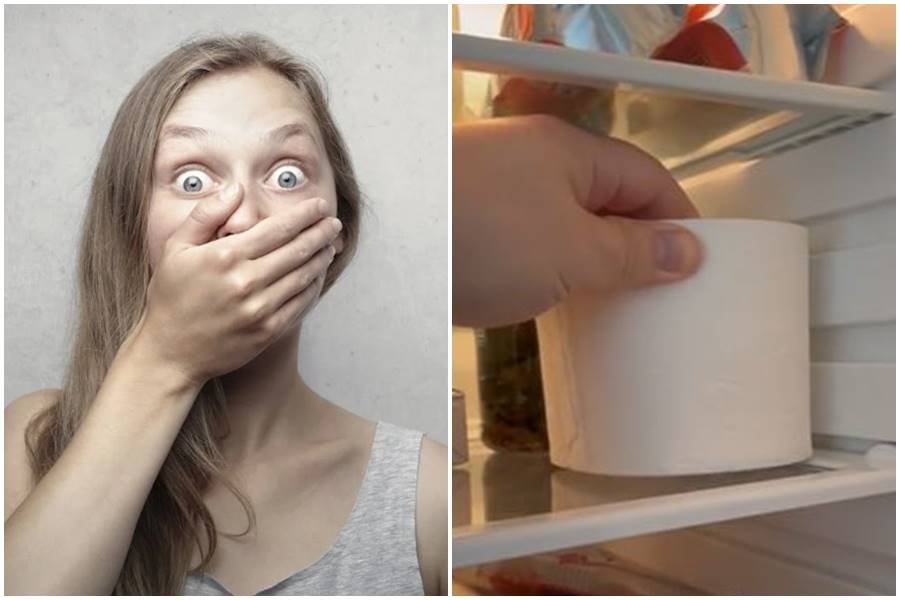
a woman covers her mouth in shock; a man places a roll of toilet paper in the refrigerator.

Have you heard the new toilet paper hack?

Before the COVID-19 pandemic, people took toilet paper—especially its availability—for granted. Everyone who experienced those hectic days probably has a new appreciation when they roll down the aisle of their local supermarket and see fully stocked shelves of TP.

A new trend shows that people aren’t only appreciating their toilet paper but finding new ways to use it that go beyond its traditional use: keeping toilet paper in their refrigerators. The most common reason is that it is an effective and affordable way to keep them smelling fresh and clean. It seems that TP’s absorbent qualities go far beyond the bathroom.

The new practice has been popularized on TikTok, where most new life hack trends seem to be springing up these days.


In late September 2023, TikTok user @Ezenwanyibackup shared a toilet-paper-in-the-fridge hack, and it received over 1400 views. The hack involves creating a paste out of baking soda and applying it to the top of the roll. "Now, just stick it in your fridge," the TikToker said. "This simple hack is going to neutralize all the smell and moisture that messes up your fridge, keeping your food fresh and tasty for way longer."

@ezenwanyibackup

Just put a roll of toilet paper in your fridge, and you won't have that problem anymore! #ezenwanyibackup #foryoupage #homemaderemedies #healthy #homemaderecipes #foryou #diy #naturalrecipes #recipe #fypシ゚viral @ezenwanyibackup @ezenwanyibackup @ezenwanyibackup @This Recipe @Queen ezenwanyi1

Smartfoxlifehacks has also helped promote the new trend in kitchen cleanliness with his video, where he shares how he keeps toilet paper in his fridge. He recommends that people change their rolls every 3 to 4 weeks. He claims the "trick" comes from the hotel industry because the toilet paper “absorbs odors."

@smartfoxlifehacks

This is a secret Trick from Hotels… 😱🦊 #lifehack #tipsandtricks #cleaningtricks #cleaninghacks

Another TikToker, @Drewfrom63rd1, has a unique use for the toilet paper in his fridge. He chills it and then uses it as an ice pack to keep his food cold. “You can use this as an ice pack,” he says, pulling a roll out of his fridge. “It does really work. It lasts about 8 hours.”

@drewfrom63rd1

Replying to @wgez

So, how does it work?

House Digest explains why toilet paper is so effective at keeping your fridge smelling fresh:

“For obvious reasons, toilet paper is designed to be extremely absorbent,” Brooke Younger writes at House Digest. “However, it doesn't just absorb liquids on contact; it can also pull them from the surrounding air. If you've ever touched your bathroom's toilet paper roll after a steamy shower, you might notice that it feels a bit damp. Placing a clean toilet paper roll in your fridge will absorb some of the internal humidity and, with it, those stinky particles.”

The site adds that toilet paper can also help keep dark, damp parts of your house, such as a closet or basement, stay fresh, too.

The toilet paper hack is effective, and it’s also a great way to save money. According to The New York Times Wirecutter, a roll of TP costs around $5—$7 on average in the US, which is much cheaper than a refrigerator deodorizer that can set you back between $10—$20, depending on the brand.

Now, for the sake of all the people who love this hack, let’s hope that word spreads so that no one gets any side-eye for having stacks of TP in their fridge. But, we should also hope it doesn’t become so popular that people start hoarding toilet paper again. That wasn’t fun the first time.


This article originally appeared last year.

shhh, quiet, zip it, mouth closed, say nothing, be quiet

A woman zipping up her lips.

There are times to speak up, moments when it’s best to say nothing, and opportunities be very considerate in your response. But when you’re on the receiving end of a back-handed compliment, a foolish remark, or a coworker takes you down a peg, and your emotions are up, it can be hard to have a thoughtful response. Often, we say something we shouldn’t.

How is it that some folks fly off the handle and say things they’ll later regret, while others can stay calm and remove themselves from the situation or take the high ground? One way to be less impulsive with your words is to use the “name it to tame it” neuroscience hack, originally coined by author and psychiatrist Dr. Dan Siegel. When used properly, it allows you to step back from the moment and choose the best response in a challenging situation.


shhh, quiet, zip it, mouth closed, say nothing, be quiet A man saying "be quiet."via Canva/Photos

How to use the ‘name it to tame it’ hack

When someone upsets you, the first thing to do is to go inside yourself and describe the emotion that you feel in your body. Are you angry? Are you sad? Are you afraid? Do you feel rejected? Are you disappointed? The moment you name the emotion, it will begin to subside and give you the emotional and mental room to respond to the person who caused the negative emotion, rather than impulsively reacting.

How to respond to a reactive emotion so you don’t fly off the handle:

Event happens:

1. Your body stiffens up

2. You feel an intense emotion

3. You examine the emotion and give it a name: “My body is telling me I am angry.”

4. You should feel the emotion beginning to subside

5. Choose your response instead of being impulsive

shhh, quiet, zip it, mouth closed, say nothing, be quiet A woman zipping up her mouth.via Canva/Photos

Why does ‘name it to tame it’ work?

“Name it to tame it” works because, when we have a strong emotional reaction, our lizard brain kicks in, and we go into fight, flight, or freeze mode. The lizard brain is not known for giving thoughtful and strategic responses to challenging situations. When we name the emotion, our prefrontal cortex, or the thinking brain, kicks in. The thinking brain looks at the situation and says, “Alright, we don’t need to run or fight here. It's best to give a strategic response.”

When we tune into the negative emotions by naming them, they relax because they feel heard, like when a child has hurt their knee or a loved one has real concern and you gives them undivided attention. Once the emotions are named, they are tamed. Then, you are more likely to respond to the negative person with grace and speak from the best part of yourself.

Dr. Dan Siegel, who coined the phrase “Name it to tame it,” explains the brain science behind the technique in the video below. He does a great job of explaining how it allows us to transfer our thoughts from the downstairs brain (the lizard brain) to the upstairs brain (the thinking brain), so we can calm down and respond appropriately to the situation.

- YouTube www.youtube.com

cats; cats stealing spot; cats in chair; cats stealing chair; animals; pets

Fluffy white cat on a chair.

It never fails: someone's been sitting for a while and decides to stand to stretch their legs. The moment a cat owner's knees fully extend is the exact moment their cat jumps into their seat. Often, it seems like they were pre-curled into their adorable pose before seemingly levitating onto the pre-warmed seat.

This normal kitty behavior can sometimes be irritating to cat owners, especially when they were planning to sit right back down. When there's a cat snuggled in a chair, it can become a struggle to get them out, especially if the cat is a little stubborn. Some cats refuse to move, seemingly pressing their weight into the seat, while others grab onto the fabric with their nails in an effort to claim the chair. It's a battle that can happen multiple times per day.


It can begin to feel like you're in a fight for dominance with a 10-pound furball that can't open doors without your assistance. A cat owner can successfully shoo the cat out of their chair, turn around to sit, and the cat beats them to it all over again. So what's the deal? Are people really in a power struggle with their cats, or do cats have a logical reason for continually stealing seats from the people who feed them?

cats; cats stealing spot; cats in chair; cats stealing chair; animals; pets Cat sitting in an office chair.Photo credit: Canva

Well, some cats are being naughty and use this behavior as attention-seeking. They want their human to pick them up, pet them, or play with them. But this isn't always the case, according to experts. There are four other reasons cats do this that have nothing to do with bad behavior.

They feel safer on surfaces above the ground

According to Cats.com, "When a cat sleeps, they are at their most vulnerable. Therefore, they like to pick nice, safe places to take their naps. Our human chairs are raised off the ground, and often are protected on three sides by the tall back and arms, so they offer more protection than a standard cat bed placed on the floor."

The higher vantage point also allows them to have a good view of the room while they're relaxing, so they prefer to claim the spot as their own.

cats; cats stealing spot; cats in chair; cats stealing chair; animals; pets Cozy cat napping on a comfy chair.Photo credit: Canva

It smells like you

Even though cats have a representation of not caring much about their human roommates, it couldn't be further from the truth. Cats love the people in their home, which means they also love the way they smell because they trust you. Catster explains, "They begin to associate your scent with familiarity and safety, so leaving it behind on your seat is going to draw them to it."

They're claiming you and everything you love

Cats are territorial, so jumping into a seat after their human leaves is a sign of deep affection. They want everyone, including other animals in the home, to know that you belong to them. One way to do that is by sitting in your chair to leave their scent in your space.

According to Dr. Mark West, a veterinarian who shares content on TikTok, "When your cat looks at you, they don't see someone who feeds them, they see their safe place, their territory, their anchor in the world. To your cat, that spot is not just somewhere to sit; it is your spot. And when they choose it, they are choosing you." He later adds, "Your scent tells them everything is okay. They feel like they're protected, that they're home."

Your seat is warm

This is probably the most logical reason someone could think of. Even as humans, we love to hop into something pre-warmed. Think about the pre-warmed towels at a spa, or hopping into the bed still warm from your partner's body heat. It's cozy. Cats love a cozy spot as much as their humans.

cats; cats stealing spot; cats in chair; cats stealing chair; animals; pets Relaxed tabby cat chillin' on a chair.Photo credit: Canva

PetBook says, "The cat doesn't know we planned to return there. Cats love warmth, and we often surround ourselves with cozy, warm blankets and pillows. Especially in winter, our seats have an almost magical attraction for the animals. But even in summer, cats seek out cozy spots without drafts."

arthur c. brooks, harvard, psychology, happiness research, bucket list

Harvard researcher Arthur C. Brooks studies what leads to human happiness.

We live in a society that prizes ambition, celebrating goal-setting, and hustle culture as praiseworthy vehicles on the road to success. We also live in a society that associates successfully getting whatever our hearts desire with happiness. The formula we internalize from an early age is that desire + ambition + goal-setting + doing what it takes = a successful, happy life.

But as Harvard University happiness researcher Arthur C. Brooks has found, in his studies as well as his own experience, that happiness doesn't follow that formula. "It took me too long to figure this one out," Brooks told podcast host Tim Ferris, explaining why he uses a "reverse bucket list" to live a happier life.


bucket list, wants, desires, goals, detachment Many people make bucket lists of things they want in life. Giphy

Brooks shared that on his birthday, he would always make a list of his desires, ambitions, and things he wanted to accomplish—a bucket list. But when he was 50, he found his bucket list from when he was 40 and had an epiphany: "I looked at that list from when I was 40, and I'd checked everything off that list. And I was less happy at 50 than I was at 40."

As a social scientist, he recognized that he was doing something wrong and analyzed it.

"This is a neurophysiological problem and a psychological problem all rolled into one handy package," he said. "I was making the mistake of thinking that my satisfaction would come from having more. And the truth of the matter is that lasting and stable satisfaction, which doesn't wear off in a minute, comes when you understand that your satisfaction is your haves divided by your wants…You can increase your satisfaction temporarily and inefficiently by having more, or permanently and securely by wanting less."

Brooks concluded that he needed a "reverse bucket list" that would help him "consciously detach" from his worldly wants and desires by simply writing them down and crossing them off.

"I know that these things are going to occur to me as natural goals," Brooks said, citing human evolutionary psychology. "But I do not want to be owned by them. I want to manage them." He discussed moving those desires from the instinctual limbic system to the conscious pre-frontal cortex by examining each one and saying, "Maybe I get it, maybe I don't," but crossing them off as attachments. "And I'm free…it works," he said.

- YouTube www.youtube.com

"When I write them down, I acknowledge that I have the desire," he explained on X. "When I cross them out, I acknowledge that I will not be attached to this goal."

The idea that attachment itself causes unhappiness is a concept found in many spiritual traditions, but it is most closely associated with Buddhism. Mike Brooks, PhD, explains that humans need healthy attachments, such as an attachment to staying alive and attachments to loved ones, to avoid suffering. But many things to which we are attached are not necessarily healthy, either by degree (over-attachment) or by nature (being attached to things that are impermanent).

"We should strive for flexibility in our attachments because the objects of our attachment are inherently in flux," Brooks writes in Psychology Today. "In this way, we suffer unnecessarily when we don't accept their impermanent nature."

What Arthur C. Brooks suggests that we strive to detach ourselves from our wants and desires because the simplest way to solve the 'haves/wants = happiness' formula is to reduce the denominator. The reverse bucket list, in which you cross off desires before you fulfill them, can help free you from attachment and lead to a happier overall existence.

This article originally appeared last year.

sleeping, dreaming, lucid dreams, creativity, productivity, sleep, sleep mask

A woman in a sleep mask.

We spend a third of our lives asleep, and during that time our bodies and minds are restored. But wouldn't it be great if we could also use that time to think brilliant thoughts that help us when we wake? Imagine if, while you sleep, your mind could solve problems, come up with creative ideas, and recall long-forgotten memories.

A new study by neuroscientists at Northwestern University has taken the first step toward making this possible by training people to solve difficult puzzles in their sleep.


The researchers conducted a sleep study with 20 people who had prior experience with lucid dreaming. Participants were given a series of tough brainteasers to work on for three minutes, with each one paired with its own musical soundtrack.

The brainteasers were difficult enough that most went unsolved. As participants went to bed in the lab that night and entered REM sleep, researchers played the soundtracks from the unsolved puzzles to encourage them to dream about them. When participants woke up the next morning, the findings were remarkable.

sleep study, man sleeping, sleep research, dreams, creativity in dreams A man in a sleep study.Photo credit: Canva/Photos

What the sleep study found

Sixty percent of the participants had dreams that referenced the specific puzzles they couldn't solve while awake. Those who dreamed about the unsolved puzzles increased their problem-solving ability from 20% to 40%.

Karen Konkoly, a post-doctoral researcher in Paller's Cognitive Neuroscience Laboratory, explained the findings in a press release:

"Even without lucidity, one dreamer asked a dream character for help solving the puzzle we were cueing. Another was cued with the 'trees' puzzle and woke up dreaming of walking through a forest. Another dreamer was cued with a puzzle about jungles and woke up from a dream in which she was fishing in the jungle, thinking about that puzzle. These were fascinating examples to witness because they showed how dreamers can follow instructions, and dreams can be influenced by sounds during sleep, even without lucidity."

The study shows incredible potential for using our dreams to solve complex problems and increase creativity.

"My hope is that these findings will help move us towards stronger conclusions about the functions of dreaming," Konkoly said. "If scientists can definitively say that dreams are important for problem solving, creativity, and emotion regulation, hopefully people will start to take dreams seriously as a priority for mental health and wellbeing."

sleep study, woman sleeping, sleep research, dreams, creativity in dreams A woman in a sleep study. Photo credit: Canva/Photos

How to lucid dream using the MILD technique

Wouldn't it be incredible if you could tap into the power of your dreams to solve problems or come up with new ideas like the participants did in the laboratory? Even though it may sound too good to be true, there are research-backed ways to learn how to control your dreams. One of the most popular is the MILD (Mnemonic Induction of Lucid Dreams) technique.

Here are some steps to achieve lucidity, according to lucid dreaming instructor Daniel Love:

Step 1: Prepare for lucidity

Before you fall asleep, tell yourself that you will wake up and remember your dreams during each period of the night.

Step 2: Remember your dream

When you awaken from a dream period, do your best to recall every possible detail. Stay awake until you've remembered all you can.

lucid dream, dream creative dream, dreamscape, clouds Faces in the clouds in a dream. Photo credit: Canva/Photos

Step 3: Create your intent

As you prepare to fall back asleep, focus on the following intention: "The next time I am dreaming, I will remember to recognize that I'm dreaming."

Love says to think about it the same way you would think about a product you want to buy at the store.

Step 4: See yourself as lucid

As you focus on step three, imagine yourself back in the dream noticing that you are lucid, and rewrite the dream as if you are now in control.

Step 5: Repeat as necessary

Repeat steps three and four until you fall asleep. If your mind wanders from your intention, simply repeat them again.


@inducedlucidity

This is what I consider the most effective method to lucid dream - the mild technique #luciddreaming #luciddreams #luciddreamingtips #spirituality

shower curtain; shower liner; get orange out; clean shower liner; shower liner cleaner

Woman wearing a shower cap smiles from behind a shower curtain.

Shower liners are like any other piece of fabric; they need to be washed. As people become more environmentally conscious, fewer plastic shower liners are ending up in the trash. Instead, people have been investing a few extra dollars into reusable shower liners, but are finding that the dreaded orange stain is still showing up after a washing.

The orange stain seems to start creeping up, not long after hanging the bright white liner behind your shower curtain. What is this stain, and how can you get it out without having to replace the entire liner? According to experts, the orange stain can be caused by different things, but ruling out dye from a shower curtain, the likely culprits are hard water or bacteria.


"If you live in an area prone to hard water, then there's a good chance that the orange stains in your shower curtains are caused by mineral buildup," Allie Ogletree writes for Angi before later sharing the other culprit. "If your shower curtains are orange and slimy, then bacteria called Serratia marcescens could be the reason behind your orange shower curtains."

shower curtain; shower liner; get orange out; clean shower liner; shower liner cleaner Shower curtain with visible mold spots.Photo credit: Canva

While hard water is more of an annoyance than a health hazard, an orange stain caused by bacteria may be a bigger concern, making it a priority to keep it off your shower liner.

The Cleveland Clinic notes that this particular bacteria, often found on shower curtains, can cause unpleasant health issues. They write, "Serratia marcescens is bacteria that sometimes causes infections, including UTIs and pneumonia. You're at higher risk for infection if you're in the hospital or at a long-term care facility, have a weakened immune system or a medical device in your body. S. marcescens can be hard to treat because it's often resistant to many antibiotics."

Tossing the shower curtain into the washer may kill the bacteria, but it doesn't always get the stain out. Cleaning experts have a solution.

shower curtain; shower liner; get orange out; clean shower liner; shower liner cleaner Cleaning the shower with green gloves and a blue cloth.Photo credit: Canva

Method One

Spray down the orange parts of the liner with an enzyme stain remover spray, then soak it in OxyClean and scrub with a soft brush. Once the first few steps are done, toss it in the washing machine with a half cup of baking soda. When the washer reaches the rinse cycle, add a half cup of vinegar. According to Real Simple, following these steps will have your shower liner looking good as new.

If you have a plastic liner, you can wash it by hand and skip a few of the steps, but you may still want to scrub any residue off with a scrub brush. Cleaning enthusiast Jeneva Aaron tells Real Simple, "You can soak a plastic liner in a baking soda and vinegar solution to remove soap residue."

shower curtain; shower liner; get orange out; clean shower liner; shower liner cleaner Woman diligently cleaning shower glass with spray and cloth.Photo credit: Canva

Method Two

Going back to basics just may be what works. Angi touts using a simple vinegar and water mixture on the stain, allowing it to sit for 15 minutes before scrubbing, which can do the job. But you can take it one step further by adding baking soda to a few drops of white vinegar to create a paste to spread onto the grime, then scrub off.

According to the experts at Angi, "If your shower curtain still has discoloration after cleaning it, you can toss the shower curtain in the washing machine on the delicate setting to try to remove any remaining bacteria and then soak it in bleach to remove the orange. Just be sure to wear PPE, have good ventilation, and avoid mixing bleach and vinegar, as this creates a hazardous gas."

shower curtain; shower liner; get orange out; clean shower liner; shower liner cleaner Laundry day vibes in a cozy, tidy room.Photo credit: Canva

How to keep the orange away

One of the reasons bacteria builds up is due to the moisture in the bathroom, so ventilating the bathroom will help cut down on how often the liner needs to be washed. In addition to ventilating the bathroom, close the shower curtain and place it on the outside of the bathtub where it's dry. Closing the shower curtain after getting out of the shower will allow the liner to dry completely, as it will not be folded onto itself.

Surprisingly, there's no need to wash the shower liner weekly to aid in keeping the bacteria from discoloring it. Cleaning experts at Real Simple say that a fabric shower curtain should be washed once every three months, as long as a shower liner is used. The liner should be washed monthly to interrupt bacterial growth.