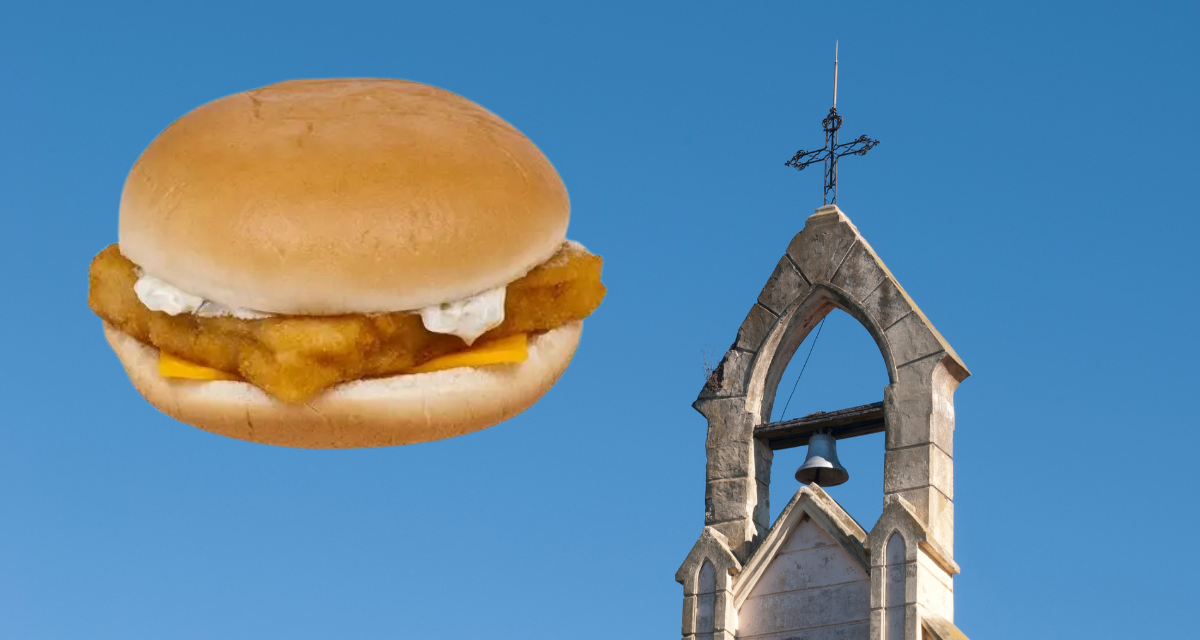
You have probably eaten one without a second thought. You’re not alone. The McDonald’s Filet-O-Fish sandwich—a soft little square of breaded fish, tartar sauce, and a slice of cheese—is one of the best-selling fast-food sandwiches on the planet. Approximately 300 million are sold per year. That’s equal to about 820,000 fish sandwiches a day.
But did you know it only exists because of a centuries-old religious rule, a struggling restaurant owner, and an epic showdown against a grilled pineapple sandwich?
Yes, really. Stick with us. This is one of the great origin stories in fast food.
A Friday problem in a Catholic neighborhood
Rewind to Cincinnati in 1962. A franchisee named Lou Groen ran a McDonald’s on the west side of town, which was heavily Catholic, according to The Catholic Telegraph.
Back then, observant Catholics didn’t eat meat on Fridays. For a restaurant that sold almost nothing but burgers, that spelled a slow-motion disaster. Every Friday, and all through the 40 days of Lent, Groen’s customers walked right past him to a nearby Frisch’s Big Boy that served a fish sandwich.
Here’s the part that matters most: Groen was Catholic himself. So he didn’t have to study his customers to understand them; he was one of them. He knew how they thought and how they behaved. He understood exactly the kind of sandwich that would bring customers back to McDonald’s on Fridays.
Why fish, and not a burger?
The answer comes down to an overlooked piece of church tradition.
For centuries, Catholics marked Fridays by giving up meat—the flesh of warm-blooded land animals like beef, pork, and chicken—as a small weekly sacrifice. Fish, which comes from the water, was always allowed. So a fish sandwich, for Groen, wasn’t just a clever loophole. He knew this was often the only protein a Catholic would eat all day. It let them keep the rule without skipping dinner.
Groen set out to fill that gap—meatless, but still satisfying—and changed the history of fast food forever.
One sandwich, one very strange contest
Groen got to work. He tested sandwich after sandwich before finally landing on his Filet-O-Fish prototype: a filet of battered fish spread with tartar sauce, sitting on a golden bun. He drove his precious idea to headquarters to pitch Ray Kroc, founder of the McDonald’s Corporation.
Kroc hated it. “I don’t want my stores stunk up with the smell of fish,” he told Groen.
Secretly, there was another problem. Kroc had a meatless idea of his own: the Hula Burger, a slice of grilled pineapple with cheese on a bun. (Yes, he genuinely thought this was a good idea.)
So the two men made a bet. On one Good Friday, both sandwiches would go on sale, and whichever sold more would earn a permanent spot on the menu. Kroc was so sure he’d win that he wagered a new suit with his right-hand man, Fred Turner.
It wasn’t close. Groen’s fish sandwich sold 350. The Hula Burger sold six. Fred got his suit, and McDonald’s got the Filet-O-Fish.
From a Cincinnati fix to a global icon
That win made history. By 1965, the Filet-O-Fish had rolled out nationwide as the first new item ever added to McDonald’s original menu. It was a real milestone for a chain built on burgers and fries.
The recipe shifted over the decades. Groen’s original halibut eventually gave way to more affordable, sustainably sourced Alaska pollock, which is what you’re eating in the United States today.

And the sandwich never forgot where it came from. Even now, about a quarter of all Filet-O-Fish sales each year occur during Lent. More than 60 years on, that little fish square is still doing the exact job Groen built it for.
The bigger story hiding between your fries
It’s easy to forget that the mainstream American menu didn’t appear out of nowhere. Everything we eat contains a story, a history. The Filet-O-Fish is a small, delicious reminder that Catholic culture shaped what millions of us eat—most of us without ever knowing it.
For Groen, none of this was a gimmick. The sandwich saved his franchise and built a legacy: his family ran his Cincinnati restaurants for three generations, passing the business to his grandchildren.
So next time you unwrap that unassuming little sandwich, give it a second look. You’re biting into a piece of American history, invented by a man who understood his neighbors well enough to save his business and who changed fast food by accident.