The latest and greatest, state-of-the-art iPhone features a battery that can support over 30 hours of video playback.
That’s cool. But engineers in the early 1800s once created a small battery that still, to this day, has not run out. It’s the world’s longest lasting battery, and it’s also a bit of a mystery to modern scientists.
London ‘instrument makers’ create battery inspired by Italian physicist
In 1825, manufacturing company Watkins and Hill created a battery inspired by the work of 19th-century Italian physicist and priest Giuseppe Zamboni. Zamboni had developed a method of creating batteries called “dry piles,” or tall stacks of extremely thin layers of tin foil separated by layers of paper.
They’re called dry piles because, unlike many modern batteries, they don’t contain any liquid. This early battery design could generate an extremely high voltage but a very low current. That means that the large power potential of the battery flows out slowly, creating a battery that can theoretically last for a long time.
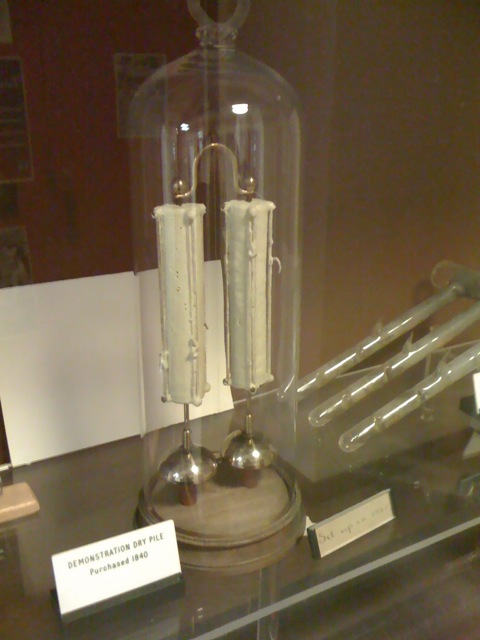
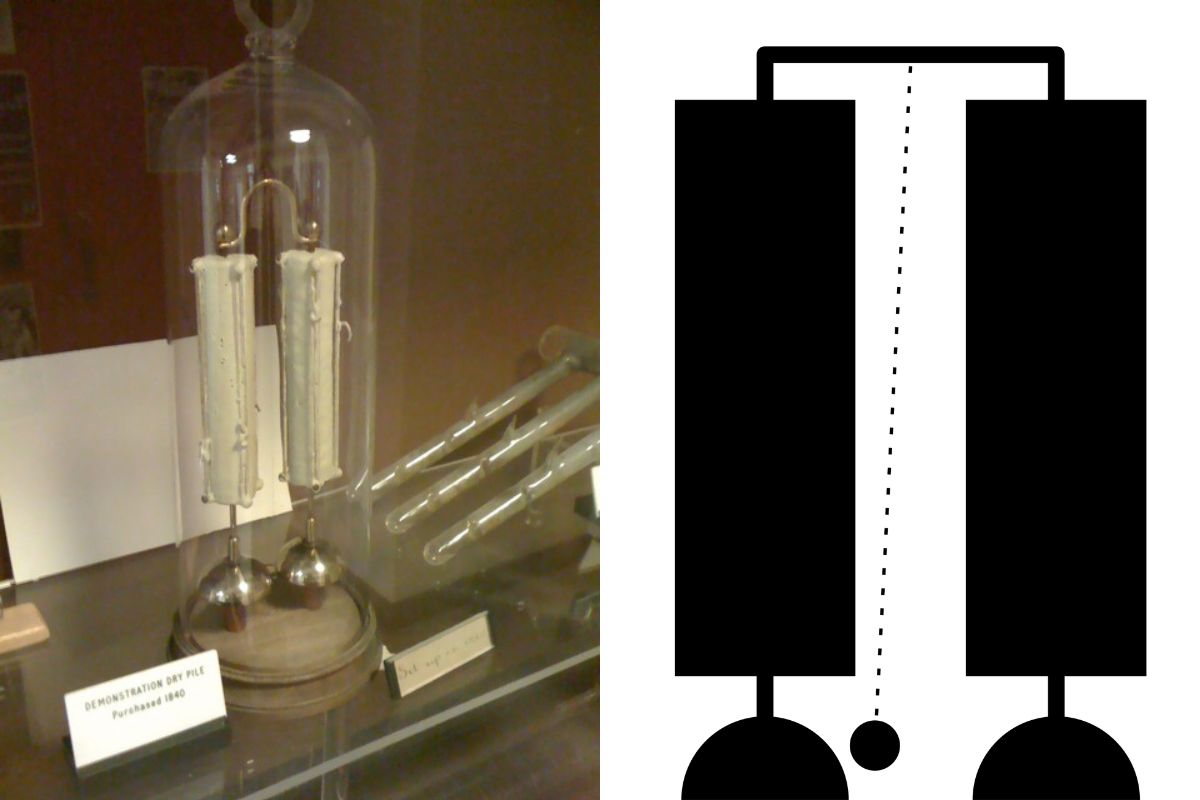
In 1840, Reverend Robert Walker purchased the device: two dry pile batteries attached to two metal ball bells, with a “clapper” in the middle. He set it up the same year to ring continuously at a frequency of 2hz, striking twice per second as the battery piles repel the clapper from one bell to the other using electrostatic force.
Today, it is housed in the Clarendon Laboratory at the University of Oxford, and it has not stopped ringing since it first began in 1840.
It has rung well over 10 billion times, earning it a Guinness World Record for being the “world’s most durable battery.”
Inner workings of the battery are a bit of a scientific mystery
Scientists and engineers are well-versed in how dry pile batteries of the era worked.
However, one of the most fun aspects of the Oxford Electric Bell experiment is that no one can say for absolute certain what’s going on inside the device.
There’s no documentation available that says exactly what the layers are made of. Zamboni used tinfoil, but other designs at the time used zinc, sulfur, or silver. No one can be certain what the Watkins and Hill battery consists of, how many layers are inside, or exactly why this particular device has had such stunning longevity.
The arrangement inside the piles is of great interest to scientists as the Oxford Electric Bell has easily outlasted other existing dry pile batteries from the same era by an enormous margin.
Even Watkins and Hill wrote, at the time, that they expected the electrical power to last “three or four years.”
Why not break it open and find out? Well, because that would ruin the experiment. Of even greater interest to scientists than exactly what’s inside the battery is just how long it will go if left untouched.
How much longer the Oxford Electric Bell is expected to last
It’s a fun and fascinating experiment, but alas, it has to end sometime. Every battery runs out eventually.
However, there is no known timeline for when the dry pile batteries in this electric bell will finally give out.
The amount of power it takes for the bells to repel the clapper and generate a ring (a quiet one, at that) is incomprehensibly small: about one nanoamp of current.
For reference, a tiny electric wristwatch measures its energy consumption in microamps, which are 1000 times larger than nanoamps.
The Oxford Electric Bell might run out of power in a few years, seeing as it has slowed down in recent decades. Or, it might ring for many decades more.
Either way, scientists are in no hurry to solve the mystery. Cracking open the dry piles inside likely won’t revolutionize modern battery design or reveal the secrets of unlimited renewable energy. Learning the exact construction that has led this battery to outlast its expected lifetime by well over a century is something to look forward to. In the meantime, it’s a lot more fun to root for the little battery to keep going on its march to 200 years old.