Pretty much everyone would be overjoyed at the thought of being given some free money. But how much of that free money would you be willing to risk to double it?
It sounds like a question for the Las Vegas casinos. But they make their money with long odds, and games that seem winnable but usually aren’t. A classic riddle simplifies the equation and, in doing so, brings up a fascinating debate between human psychology and raw math.
The two envelope problem explained
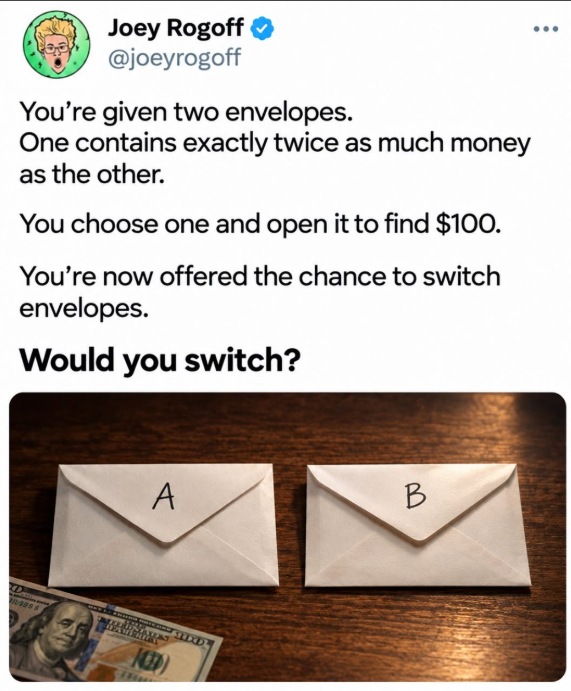
Content creator Joey Rogoff recently shared something of a riddle on his Facebook page.
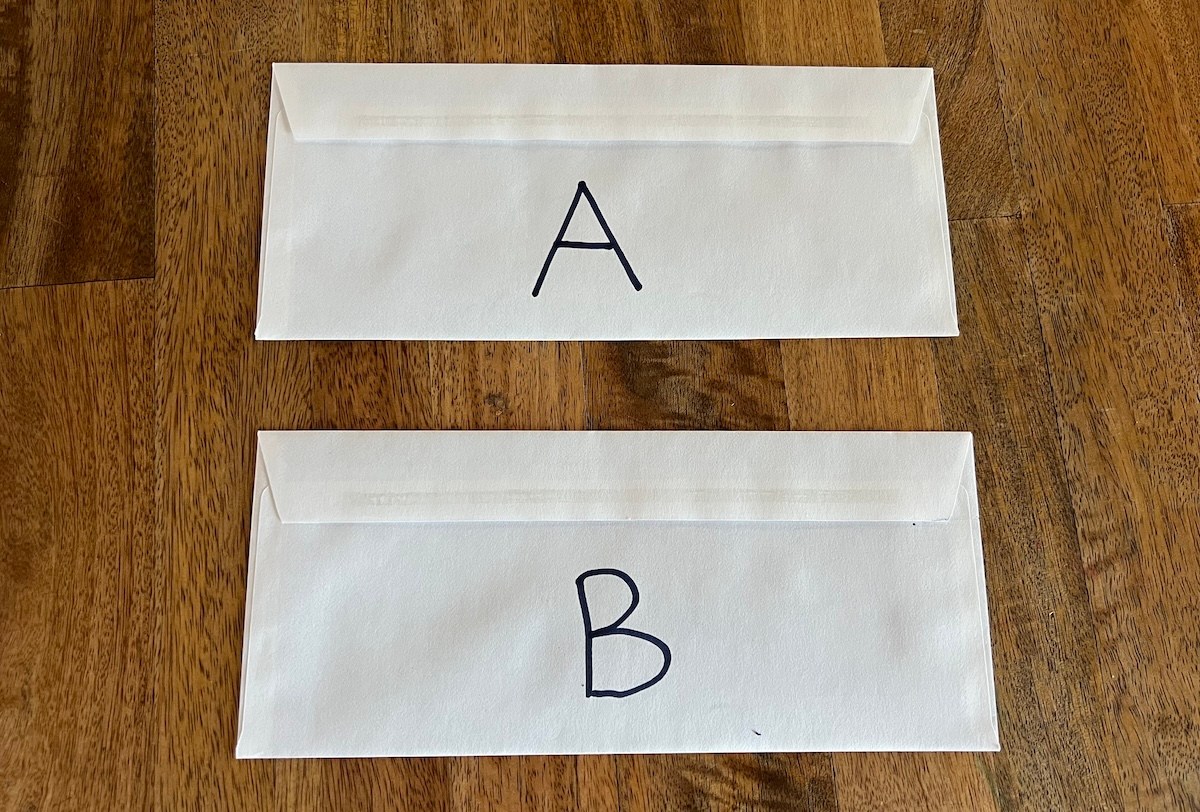
“You’re given two envelopes. One contains exactly twice as much money as the other. You choose one and open it to find $100. You’re now offered the chance to switch envelopes. Would you switch?”
It’s a variation on a classic prompt called the “two envelope problem.”
In essence, the question says that you could walk away with $100, or you could choose the other envelope which has an equal shot at being either $50 or $200.
What would you do?
The mathematically correct answer is…
The math behind the riddle is simple… at first.
We assume the other envelope has equal odds of containing either $50 or $200. That puts the EV, Expected Value, of opening the other envelope at $125—it’s the average of the two possible outcomes.
If you did the exercise a billion times, you’d come out ahead by switching.
Simple.
Where things start to get a little confounding is if you leave both envelopes closed. You select one, your chosen envelope, but don’t open it quite yet. If you are given the choice of switching in that split second before you find out what’s inside, the math says the same thing: The other envelope yields a 1.25 EV.
So you switch, and choose the other one. But before you open that one, the math again suggests that you should switch back. See the problem?
It creates an infinite loop. A paradox.
Lucky for us, mathematicians have been hard at work on the two envelope problem for years. The problem with the logic above is that, in the real world, not all outcomes are equally likely.
If the scenario were real, there would have to be a top limit, or a budget. There could be no infinity dollars inside one of the choices.
So the bigger the number you’d find in your original envelope, the less likely you would be to want to switch; both because the odds that the other envelope contained double your already large amount get smaller, and because the potential loss would hurt far more.
However, for Rogoff’s hypothetical version, where the first envelope contains $100, it feels like you should switch, even if the math behind it is a little murky.
Psychology shows why the problem has people divided
Even if you feel like switching is the right choice, your actions might get overridden by another feeling all together.
A commenter on Rogoff’s post made a salient point when he wrote, “I fully understand the math logic in most of the other comments about switching, but I would stand pat. Whenever I have an either/or choice, I always make the wrong choice. Every time. I know no matter what I do will be wrong, so I would rather be wrong with $100 than with $50.”
And this commenter wasn’t the only one. For every person who understood that the probability of walking away with more money was better with a switch, there was another person too afraid of losing the $50 to pull the trigger.
“I’m taking the $100 and walking away. Most of y’all need to stay away from casinos.”
“You can’t lose money you don’t win. Only on money you possess. That means keeping the $100 isn’t you losing $100 if you didn’t get the $200 by switching. You DO lose money if you switch and the other envelope only has $50”
There’s clearly something larger at play in this problem than just mathematics.
What the pure numbers don’t account for is something psychologists call loss aversion. It’s a cognitive bias that says the pain of losing something is worse than the joy of an equivalent gain. In this context, many people feel that losing out on $50 would not be worth the potential thrill of winning an extra $100.
It’s a fascinating concept. Many experts argue that loss aversion holds us back and impairs our ability to make the best decisions in many areas of life: career, money, dating, friendships. But sometimes that deep fear of losing out protects us. For example, what if the two envelope problem wasn’t a hypothetical game, but a real scenario, and you needed the money to pay rent? Risking the switch would be difficult for most people in that scenario, even though the math would stay the same.
The two envelope problem is such a classic because you can argue about it forever and never be wrong. It’s a fantastic litmus test for our risk tolerance, and even if the math gets a little shaky in hypothetical-land, your response to the riddle can tell you a lot about how you make decisions.