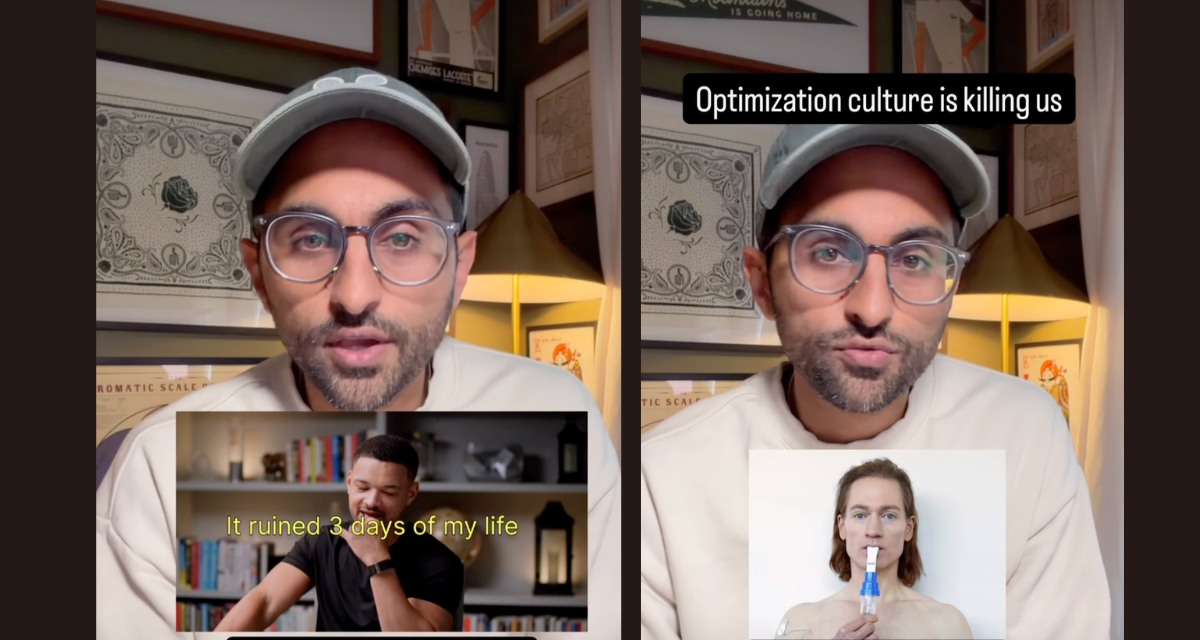
Recently, Diary of a CEO host Steven Bartlett (a man known for his “obsession” with data and wellness tracking) drew some backlash after sharing what became a hot take. He claimed that a couple of glasses of wine “ruined” his life for the next three days, primarily because of the way they affected his sleep, gym time, and podcasting, i.e., his work.
But among the online criticism, one comment from a self-described “reformed optimizer” really stands out.
When self-improvement starts feeling like self-surveillance
A content creator named Ashwinn Krishnaswamy (@schwinnabegobrand) confessed that, like Bartlett and many productivity aficionados, he spent years tracking his sleep, eating/drinking, and exercise, which he then tallied at the end of the year. And yet, keeping that data didn’t necessarily add to his well-being.
It led him to realize one important thing: “optimization culture has gone too far, and it is spiritually killing us.” That the “tyranny of measurement” tries to make us into better machines, not better humans.
“We need a 90 sleep score, walk 10,000 steps a day, a bed cooled to 68 degrees, six miles of Strava, all for us to be better at sending emails,” argued Krishnaswamy, adding that, despite the countless number of apps and supplements out there that promise a happier, healthier version of ourselves, many of us feel the opposite.
“We’ve been optimizing for years, yet somehow we are more isolated, more anxious, and less happy,” he said.
He then went on to suggest that the very things these products aim to minimize are the cure to what ails us, since they remind us what it means to live, and that “ultimately, life is felt through contrast.”
“Maybe what we need is three glasses of wine with our friends, a conversation of economically unproductive laughs…Maybe we need to sleep in for a day, miss the gym, so that we can remember what it feels like to feel both dead and alive.”
This statement clearly struck a nerve
Krishnaswamy is certainly not alone in his sentiment, judging from both the comments to his video and similar posts made in response to the podcast snippet.
“Somewhere along the way, we forgot that all of the best experiences in our life have nothing to do with optimization,” said one comment.
“Turning your body into another full-time job is a disorder. It’s another form of dissociation,” affirmed another.
“‘We have surrendered ourselves to the tyranny of measurement and forgotten what it means to live’ 👏 wow,” another agreed.
“Drinking wine with friends and family, sometimes more than you planned, getting messy and maudlin with loved ones, is what makes life worth living and is 10X as valuable as optimized workouts, apex podcasting, and whatever that is that he’s selling on his wrist,” one commenter concluded.
The growing divide between efficiency and humanity
Technology has undoubtedly brought us to an existential crossroads. In the one camp, you have the pro-optimizers, constantly striving for clean, streamlined perfection by way of AI, fancy gadgets, newfangled software, etc. In the other camp, some argue that glorious imperfection is a key part of the human experience.
If this story is any indicator, the middle ground between these two ideologies is slowly but surely disappearing. That’s why an offhanded comment about drinking “too much” made such a big impact. Many people are feeling like we’ve collectively lost the plot in the name of bettering ourselves.
Bottom line: everything in moderation…including moderation. Sure, do your best to make each day count. Carpe diem and all that. But remember that often what makes it count are the laughs, the joy, and the connections made…not that other stuff.
Otherwise, the robots really do win.