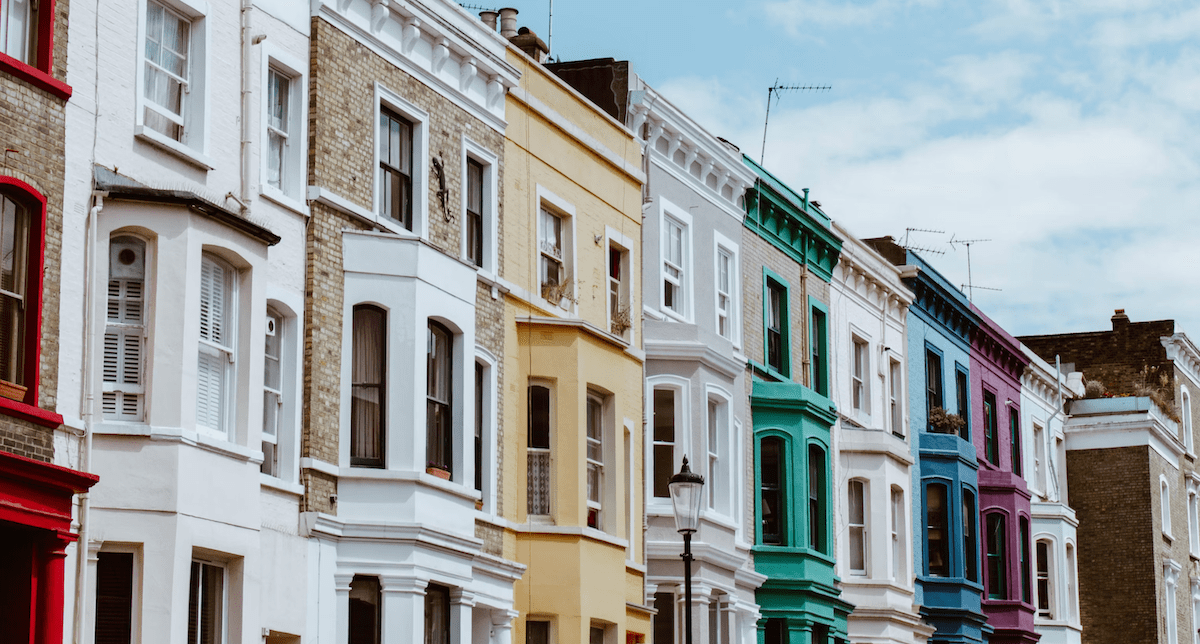
Leinster Gardens in Bayswater is a long white terrace of five-story Victorian houses with Corinthian columns, heavy front doors and iron balconies. Numbers 23 and 24 fit in perfectly with the rest of it, which took some doing, because there’s nothing behind them.
The are clues giving it away if you know where to look. The windows are painted on, they’re just flat grey rectangles that never catch the light the way the real ones do. There are no curtains and the doors have no mailboxes or keyholes. Everything above the front step is a five-foot-thick shell of brick and stucco, propped up from behind with steel girders, and past that is a straight drop into an open railway cutting.
The Metropolitan Railway opened the world’s first underground line in 1863, running between Paddington and Farringdon. Five years later it pushed west through Bayswater, Notting Hill and Kensington, and it did so using the only method available at the time. Cut and cover meant digging an enormous trench through the city, laying the track at the bottom and roofing it over, which meant demolishing whatever was standing in the way. Numbers 23 and 24 came down in 1868.
Most of what the railway knocked down along that route got rebuilt. These two didn’t, because the trains were steam-powered, which meant they had condensers to catch some of the smoke, but they still needed open sections of track at intervals to vent everything they’d built up, or the tunnels would have filled with smoke and become unusable. Leinster Gardens was one of those gaps.
What the railway didn’t want was a hole in the middle of one of the best addresses in the neighborhood, so it built the fronts of the houses back exactly as they had been and left the rest off. Trees went in out front and the windows were painted in. From the pavement the terrace runs unbroken from 22 straight through to 25.
It worked well enough that people have been getting caught by it for more than a century and a half. Delivery drivers have been sent to the address as a joke since at least the early 1900s, and every takeaway and minicab firm in that part of London now flags the address before anyone gets dispatched. In the 1930s, con artists sold tickets to a charity ball at 23 Leinster Gardens for ten guineas apiece. Members of London society turned up in evening dress and stood on the step knocking.
In Underground, Overground, his history of the Tube, Andrew Martin describes visiting in the late 1990s and going into the hotels on either side to ask about it. The staff had no idea, they’d simply noticed that their neighbors were unusually quiet.
The BBC used the facades in the third-season finale of Sherlock, projecting Mary Watson’s face across the front of them before a tracking shot goes over the roofline and shows the whole thing is a wall. It was a reasonable choice for a show about Sherlock Holmes, given that a false building sits at the center of one of Conan Doyle’s stories.
Transport for London maintains the facades now. The line behind them carries Circle and District trains, and they run on electricity, so the venting that the whole arrangement was built for stopped being necessary a long time ago, but still nobody has taken it down.