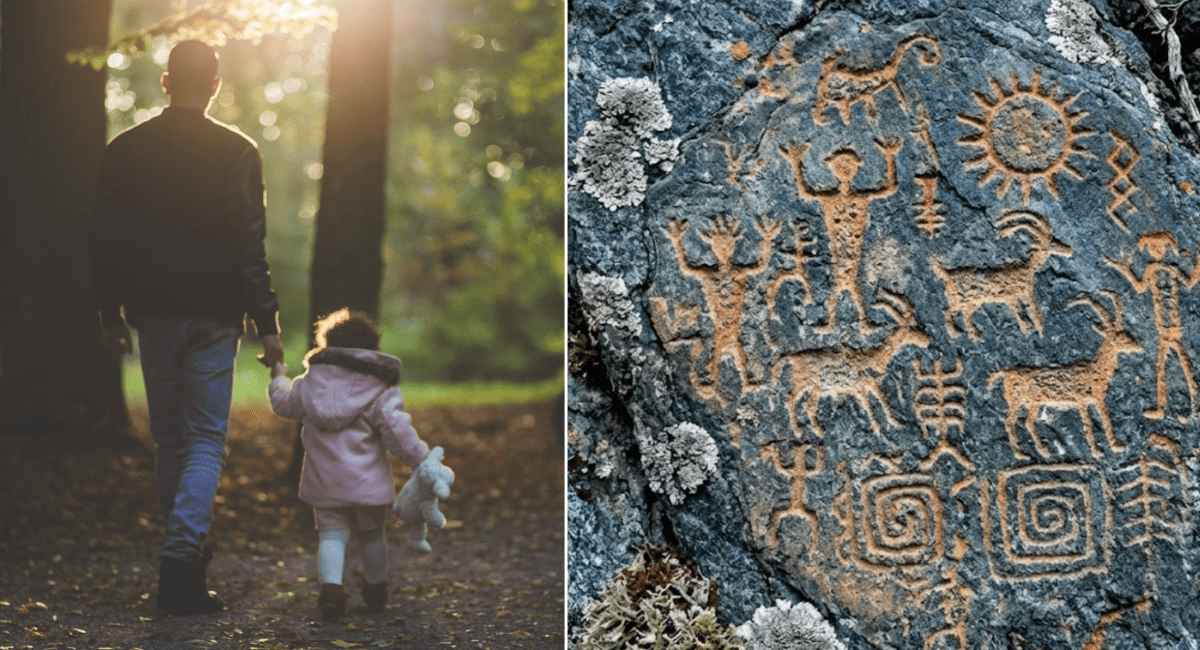
Tormod Fjeld is a graphic designer by day and a rock-carving hunter by passion. He’s been at it for years, and his eye for the terrain is good enough that he and his friends have collectively discovered hundreds of previously unknown carving sites across Norway. So when he was driving his daughter Ada through Bærum in eastern Norway and something about a hillside near Kolsåstoppen caught his attention, he stopped.
What they found had been sitting there for roughly 3,000 years.
Carved into the exposed sandstone were ships. Large, detailed Bronze Age ships, some carved upright, others inverted, packed with small human figures whose heads were rendered with unusual clarity. The scenes may show people sitting in their vessels, possibly wearing helmets. According to Science Norway, which first reported the discovery in late January 2026, some of the ship imagery may be symbolic of trade routes, ritual journeys, or cosmological beliefs about the sun and the afterlife.
But the ships weren’t the most striking part.
Alongside them was a large footprint, clearly showing the sole of a foot, and nearby a carved hand with five thick, wide-set fingers. Human body parts appear far less frequently in Norwegian rock art than animals or ships, which makes them archaeologically significant. Researchers say footprints and handprints at sites like this often signal ritual presence, acts of identity, or a deliberate desire to leave a lasting human trace in a meaningful place. Someone 3,000 years ago stood at that hill and essentially said: “I was here.”
What makes the find particularly unusual is the material. Fjeld typically hunts for carvings in hard granite in the Østfold region. This site is sandstone, which has a completely different surface and requires a different carving technique. “You can almost see each strike as a small indentation in the surface,” he told Science Norway. “It’s also not as densely carved as in hard granite.”
Local archaeologist Reidun Marie Aasheim praised the discovery and noted that limited funding means archaeologists can’t get to every site. “We know there are many cultural heritage sites that still haven’t been registered,” she said. Amateur hunters like Fjeld have become crucial to filling those gaps. He’s located more than 70 sites on his own.
The timing matters because these sites are disappearing. According to a 2018 Cambridge University study, nearly 95% of rock art sites in Norway are at risk from weathering and damage. Norway’s Norwegian National Rock Art Project works to manage, document, and conserve registered sites, and while roughly 150,000 sites are already in the national heritage database Askeladden, experts say that represents only a fraction of what’s actually out there.
Fjeld said the sandstone carvings at Kolsåstoppen were “unbelievably beautiful.” It’s a reasonable reaction to stumbling onto something a Bronze Age community spent considerable effort carving into a hillside three millennia ago, presumably hoping it would last.
It did.