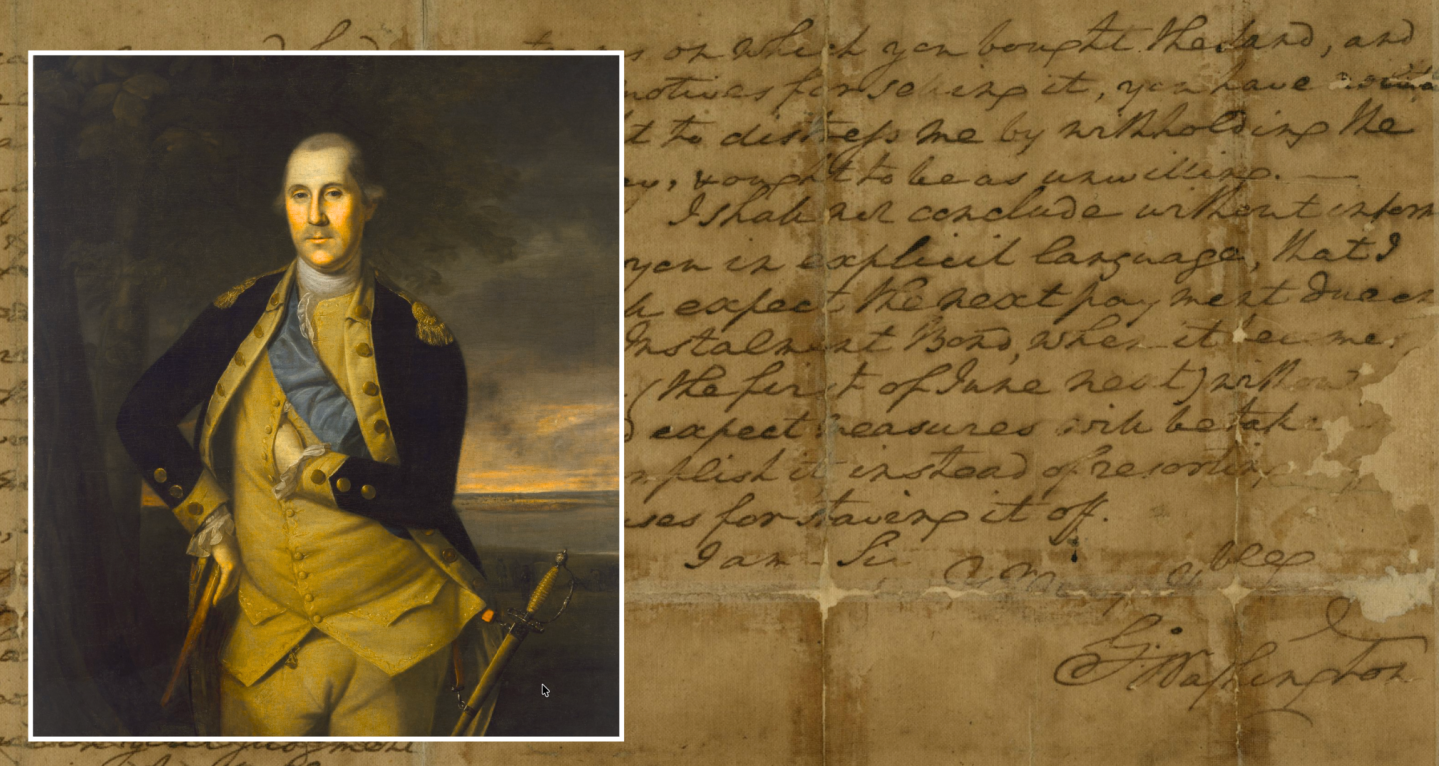
It turns out that George Washington gracing the dollar bill may be a small, historical irony. In the spring of 1787, the man whose face is on the dollar was conspicuously short on them.
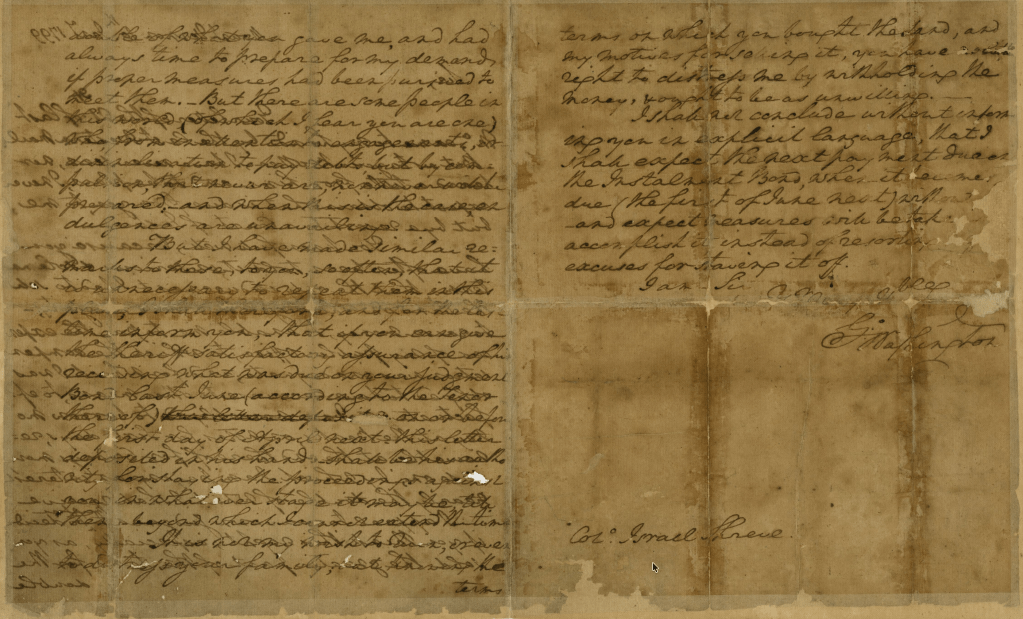
In 2023, the Raab Collection announced a letter that had sat unknown to scholars for more than two centuries. It shows Washington in a distinctly un-mythic moment: land-rich, cash-poor, and trying to fix the problem by selling off a piece of the frontier.
In February 2023, CNN reported the letter is dated March 1787, a couple of months before Washington reluctantly agreed to preside over the Constitutional Convention in Philadelphia. He wanted to be a private citizen at Mount Vernon, tending a long-neglected estate. What complicated that wish was money. He had spent years away commanding the Continental Army, and his plantation’s finances had eroded badly in his absence.
Credit instead of cash
His solution was a 1,644-acre tract along the Youghiogheny River in western Pennsylvania, known as Washington’s Bottom. The would-be buyer was Israel Shreve, a New Jersey farmer who had served under him as a colonel at Valley Forge. Shreve wanted the land but hoped to pay with military certificates, a form of credit. Washington was not interested in credit.
“The land you mention is for sale, & I wish it was convenient for me to accommodate you with it for military certificates; but to raise money is the only inducement I have to sell it,” Washington wrote, adding that certificates, “if they cannot be converted into cash, will not answer my purpose.”
The detail that makes the letter land is the gap between the man and the myth. According to WHYY, Joseph Stoltz of the George Washington Presidential Library explained that Mount Vernon’s agricultural business had declined while Washington was off winning the war, leaving the general in a serious cash hole. Nathan Raab, president of the Raab Collection, put it more plainly. Washington “was in a situation where he was helping family, entertaining people at his home, and he needed money,” Raab said. “It shows him having the kinds of problems that anybody might have, which is, ‘I need cash.’”
Washington’s debt didn’t just go away
There is a harder edge to the picture that the “relatable money problems” framing tends to skip. Washington at times controlled as many as 70,000 acres of land, and the wealth he did have was built and maintained by enslaved people, more than 300 of whom lived at Mount Vernon by the end of his life. His was not experiencing poverty in any meaningful sense. It was illiquidity, the particular bind of the landed gentry whose fortunes were locked up in acreage and crops rather than coin. The letter is a window into that structural problem as much as into one man’s wallet.
It also helps explain why a wealthy planter would hesitate at a summons to Philadelphia. The financial strain was real, the estate needed attention, and selling distant land for cash was a slow, uncertain business. Washington went to the Convention anyway, chaired it, and two years later became the first president. His money troubles followed him into office.
Benjamin Huggins of the University of Virginia’s Washington Papers project called it a genuine discovery, a small but real addition to the record of a man we mostly remember in marble.
There’s one more detail that the years quietly arranged. Washington eventually did sell Shreve the full 1,644 acres, closing the deal during his second term as president, and this time Shreve paid in cash. The two men, the cash-strapped general and the colonel who finally bought his land, died on the same day: December 14, 1799.