upworthy
Add Upworthy to your Google News feed.
Google News Button
Pop Culture

People share the 18 things that are a 'subtle sign' someone is really smart

"They effortlessly communicate complex concepts in a simple way."

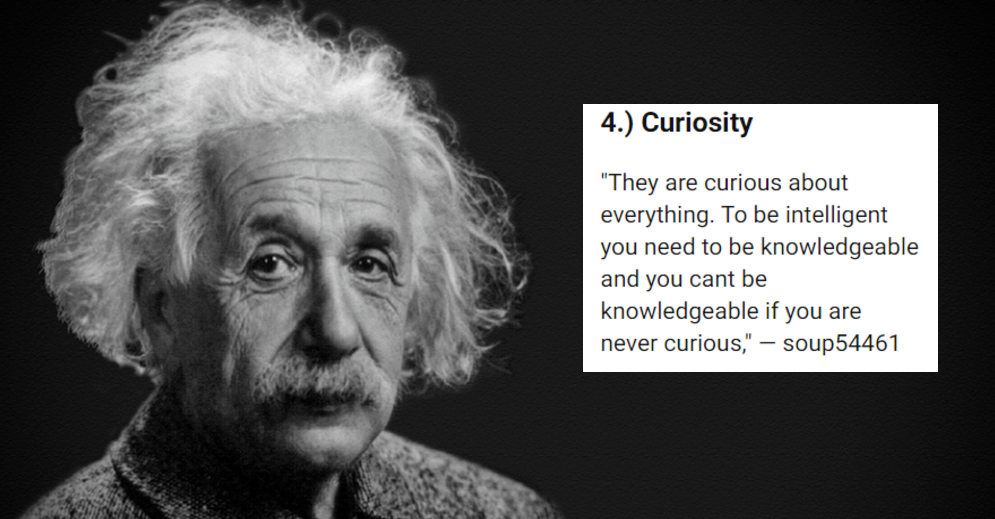
Albert Einstein beside a comment

Albert Einstein

One of the strangest things about being human is that people of lesser intelligence tend to overestimate how smart they are and people who are highly intelligent tend to underestimate how smart they are.

This is called the Dunning-Kruger effect and it’s proven every time you log onto Facebook and see someone from high school who thinks they know more about vaccines than a doctor.

The interesting thing is that even though people are poor judges of their own smarts, we’ve evolved to be pretty good at judging the intelligence of others.


“Such findings imply that, in order to be adaptive, first impressions of personality or social characteristics should be accurate,” a study published in the journal Intelligence says. “There is accumulating evidence that this is indeed the case—at least to some extent—for traits such as intelligence extraversion, conscientiousness, openness, and narcissism, and even for characteristics such as sexual orientation, political ideology, or antigay prejudice.”

Reddit user Gisgiii posed a question to the AskReddit subforum: “What is a subtle sign that someone is really intelligent?”

The answers painted a clear picture of how smart people behave: They tend to be great communicators who understand their audience and are more concerned with getting things right than being right.

Here are 18 of the best answers.

1. They draw wisdom from multiple sources.

"They draw wisdom from multiple sources. Wait but that might be more wise than intelligent... But I guess those two tend to be seen together a lot," — Puzzlehead-Engineer

2. They know their audience.

"They can switch up the way they talk to match the person they're talking to without sounding condescending. They listen to how others learn and explain it in that person's language of understanding," — Wynonna99

3. They develop a keen sense for their job.

"I used to work with a doctor - Tom Howard - and the day I realized he was a genius was the time he guessed every single condition a patient of mine had based on minute pieces of information about him," — Yodei_Mon

4. Curiosity.

"They are curious about everything. To be intelligent you need to be knowledgeable and you can't be knowledgeable if you are never curious," — soup54461

5. They're great at conveying ideas.

"When they explain something they make you feel intelligent," — gwoshmi

6. Considerate questions.

"They spend time thinking before asking a question," — ParkMan73

7. They make hard ideas simple.

"They effortlessly communicate complex concepts in a simple way," — joculator

8. They know what they don't know.

"They know when their knowledge ends and say something to the extent of 'i don't know and anything else i say on this topic is ignorant speculation,'" — blutoboy

9. They ask great questions.

"They can ask really good questions."

"Edit: to anyone not understanding what mean, I’m talking about people who ask “really good questions”, not just any questions, really good ones. I don’t know how one would achieve this skill(I know I haven’t)," — milkmanbran

10. They don't pretend to know everything.

"They aren’t afraid to say they don’t know the answer to a question," — xchernx

11. They change their minds with new information.

"They admit to changing their mind about something," — FarAwayAdventure

12. They pivot well.

"They apply knowledge from one realm into a new and relevant situation," — soubestitch

13. They are open-minded.

"They can genuinely consider an idea which opposes their worldview without necessarily accepting it," — paidshill29

14. They use analogies.

"People who use analogies to explain concepts to others. It’s a form of code-switching and integrating concepts on the fly and is a clear indicator someone is both socially and conceptually intelligent," — SwimmerAutomatic2488

15. They don't argue.

"I think intelligent people are more willing to calmly debate/discuss, rather than argue. Like, you explain to them why you disagree, and they listen to you and ask further questions about your viewpoint before offering a different perspective; as opposed to an unintelligent person, who would just resort to insults when other people disagree with them," — AngelicCinnamonBun

16. They learn from mistakes.

"Admitting when they're wrong and being willing to learn from mistakes," — siyl1979

17. A sense of humor.

"Humor. I think that truly funny people are often very smart and cognizant of the different ways an idea can be humorous on several levels. They also know their audience. I think the difference between say a Jeff Foxworthy and a Dave Chappelle and a Bo Burnham is their audience and their interests," — biscuitboi967

18. A love of learning.

"They say they love learning and they learn something new every day. Then they listen more than talk," — throwingplaydough


This article originally appeared three years ago.

boomer, boomers, boomer clutter, clutter, hoarding, too much stuff

A Baby Boomer stands in his cluttered garage.

Millennials with Baby Boomer parents have not been shy about airing their complaints about the older generation. Millennials have previously noted that their parents tend to hoard food—and now they're are airing their grievances about Boomer "stuff avalanche."

On Reddit, Millennials discussed their frustrations about their Boomer parents and the insane amount of junk they have in their homes that (allegedly) will one day be passed down to them to deal with. Many Millennials shared that it is a source of contention for them, and that they wish their parents would just throw things out.


"3 car garage...cannot fit a single car in there," one commented. And another stated, "I am very concerned with the amount of junk my parents are holding onto."

- YouTube www.youtube.com

A fellow peeved Millennial added, "The worst part is that our parents think this is all worth lots and lots of money. Don’t worry kids, these three sets of china I’m saving for you will be worth millions!"

Another had laid down the law: "My mom kept joking about all the 'stuff' being my inheritance. After a few times I was tired of it, I looked her dead in the face and said in the most monotone I could get. 'I will get the biggest dumpster I can, and it will all go in the trash.' She stopped making that joke, and my parents have been slowly throwing out their junk ever since."

clutter, baby boomer stuff avalance, stuff, too much stuff, decluttering A Baby Boomer garage filled with stuff.Photo credit: Canva

Why Boomers struggle to throw things away

"The Boomer generation grew up in the post-war era shaped by rationing and economic rebuilding," Daniel Glazer, clinical psychologist and co-founder of US Therapy Rooms, tells Upworthy.

He adds that the Boomer inability to let stuff go is often criticized, but when you look at the psychology of their attachment to objects, their behavior makes much more sense.

"Not so long ago, saving things was an adaptive habit. 'That might come in handy' was a common refrain in households in which replacing something was not so easy, or affordable," says Glazer. "There is also an element of emotional security that comes from the things that have surrounded us through decades of life events, or even across a lifetime."

And for many Boomers, getting rid of stuff can signify an even bigger mental battle.

"As people age, there can also be an increased awareness of mortality," says Esin Pinarli, founder and holistic psychotherapist at Eternal Wellness Counseling. "Letting go of objects can feel symbolic, almost like letting go of chapters of their life. If no one is asking about those chapters anymore, those objects become the tangible proof that those experiences mattered. So it’s not stubbornness. It’s often about attachment, meaning-making, and a fear of losing relevance or erasing parts of their story."

How to help Boomers declutter

- YouTube www.youtube.com

Starting the conversation with Boomer parents in an empathetic and understanding way may help the process go more smoothly and deepen the relationship between them and their children. Here are a few examples of conversation starters Millennials can use when talking to their Boomer parents about decluttering:

Conversation Starter #1: "I know these things mean something to you. I’d love to hear the story behind a few of them."

"This shifts the focus from getting rid of objects to honoring the meaning behind them," says Pinarli. "When a parent feels seen and understood, they’re often more open to eventually letting go. It validates that the attachment is about memory and identity, not just stuff."

Conversation Starter #2: "What would feel good for you to keep, and what feels like it’s just taking up space now?"

"This gives them agency," Pinarli explains. "Instead of telling them what to throw away, it invites them to reflect on what still feels meaningful versus what might no longer serve them. That sense of control reduces defensiveness."

Conversation Starter #3: "Would it help to go through this together so we can make sure the important things are preserved?"

"This frames decluttering as a collaborative and supportive process, not a demand," Pinarli shares. "It reassures them that their memories and legacy won’t be dismissed or erased, which can lower the emotional intensity around letting go."

Kaitlyn Brande TikTok, boomers vs Gen Z restaurant, waitress table etiquette, generational debate TikTok, stacking plates restaurant, server etiquette viral, boomer Gen Z manners, restaurant worker TikTok, viral waitress video, dining etiquette generational
Canva

Young people enjoying a big dinner

In March 2020, an 18-year-old waitress from Utah named Kaitlyn Brande (@katebrande) pointed her phone camera at two tables in her section and said exactly what she was thinking. The video was 20 seconds long. It hit 9.3 million views, got her reprimanded by her employer, and launched a generational argument that apparently has no expiration date, because here we are again.

The setup is simple. Brande pans to the first table, still scattered with plates, napkins, and leftover food. "Here's all I'm saying," she says. "This is a table of five boomers that I took some plates out of the way of already." Then she swings the camera to the table next to it, where every plate has been stacked neatly at one end, cups grouped together, trash consolidated. "This is a table of six Gen Zs. They did that. Just saying."


Her caption did the rest: "They get paid to do that" VS "We know restaurant life is hard, here, let us help you out."

@katebrande

“They get paid to do that” VS “we know restaurant life is hard, here, let us help you out”

When the video hit 9.3 million views, corporate noticed. Brande deleted it. Then she quit the job and reposted it. In a BuzzFeed interview at the time, she was careful to clarify what she was and wasn't saying. "I'm not saying I expect people to ever stack their plates like that, because hey, I'm a person too," she told BuzzFeed. "All I'm saying is it was cool and helpful of the younger people, and I appreciated it." Her stated motivation was the irony of it: older generations tend to be the ones demanding respect from younger ones. "I posted it because I thought it was ironic since older people always expect respect," she said.

Kaitlyn Brande TikTok, boomers vs Gen Z restaurant, waitress table etiquette, generational debate TikTok, stacking plates restaurant, server etiquette viral, boomer Gen Z manners, restaurant worker TikTok, viral waitress video, dining etiquette generational Dirty dishes left on a tableCanva

The comments, then and now, split in every direction. Some people praised the Gen Z table for the gesture. Others pushed back on the framing entirely, pointing out that stacking plates isn't automatically helpful, and can actually make a server's job harder depending on how it's done. @rayvenia wrote: "Half of your server squad would prefer the plates not stacked. You all need a handbook to get it together." @skyerose1213 the more measured version of that argument: "I was taught by the main dishwashers to always be cautious about how you stack, and leave it if you don't know how. However, there is a difference between cleaning up your area and 'leaving it.'"

Kaitlyn Brande TikTok, boomers vs Gen Z restaurant, waitress table etiquette, generational debate TikTok, stacking plates restaurant, server etiquette viral, boomer Gen Z manners, restaurant worker TikTok, viral waitress video, dining etiquette generationalGif of overwhelmed waitress via Giphy


Others bypassed the plate-stacking question and went straight to the generational read. @bhaobansidhe commented: "It doesn't matter even if they do get paid for it, it helps the staff out, especially if it is hella busy and they don't get as much money as you think." @mariannlws52, who identified as Gen X, wrote: "I have been cleaning up tables for waitstaff for decades. Not only is it helpful, but it's also the right thing to do." And some people on the other side simply noted that clearing tables is, in fact, part of the job description, and that customers shouldn't feel obligated to do it.

What keeps this video resurfacing every year or two isn't really about plates. It's about what those plates represent: who sees service workers as people doing a hard job under pressure, and who doesn't register them much at all. That's a question without a clean generational answer, which is probably exactly why nobody can stop arguing about it.

Kaitlyn Brande TikTok, boomers vs Gen Z restaurant, waitress table etiquette, generational debate TikTok, stacking plates restaurant, server etiquette viral, boomer Gen Z manners, restaurant worker TikTok, viral waitress video, dining etiquette generational YouTube

This article originally appeared earlier this year.

Woman on a mission to bring back lost Black American recipes has people gasping at vinegar pie

Most of the recipes were created out of poverty to provide families with a sweet treat.

lost recipes; Black American recipes; pie; Black history; vinegar pie
Images via Canva

Woman on a mission to bring back lost recipes has people gasping at vinegar pie.

People get very creative when it comes to cooking with limited ingredients and no budget. This combination is something people who lived through the Great Depression were very familiar with. It's also something Black Americans experienced frequently in the 1800s, but time has stolen many of the ingenious recipes. Until now.

One woman is on a mission to dig up these lost recipes for Black History Month. All February, Sonja Norwood, who runs the social media page for Wick'd Confections and owns Sonja Norwood Custom Cookies, has been baking up long-lost Black American recipes. Though the ingredients have folks scratching their heads, her videos clear things up by sharing each dish's history.


@wickdconfections

Peanuts became a major Southern crop after the Civil War, and at Tuskegee Institute, George Washington Carver helped popularize peanuts as an affordable, soil-restoring crop with hundreds of uses. In Black Southern kitchens, that peanut power turned into breads, cookies, cakes, candy… and survival baking. During the Great Depression and WWII rationing, butter, eggs, and milk were often scarce. Peanut butter became the substitute for fat and protein, and peanut butter bread became a school-lunch staple and family recipe passed down through generations. Serve warm with a nostalgic molasses glaze and you’ll understand why this deserves a comeback 🤎 🥜 Peanut Butter Bread (One-bowl, no eggs, no butter) Ingredients 1 ¾ cups all-purpose flour (220 g) ½ cup granulated sugar (100 g) ¼ cup brown sugar (50 g) 1 tbsp baking powder ½ tsp salt 1 cup milk (240 ml) ¾ cup creamy peanut butter (190 g) 1 tsp vanilla extract Optional topping: 2 tbsp sugar Instructions 1️⃣ Preheat oven to 350°F / 175°C. Grease a 9×5 loaf pan. 2️⃣ Whisk flour, sugars, baking powder, salt. 3️⃣ Add milk, peanut butter, vanilla. Mix until just combined. 4️⃣ Spread into pan, sprinkle sugar if using. 5️⃣ Bake 50–60 min until toothpick comes out clean. 6️⃣ Cool 15 min, remove, slice. ✨ Molasses Glaze 2 tbsp butter (28 g) 3 tbsp molasses (45 ml) 2 tbsp milk (30 ml) 1 cup powdered sugar (120 g) ¼ tsp vanilla + pinch salt Optional: pinch cinnamon or ginger Melt butter, whisk in molasses + milk until warm. Remove from heat and whisk in powdered sugar until smooth. Stir in vanilla and salt. #BlackHistory #BlackHistoryn#TikTokLearningCampaign##FoodHistorye#VintageRecipes

One particular recipe caused the former Food Network contestant to give a disclaimer before tasting it, saying, "Before I try this, we understand that there's a reason this pie exists, right? It's genius. Very creative. That does not mean I have to like it."

A unique recipe

Norwood tried her hand at vinegar pie, and just like viewers of the video, the baker was unsure how the dessert would turn out:

"Vinegar pie, also known as desperation pie, is classified as a pantry or make-do pie. As you can tell, this pie was born out of necessity, when fruit or citrus lemons were hard to come by. Home cooks used what they had on hand. Simple pantry staples to make something sweet, like sugar, eggs, butter, flour, and salt. A lot of people associate vinegar pie with the Great Depression, when fresh fruit was super expensive and scarce, but recipes go back much further. As early as 1855."


@wickdconfections

Navy Bean Pie 🥧✨ A true heritage dessert with deep roots in Black American food culture. This traditional navy bean pie has a smooth, firm custard texture — rich, lightly spiced, and beautifully sliceable without hours of chilling. Simple ingredients, timeless flavor, and a recipe shaped by community and history. 🥧 Classic Navy Bean Pie (9-inch) Texture: traditional • smooth • firm custard • faster set Crust
• 1 (9-inch) pie crust (homemade or store-bought) Filling
• 1½ cups cooked navy beans (300 g) OR 1 (15-oz) can, drained & rinsed
• ¾ cup unsalted butter, melted (170 g)
• 1 cup evaporated milk (240 ml)
• 4 large eggs
• 1 cup granulated sugar (200 g)
• 2 tbsp all-purpose flour (15 g)
• 1 tbsp cornstarch (8 g)
• 1 tbsp vanilla extract
• 1 tsp cinnamon
• ½ tsp nutmeg
• ½ tsp salt ⭐ If using canned beans (flavor boost)
• Rinse well
• Simmer in fresh water 5–10 minutes
• Drain completely Instructions
1️⃣ Preheat oven to 350°F / 175°C
2️⃣ Blend beans until completely smooth and creamy
3️⃣ Whisk butter, sugar, eggs, milk, vanilla, spices, flour, and cornstarch
4️⃣ Stir in blended beans until smooth
5️⃣ Pour into crust and smooth top
6️⃣ Bake 45–55 minutes (edges set, center barely jiggles)
7️⃣ Cool 1 hour at room temp, chill 1 hour for clean slices Slice, serve, and enjoy ✨ #BlackHi#BlackHistoryn#LearnOnTikToke#BeanPies#FoodHistoryalCooking

For the recipe, the custom cookie maker used vanilla, honey, and apple cider vinegar in the runny mixture. At first glance, it’s hard to see how this could turn into a pie meant to be cut and eaten with a fork, as it has the consistency of French toast batter. But once it’s poured into a pie pan and popped into the oven, it begins to look like a pie.

"Black cooks in the South and the Midwest adapted pantry-based dishes like this into their family food culture," Norwood shares while mixing ingredients. "So you were going to see this pie at Sunday dinner and on special occasions, and it doesn't taste the way you think a vinegar pie would taste. The acidity cuts through the sweetness and mimics lemon pie without the fruit."


@wickdconfections

Lost Black American Recipes: Vinegar Pie 🥧 To kick off Black History Month, I’m starting a series honoring lost and forgotten Black American recipes—beginning with vinegar pie. Also known as desperation pie or pantry pie, this dessert was born from necessity. When fruit and citrus were scarce, home cooks used simple pantry staples to create something sweet, comforting, and joyful. Made with sugar, eggs, butter, and a splash of apple cider vinegar, vinegar pie has a flaky crust and a rich custard filling. The vinegar doesn’t make it sour—it adds brightness, mimicking the tang of fruit and balancing the sweetness. It’s a reminder of how Black foodways transform struggle into creativity and care. 🖤 Vinegar Pie Recipe (9-inch pie): 4 eggs ½ cup sugar ½ cup brown sugar ½ tsp vanilla 6 tbsp butter, melted 2 tbsp apple cider vinegar 2 tbsp honey 2 tbsp flour ¾ tsp salt Unbaked 9-inch pie crust Blind bake crust at 350°F (175°C). Whisk remaining ingredients until smooth, pour into crust, and bake 35–45 minutes. The center should still wobble slightly when gently shaken. Cool completely and dust with powdered sugar. Follow along as we honor Black history through food—one lost recipe at a time. #BlackHistoryMonth #BlackAmericanFood #LostRecipes #BlackFoodHistory #FoodReels

Viewers were shocked at how good the pie looked when it was done. Some even plan to give the Black American recipe a try. One person writes, "I[t] looks good and it was way less vinegar than my mind thought lol."

Another says, "This looks so good! My grandma is 93 born & raised in Georgia and she swears by this pie & buttermilk pie. She watched this & just kept saying 'yup, yup' so I know it’s good."

This person appreciates the history: "I appreciated acknowledging that it came out of necessity and that you don't have to like it. Sometimes people have to make due with what they have and it's not always what you necessarily want."


@wickdconfections

Lost Black American Recipes: Blackberries & Dumplings 🍇🥟 Blackberries and dumplings is a sweet summertime dish rooted in Black American food culture. When sugar and money were scarce, the land provided. Black families relied on foraging, gathering blackberries that grew freely along fence lines, woods, and roadsides across the South. What began as necessity became tradition — turning simple ingredients into a communal, nourishing meal. Passed down orally and cooked intuitively, this dish was rarely written into cookbooks. Flour stretched what little was available, dumplings absorbed the berry juices, and one pot could feed many for very little. Though we still see cobblers today, blackberries and dumplings remain a largely forgotten seasonal treat — one deeply connected to land, resilience, and care. Blackberries & Dumplings Recipe Blackberry Syrup: 4 cups blackberries 1 cup sugar 2 cups water 1 tbsp lemon juice Lemon zest Dumplings: 2 cups flour ¼ cup sugar 1½ tsp baking powder ½ tsp salt ¼ tsp nutmeg ¾ cup milk 1 egg 1 tsp vanilla Simmer blackberries with sugar, water, lemon juice, and zest until juicy. Mix dumpling dough until it feels right. Drop spoonfuls into simmering berries, don’t stir, cover and cook 15 minutes. Uncover and simmer 5 more minutes. Serve warm with plenty of syrup. Follow along as I honor Black history through lost recipes — one pot at a time. #BlackHistory #TikTokLearningCampaign #BlackAmericanFood #LostRecipes #FoodHistory

"This is brilliantly done," someone else writes. "Showing the ingenuity and innovation of Black folks is beautiful! This video is information and funny! I'm glad you actually liked the pie. Def going to ask my 90 year old granny about this recipe. Thanks for posting this."

Vinegar Pie Recipe (9-inch pie):

4 eggs
½ cup sugar
½ cup brown sugar
½ tsp vanilla
6 tbsp butter, melted
2 tbsp apple cider vinegar
2 tbsp honey
2 tbsp flour
¾ tsp salt
Unbaked 9-inch pie crust

Blind bake crust at 350°F (175°C). Whisk remaining ingredients until smooth, pour into crust, and bake 35–45 minutes. The center should still wobble slightly when gently shaken. Cool completely and dust with powdered sugar.

costco, costco cake, costco cakes, costco cake order, costco custom cake app
Canva/Wikimedia

Costco announces new app for custom cake orders.

Loyal Costco fans are lauding their favorite big-box store for a long-awaited change to its custom cake ordering system. In a company memo, Costco announced that it will be launching an app for customers to order customized cakes at the touch of their fingers without having to enter a Costco store.

"We've got ordering cakes and deli trays online coming," said Costco CEO Ron Vachris. "Many of the things that we've heard from our members that could be a little bit clunky are now moving to a digital state, and we're seeing great adoption right out of the chute."


It's a massive change from the previous custom cake process. Costco lovers have long complained about the old-school ordering system that required customers to physically go to the store's bakery, where they would fill out a slip of paper with their order requests and simply drop it in the order box.

@eatsbyrachel

Anyone else feel like the @Costco Wholesale custom cake ordering system is a bit antiquated? 🤔 Regardless, their analog process somehow always works 💯 #costco #costcobakery #cake #customcake #costcodoesitagain #costcocake #costcofinds #costcodeals #costcofind #costcofinds #eatsbyrachel

Costco's "1800s" custom cake ordering

Back in 2023, writer Lucy Huber humorously poked fun at Costco's seemingly outdated custom cake ordering system that resonated with fellow Costco shoppers. And her words went viral:

"Ordered a cake from Costco and their system is from the 1800s, you write what you want on a piece of paper & put it in a box then nobody follows up and you just show up and hope they made it? I tried to call to confirm & they were like 'if you put it in the box, it will be there'," she wrote.


It was a system that also caused Costco members on Reddit a lot of anxiety.

"We did our wedding cakes from Costco, talk about a nerve-racking experience hoping everything worked out," one wrote.

Another shared, "Drop a paper in a hole and cross your fingers 🤣🤣."

Costco customers have mixed feelings

Many Costco customers and Redditors expressed their positive reactions to the updated ordering system news:

"As someone who lives 1.5 hours away from three different Costcos I LOVE this. I'm rarely in the market for a custom cake, but when I am I'm not driving an hour and a half to fill out the request form in store."

"This is GREAT! But will I also be able to order chocolate cake with white icing and vice-versa? Because currently I can’t do that at my Costco."

"While the box system worked, it was archaic. With anything, the new system will take time to implement."

"Jumping from the 19th century to the 21st century. Bravo Costco!"

Others weren't as happy:

"Kind of sad in a way. There are not too many interactions like this in the digital age."

"But the Paper & Pencil worked."

"Coming in 2027: I didn't get my cake at Costco because Amazon-East-1 is down :(."

"I have ordered many cakes with this low tech. Never an issue."

Costco bakery workers react

Workers in Costco bakeries also chimed in, many with negative opinions:

"As someone who works in the bakery this is going to be a disaster. Half the people don’t even know the name on the order or what the cake says when they come to pick up. Like 2 times a week we get someone trying to pick up at the wrong Costco."

"As a bakery employee, this is going to be a nightmare. The whole point of keeping the order form in warehouse only was to not overwhelm our staff AND (this one being the real reason I was given), is it makes people come in and 'grab a few items while their there, and then again when they come pick up the cake.' I am not looking forward to this. People are going to order at the wrong Costco, not do it right and then get mad at us. I'm terrified of this change 🫣."

"As someone who has worked in the bakery at Costco, the prevailing thought has been 'the system we have works fairly well, so they’re probably not gonna change it.' It’s the same reason that the major sales department still uses paper slips for computers. Well, except for the apple tables. Those have a little iPad kiosk that will print out your slip for you, but literally none of the members ever use it and instead ask us to do it for them."