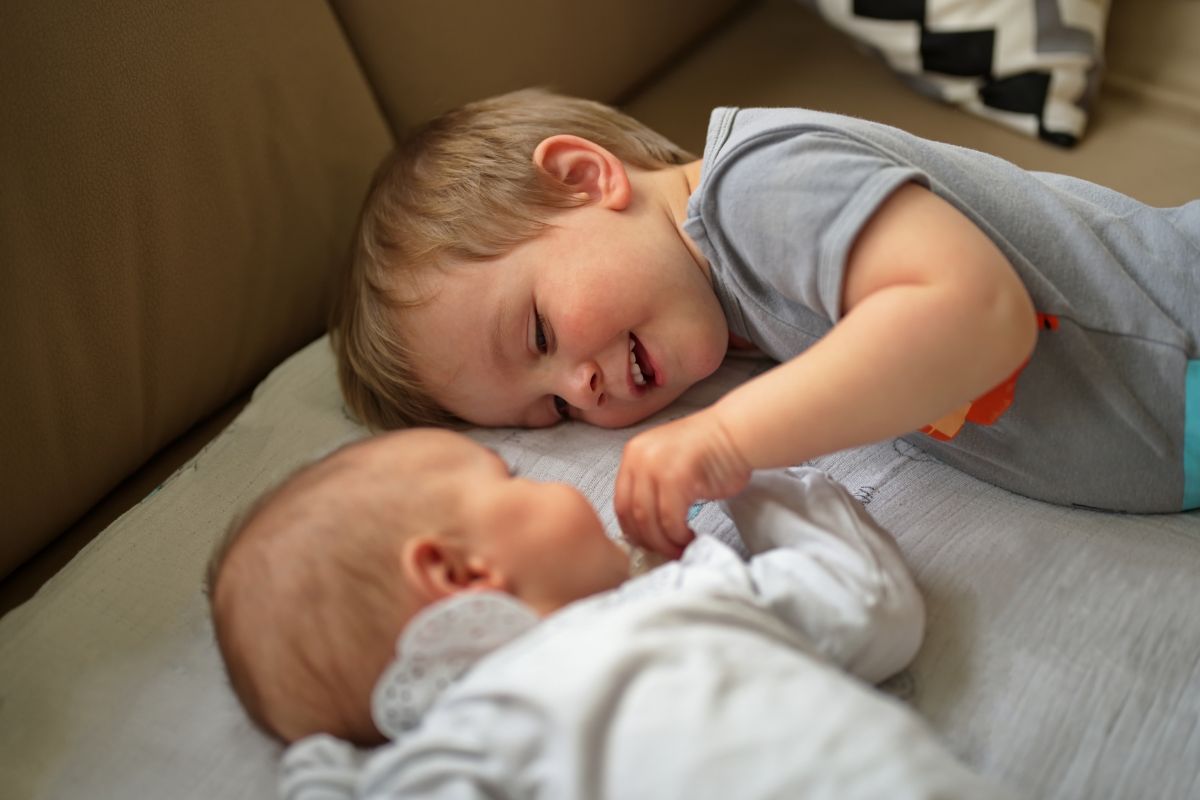
It sounds like the setup to a riddle: How can one mom have two kids who were conceived at the exact same time but born three years apart?
Well, there are no tricks in this real-life story. But there is some extremely cool science.
Mom reveals how her ‘twins’ were conceived at the same time but born three years apart
Taylor Greenhagen is a popular social media creator who shares her life as a mom of two. She’s built a following with her raw-yet-hilarious takes on pregnancy, marriage, and life with young kids.
She’s also been vulnerable and open over the years about her journey with in vitro fertilization, or IVF.
By now, most people are familiar with the basics of IVF. In recent years, it has become far more mainstream and accessible for growing families. In the United States, more than 100,000 babies were born through IVF last year—an all-time high.
Still, IVF is expensive and complex. There’s a lot most hopeful parents don’t know about the process, and that’s where people like Greenhagen are making a difference.
In a recent TikTok post that’s now gone viral, she shared how she ended up with two IVF babies from the same cycle who were born years apart.
“My son and daughter were conceived at the same time via IVF in 2022 and spent the first 5 days of their lives as embryos growing side by side,” she wrote in the caption over footage of the two snuggling and playing adorably. “One was born in 2023 and the other in 2025. Now they’re finally together. Our ‘fraternal twins’ are reunited.”
Frozen embryo transfer is real science that sounds like science fiction
A cycle of IVF involves stimulating the ovaries to mature multiple eggs at once, retrieving the eggs when they’re ready, and fertilizing them with sperm in a laboratory.
It’s a delicate and complex process, and there are no guarantees it will result in a viable embryo.
However, sometimes the process results in multiple viable embryos. One or more can be transferred to the mother’s uterus, while any remaining embryos can literally be frozen for future use. It sounds like something straight out of Austin Powers, but it’s true: A frozen embryo can remain viable almost indefinitely.
One study even found successful, healthy pregnancies resulting from embryos frozen for more than 20 years.
So while Greenhagen’s children were both conceived at the same time in the same lab, and grown and monitored together for several days, one of them was then frozen before becoming her baby daughter a few years later.
Fellow IVF parents agree: These special twins need a cool name
Greenhagen, in her post, refers to the kids as “fraternal twins.” In the traditional sense, fraternal twins are two separate eggs fertilized by two different sperm during the same pregnancy. But Greenhagen told Newsweek the term is also used in the IVF community to refer to babies from the same IVF cycle, or group of embryos, even when they’re born at different times.
There are also identical twins, of course, who share 100% of the same DNA. There are even “mirror-image” twins, who are genetically identical but have certain features reversed—for example, a birthmark on opposite sides of the body or opposite dominant hands.
In rare cases, a woman who’s already pregnant can become pregnant again if she ovulates and another egg is fertilized during the existing pregnancy. The babies are typically born at the same time despite being conceived days or even weeks apart—a phenomenon known as superfetation.
But is there a more descriptive, accurate name for these frozen-embryo twins born years apart?
Commenters on Greenhagen’s video had a few ideas:
“We call our ‘twinbryos’”
“Science twins”
“Twiblings”
But the best—and most fun—suggestion came from a commenter named Chelsea, who wrote, “Time travel twins.”
Whatever parents end up calling them, two IVF siblings born years apart are nothing short of a modern miracle. After the expensive, invasive, exhausting, and emotional journey of IVF, a parent could hardly ask for a more beautiful outcome.