According to an April 2024 Gallup poll, 54% of Americans identify as part of the middle class, with 39% identifying as “middle class” and 15% identifying as “upper-middle class.” That percentage has held fairly steady for years, but what it feels like to be a middle-class American has shifted for many. In fact, a Pew Research Center survey released in August 2026 found that 60% of U.S. adults now say “working class” describes them well, up from 54% in 2024, including half of upper-income adults.
Notably, inflation that spiked after the pandemic has hit middle-class families hard, with incomes not keeping up with cost-of-living increases: inflation-adjusted hourly earnings fell 0.7% over the year ending September 2026, according to the Bureau of Labor Statistics. Housing costs have skyrocketed in many areas of the country, the average 30-year mortgage rate was 7.32% as of Oct. 22, 2026, up from 6.19% a year earlier, and grocery bills have increased significantly. Overall, prices are up about 29% since January 2021, according to Bureau of Labor Statistics data, putting a squeeze on everyone, including the middle class.
How much do families really have saved?
In July 2024, one woman shared that her family is just getting by and asked other middle-class people to “chime in” with what they have in their savings accounts.
“I swear, every paycheck I am putting money into my savings, but needing to transfer it back within a few days,” shared @abbyy..rosee on TikTok. “My registration is due. My husband’s registration is due. He needed two new tires, even though they had a warranty. That’s $300. My oldest needs braces, he needs a palate expander, that’s $120 a month. Not to mention groceries are $200 more a week. Forget about feeding your family great ingredients because who has $500 a week to spend on perfect ingredients to feed your family?”

She explained that her husband makes enough money that they should be able to live comfortably, and that she quit her job because the cost of daycare was more than she was making.
“At some point, something has to give,” she said. “What is going on? How do I save money?”
The answers were eye-opening
People in the comments chimed in with their savings account totals and it was quite eye-opening. Many people shared that they have $0 saved.
“We make the most money we ever have and have zero savings. We live paycheck to paycheck and every month I don’t know how we get by.”
“I think the middle class is 1 personal disaster away from bankruptcy.”
“Y’all got savings accounts?!?!”
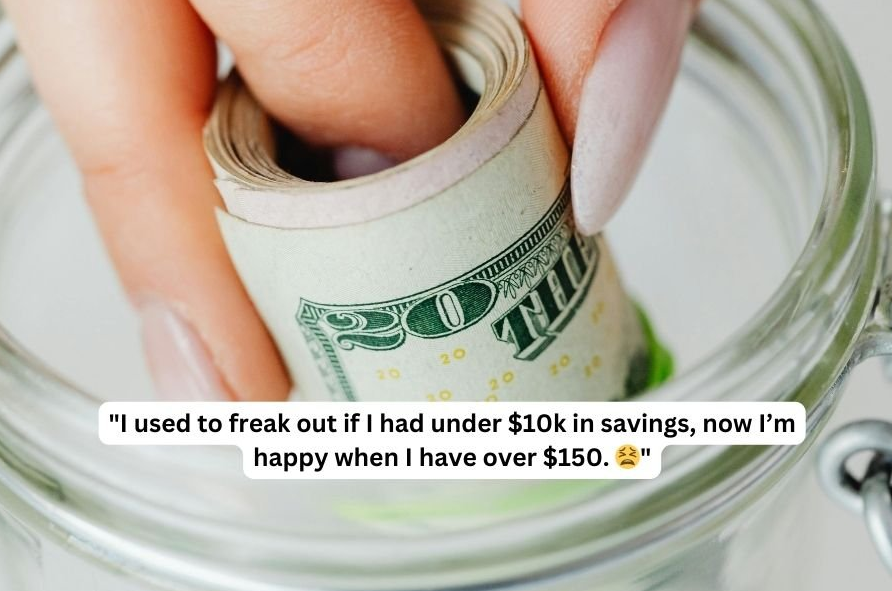
“I used to freak out if I had under $10k in savings, now I’m happy when I have over $150.”
“We make almost 100,000 a year with no savings!!!! It’s always something!!”
“I’m lucky if we have $500-$1K for an emergency. Every single time we start saving, something happens: the vet, the cars, the kids… something.”
“Savings account? I transfer money each paycheck but always end up needing to transfer it back. My husband makes great money too but we are scraping by.”
“$803 but we have to pay a $750 deductible this week b/c my Husband hit a deer soooo… back at it It’s exhausting. Constantly draining it, refilling it, transferring.”

Why saving feels so out of reach
Some people shared that they do have some savings, but several said it was because they’d had an inheritance or other chunk of money come their way. Many people shared that their savings has dwindled as increased costs have taken their toll. Some people gave lifestyle advice to save money, but most agreed that just the basics have gotten so expensive it’s harder to make ends meet, much less put extra into savings.
Inflation had been cooling earlier this year, but it has picked back up: consumer prices rose 3.7% over the 12 months ending in September 2026, up from 2.4% in January, according to the Bureau of Labor Statistics, with gasoline prices up 34% over the year. Even just plateauing at their current financial reality isn’t ideal for many American families. Middle class is supposed to be a comfortable place to be: not rich, but well enough off to feel secure. That’s not how many middle class folks feel, though. Most Americans don’t have anything close to the amount of money saved that is recommended across the age spectrum, but at least hearing that others are in the same boat is somewhat comforting.
What the national data says
Further, a 2024 Empower study found that 37% of Americans can’t afford an unexpected expense over $400, and 21% have no emergency savings at all. The Federal Reserve’s most recent survey, released in May 2026, found that 63% of adults would cover a $400 emergency completely with cash or its equivalent, and that 55% had set aside three months of expenses in an emergency fund. “Not all surprises are good, and people know it. The study suggests financial precarity at a time when household finances may be stretched due to rising prices and inflation,” said Rebecca Rickert, who was head of communications at Empower at the time. “Life happens, and people are stressed about the surprise expenses that could tip them off-balance.”
It can be vulnerable to share your financial reality, but it’s helpful to hear what other people are doing and dealing with so we all feel less alone when we’re struggling. Perhaps if people were more open about money, we’d all be able to help one another find ways to improve our financial situations rather than lamenting our empty savings accounts and wondering how to change them.
This article originally appeared two years ago. It has been updated.