upworthy
Add Upworthy to your Google News feed.
Google News Button
More

Michelle Obama Makes Me Not Hate Politics For One Beautiful Moment

I've never seen a convention speech elevate the discourse before. Until now. Below the video is the list of all the awesome moments, and their time stamps, if you only have time to watch the best bits.


  • At :55, she talks about awesome Americans.
  • AtAt 3:00, she talks about tragic date nights.
  • At 3:40, she pulls out the old days were so rough bit. With a coffee table.
  • At 4:40, we learn the tragic and beautiful story about her dad.
  • At 5:40, she reminds us why government and family are important.
  • At 7:00, she reminds us why being a woman is harder in this country.
  • At 7:40, she defines what it means to be an American more eloquently than a Founding Father.
  • At 8:30, she explains everything wrong with the media and politics today.
  • At 9:30, she makes the most eloquent case for Obama's presidency I have heard thus far. (Though she's probably biased.)
  • At 11:00, she rattles off his accomplishments.
  • At 12:30, she explains why all women should probably vote for him.
  • At 13:00, she explains how out of touch Mitt is, without ever mentioning his name. Well played.
  • At 14:20, she explains what being an American means in yet another beautiful way.
  • At 15:20, she explains what being a good Christian is.
  • At 15:55, she reminds me what being a new dad is all about.
  • At 16:20, I start getting a little teary. At 17:30, the crowd stops yelling.
  • At 18:00, she asks us to listen to our better angels.
  • At 19:40, she yet again defines what it means to be an American, in yet another awesome way.
  • At 21:00, she pulls out some mom guilt and demands you vote.
  • From 21:30 to 23:10, she makes me get teary again. Not cool.
  • From 23:20 to the end she makes me want to go home and hug my kids and then go out and get people to vote and then vote myself.


STOP MAKING ME CARE ABOUT POLITICS! Every time I get out, they pull me back in!

Now I have to share this. GAH.
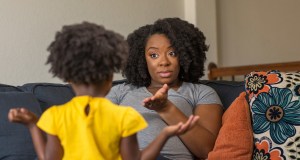
boomer grandparents, boomer grandparent, millennial parents, millennial parent, grandkids
Image via Canva/PeopleImages

Boomer grandparents are excessively gifting their grandkids, and Millennial parents have had enough.

Millennial parents and Boomer grandparents don't always see eye to eye on parenting and grandparenting. Now, Millennial parents are uniting on a nightmare Boomer grandparenting trend that sees them "excessively gifting" their grandkids with tons of both new and old *unwanted* stuff during visits.

Ohio mom Rose Grady (@nps.in.a.pod) shared her "Boomer grandparent" experience in a funny and relatable video. "Just a millennial mom watching her boomer parents bring three full loads of 'treasures' into her home," she wrote in the overlay.


Grady can be seen looking out the window of her home at her Boomer mom and dad carrying bags and boxes up her driveway after several visits. The distressed and contemplative look on Grady's is speaking to plenty of Millennial moms.

@nps.in.a.pod

Today's "treasure" highlight was the mobile that hung in my nursery... #boomerparents #boomers #boomersbelike #millennialsoftiktok #millenialmom #motherdaughter

Grady captioned the video, "Today's 'treasure' highlight was the mobile that hung in my nursery..."

The humorous video resonated with with fellow Millennial parents. "Straight to the trash when they leave," one viewer commented. Another added, "I always say 'if you don’t want it in yours, we don’t want it in ours' 😂."

Even more Millennial parents have shared and discussed their situations with Boomer grandparents buying their kids too much stuff on Reddit. "Both my mother and my MIL love buying and sending toys, books, clothes, etc. I don't want to be ungrateful but we just don't need it and don't have the space. I have brought this up politely in 'we are all out of drawers for that' but it hasn't slowed things down," one explained. "I think part of the issue is that the grandparents live in different cities and vacation a lot. They don't get to see our daughter much so they buy stuff instead."

Another Millennial parent shared, "While the intention is very kind behind these, all the grandparents are very aware that we do not need, nor wish to receive these gifts in such an excessive volume - as it creates a daily struggle to store and accommodate in our home. I struggle to keep on top of tidying as it is, and this is a massive added challenge."

millennial parents, millennial parent, millennial mom, kids room, organize Millennial mom struggles to organize her son's room.Image via Canva/fotostorm

How to talk to Boomer grandparents about gifts

So, why are Boomer grandparents excessively gifting? "Boomer grandparents may be the first grandparent generation to have accumulated the substantial discretionary funds that enables them to spend money on their grandchildren," Sari Goodman, a Certified Parent Educator and founder of Parental Edge, tells Upworthy. "These grandparents probably grew up with grandparents who didn’t have that kind of money and so they may be excited to give their grandchildren the things they didn’t get."

Goodman suggests that Millennial parents first discuss with them the "why" behind the gifting. "What comes before setting a boundary to limit over-the-top gift-giving is delving into the reasons grandparents are buying so much," she explains. "Coming from a place of compassion and understanding makes it possible to come up with mutually beneficial solutions."

- YouTube www.youtube.com

She recommends that Millennial parents sit down with their Boomer parents to learn more. "Did they grow up without many toys and clothes and are fulfilling a dream? Ask them about the values they learned as children (hard work, perseverance, the power of delayed gratification) and how they can pass on these lessons to the grandchildren," she suggests.

She adds that another reason may be that Boomer grandparents live far away and want their grandchildren to feel a connection with them. "Set up a regular FaceTime or Zoom meeting. Rehearse with the kids so they have something to say and suggest a topic for the grandparents," says Goodman. "Or send snail mail. Kids love getting mail. The grandparents can send postcards from where they live and explain some of the special sites."

boomer grandparents, boomer grandparenting, video chat, video call, grandkids Boomer grandparents have a video call with grandkids.Image via Canva/Tima Miroshnichenko

Finally, Goodman adds that for some grandparents, this may be is the only way they know how to show their love. Millennial parents could ask if they would be open to other ideas. "Parents can set up an activity for grandparents and kids to do when they come over—a jigsaw puzzle, art activity, board game, magic tricks," she says. "Arrange for the grandchildren to teach the grandparents something their phones can do or introduce them to an app they might like."

This article originally appeared last September

kids, teens, children, young people, inventions, inventors, innovation, history

Kids and teens have invented a lot of things we use every single day.

A girl named Margaret Knight was 12 years old in the 1850s when one of her friends was injured working in a cotton mill. She couldn't solve child labor, which wouldn't disappear for another several decades, but she did have an idea to keep kids like her friend safer. Knight was shortly thereafter credited with inventing a "safety loom" for use in the mills. It wasn't just some ambitious side project. The Library of Congress reports that a variation of her design was "in universal use" by 1913. Years later, Knight went on to invent none other than the paper bag. It may not seem like an earth-shattering invention now, but at the time, a bag that could stand upright on its own was incredibly useful.

Suffice it to say, kids have been coming up with awesome ideas and turning them into real inventions for centuries. Their active imaginations and natural optimism make them ideal inventors. Here are some relatively-everyday things most people have no idea were invented by kids and teenagers.


1. Braille

kids, teens, children, young people, inventions, inventors, innovation, history The Braille system was inspired by French military cryptography. Photo by Ramona on Unsplash

Louis Braille lost his sight at just three years old due to an eye infection stemming from an accident. In school, he learned about a cryptography system used by the French military for nighttime battle communication and had the idea to adapt the concept into a form of reading and writing for the visually impaired.

In 1824, when he was 15, Braille presented his finalized system of raised dots on paper to peers for the first time. Today, braille is in almost universal use.

2. Trampolines

George Nissen of Iowa was just 16 years old when he got an idea by watching aerialists at the circus. The artists would fly through the air before landing into a safety net, but he wondered if there was a way in which they could bounce back up and continue tumbling. The idea for the trampoline was born, and though it took him a few years and failed attempts, he did eventually secure a patent for his "tumbling device."

- YouTube www.youtube.com

3. Christmas lights

Though the electric light bulb was created by Thomas Edison in 1879, and he even had the idea to string them together for decoration, Christmas lights initially had a hard time catching on. People were skeptical of electricity at the time and preferred to light their trees with candles.

Needless to say, this was a beautiful but outrageously dangerous method:

- YouTube www.youtube.com

It wasn't until 1903 that Albert Sadacca, a teenager whose parents owned a lighting company, created colorful strings of lights that were safer and far more affordable than anything else available at the time. The Library of Congress adds that, prior to Sadacca's design, lighting a Christmas tree with electric lights would have cost the equivalent of $2,000.

4. Popsicles

Eleven-year-old Frank Epperson was drinking a soda on a cold San Francisco day in 1905. He'd been using a simple wooden stick to mix the powdered soda into water, and left the whole concoction outside overnight after a long day of play. The next day, it was frozen solid, and Epperson realized it was delicious.

It took a few years for Epperson to begin selling his creation around town, and eventually the named was changed from Ep-sicles to Popsicles at the behest of his children: Pop's 'Sicle.

kids, teens, children, young people, inventions, inventors, innovation, history Popsicles were not only invented by a kid, but totally by accident, as well. Photo by Jarritos Mexican Soda on Unsplash

5. Earmuffs

Fifteen-year-old Chester Greenwood was tired of suffering through brutal Maine winters in the late 1800s. He tried wrapping a thick scarf around his head to keep his ears warm but found it cumbersome and ineffective. But the failure did give him another idea. He bent a piece of wire into a shape that would fit around his ears and asked his grandmother to sew beaver fun onto the loops.

He tweaked the design several times before arriving on his final version, which he received a patent for in 1877 at the age of just 18.

6. Swim flippers

Benjamin Franklin (yes, that Ben Franklin!) was just 11 when he came up with the idea for swim flippers. Of course, his original design went on your hands instead of your feet, and they were essentially wooden paddles rather than flexible flaps of rubber. But they were an excellent proof of concept from the avid swimmer.

In 1773, he wrote, "In swimming I pushed the edges of these forward, and I struck the water with their flat surfaces as I drew them back. I remember I swam faster by means of these pallets, but they fatigued my wrists."

7. Wristies

Anyone who's ever spent time out in the cold knows how annoying that little gap between your glove and coat can be. Cold air pours in, stinging your skin and leaving you uncomfortable.

Ten-year-old KK Gregory was equally annoyed by this, but had a brilliant idea to combat the cold: She worked with her mother to create fuzzy wrist-sleeves that would bridge the gap from coat to glove and help keep her arms warm. Today, Wristies is a thriving business and has been one of the pioneers of the popularity of glove-liners and the like.

8. Calculators

Though various adding machines (like the abacus) have existed for centuries, you might be surprised to know that one of the earliest mechanical calculators was invented by a French teenager in 1642.

NPR writes, " The family business involved a lot of tedious arithmetic, so Blaise Pascal came up with a machine - a wooden box with a series of dials connected to cogs and levers to help his dad with some of that adding and subtracting. He invented, basically, a calculator, and he was 19 years old."

9. The television

kids, teens, children, young people, inventions, inventors, innovation, history Believe it or not, a farm boy went on to invent the first electric television.By PSchatzkin/Wikimedia Commons

A humble, TV-loving farm boy named Philo Farnsworth was inspired by the neat rows of lines he'd create when plowing the fields. Mechanical televisions existed at the time, but Farnsworth figured there might be a way to scan images in a line pattern instead. He was a teenager when he began his work and research on the necessary components, and was 21 when he "developed what he called the 'image dissector,' the first working electronic camera tube, in San Francisco in 1927. His work led him to invent the first fully electronic television system," writes Elon University.

There are many incredible inventions by young people that continue to make waves behind the scenes and in the realms of health and science.

Seventeen-year-old Ryan Patterson invented a glove that detects American Sign Language and displays the words as easy-to-read text. His ideas have been iterated and improved upon by other researchers, and now sign language gloves are widely available for certain uses. Patterson won the Junior Nobel Prize for his work.

When he was 14, Javier Fernandez-Han created a system that turns sewage and algae into renewable energy.

Much like the story of the popsicle, kids are also great at discovering amazing things by accident. A middle-schooler in Chicago recently discovered a new compound in goose poop that shows potential for treating human cancer cells.

The 3M Young Scientist Challenge showcases the best and most innovative inventions by young people all over the world each and every year. Recently, finalists and winners in 2025 including Kevin Tang, a 13-year-old who created a real-time fall detection system for seniors. Aashritha Pasam created a wildfire detection alert system. Fourteen-year-old Amaira Srivastava from Arizona invented biodegradable cups infused with fruit peels to fight plastic waste and food loss.

Young people are absolutely amazing, and if you stop to look around and take the time to learn about the origins of some of the everyday items we take for granted, you'll gain an even greater appreciation for their natural curiosity.

Pop Culture

In 1969, the Monkees appeared on The Johnny Cash Show and played a stunning, original country song

"Nine Times Blue" is a jaw dropping intersection of craftsmanship and pure talent.

the monkees, nume times blue, monkees live, monkees country, johnny cash show

The Monkees perform on "The Johnny Cash Show."

The great debate about The Monkees is whether they were a real band or just a group of actors thrown together for a TV show. The answer is yes. They were actors cast to play an American version of The Beatles, and many of their early songs were written by big-time professional songwriters such as Tommy Boyce, Bobby Hart, Neil Diamond, Carole King, and Gerry Goffin.

However, The Monkees would pick up their own instruments, play on the 1967 Headquarters album, and perform as a live band on sold-out tours. After a resurgence in the '80s, the band enjoyed a lucrative career as a legacy act, with various members continuing to perform as The Monkees until Michael Nesmith died in 2021. Nesmith, originally a country singer from Dallas, Texas, wrote several of The Monkees' hits, including "Mary, Mary," "Papa Gene's Blues," "The Girl I Knew Somewhere," and "Listen to the Band," and was a driving force in the group being taken seriously as musicians.


By the summer of 1969, The Monkees' TV series was off the air, and the affable Peter Tork had exited the group, citing exhaustion. The remaining three soldiered on, performing on The Johnny Cash Show to promote their latest album, Instant Replay. The band chose to perform "Nine Times Blue," a country song written by Nesmith that he had demoed at the time but wouldn't be released until he recorded it as a solo artist in 1970.

The performance is a wonderful reminder that The Monkees were great comedic actors and accomplished musicians. Davy Jones and Micky Dolenz do a fantastic job singing harmonies on the chorus, while Nesmith plays some nice fills on his Gibson acoustic.

- YouTube www.youtube.com

Later in the show, The Monkees joined Cash for a performance of his 1966 novelty song, "Everybody Loves a Nut," which perfectly suited the band's comedic sensibilities. Two weeks after the release, Cash scored one of his biggest hits with "A Boy Named Sue," recorded live at San Quentin prison.

A few months later, Nesmith left The Monkees to pursue a country-rock career, first with the seminal group The First National Band, which scored a Top 40 hit with "Joanne" from the album Magnetic South.

- YouTube www.youtube.com

Although Nesmith's country-rock albums of the '70s were moderately successful, he was still overshadowed, as a musician, by The Monkees' towering success and subsequent downfall. In the '70s, it wasn't easy for Nesmith to get the respect he was due as a country artist. But in the years leading up to his death in 2021, Nesmith's work was reappraised, and he was seen as a brilliant songwriter who anticipated the rise of alt-country.

The Monkees hold a complicated place in rock 'n' roll history. While some see them as a prefabricated band assembled to cash in on The Beatles' success, others recognize them as talented musicians brought together under bizarre circumstances who forged their own path and created something fresh and innovative, only earning proper respect years later.

shoes, cheap shoes, fast fashion, fast fashion brands, sustainable fashion, economy, shrinklfation, money, sustainable shoes

Remember things being built to last?

Unfortunately, most Americans are well aware of shrinkflation, where food companies reduce the sizes of their products while the price remains the same at the grocery store. You see this in fast food restaurants when you pick up a burger and feel like your hand has grown a few inches, and at the supermarket when you buy a box of cookies, it weighs less than it did a few weeks ago. Companies use this strategy when they think you’ll be less likely to notice a dip in quantity than a hike in the price.

We see something similar in the world of retail, particularly fast fashion. Fast fashion offers cheaper garments made from low-quality materials that last about as long as the trend does, so people can throw them away and buy the next hot thing. This can be a real problem because fast fashion harms the environment and leads to exploitative labor practices. And the tough part is—even for the most conscious of consumer, it's hard to escape from.


Here's a prime example of what this looks like in the real world. A few months ago, a TikTokker named Tom (@SideMoneyTom), popular for making videos about consumer products, went viral for a video where he called out shoe manufacturers for dropping their quality while keeping prices high. “So many of you guys want to shoot the messenger, but look, it's not my fault shoes are made out of Styrofoam and oil now,” Tom says in a TikTok with over 528,000 views. “It's literally every shoe you look at now. It's not even just the cheap ones. I can find hundred dollar plus pairs of shoes all day long with glue squeezing out of their Styrofoam cracks.”

@sidemoneytom

Replying to @Oscar Magaña shoes are done #fyp #shoes #foryou

Tom notes that recently, shoes have been made with foam soles instead of rubber. Both have pros and cons. Foam is a little more comfortable, but rubber lasts a lot longer. Rubber shoes keep shape and support over time and are much more durable. Conversely, foam shoes compress over time, losing their support and comfort. When companies sell cheaper shoes that wear out more quickly, they make much more money because you must keep replacing them.

In the video, Tom adds that many companies that used to have shoes made with rubber heels, such as Carhartt and Timberland, have switched to foam. This is an interesting choice for brands that pride themselves on selling durable products.

Cora Harrington, a writer and lingerie expert, says that companies aren't entirely to blame. Americans don’t want to pay higher prices. “People don’t exactly want to pay more for all that stuff,” Harrington told Vox. "So what has to happen if everything is more expensive and the customers still want to pay the same price, something has to be cut and that’s often going to be the quality of the garment.”

“There is an entire generation of consumers at this point that doesn’t actually know what high-quality clothing feels like and looks like,” Harrington continues. “It gets easier, I think, for consumers to just not know any better.”

@sidemoneytom

Replying to @donkles #shoes #fyp #sketchers #nike

Many commenters have noticed the decline in shoe quality and praised Tom for pointing it out. "I am so happy I’m not the only one who is baffled by shoes being made of styrofoam and then being upcharged for them," one commenter wrote. "When shoes started being named some version of 'Air Light Cloud float,' my thought was it was because they went from quality rubber to cheap foam and less materials,” another commenter added.

Tom believes the decline in shoe quality is an example of a more significant trend affecting American consumers' products: quality is decreasing while prices remain the same. “The quality of everything is going to hell, and the prices are going up," Tom concludes his video. "The problem is, so many of us have just become used to it that we keep buying it, and we basically allow them to dumb down the quality of everything. Everything in our lives. These shoes are just the tip of the iceberg. Start thinking about it in your life. What are you gonna allow to be garbage quality?"

This article originally appeared in March. It has been updated.

stay at home mom, sahm, stay at home dad, sahd, kids, family, marriage, gender roles, good dads, ups driver, ups
via J.R. Minton (used with permission)

A Texas UPS driver has a strong opinion on stay-at-home moms.

J.R. Minton, a 33-year-old UPS driver from the Dallas, Texas, area, recently ruffled some feathers with a viral TikTok video titled “SAHMs Listen up!” that begins with him asking, “I mean, how entitled could you be?” At first, Minton appears to fail to appreciate the enormous amount of emotional, mental, and physical labor that stay-at-home moms provide.

“I truly cannot imagine the amount of arrogance you must have to sit there and complain when you are so privileged to have a person who is willing to provide such a carefree life for you,” Minton continues. “Let’s get real! What do you do all day? Your spouse is taking care of everything so you can take care of one thing. How complicated could it be: all you do is go to work?”


At this point, legions of stay-at-home mothers and those who love them considered trucking themselves to Dallas to find this unappreciative UPS driver. However, it was soon apparent that Minton was referring to himself.

“For 10 hours a day, you get to live the life of a single, childless, carefree man because your wife was willing to take the financial risk of allowing you to be successful in your career while she takes care of everything else,” he continues. “She provides childcare services, home cleaning services, medical services, food services, scheduling services, and a list that goes on and on. And you provide... a paycheck? And you have the nerve to call yourself the provider! What is it going to take for you to realize that, bro, everything you have in your life is because of a stay-at-home mom.”

The commenters on the video breathed sighs of relief and then praised Minton, a father of 4, for publicly appreciating his wife’s work.

"My sleeves were rolled up, earrings were off, hair tied up.... I was so ready...." one commenter joked. "I thought I landed in enemy territory for a min..." another added. "You have just made me realize after all these years that *I* am the freaking provider and that feels amazing,” a stay-at-home mother wrote.

People appreciate Minton’s post because he praised stay-at-home mothers and placed his wife’s work above his, which he characterized as merely bringing home a paycheck. Minton has one job, delivering packages, but as he noted, his wife is an expert in over five different professions. In a world where stay-at-home moms are fighting to be seen as equals to their working spouses, Minton places them on a pedestal and owes his “carefree life” to them.

stay at home mom, sahm, stay at home dad, sahd, kids, family, marriage, gender roles, good dads, ups driver, ups A couple cooking in the kitchen with a cat sitting on the table beside chopped ingredients.Photo credit: Canva

"Married life, with children, is bound to be chaotic," Minton told Upworthy. "It’s bound to have its ups and downs; It’s made me question myself a thousand times. However, the marriage my wife and I share has given me the space to find peace."

Minton may be sharing an opinion we don't hear often enough, but he doesn't think he's the only one who thinks that way. "The last thing I am is rare or unique. There’s nothing special about the way that I feel or the things that I say. I have the same thoughts, feelings, frustrations and problems that any other husband or father might be struggling with," he told Upworthy. "The only difference that might be apparent is how I choose to react to the same situations any other man might encounter."

This post isn’t the first time Minton has pulled the bait and switch on his followers. Last year, he made a video where he appeared to take pride in the fact that he never “helps” his wife with chores.

The twist in this video was that he doesn’t “help” his wife with chores because they are also his responsibility. "Because I do what I am supposed to do as a father and a husband. I cook. I clean. I do the laundry. I take care of the kids. I can't help my wife do those things because they are my job, too,” he reveals.

He then urged men to change their perspectives on how they view stay-at-home moms. “Change the way you speak, change the way you think, and grow the f*** up and be a man," he added.

Minton is an equal partner to his wife because he wants to treat his wife and family differently from how he was raised. “Pretty much everything about my parenting style is in spite of what I saw when I was growing up,” he told Today.com.

It's wonderful to see someone like Minton breaking the generational cycles. What makes it even better is that he wants to teach others to do the same.

This article originally appeared in January 2025.