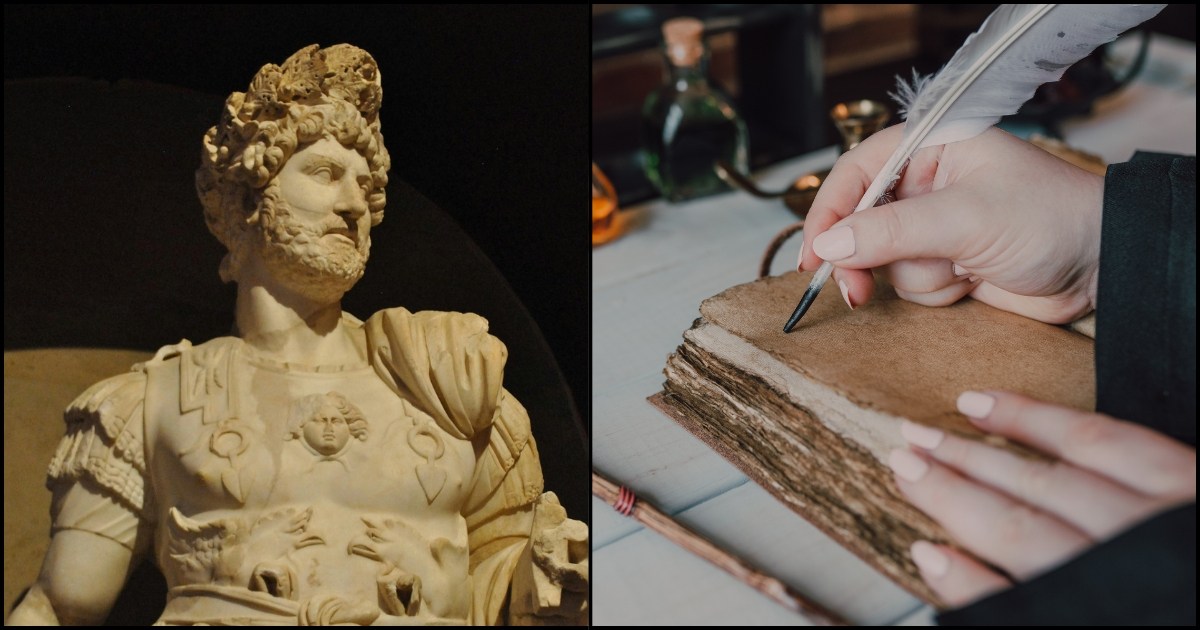
It’s still dark in Rome, and the most powerful man in the world is awake before he wants to be. He lies in his warm bed, made even more snug contrasted with the room’s cold, and wills himself to get up and put his feet on the floor. Then he does something strange for an Emperor: he reaches for his notebook and argues with himself there, writing down the intellectual reasoning against bed-rotting. We’ve been reading it for almost 1,900 years. We call it Meditations, and the groggy man losing the fight with his blanket is Marcus Aurelius.
His little private notebook

Some context, since the name “Marcus Aurelius,” usually conjures images of an old, weathered statue with no backstory, or some misremembered scene from Gladiator. Marcus Aurelius ruled the Roman Empire from 161 to 180 CE and practiced Stoic philosophy. The reason we still talk about him isn’t a statue or battle. It’s a small book called Meditations, and he almost certainly never meant for you to read it.
He wrote it as a private notebook, a set of reminders to himself about how to think and act under pressure. Meditations offers a rare view of a ruler trying to discipline his own mind amid war, administration, illness, and loss. And sleepiness, apparently. Sometimes, it reads like one man’s mission to lock in, told across 12 short books, and it’s shocking how much it sounds like us at 6 a.m.
It’s not a Google Calendar
Meditations covers a lot of ground, but if you’re expecting an hour-by-hour breakdown of Aurelius’s day, you will be disappointed. What he wrote wasn’t a schedule, exactly. “Wake at 5, curse existence, do morning pages for 20 minutes” is not a sentence that ever left his quill. What we call his “routine” is really a set of mental habits, practical philosophical exercises meant to help him live by Stoic ideas and shape his actions accordingly.
The internet tends to flatten those habits into cold discipline: rise before dawn, seize the day, crush your goals. But the passage Aurelius wrote to “Himself” is gentler, and far more human. Think of it as 400 short reflections on how to live well when life is unstable, irritating, painful, or beyond one’s control. Here are the 3 most relatable takeaways that are still relevant today.
1. Duty over comfort

“At dawn, when you have trouble getting out of bed, tell yourself: ‘I have to go to work—as a human being. What do I have to complain of, if I’m going to do what I was born for—the things I was brought into the world to do? Or is this what I was created for? To huddle under the blankets and stay warm?’ But it’s nicer here…”
–Marcus Aurelius, Meditations 5.1, trans. Gregory Hays (2002)
Of course, it’s a translation, but isn’t it wonderful to know that the Roman Emperor also has thoughts like “is this what I was created for? To huddle under the blankets and stay warm?” That’s it. No superpowers. Just a tired man reminding himself he has people to help and a day to show up for. A helpful modern reading of this section would be: replace “I need to dominate the day” with “What is one useful responsibility I can meet with care?”
2. Prepare, don’t fantasize
Aurelius didn’t stop at the alarm, either. He also braced for the people he’d meet. In Meditations 2.1:
“When you wake up in the morning, tell yourself: The people I deal with today will be meddling, ungrateful, arrogant, dishonest, jealous, and surly.
They are like this because they can’t tell good from evil… And so none of them can hurt me. No one can implicate me in ugliness. Nor can I feel angry at my relative, or hate him. We were born to work together like feet, hands, and eyes, like the two rows of teeth, upper and lower. ”
It starts bleak, but Rome’s Emperor catches himself, and softens immediately. People are built to work together, he reminds himself, and he shares something even with the most annoying of them. Less “brace for enemies,” more “don’t let rude people run your morning.”
This ties into premeditatio malorum , or premeditation of adversity, the Stoic exercise of where you imagine setbacks to reduce surprise and improve your response in the moments. Prepare, don’t despair. That’s the mantra.
3. Remember your mortality
“You could leave life right now. Let that determine what you do and say and think.”
–Meditations 2.11
“Each of us lives only now, this brief instant.”
–Meditations 3.10
In Meditations 2.11, and echoed in Meditations 3.10, Aurelius treats death as an unavoidable fact, not to entertain morbidity, but to live more fully in the present. In moments of fear, vanity, and trivial resentments, it might be useful to remember that time is precious and limited, and that your attention is better served towards things that really matter.
4. Pick your thoughts carefully
“The things you think about determine the quality of your mind. Your soul takes on the color of your thoughts.”
–Meditations 5.16
It’s not as simple as “think positively, and good things will come.” Here, Aurelius asserts that repeated attention gradually becomes a mental habit. Shouldn’t that brain power be used properly? Train the mind through deliberate, repeated judgments, rather than letting its most anxious or angry thoughts set the tone.
What you can actually borrow
For centuries, we’ve turned Marcus into a marble statue: calm, wise, untouchable. And that’s not only because they didn’t have flash photography when Meditations was written. By turning a real, flawed human being into a paradigm of philosophy, we’ve not only gotten the facts wrong, but also created an impossible standard of which to judge ourselves by. In comparison to “the great Stoic Marcus Aurelius,” we look like failures. If he supposedly rose serene at dawn, then there must be something wrong with you and your groggy, reluctant mornings.
Meditations reminds us that the opposite is true. Journaling 101 newsflash: You don’t write the same reminder to yourself over and over if you’ve already mastered it. The repetition is the tell. Steadiness didn’t come naturally to Aurelius, so he kept coaching himself toward it, morning after morning.
If the Emperor of Rome, at the height of his power, still had to talk himself out from under the covers, saying “one more minute,” then hitting snooze on your alarm can’t be as bad as everyone makes it out to be, right? It’s called being a person.
You don’t need a color-coded routine to be like Marcus Aurelius. He’d say that he’s a human himself, as are you. So every time you drag yourself out of bed, brace for a hard day, and choose to be decent anyway, you’re taking a page out of his book.