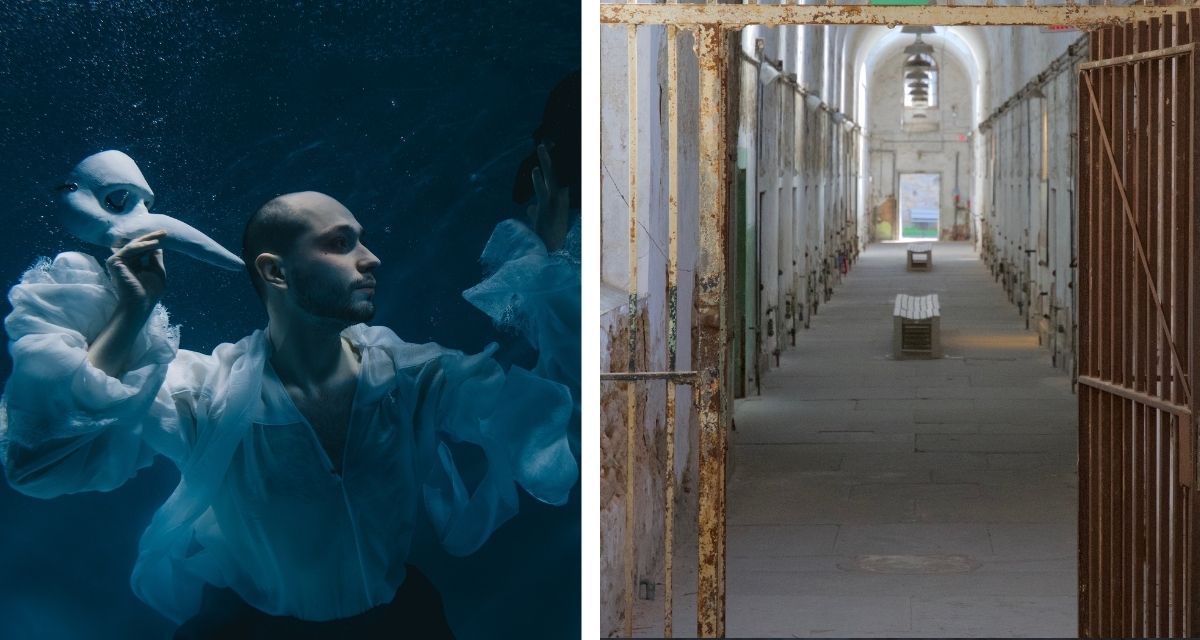
When theatre director and playwright Armando Punzo stepped inside the Volterra prison, one of Italy’s oldest jails, in 1988, he had one goal in mind: to prove that the healing, transformative power of art can be cultivated even in the most unlikely of places.
Around forty successful productions later, and that theory seems to still be going strong.
Punzo and his team created “Compagnia della Fortezza”, aka “Company of the Fortress,” a theatre company made up of Volterra inmates. As reported by The Washington Post, these inmates don’t simply act in the annual productions. They participate in the overall creative process, working alongside local theatre professionals to develop the performances, which are open to the public (including young people, aged 16+, as of July 2026).
And with each production, inmates are not only treated as human beings, but as artists.
That distinction gets to the heart of Punzo original experiment, and why it has been so successful.
Prison is, by design, an environment built around restriction. Punzo introduces something that operates according to the opposite principle. Creativity asks people to free their minds and hearts, to imagine possibilities rather than limitations.
This simple, yet powerful shift away from strict punishment makes all the difference in rehabilitation, argued prison director Valentina Bruno.
“They (prisoners) feel that the staff cares for them in the best possible way. They feel valued as individuals, not merely as numbers or files. They feel that they matter, and that their family context matters too, given the frequent contact we maintain with their relatives”, she told Euronews.
“Above all, I believe what they strongly feel is hope: the hope of returning to society, whether upon completing their sentence or even sooner, as changed individuals capable of giving something back to the community,” she added.
That sense of possibility can also create an environment where people have the space to reflect on their lives and imagine what they might become, rather than solely focusing on punishment.
As Volterra inmate/Compagnia della Fortezza actor Giacomo shared with The Washington Post, “The metaphor which I find incredibly important is that by losing my freedom in here, with a state of total confinement, I am finding total openness.”
The idea has found life beyond Volterra
Punzo may have helped pioneer this particular concept, but Compagnia della Fortezza isn’t the only theatre program of its kind these days.
Several prisons have dedicated theater companies and arts programs that foster rehabilitation, self-expression, and community. The Auburn Correctional Facility in New York, for example, has its Phoenix Players Theatre Group. California’s San Quentin has the Marin Shakespeare Company, which offers weekly classes and Shakespeare performances.
Programs like these give incarcerated people opportunities to practice valuable skills that extend beyond the stage. Research on arts-based rehabilitation has been linked with greater empathy, emotional regulation, and accountability, all of which are associated with recidivism rates.
What happens when we make room for creativity?
Punzo set out to test whether or not creativity could take root somewhere that wasn’t inherently designed to nurture it. For forty years, his project, and others like it, have proven the answer to be a resounding yes.
As Punzo put it, “This tells us that art and culture can truly reach everyone; if they fail to do so, it is simply because the necessary work to make that happen has not been done.”
It really leaves one wondering what the world might look like if active engagement in the arts were more of a mainstream commodity, rather than either passive consumption or a luxury for the privileged few.
Perhaps the next question to ask isn’t whether everyone can benefit from creativity (that answer seems clear), but what becomes possible when everyone is given the chance to create.