On January 31, 1971, Apollo 14 took off from Earth for its NASA mission to space and a lunar orbit. Astronaut Stuart Roosa was one of the 3-man crew.
Roosa was a former U.S. Department of Agriculture Forest Services smoke jumper. And on the trip, he packed the tiniest elements for an “out of this world” scientific experiment—tree seeds.
The experiment: to test if seeds that had been to space (a.k.a. zero gravity) grew any differently than seeds stuck on planet Earth. And it ended with surprising results.
What was the Apollo 14 “Moon Trees” experiment?
Roosa connected with Stan Krugman at the U.S. Department of Agriculture Forest Services to conduct the tree experiment. He packed over 2,000 seeds that had been classified, sorted, and sealed in small plastic bags that were held in a metal cannister that he carried in his personal canvas kit.
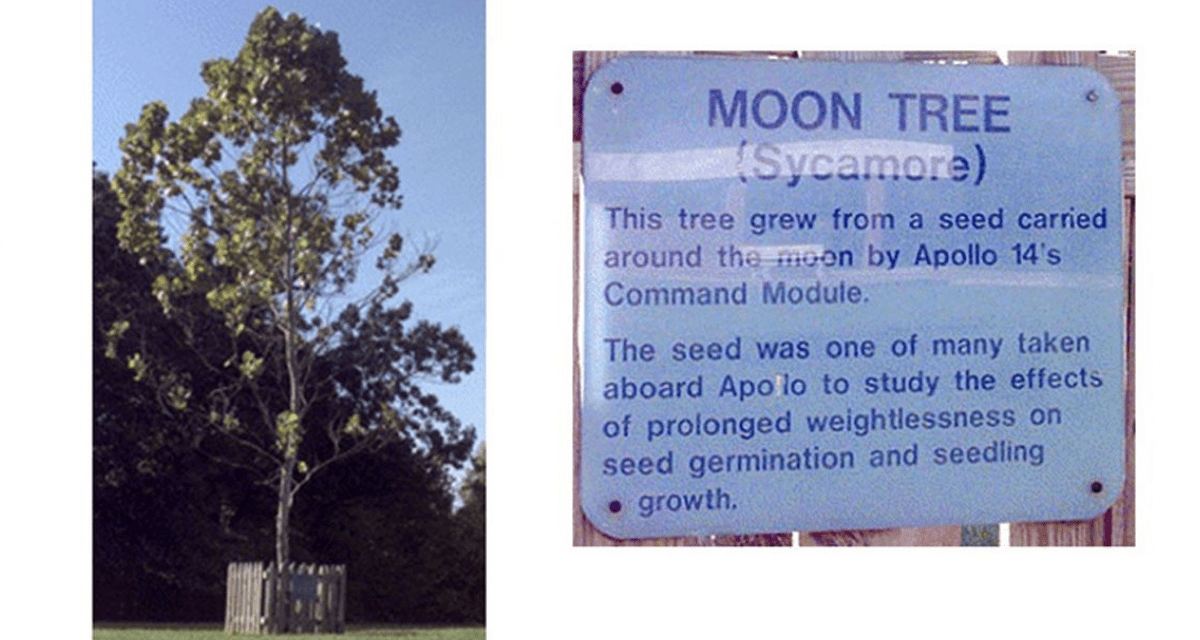
According to NASA, the seeds came from five different types of trees: loblolly pine, sycamore, sweetgum, redwood, and Douglas fir.
The seeds successfully made it to orbit, but the experiment almost failed after “the seed bags burst open during the decontamination procedures after their return to Earth, and the seeds were scattered about the chamber and exposed to vacuum, and it was thought they might not be viable.”
The “Moon Tree” experiment results
Despite the seeds being exposed, Krugman attempted to germinate some of the seeds in Houston, Texas (where NASA is headquartered). Unfortunately, “they did not survive long because the facilities there were inadequate.”
However, a year later other seeds from the Apollo 14 mission were planted in Gulfport, Mississippi (sycamore, loblolly pine, and sweetgum) and in Placerville, California (redwood and Douglas fir).
The result? Successful germination that resulted in viable seedlings. These were planted alongside the control seeds in 40 different states, including at the White House (where a loblolly pine was planted).
NASA
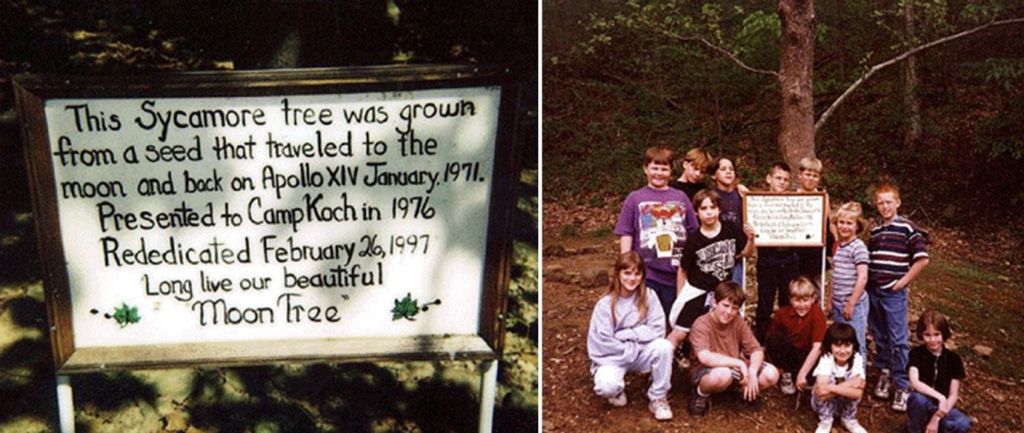
The” trees “Moon Trees” had no marked differences in growth or appearance compared to the experiment’s controlled seed trees. Today, you can visit the Apollo 14 “Moon Trees”. (You can find Moon Tree locations here.)
And in 2022, NASA’s Office of STEM Engagement partnered with U.S. Department of Agriculture Forest Services once more to bring more tree seeds to space aboard Artemis I.