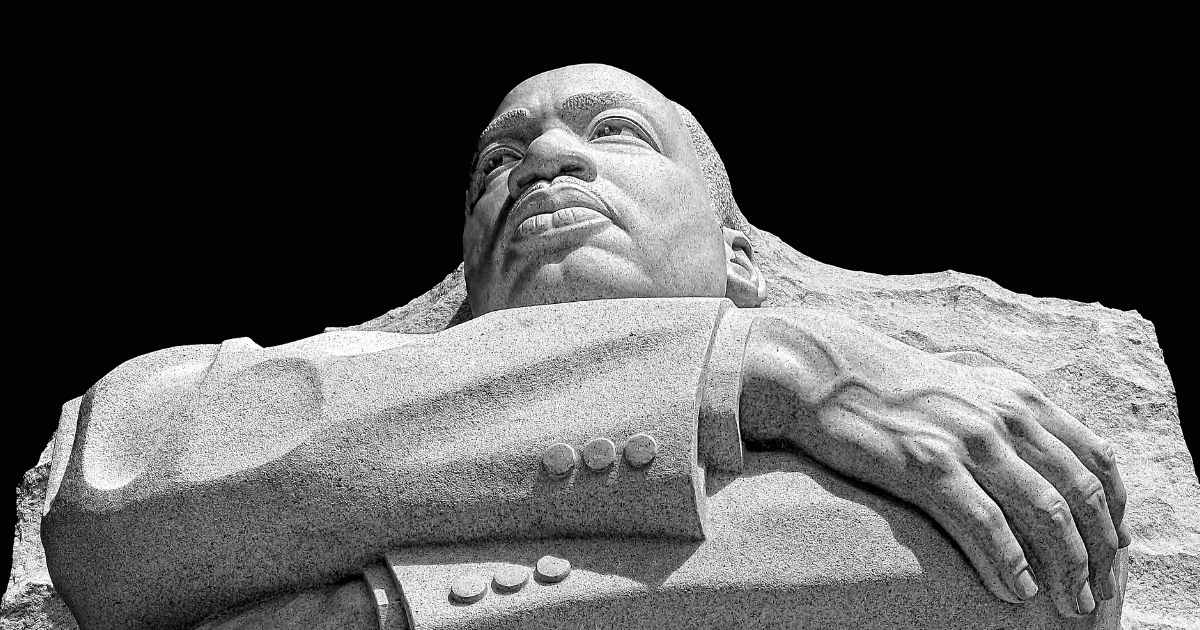
Before you share an MLK quote, understand that you’re quoting a proud political radical

Every year around Martin Luther King, Jr. Day, social media feeds get flooded with memes bearing Dr. King’s face and words—snapshots of the man with a snippet of his message, wrapped neatly in a square package, easily digested by the masses. We get bombarded by the “not by the color of their skin, but by…

Array
Photo credit: Photo by Ricardo Gomez Angel on UnsplashArray

Every year around Martin Luther King, Jr. Day, social media feeds get flooded with memes bearing Dr. King’s face and words—snapshots of the man with a snippet of his message, wrapped neatly in a square package, easily digested by the masses.

We get bombarded by the “not by the color of their skin, but by the content of their character” quote we all know and love. We get hit with “darkness cannot drive out darkness” memes that keep us feeling cozy in our comfort zones. We see “I have decided to stick with love. Hate is too great a burden to bear,” over and over, and nod our heads in placid agreement. People of all stripes share MLK quotes that give us all the warm fuzzies, and we think, “Wow, what an amazing, peaceful, universally beloved man.”
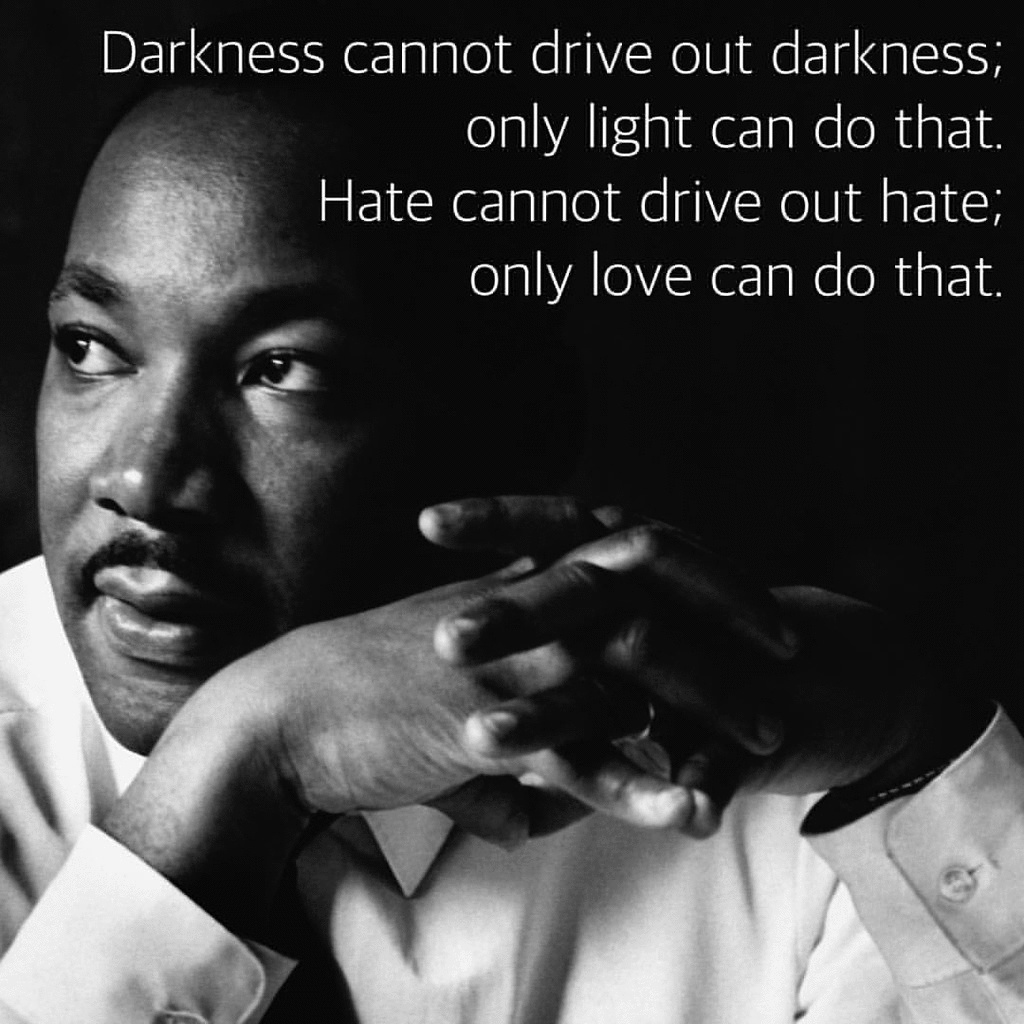

But there are two big problems with such memes.

1) Sharing one or two sentences drastically dilutes Dr. King’s legacy, turning his core message into a socially neutral, politically palatable, let’s-all-hold-hands-and-skip-together philosophy—one that challenges no one and betrays the radical reality of his work.

2) Such a whitewashing of King’s message enables people to share his words in a way that actually upholds or overlooks the very injustices he was trying to fight.

RELATED: Steve Bannon claimed MLK would be proud of Trump. King’s daughter shut him down.

For example, I’ve seen people say that people should be “judged not by the color of their skin but by the content of their character” as an argument against Affirmative Action-type programs. I’ve seen people say “hate cannot drive out hate” while mischaracterizing a calling out of racial injustice as hatred. I’ve seen people quote King’s “I have a dream” speech while asserting that talking about racism just perpetuates racism—an assertion King simply didn’t abide.

People frequently twist King’s words to fit their worldview, and in doing so, dishonor the man and his fight for true justice. The radical nature of his message seems to have been watered down into what people think he was—a gentle leader who advocated a non-violent approach to fighting for equality—instead of what he actually was—a passionate disrupter who constantly pushed boundaries and pulled no punches when calling out injustices of all kinds. Many Americans today would undoubtedly call him a “race-baiter” at best, and an “extremist thug” at worst.

We mustn’t forget that King was considered a radical and a criminal, by both the U.S. government and much of mainstream America, during his lifetime. At the height of his activism, nearly two-thirds of Americans had an unfavorable opinion of King. And that disapproval didn’t just come from the openly racist South. After being hit with a rock at a desegregation march in Chicago, King remarked, “I have seen many demonstrations in the South, but I have never seen anything so hostile and so hateful as I’ve seen here today.”

King had strong words for those of us who think we’re not racist. When I first read King’s Letter from a Birmingham Jail—his response to a group of clergymen who agreed with his antiracism sentiments but criticized his “extreme” methods—I was blown away. I remember thinking that my education about Dr. King had been sorely lacking, that I’d never learned how much criticism he’d faced and how frequently he was considered an extremist by white moderates, and that I had no idea how he had directly challenged white Americans of goodwill. (In other words, people like me.)

The least we can do to honor King’s life is to go beyond popular one-liners, take the time to read one of his most important works, and to meditate on the challenges he presented to us. You can read King’s Letter from a Birmingham Jail in its entirety here, but I’ve included some excerpts below that highlight some of its main points.

For example, this passage explaining how peaceful activism doesn’t mean avoiding tension and crisis:

“You may well ask: ‘Why direct action? Why sit ins, marches and so forth? Isn’t negotiation a better path?’ You are quite right in calling for negotiation. Indeed, this is the very purpose of direct action. Nonviolent direct action seeks to create such a crisis and foster such a tension that a community which has constantly refused to negotiate is forced to confront the issue. It seeks so to dramatize the issue that it can no longer be ignored. My citing the creation of tension as part of the work of the nonviolent resister may sound rather shocking. But I must confess that I am not afraid of the word ‘tension.’ I have earnestly opposed violent tension, but there is a type of constructive, nonviolent tension which is necessary for growth. Just as Socrates felt that it was necessary to create a tension in the mind so that individuals could rise from the bondage of myths and half truths to the unfettered realm of creative analysis and objective appraisal, so must we see the need for nonviolent gadflies to create the kind of tension in society that will help men rise from the dark depths of prejudice and racism to the majestic heights of understanding and brotherhood. The purpose of our direct action program is to create a situation so crisis packed that it will inevitably open the door to negotiation.”

RELATED: Ad execs probably should have read the full MLK speech before making that commercial.

Or this passage about the “timing” of taking action against injustice:

“We know through painful experience that freedom is never voluntarily given by the oppressor; it must be demanded by the oppressed. Frankly, I have yet to engage in a direct action campaign that was ‘well timed’ in the view of those who have not suffered unduly from the disease of segregation. For years now I have heard the word ‘Wait!’ It rings in the ear of every Negro with piercing familiarity. This ‘Wait’ has almost always meant ‘Never.’ We must come to see, with one of our distinguished jurists, that ‘justice too long delayed is justice denied.’”

Many people who praise Dr. King would have called him a criminal if he were still alive today, as he advocated breaking unjust laws:

“One may well ask: ‘How can you advocate breaking some laws and obeying others?’ The answer lies in the fact that there are two types of laws: just and unjust. I would be the first to advocate obeying just laws. One has not only a legal but a moral responsibility to obey just laws. Conversely, one has a moral responsibility to disobey unjust laws. I would agree with St. Augustine that ‘an unjust law is no law at all.’”

He added that a just law can sometimes be applied unjustly, and that how one violates a law matters:

“Sometimes a law is just on its face and unjust in its application. For instance, I have been arrested on a charge of parading without a permit. Now, there is nothing wrong in having an ordinance which requires a permit for a parade. But such an ordinance becomes unjust when it is used to maintain segregation and to deny citizens the First-Amendment privilege of peaceful assembly and protest.

I hope you are able to see the distinction I am trying to point out. In no sense do I advocate evading or defying the law, as would the rabid segregationist. That would lead to anarchy. One who breaks an unjust law must do so openly, lovingly, and with a willingness to accept the penalty. I submit that an individual who breaks a law that conscience tells him is unjust, and who willingly accepts the penalty of imprisonment in order to arouse the conscience of the community over its injustice, is in reality expressing the highest respect for law.”

In addition, he pointed out that some of history’s most unjust acts were legal, while some of the most righteous acts were illegal:

“We should never forget that everything Adolf Hitler did in Germany was ‘legal’ and everything the Hungarian freedom fighters did in Hungary was ‘illegal.’ It was ‘illegal’ to aid and comfort a Jew in Hitler’s Germany. Even so, I am sure that, had I lived in Germany at the time, I would have aided and comforted my Jewish brothers. If today I lived in a Communist country where certain principles dear to the Christian faith are suppressed, I would openly advocate disobeying that country’s antireligious laws.”

One of the most important points King makes in this letter is how white moderates who put law and order over justice do as much, if not more, harm to the cause of justice as outright racists:

“I must confess that over the past few years I have been gravely disappointed with the white moderate. I have almost reached the regrettable conclusion that the Negro’s great stumbling block in his stride toward freedom is not the White Citizen’s Counciler or the Ku Klux Klanner, but the white moderate, who is more devoted to ‘order’ than to justice; who prefers a negative peace which is the absence of tension to a positive peace which is the presence of justice; who constantly says: ‘I agree with you in the goal you seek, but I cannot agree with your methods of direct action’; who paternalistically believes he can set the timetable for another man’s freedom; who lives by a mythical concept of time and who constantly advises the Negro to wait for a ‘more convenient season.’ Shallow understanding from people of good will is more frustrating than absolute misunderstanding from people of ill will. Lukewarm acceptance is much more bewildering than outright rejection.

I had hoped that the white moderate would understand that law and order exist for the purpose of establishing justice and that when they fail in this purpose they become the dangerously structured dams that block the flow of social progress. I had hoped that the white moderate would understand that the present tension in the South is a necessary phase of the transition from an obnoxious negative peace, in which the Negro passively accepted his unjust plight, to a substantive and positive peace, in which all men will respect the dignity and worth of human personality. Actually, we who engage in nonviolent direct action are not the creators of tension. We merely bring to the surface the hidden tension that is already alive. We bring it out in the open, where it can be seen and dealt with. Like a boil that can never be cured so long as it is covered up but must be opened with all its ugliness to the natural medicines of air and light, injustice must be exposed, with all the tension its exposure creates, to the light of human conscience and the air of national opinion before it can be cured.”

How about this bit about “the appalling silence of the good people”?

“We will have to repent in this generation not merely for the hateful words and actions of the bad people but for the appalling silence of the good people. Human progress never rolls in on wheels of inevitability; it comes through the tireless efforts of men willing to be co workers with God, and without this hard work, time itself becomes an ally of the forces of social stagnation. We must use time creatively, in the knowledge that the time is always ripe to do right.”

And finally, some words about law and order and the role of the police in “preventing violence”:

“Before closing I feel impelled to mention one other point in your statement that has troubled me profoundly. You warmly commended the Birmingham police force for keeping ‘order’ and ‘preventing violence.’ I doubt that you would have so warmly commended the police force if you had seen its dogs sinking their teeth into unarmed, nonviolent Negroes. I doubt that you would so quickly commend the policemen if you were to observe their ugly and inhumane treatment of Negroes here in the city jail; if you were to watch them push and curse old Negro women and young Negro girls; if you were to see them slap and kick old Negro men and young boys; if you were to observe them, as they did on two occasions, refuse to give us food because we wanted to sing our grace together. I cannot join you in your praise of the Birmingham police department…

I wish you had commended the Negro sit inners and demonstrators of Birmingham for their sublime courage, their willingness to suffer and their amazing discipline in the midst of great provocation. One day the South will recognize its real heroes.”

As King’s daughter, Bernice, pointed out on his birthday, January 15, “The authentic, comprehensive King makes power uneasy & privilege unhinged.” Such a description makes one wonder how Dr. King would be regarded today if he had lived and continued to directly call out the racial injustice that still exists in our society.


  • Singer in hospice performs soulful ‘Landslide’ cover ‘one last time’
    Photo credit: via Recordsnet and Matt Becker/Wikimedia CommonsSingers Marirose Powell (L) and Stevie Nicks (R).
    ,

    Singer in hospice performs soulful ‘Landslide’ cover ‘one last time’

    She was Stevie Nicks in a Fleetwood Mac cover band for over 20 years.

    The final performance of singer Marirose Powell has people welling up all over TikTok because of the soulful way she sang “Landslide” by Fleetwood Mac while in hospice care. Powell performed as Stevie Nicks in a Fleetwood Mac cover band for over twenty years, so the song was a major part of her life.

    A week before she died from cancer, some friends showed up at her home and asked what she would like to sing. “And she said, ‘I want to sing ‘Landslide.’ And so she sang ‘Landslide’ one last time,” Powell’s daughter-in-law, Sam Xenos, who posted the video on TikTok, told People. 

    In the video, Powell grabs the railing over the medical bed as she sings a song about the inevitability of the passing of time. The song had to have taken on an even greater meaning as Powell was in the final days of her life. “I’ve been afraid of changing because I built my world around you,” Powell sings. “Time makes you bolder, and even children get old and I’m getting older, too.”

    “My mother-in-law performed as Stevie Nicks for decades,” Xenos wrote in a video overlay. “This was her final performance before she passed the following week.” In the caption, she added there wasn’t “a day that goes by that I wish we’d had more time with her. She was truly the only person I’ve ever known to leave people better than she found them. Until we can be together again, mama.”

    Powell passed away on April 10, 2024, at 62.

    @samxenos

    there isnt a day that goes by that i wish we’d had more time with her. she was truly the only person i’ve ever known to leave people better than she found them. until we can be together again mama…

    ♬ original sound – samxenos

    In her obituary, she is remembered for her “infectious smile” that “guaranteed to brighten anyone’s day and she was known for her incredibly kind soul and generous heart. She had the beautiful ability to leave all those she touched better than she found them.”

    In addition to performing as Steve Nicks, Powell released 3 solo albums and worked as an ER nurse. As a lifelong musician, she would probably be more than pleased to learn that her final performance has touched many people.

    “I hope Stevie Nick sees this. She would be proud to know that your mom sung her songs for decades,and her choice of this song was heartfelt,” one commenter wrote. “I’m sobbing. God bless you and your family. Your mom is beautiful,” another added.

    “That might be the most touching performance of ‘Landslide’ to ever exist,” a commenter wrote.

    Xenos and her husband, Powell’s son, are overjoyed that the video has gone viral. At first, she was afraid of how her husband would react to the clip being posted on TikTok. “I remember calling my husband nervous because he didn’t know I posted it,” Xenos told Upworthy. “He was over the moon after reading the comments and seeing people feel her genuine soul from that small clip. He asked me to post more videos of her and they have generated a phenomenal response. She was the most giving and generous person. I would tell her to post her music and she was worried no one would care. I’m so honored to have proved her wrong on that fact.”

    Nicks says she wrote “Landslide” in Aspen, Colorado, at 27. “I did already feel old in a lot of ways,” Nicks told The New York Times. “I’d been working as a waitress and a cleaning lady for years. I was tired.”

    She was also having a hard time in her relationship with Fleetwood Mac guitarist Lindsey Buckingham. She composed the song while looking out her window in the snow-covered Aspen mountains. “And I saw my reflection in the snow-covered hills / Til the landslide brought me down.”

    Here is a full performance of “Landslide” that Powell gave in 2016 at the Prospect Theater in Modesto, California. Jamie Byous joins her on guitar. 

    This article originally appeared last year. It has been updated.

  • Indigenous woman cries tears of joy after hairdresser discovers ‘unruly’ grey hairs
    Photo credit: CanvaIndigenous woman cries tears of joy after hairdresser discovers 'unruly' grey hairs

    Grey hair has been a concern for people since before hair dye was invented. Some people pluck them and dye them as soon as they see them growing in, while others embrace the silvery hairs. Chiara Do’wal Sehi (Sunshine) Enriquez, an Indigenous woman from the Karankawa Tribe, recently shared her excitement about learning she had grey hair.

    For a brief period of time, people were actually dyeing their hair grey prematurely. It wasn’t uncommon to meet a 20-something with “granny grey” purplish-silver hair, but the popularity faded nearly as fast as it started. But for Enriquez, grey hair isn’t a fad or something to hide. It’s a right of passage to celebrate.

    indigenous, grey hair, getting older, culture and humanity, going grey
    Indigenous woman with long braids.
    Photo Credit: Canva

    During the colonization of the Texas Gulf Coast where the Karankawa originated, the Indigenous tribe was nearly eliminated. According to the Texas State Historical Association, the Karankawa people fought to maintain their land from 1685 until 1858 from French and Spanish settlers. Due to this multi-century, on-and-off battle for their territory, the tribe’s numbers became so small that they were considered “extinct.”

    Enriquez is a descendant of the small number of Karankawa that survived. To her, living long enough to experience the growth of grey hair is a gift. The woman shares how much her “unruly” greys mean to her in a video uploaded to her Instagram page.

    indigenous, grey hair, getting older, culture and humanity, going grey
    Indigenous woman standing in sunshine.
    Photo credit: Canva

    “I got my hair styled today. I don’t get it cut. It’s a cultural belief that I was taught by my mother. We don’t cut our hair, we let it grow. We save the cut for very, very serious and important moments in our lives,” she says while sitting in her car.

    The woman explains that while she was having her hair styled, she asked the hairdresser about the texture of her hair. This is when she learned of her wiry new strands. She surprised hairdresser with her delighted response. “She said to me that it was because I had many little greys, and the unruly ones that were pushing up my other hair that weren’t grey were causing it to be a little bit frizzy.”

    Enriquez lights up and smiles while recalling the moment in her hairdresser’s chair. She reveals, “And that felt so incredible. What an honor, and I was…I’ve only ever seen my head grow one grey hair, and even when I knew I had one grey hair, I was incredibly thankful. When she saw that I was smiling and so happy, she said, ‘Oh wow, you really must come from a different culture.’”

    indigenous, grey hair, getting older, culture and humanity, going grey
    Elderly indigenous woman.
    Photo credit: Canva

    She later adds while tearing up, “I’m very happy to report that not only do I have for sure one grey hair, I have many. A plethora of grey hair. What an honor. What a fantastic gift to be lucky enough to see myself grow grey hair. That is so incredible. I am so lucky. What a life it has been. What a life it continues to be.”

    Enriquez wipes away tears as she encourages others to embrace their grey hair. Viewers were moved by her joyfully emotional response to finding out she has a head full of grey hairs pushing their way through.

    One person shares, “As a chemo patient I am always surprised when people are upset about their grey hair. I have come to see it as a privilege and dream of the day I might have greys, though my mom’s hair has never changed colors, and neither did her dads. Their hair has always stayed brown for some reason. Since my hair has begun growing again I have decided not to cut it for as long as possible. So I can say, I’ve been cancer free for this long, and show people my hair for reference.”

    Someone else writes, “This had me in tears because i’ve loss so many people and im only 30 and the day i get grey hairs i will celebrate with them!”

    Another person says, “i’m so happy to hear this expression of delight regarding your grey hair~ i am only just now getting greys & my own natural reaction was very different from my mom’s & grammom’s reactions~ i was surprised to find that i like seeing them appear~ hearing your perspective makes me think that it’s because i am not as tethered to the usa culture as they…
    so thank you for sharing your experience & offering food for thought~ & congratulations.”

    “I have been allowing my greys to come in naturally and have stopped dyeing my hair and it’s very liberating and in a society where ageism is everywhere it feels like resistance. And I love that! I have more greys than my mom. :),” someone else shares.

    indigenous, grey hair, getting older, culture and humanity, going grey
    Elderly Indigenous woman with hair covered.
    Photo credit: Canva

    “What a sacred and healthy perspective,” one person says.

    Another reveals, “I love this so much! Thank you for sharing your joy and gratitude with us. I’m getting grey and have been oscillating between feeling happy about it and feeling like I’m not sure i feel “ready” to have grey hair.”

    Enriquez says, “I’ve always been of the personal belief that humans take the longest to change the color of their foliage in observation of their reconnection with Mother Earth and the cyclicity of her seasons and transitions.” She then explains that trees change with the seasons, grass goes through a cyclical change, and even animals turn grey and calm with age. “And it has always been representative that you have lived a full life. Do you know how many people didn’t get to grow grey hair? Didn’t get to see the hair change? What a gift,” she adds.

  • A young girl tells Carol Burnett ‘hello’ from her neighbor. It happened to have been Carol’s biggest crush.
    Photo credit: Elmer Holloway, NBC, Wikimedia CommonsComedian Carol Burnett in a 1958 TV sketch.

    When a person consistently brings the world joy, it’s extra special when we see them experience it tenfold. This is what happened for iconic comedian Carol Burnett when a young girl relayed a message from her next-door neighbor. Burnett’s response was pure delight.

    A re-surfaced clip of Burnett shows her taking questions at the Q&A segment before her taping of The Carol Burnett Show. A young girl tells Burnett that she “lives next door” to one of her old boyfriends and that he says “Hello.” Burnett, clad in a lively black and yellow dress with a giant chiffon bowtie, confirms, “You live next door to an old boyfriend of mine and he says hello?” She throws her head back in jest. “There were so many!” The audience, as they so often did, laughs uproariously.

    Tommy Tracy?

    Burnett leans toward the girl and asks, “Who?” The firl answers quickly, “Tom Tracy.” Burnett, who had reportedly not planned the reaction, answers in earnest shock, crying, “TOMMY?! You’re kidding? Tommy Tracy?” Clearly, Burnett can hardly believe it. “She lives next door to… I can’t believe this! ” she stutters as she squats down. “How IS he?”

    The audience continues to eat up the exchange, while Burnett adds a vulnerably adorable tidbit to the story. “Did you know that I loved him from the time I was about 12 years old up till the time I was 17? Which was about ten years ago. I always loved Tommy Tracy. And I always dreamed that someday we’d get married and have two children and I’d name them Stacy Tracy and Dick Tracy.”

    An Instagram page shared the clip, noting a super fun fact: “The audience Q&A was one of the most beloved segments on The Carol Burnett Show, which ran on CBS from 1967 to 1978. Carol never knew what she’d be asked, so it was pure improv. The Q&A was done without any wigs, costumes, or character, just Carol herself, and if she ended up with egg on her face, so be it, which is exactly what made audiences connect with her so deeply.”

    Making sure he could find her

    The Instagram handle continued. “Carol has said she actually considered changing her name to Carol Creighton early in her career because she thought it sounded better, but she kept Burnett specifically because she wanted Tommy Tracy to know it was her if she ever became successful. He sent his regards via a little girl in a studio audience decades later.” (This anecdote has been confirmed!)

    The clip had over a quarter of a million likes in less than a week and many comments. Quite a few simply reveled in the brilliance and happiness Burnett brought (and brings) to a crowd. One noted how sincere her “Tommy” squeal was, writing, “That ‘Tommy’ was from the heart.”

    Many joked about Tommy himself. “Tom went to everyone he knew saying, ‘I told y’all I dated Carol Burnett!”

    Jerry Hall

    This wouldn’t have been the only time Burnett was shocked by a crush during Q&A. In 1976, a young girl showed up in the audience and asked, “Did you know Jerry Hall?” Burnett proudly proclaimed, “I had a crush on Jerry Hall!” The audience goes wild, exclaiming, “This is his daughter!”

    Burnett hilariously responds, “You’re Jerry Hall’s daughter? You could have been mine!” She then comes into the audience to give the young girl a giant hug.

    This clip has yielded well over half a million likes as well. One Instagrammer seemed to sum up what so many of us feel, writing, “Every time I see a clip from her show I can’t help but smile. She’s so infectious.”


  • After his father rejected a circus’ offer to buy him for $5,000, 3-foot-tall man becomes a doctor
    Photo credit: via Sir Takhtasinhji General Hospital/InstagramSir Takhtasinhji General Hospital Bhavnagar and Dr. Ganesh Baraiya.

    The odds seemed stacked against Ganesh Baraiya at birth. He had seven brothers and sisters, was born with dwarfism, and has a locomotor disability that impairs his movement. His prospects in life were so limited that while he was in primary school, a circus offered his family 500,000 rupees ($5,350) to take him as a performer. Even though it was a life-changing amount of money, his father refused, in hopes that his son would pursue an education.

    His hard work in school paid off, and in 2018, Ganesh eventually passed India’s medical exam. However, instead of celebrating, Ganesh faced another barrier: the Medical Council of India rejected his admission to an MBBS program because of his physical disability.

    The council believed that his height could be a hindrance during medical emergencies. “I was very disappointed,” Ganesh told the BBC. “I could not see a way out… I was thinking that my dream of becoming a doctor would remain incomplete.”

    Ganesh was hurt, but he wouldn’t take no for an answer

    “When the MCI rejected my application, I was very disappointed. But I didn’t give up,” he told The Federal. “I approached my college principal, Dr. Dalpatghai Katariya, who encouraged me to fight for my right to pursue medicine.” With the help of his friend, he fought the rejection in India’s high court, but his plea was rejected.

    Undeterred, Ganesh appealed the decision, and the case reached India’s Supreme Court. “After four months, the Supreme Court of India ruled in my favor on October 22, 2018,” he told The Federal. “After completing my MBBS and internship, I began my first posting as a medical officer on November 27, 2025. It’s a moment I’ve worked hard for.” Ganesh now works as a medical officer at Bhavnagar Civil Hospital, the same place where he received his medical degree.

    Ganesh’s story is an inspiration for us all 

    While some may believe that being only three feet tall and weighing a little over 40 pounds might pose serious drawbacks as a medical practitioner, Ganesh says his stature offers unique benefits. “Children would open up to me easily,” he told the BBC. “They would tell me their small problems, which they would not share with other doctors.”

    Looking ahead, Ganesh wants to pursue a career that leverages his strengths, including radiology, pediatrics, and dermatology. Now that he has a steady income, he’d also like to build a brick house for his family. 

    Ganesh’s story is a powerful example of what can happen when you refuse to settle, whether that’s joining a circus or giving up when powerful institutions say you can’t pursue your dreams. He’s also a great inspiration for anyone who has had to pick themselves up from a major setback. If a three-foot-tall man born into a humble farming family can fulfill his dreams, then anything is possible.

    “A life without struggle is like not living at all,” he told the BBC. “Many times in life, I feel like I am failing. But you have to keep moving ahead toward your goals.”

  • A bagel shop manager noticed a stroke survivor struggling to order. His response moved her son to tears.
    Photo credit: Canva(L) Restaurant manager approaches a table; (R) An elderly woman having difficultly at her table
    ,

    A bagel shop manager noticed a stroke survivor struggling to order. His response moved her son to tears.

    Chris Hansen didn’t make a fuss. He just quietly made sure she got exactly what she wanted.

    Chris Leavitt had been his mother’s primary caregiver for six months, ever since she suffered a stroke and he moved across the country to help her. He drives her to therapy appointments, helps her communicate, and tries to give her as much independence as possible on the days when that feels within reach.

    December 20 was her 60th birthday. They’d already had a full day of therapy sessions, but Leavitt wanted to mark the occasion. He let his mother choose where to go for lunch, and she navigated them to Hole in One Bagel Deli, a strip mall spot on Route 33 in Neptune, New Jersey. It wasn’t a restaurant he knew. It turned out to be exactly the right place.

    The obstacles of stroke recovery

    Leavitt’s mother walks with a cane and still has difficulty speaking as she recovers. Once inside, ordering proved harder than expected. The menus were displayed on TV screens that were difficult to read in the lighting, and when Leavitt asked whether paper menus were available, there weren’t any. As he worked to help his mother communicate what she wanted, he was aware of the other customers around them, the noise, the weight of the moment.

    That’s when manager Chris Hansen came around the counter.

    The quiet kindness of a stranger

    He didn’t make an announcement or draw attention to the situation. He simply started presenting options to her, one at a time, letting her point at what she wanted. A poppy seed bagel. Then lox. “I got you,” Hansen told her. “Don’t worry about it.” According to Leavitt, Hansen moved fluidly between helping them and the other customers coming in and out, never once making them feel like an inconvenience.

    @notjustabartender

    Just needed a good cry on the internet today.

    ♬ original sound – Chris

    “From the moment we walked in, the manager Chris showed us incredible grace and patience,” Leavitt wrote later on GoFundMe. “In truth, I’m not sure I would have figured out what she wanted on my own.”

    When their food arrived, Hansen returned to the table with something they hadn’t ordered: a chocolate pastry. He told them the whole meal was on the house. When Leavitt tried to refuse, Hansen insisted. “Please, please enjoy.”

    The power of a random act of kindness

    Leavitt said his mother didn’t fully register what had just happened. But he did. “It took everything in me not to sob inside the deli,” he wrote.

    As they were leaving, Hansen said one thing that stayed with Leavitt long after they drove away: “What’s the point of life if you can’t be nice every once in a while?”

    Responding in kind

    Leavitt, who has worked in hospitality for 15 years, posted about the experience to his Instagram following of over 400,000 people. The response was immediate. Within a day, he’d received more than a thousand comments and messages. He also quietly launched a GoFundMe to benefit Hansen directly, as a thank you. As of late December, it had raised more than $16,500.

    He also brought his mother back to the deli to see Hansen in person, as News12 New Jersey reported.

    The comment that seemed to resonate most with viewers came from someone who put it simply: “A man crying because his mom was treated with respect and dignity is pure gold.”

  • A little girl’s classmate asked who the man picking her up was. Her two-word answer made him emotional for the rest of the day.
    Photo credit: CanvaStep-dad picking up girl from school

    Julian wasn’t expecting anything unusual when he pulled up to pick up his stepdaughter from school. Just another ordinary afternoon errand. But when one of her classmates pointed at him and asked who he was, his stepdaughter answered without hesitating for even a second.

    “That’s my dad.”

    Stepping up to just ‘dad’

    Julian shared the moment in a TikTok video that quickly resonated with thousands of viewers, many of whom have lived some version of this story themselves. He said he wasn’t sure she’d ever give him that title — not because things were bad between them, but because he’d never pushed for it. He’d just tried to show up, consistently, and let her lead.

    That’s what made the moment so meaningful. She didn’t say it for him. She said it because it was simply true to her.

    People knew how it made him feel

    The comments filled up almost immediately with people who understood exactly what that kind of moment feels like. One commenter wrote that her husband cried the first time one of his stepsons said the same thing. Another, who grew up with a stepfather herself, offered a perspective worth sitting with: “She will see you differently the moment you just call her your daughter, not a stepdaughter. Just like how you felt — that feeling is the same both ways.”

    Kids are figuring things out, too

    That symmetry is easy to miss in blended families, where so much of the emotional weight tends to fall on the adults trying to figure out their role. Kids are often doing the same calculus quietly on their end, watching to see if this person is going to stick around, wondering what to call them, not wanting to get it wrong either.

    Julian ended his video saying he was going to take her out for food — which, as many commenters pointed out, is about the most dad response imaginable.

    The title of “dad” isn’t something you can ask for or negotiate. It’s conferred. And apparently, a school pickup on an ordinary afternoon is exactly the kind of place where it happens.

    You can follow Julian (@jayvalenz_20) on TikTok for more content on parenting and family. 

  • He googled “what do you put in an obituary” when his dad died and wrote one of the most beloved ones the internet has ever seen
    Photo credit: CANVAPeople smiling at a funeral celebrated a life
    ,

    He googled “what do you put in an obituary” when his dad died and wrote one of the most beloved ones the internet has ever seen

    “We have all done our best to enjoy/weather Robert’s antics up to this point, but he is God’s problem now.”

    Charles Boehm had never written an obituary before. When his father Robert died in October 2024 after a fall in his Clarendon, Texas apartment, Charles sat down in his Houston home, completely stumped, and did what anyone would do.

    He Googled it.

    “I decided to Google, ‘What do you put in an obituary?’” he told The Washington Post. What came up changed everything. He found the obituary of a Connecticut man named Joe Heller, written with wit and irreverence and genuine love, and immediately thought: that sounds like something my dad would do.

    So Charles did the same. What he wrote for Robert Adolph Boehm, 74, of Clarendon, Texas (population 2,000) went viral almost instantly when Robertson Funeral Directors shared it on Facebook. It has since been viewed more than a million times.

    The viral obituary of a Texas man

    It begins like this:

    Robert Adolph Boehm, in accordance with his lifelong dedication to his own personal brand of decorum, muttered his last unintelligible and likely unnecessary curse on October 6, 2024, shortly before tripping backward over ‘some stupid mother****ing thing’ and hitting his head on the floor.”

    It continues. Robert was born in Winters, Texas in 1950, “after which God immediately and thankfully broke the mold and attempted to cover up the evidence.” He managed to avoid the Vietnam draft by getting his wife Dianne pregnant three times between 1967 and 1972. His youngest son Charles arrived in 1983, the obituary notes, “with Robert possibly concerned about the brewing conflict in Grenada.”

    His lack of military service was, the obituary observes, “probably for the best” — given that Robert later took up shooting as a hobby and managed to blow two holes in his own car’s dashboard on two separate occasions. His wife Dianne, “much accustomed to such happenings in his presence, may have actually been safer in the jungles of Vietnam the entire time.”

    Good grief: Humor helps a family heal

    There’s the fashion: homemade leather moccasins, a wide collection of unconventional hats, boldly mismatched shirts and pants. The career: he became “a semi-professional truck driver — not to be confused with a professional semi-truck driver.” The hobbies: historical weapons spanning from a 19,000 BC French atlatl to a Soviet-era Mosin-Nagant, plus a wide selection of harmonicas he kept on hand but rarely played. When Robert’s wife Dianne died in February 2024, Charles wrote that God had gotten her “the hell out of there for some well-earned peace and quiet.” In her absence, Robert had thrown himself into entertaining the people of Clarendon with what the obituary calls his “road show.”

    It closes: “We have all done our best to enjoy/weather Robert’s antics up to this point, but he is God’s problem now.”

    Attendees at the funeral were requested to wear “outlandish or mismatched outfits” in his honor.

    The reaction said it all

    Chuck Robertson, who owns the funeral home and received the obituary, told The Washington Post he almost choked on his breakfast laughing. “I told people in the office, ‘Well, this is going to get us some attention,’” he said. “I’d never had a family come through the doors that wrote an obituary as classic as that one.”

    Charles said he was astonished by the response. “I was sad that my father was going to be forgotten and that my parents’ small life would get packed up into my trailer and that would be the end of it everywhere but inside my own mind,” he told TODAY. “That obituary was intended to ease my own pain and make a handful of people in a town of two thousand smile instead of frown, and it’s probably done that for 2 million at this point.”

    The message behind the laughs

    He also has a message for anyone reading: don’t let your parents slip through the cracks in small towns. “There are people all over the country like my dad,” he said. “They go there to retire, then when they’re old, their kids scatter and they end up alone.”

    When the family cleaned out Robert’s apartment, they found four harmonicas immediately.

  • A Gen Z teacher gave his students 10 minutes to rant about anything they wanted. The essays were gloriously unhinged.
    Photo credit: TikTok | @mrcoachwhiteheadScreenshots of a young teacher talking on TikTok
    ,

    A Gen Z teacher gave his students 10 minutes to rant about anything they wanted. The essays were gloriously unhinged.

    A 23-year-old English teacher cracked the code on getting students excited about writing. It involved a cartoon character getting roasted.

    Dean Whitehead is 23 years old and in his first year of teaching high school English. He’d heard enough complaints from students about boring essay topics to know he needed to try something different. So one day he set up a camera in his classroom, opened a shared document he’d titled “Argumentative Fun,” and gave his students an assignment unlike anything they’d been asked to do before.

    Ten minutes. Any topic. No grammar corrections, no spelling deductions. The only way to win bonus points was to be genuinely convincing.

    “It has to be something you feel so strongly about that you can type for 10 minutes straight,” Whitehead told them, as captured in his TikTok video posted to @mrcoachwhitehead. A few students immediately had questions. One asked for a minute to think. Whitehead gave them eleven. Voice-to-text was off the table.

    Students take writing to another level – their own

    The essays came in. They were, as promised, unhinged.

    @mrcoachwhitehead

    Replying to @Titus.333 the moment you’ve all been waiting for#fyp #foryou #teachersoftiktok #teacher #education

    ♬ original sound – mrcoachwhitehead

    One student ranted about curfews, arguing that weekends should be completely free because school is already hard enough. Another went after boys in general. One made a detailed case for wanting to be rich specifically so they could give money to their friends and family. Someone addressed the injustice of teachers confiscating phones. One student, apparently undaunted by the fact that their teacher was reading this, wrote in the middle of their essay that Whitehead wasn’t actually the best teacher.

    Caillou hits a big nerve

    But the winner, and it wasn’t close, wrote about Caillou.

    For those who have blocked the PBS Kids animated series from memory: Caillou is a perpetually four-year-old Canadian child who whines his way through every episode and faces consequences for approximately nothing. The student’s essay, Whitehead reported in a follow-up video that has now been viewed more than 11 million times, cited Caillou’s baldness as suspicious and his ability to get away with everything as a fundamental injustice. “When I say this was the most convincing rant I’d received, I mean it,” Whitehead told his class. “I also hated Caillou.”

    Five bonus points, awarded.

    Finding passion through freewriting

    What surprised Whitehead most wasn’t the content — it was the quality. When students actually cared about their topic, the mechanics followed. “The craziest surprise was they actually did fantastic on their own with grammar and creating full, complete sentences,” he wrote in the comments. “I was super proud of them.”

    The technique Whitehead stumbled onto has a real name: freewriting. Teachers have used low-stakes, high-freedom writing exercises for decades precisely because removing the fear of being graded wrong tends to unlock students who’ve otherwise decided they hate writing. The catch is getting them to care about the topic enough to sustain it. Turns out strong opinions about animated characters work just fine.

Wholesome

After his father rejected a circus’ offer to buy him for $5,000, 3-foot-tall man becomes a doctor

Culture

A bagel shop manager noticed a stroke survivor struggling to order. His response moved her son to tears.

Culture

A little girl’s classmate asked who the man picking her up was. Her two-word answer made him emotional for the rest of the day.

Culture

He googled “what do you put in an obituary” when his dad died and wrote one of the most beloved ones the internet has ever seen