Dogs can be weird. Any dog owner will tell you that, but typically their shenanigans are just personality quirks. Unfortunately for Colleen Ferguson of Kent, England, her dog’s weird behavior wasn’t just a silly personality thing.
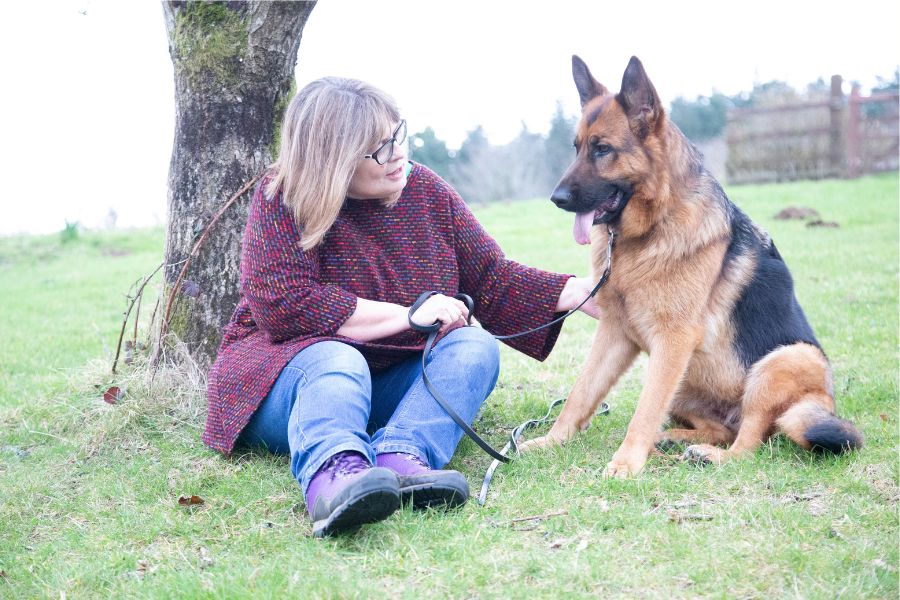
For several weeks, Ferguson’s German Shepherd was obsessively sniffing her mouth. This was a new behavior that she found quite odd. The dog, Inca, was only two years old, but she seemed to know something was wrong with her owner and was doing her best to let her know. Inca constantly sniffed around Ferguson’s mouth and frowned.

How Inca knew something was wrong
The dog’s persistence caused the then 60-year-old woman to become concerned, which led her to the dentist. Everything checked out fine, but Inca was still frowning after sniffing Ferguson’s mouth. This prompted Ferguson to visit her doctor to be tested for other things that might change the smell of her breath.
According to Medical News Today, diabetes can cause the breath to smell differently. Gluten intolerance and Celiac disease can also cause bad breath, according to Imperial Dental Center. Ferguson was cleared of any gut-related issues after tests from her doctor. Yet Inca would not stop telling her something was wrong. Growing more concerned about her dog’s new behavior, Ferguson decided to do a full-body scan to rule out anything unusual.
“Her behavior towards me changed, she just started homing in on my mouth. Every time she could get a sniff of my mouth she would frown,” Ferguson told The Mirror. “She just had this focused intent on my mouth, and you couldn’t push her away until you had done an outbreath. When she got that she would give me such a look and walk away. In no way did I expect lung cancer at all. It was such a shock because I am a non-smoker, and because I taught biology, I was very anti-smoking.”
Turns out, Inca was trying to tell her she had a tumor growing in her lungs. Thanks to the dog’s keen nose and insistent behavior, Ferguson was able to catch the cancer early. Before long, the science teacher was off to surgery, where doctors removed a golf-ball-sized tumor.

“The surgeon said…’that dog saved your life. We never catch it at stage one,’” Ferguson told the BBC.
Science is catching up to dogs’ noses
This remarkable discovery took place in 2015, and since then scientists have been working on recreating a nose like Inca’s. Dr. Andreas Mershin, who led this research at MIT for nearly two decades, has since spun the project into a company called RealNose.ai, which continues training an “e-nose” with AI to detect cancer. In May 2026, the device was demonstrated to Queen Camilla, patron of Medical Detection Dogs, at Clarence House, and researchers continue testing it against urine samples to see if it can match a dog’s accuracy.
Dr. Andreas Mershin, a physicist who led MIT’s Label Free Research Group for nearly 20 years, developed the device that is now being used to screen donated urine samples. The samples were prescreened by Medical Detection Dogs, and the results of the e-nose will be compared with those of the dogs.

“This is a major milestone,” Mershin told Medical Detection Dogs. “We’ve worked to emulate the dogs’ abilities and train machines in a similar way, rewarding them for correct identifications. It’s like giving our devices a new sense: a nose. Phones already have eyes and ears, but machine olfactors are the next frontier in health technology and AI sensing. This could transform the world of diagnosis, screening, and early detection.”
While the e-nose is currently designed to detect prostate cancer, once it’s perfected, the mechanical nose will hopefully detect other cancers as well.
A second chance thanks to her dog
Ferguson, for one, is thankful that her dog’s nose detected her lung cancer early, giving her a renewed chance at life. Inca, now around 13 years old, has since been trained as a recovery assistance dog to help Ferguson manage the anxiety that followed her diagnosis.
“I was just so lucky,” she told The Mirror. “Every day is special with her. To catch it at stage one is just remarkable. I don’t know how I would have survived with radiotherapy and chemotherapy. She saved me a lot of fuss. It was meant to be.”
This article originally appeared in March. It has been updated.