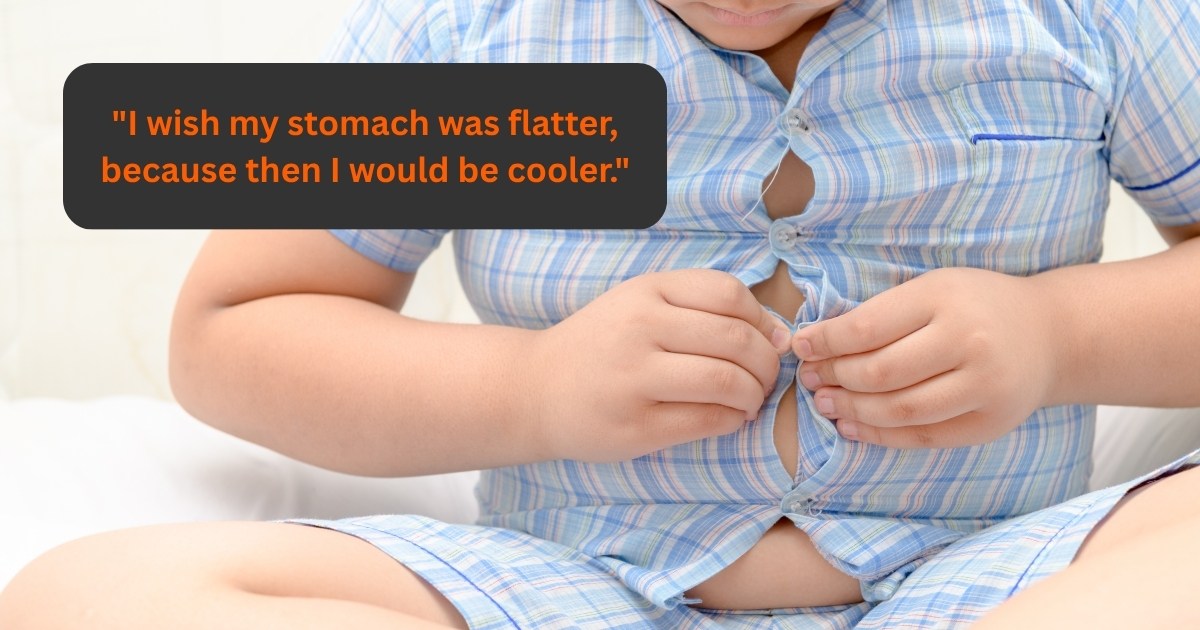
“I wish my stomach was flatter, because then I would be cooler.”
That’s what parenting creator and nutritionist Emelie Vessey (@emelie.vessey on TikTok) says her 5-year-old son told her one day, completely out of nowhere. His words shocked her. “I just never expected those feelings to show up at 5 years old,” she said, detailing the encounter in a recent TikTok titled “Someone called my son chubby. Here’s how I dealt with it.”
Her first instinct was to comfort him. Every parent knows the feeling when their child tells them something strange, worrying, or unexpected: their stomach forms a horrible knot that twists over and over. In those moments, every bone in their body screams for them to tightly hug their child and shower them with reassurance. “What are you talking about?” they might blurt out. “You’re perfect!”
It sounds uplifting, but upon a closer look, you can see how that’s not actually a satisfying answer.
The truth is that most children experience body image trouble far earlier than adults expect. In fact, one study suggests it could start as early as 3 years old. Between the tender ages of 3 and 5, children begin to form their ideas about weight, including how they feel about their own and what they think about others’.
It’s a tricky, complicated issue. If you struggle to find the right words with your children, you’re not alone.
Why ‘you’re perfect’ can secretly backfire
Imagine this: one day, your child confides in you and shares that a classmate made a rude, hurtful comment about his body. “He told me to lose weight,” he says, tears starting to pool in his little eyes. In a moment of empathy, you reach out to comfort him. “What do you mean? You’re not big,” you exclaim. “You’re beautiful!”
Pause. Stop and think about it for a second. What is your child really hearing?

“Trying to reassure them in this way is more likely to undermine their body confidence,” Charlotte Ord, a psychologist who works with adults and teens on body image, self-esteem, and their relationship with food and eating, told The Guardian. When parents rush to denial, kids receive a set of messages: Being fat is “bad,” only certain types of bodies are desirable, and people with larger figures can’t be beautiful.
As Vessey puts it, “if we immediately jump in with ‘You’re not big,’ we accidentally reinforce the idea that big equals bad.” From experience, she knows that bodies change constantly—through growth, puberty, illness, pregnancy, and aging—and worries that her kids will dread getting “bigger” as they age, or repeat harmful rhetoric to friends living in larger bodies. “Children don’t suddenly wake up one day unhappy with her bodies,” she writes. “They learn it somewhere.”
Plenty of research backs her concerns. In 2016, the American Academy of Pediatrics urged parents to avoid “weight talk” with their children (comments about their own weight or their child’s), and advised them to never tease kids about weight or openly encourage them to diet, because both raise the risk of obesity and eating disorders in adulthood.
So, when her son cried, “I wish my stomach were flatter,” Vessey did the hard thing. She bit her tongue. Then she asked one gentle question: “What do you mean by that?”
Boys worry, too
In a society where body image is usually dismissed as a “teenage girl problem,” the story of Vessey’s son reminds us that this issue affects everyone.
We tend to forget that nuance partly because girls are who we study most. One study of 5-year-old girls found that a third already showed at least moderate dietary restraint—eating less on purpose, as to appear thinner—and many had already internalized the “thin ideal,” expressing beliefs that a thinner body is the marker of beauty, attractiveness, and success, especially for women and girls.
But that’s only half the story.
A national poll from the University of Michigan’s C.S. Mott Children’s Hospital found nearly two in three parents say their child feels self-conscious about some part of their appearance. Weight was among the most common insecurities. And it’s not just a feeling kids come up with on their own: parents reported their child was mocked about their appearance by other children (28%), strangers (12%), family members (12%), teachers (5%), and health care providers (5%).
Remember, negative self-image comes from a place outside yourself. Children don’t sit around inventing ways to be unhappy with their bodies They pick it up somewhere. That means it can also be set down.
The million-dollar question
Instead of correcting her son, Vessey did something difficult: she searched for where the feeling came from. In her video, she writes: “I simply asked, ‘What do you mean by that?’ with genuine curiosity.”
By her account, that question led her to the source—a family friend whom she “really respects.” Instead of jumping to conclusions, Vessey gave the friend a chance to explain herself. Turns out, the whole thing was a misunderstanding. Vessey’s son was born prematurely and had spent his early years very small. By calling him “chubby,” the friend simply meant he’d finally caught up with his peers and was looking healthy. “She’s from a culture where talking about people’s bodies is much more common,” Vessey adds. Context always matters.
How to respond when someone comments on your kid’s body

Here’s the good news: you don’t need a script memorized. What you really need is one beat of patience before the fixing, soothing, reassuring instinct takes over. Then:
- Get curious before you reassure. “What do you mean by that?” leads to authentic connection, richer dialogue, and the root of the problem.
- Mind your own body talk. Weight comments from family members do more harm than good, even the ones self-directed or well-intentioned. Kids notice how you speak about your own body, so it’s wise to do it kindly.
- Draw boundaries. It’s worth exploring the Satter Division of Responsibility in Feeding (sDOR), which gets specific about the roles we play at the dinner table that set children up for long-term nutritional success. When both the parent (who dictates the what, when, and where of meal time) and the child (who decides whether and how much they consume), understand their respective roles, meals become a breeze.
- Give people the benefit of the doubt when you can. Sometimes a clumsy comment is just a cultural difference or a kindness that landed wrong.
Keep asking questions
The next time your child says something that makes your heart drop, try to resist the urge to fix it all in one breath. Get curious first. “What made you think about that today?” is a good question to lead with, as is “When did you start feeling that way?”
You can’t adequately help with a feeling until you understand where it really came from.