Nearly every culture in the world uses social media. However, there are some subtle differences in how and why we use social media, and it can have surprising effects on our mental health.
Harvard University professor and social scientist Arthur C. Brooks, who’s had no shortage of insights regarding living a happier life, recently shared how, when he first began teaching, his American students tended to display a “brighter” disposition than their non-American counterparts who leaned more “cynical.”
Now, that dynamic has flipped. His immigrant students seemed more “cheerful,” while the American students appeared more “jaded.”
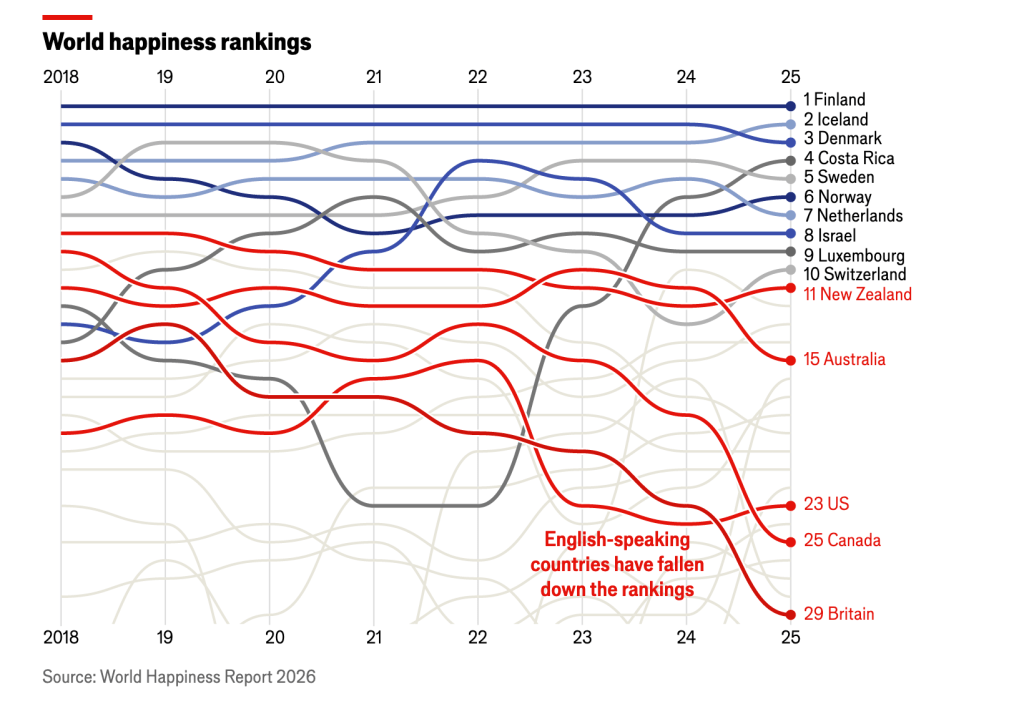
This anecdotal observation matched the finding in the World Happiness Report, showing English-speaking areas (America, Canada, Britain, and even Australia and New Zealand) ranking at the bottom for happiness.
A pattern hidden in plain sight
So, Brooks began investigating their behavior to find out why. The surprising common denominator he found was: social media. Not in terms of frequency, but in the way platforms are used.
Speaking with CBS News, Brooks noted that English speakers often relied on social media products that are, as he called it, “me-oriented,” and substitute real human relationships. This undoubtedly only begets more isolation and despair.
Whereas in other countries, platforms like WhatsApp are used to cultivate those relationships and build connections.
The distinction is subtle but important. One approach centers on consuming content from people we may never meet, while the other focuses on maintaining relationships with friends, relatives, coworkers, and neighbors. Though both happen online, they can create very different experiences.
A simple change with a big impact
While quitting social media cold turkey isn’t the answer for most of us, Brooks does say that we can still incorporate strategies other countries use in order to make our interactions with social media a little less depression-inducing.
Primarily: Don’t follow people you don’t know.
This ensures you’re only connecting with people who are actual players in your life, rather than the barrage of influencers and celebrities we see on a daily basis, but who really have nothing to do with us.
As someone who admittedly loves to follow folks I find aspirational, even I can’t help but agree that this could help mitigate that comparison trap many of us find ourselves in.
Certainly, I’m no outlier. Research has long shown that people naturally compare themselves to others. Social media can amplify that tendency by presenting a constant stream of carefully curated highlights. When the majority of what we see comes from strangers, it becomes easier to measure our lives against unrealistic standards.
Using technology to strengthen relationships
Perhaps the biggest takeaway here is that Brooks’ recommendation is ultimately less about restricting technology and more about using it differently. That’s something we can all do.
Instead of opening an app to scroll through updates from hundreds of unfamiliar faces, we might spend that same time checking in with a sibling, sharing a photo with friends, or making plans with someone we care about. Those interactions are far more likely to reinforce the social bonds that contribute to well-being.
Of course, there is nothing inherently wrong with following a favorite athlete, artist, or creator. But Brooks’ observations suggest that the healthiest social media habits may be the ones that bring us closer to the people already in our lives. As companies continue seeking to literally capture our attention, that small shift in focus could make a meaningful difference in how we win back the day, every day.