upworthy
Add Upworthy to your Google News feed.
Google News Button
Pop Culture

Former Uber employee ranks Google Maps, Apple Maps and Waze, prompting map app debate

Do you agree?

google maps and apple maps screenshots
Google Maps/Apple Maps

Which map app is the best for what uses?

Those of us of a certain age remember asking for directions and keeping two-inch thick road atlases in our cars to find our way around. Then with the internet came the miracle of Mapquest, followed by the how-did-we-ever-live-without-this GPS systems you could attach to your dashboard.

Then smartphones kicked the road trip game up a notch with map apps that not only give up step-by-step directions but also real-time traffic conditions and the ability to find a gas station or restaurant with gluten-free options along your route. Even those of us who grew up with paper maps struggle to recall how we ever got anywhere before Google Maps.

Now we're so deep into the map app era that we're past the wow stage and into the nit-picky stage. It's no longer good enough to have a handheld computer tell us how to get someplace in real time. Now we have expectations, preferences, opinions and complaints. We also have data and anecdotes with which to compare different apps and discuss which ones do what best.

And hoo boy do people have thoughts on that front.

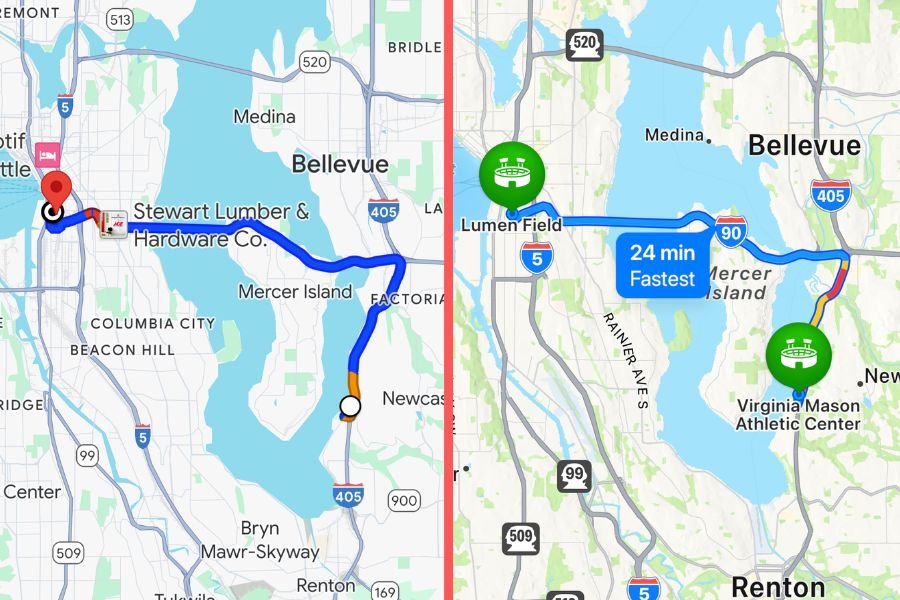
Former Uber employee Flo Crivello shared some info on X about the analysis they did with three of the most popular map apps—Google Maps, Apple Maps and Waze—using a dataset with millions of trips.

The big winner? Apple Maps.

Google came in second, and Waze was a distant third (worst "by far").

"The research also included which apps people *thought* was worse, and the order came in the exact opposite order," Crivello shared. "We understood why Apple Maps got a bad rap given how bad it was at launch — it rapidly got better, but the brand stuck. Waze was more of a mystery, and we ended up realizing that people thought its routes were best because it was exposing them to so much info on traffic, construction, police presence etc… Everyone thinks they want a minimalist UI, but in practice, when they see all this info, they subconsciously conclude 'wow, these guys really have their sh*t together' — even when the routes were actually the worst ones."

Crivello said the results "may be shocking," presumably because Apple Maps started with the worst reputation. In fact, Apple CEO Tim Cook famously apologized for Apple Maps in 2012 and recommended people use Google Maps instead.

However, in the years since, Apple Maps has redeemed itself while Google Maps has lost a bit of its initial luster. Then Waze came along, which people in cities with variable traffic touted as more accurate for timing and real-time updates, becoming some people's favorite. But according to his data eight years ago, Apple was the winner.

Do those results still hold? Some people in the replies said Google Maps was the best, hands down, while other said they preferred Apple or Waze.

It might depend on where you live and what you look for in a map app (and whether you even have access to Apple Maps). Discussions about these apps abound, with some common threads throughout. Many people agree that the U.S. is where Apple Maps shines, but Google Maps works better abroad. Apple Maps offers more natural navigation directions, such as "Not at this stop sign, but at the next one, turn right," instead of Google Maps' assumption that everyone knows how far 300 feet is. Google maps has great searchability and is easier to check reviews of places compared to Apple Maps. So opinions might vary on "best" depending on what you're using it for.

Waze has loyal users and people who love to joke about where it reroutes you when there's traffic.

These are not the only three map apps available, either. People who travel internationally and use public transportation seem partial to the CityMapper app, which makes finding train and bus routes simple with a user-friendly interface, so again, a lot depends on why you're using the app in the first place.

As far as popularity goes, Google Maps boasts a whopping 1 billion monthly users. While Apple Maps usage doesn't have any hard numbers, there is data that shows younger generations are partial to iPhones, on which Apple Maps is a native app, so its usage may be growing.

What's your experience? Which map app do you prefer?


This article originally appeared last year.

party, chatting, likable, drinks small talk, men and women

A woman speaking with two men at a party.

When we think of someone likable, we often imagine a person with a big personality who's the life of the party. We conjure up images of social butterflies and people who keep everyone at the dinner party glued to their every word when they tell a story. The funny thing is, according to research, that's not really the case.

Studies show that the easiest way to make someone like you is to show interest by asking questions during the conversation and making it clear that you like them. People also really love those who come off as genuine.


Michael Gendler, a co-founder of Ultraspeaking, a platform that helps people master the art of public speaking, recently shared three "magic" phrases that make you more likable, all of which align with what science tells us.

Three phrases that make you more likable

Phrase 1: "Here's what really scares me..."

This phrase resonates with people because it shows you're genuine by admitting your vulnerability. "Man, talk about your feats, real fears, not like 'Oh, I'm scared I'm going to be too successful.' Tell us about something that actually scares you. Don't be guarded. Be open, and other people will appreciate that," Gendler says.

Phrase 2: "You know what I really like about you?"

This phrase makes people like you because it counters a psychological phenomenon known as signal amplification bias, which suggests we tend to overestimate how clearly we express our feelings to others. This means that, many times, when we think others know we like them, they may not be so sure. So a little assurance goes a long way toward showing them the feeling is mutual. "People love being complimented as long as it is genuine," Gendler says.


Phrase 3: "Tell me more"

As Dale Carnegie wrote in How to Make Friends and Influence People, the key to interacting with others is focusing on being interested in them rather than trying to impress them by being interesting. "Be interested, not interesting," Carnegie writes.

A Harvard study supports this, showing that when you first start speaking with someone, you should follow your first question with two more. People who do this are rated as much more likable than those who, after one question, shift the conversation to themselves. "People love feeling like what they're saying is interesting. So invite them to speak more," Gendler continues.


Don't forget to be genuine

Ultraspeaking's post is a breath of fresh air for those who aren't comfortable trying to impress others at parties, on dates, or in the office. The video shows that if you make people feel important, they're much more likely to like you in return. The key is that it has to come from the heart.

"Remember, don't just use these phrases and expect them to work," Gendler says. "They have to be genuine and open. That's what makes people likable."

idioms, catchphrases, buzzwords, english language, english, office, workplace, corporate culture

Business idioms that you can totally use in your real workplace.

It seems that the higher up you ascend in your career, the more you grow to love a good business catchphrase, buzzword, or idiom. Working in an office will have you saying things like "let's kick this off," "let's circle back on this," and "let's not boil the ocean here" in no time.

Idioms, while they can get annoying when overused (especially in the workplace), do serve a helpful purpose. They're a sort of fun shorthand, conveying a lot of meaning in a few words. While idioms act as analogies or metaphors that give more context to a situation, they also come with a lot of history: when you hear one, you remember all the times you've heard it before or even used it yourself. It instantly contextualizes what's going on and quickly helps us understand what someone may be communicating.


However, run-of-the-mill workplace idioms have gotten a little stale, to the point that many of them have become meaningless cliches. We could all use some new ones, and luckily, folks on social media are chiming in with some ridiculous creations of their own.

It all started when an X user named Tomie shared what would go on to become a hugely viral post: "I've started saying nonsense phrases at work like 'that's neither cheese nor cheddar' just to see my coworkers nod seriously like they understand."

Tomie added in another post, "Like woah there, pause the pineapples."

The post received nearly 2 million views and hundreds of comments on X. Soon, it made its way to the professional crowd on LinkedIn, where people began building on Tomie's original suggestions.

Daniel Berk added a few of his own:

"Let's not microwave the lasagna on this one."

"We might be polishing the doorknob instead of opening the door."

"This feels like we're alphabetizing water."

"Let's not put racing stripes on a parked car."

"That's a lot of garnish for no entrée."

"We're measuring the shadow, not the object."


Noah Latner chimed in with:

"Let's not settle in before we buy the house."

"That lollipop isn't worth the lick."

"You've got to put the patty on the grill before it sizzles."

"This banana's got no peel to it."

"Don't juice a pickle and tell me it's matcha."

Sally Thomas writes, "One of my finest achievements was in a previous company where the manager was full of buzzwords. I got him to adopt 'It depends how you fold your napkin' as a favourite saying."

Jennifer Connelly suggested: "Let's sauce these nugs later!"

Cameron Gibbons said, "I'm not sure where it started, but one exec at Google said 'let's double click into that' and it spread like wildfire through the org."

idioms, catchphrases, buzzwords, english language, english, office, workplace, corporate culture "That banana's got no peel to it." Giphy

Liora Kern cooked up a few idioms that paid homage to different languages and cultures:

"Dutch version:
1. That's a lot of hagelslag on a very thin slice of bread.
2. It's a three bicycles beat one car type of thing.

Belgian version:
1. We're agreeing on the fries because agreeing on the sauces is harder.
2. We're arguing over the glass instead of the beer."

idioms, catchphrases, buzzwords, english language, english, office, workplace, corporate culture "We’re arguing over the glass instead of the beer." Photo by engin akyurt on Unsplash

Here are a few more from the creative minds on X:

"The last nail is the rustiest one."

"Two claps and the goat's up the hill"

"Let's toss this idea into the piranha bin."

"I'm pulling the porcupine here."

"This is all bags and boxes."

"The proof is in the parmesan."

"There's a rock behind every bush."

"There's more to being a dog than sleeping under the porch."

The funniest part about these made-up, nonsense idioms is that they kind of make sense.

Some of the idioms brainstormed by random commenters are variations of existing catchphrases, or combinations of multiple different ones ("It's not exactly rocket surgery."). But many are complete gibberish, and yet our brains still seek out and manage to find some semblance of meaning in them.

YouTube English teacher Aly says that "corporate English" is like its own language. Speaking the secret code with confidence, and pretending to understand it even when you don't, are key to success. In fact, one recent study found that more than half of employees regularly "pretend" to be working. So if you've ever felt self-conscious because you were in over your head at work or didn't know what the higher-ups were talking about, rest assured there's a good chance they were faking it, too.

- YouTube www.youtube.com

One commenter on Tomie's original post summed it up perfectly: "Office culture accepts nonsense when said confidently and calmly."

Another added, "The only way to survive corporate America is to understand its 90% make believe."

Delivering a totally made-up, nonsense business idiom with full confidence is one sure way to make people perk up and take notice of how brilliant you are.

ideas, homelessness, prodigy, social work, solutions
Photo credit: @ribalzebian on Instagram

Ribal Zebian is going to test a house he designed by living in it for a year.

Ribal Zebian, a student from the city of London in Ontario, Canada, already made headlines last year when he built an electric car out of wood and earned a $120,000 scholarship from it. Now, he's in the news again for something a little different. Concerned with homelessness in his hometown, Zebian got to work creating a different kind of affordable housing made from fiberglass material. In fact, he’s so confident in his idea that the 18-year-old plans on living in it for a year to test it out himself.

Currently an engineering student at Western University, Zebian was concerned by both the rising population of the unhoused in his community and the rising cost of housing overall. With that in mind, he conjured up a blueprint for a modular home that would help address both problems.


Zebian’s version of a modular home would be made of fiberglass panels and thermoplastic polyethylene terephthalate (PET) foam. He chose those materials because he believes they can make a sturdy dwelling in a short amount of time—specifically in just a single day.

“With fiberglass you can make extravagant molds, and you can replicate those,” Zebian told CTV News. “It can be duplicated. And for our roofing system, we’re not using the traditional truss method. We’re using actually an insulated core PET foam that supports the structure and structural integrity of the roof.”

Zebian also believes these homes don’t have to be purely utilitarian—they can also offer attractive design and customizable features to make them personal and appealing.

“Essentially, what I’m trying to do is bring a home to the public that could be built in one day, is affordable, and still carries some architecturally striking features,” he said to the London Free Press. “We don’t want to be bringing a house to Canadians that is just boxy and that not much thought was put into it.”

Beginning in May 2026, Zebian is putting his modular home prototype to the test by living inside of a unit for a full year with the hope of working out any and all kinks before approaching manufacturers.

“We want to see if we can make it through all four seasons- summer, winter, spring, and fall,” said Zebian. “But that’s not the only thing. When you live in something that long and use it, you can notice every single mistake and error, and you can optimize for the best experience.”

While Zebian knows that his modular homes aren't a long-term solution to either the homeless or housing crisis, he believes they could provide an inexpensive option to help people get the shelter they need until certain policies are reformed so the unhoused can find affordable permanent dwellings.

@hard.knock.gospel

What to buy for the homeless at the grocery store. 🛒 Most people get it wrong. After being there myself, these are the survival items that actually matter 💯 The 2nd to last one is about more than survival—it’s about DIGNITY. We are all one circumstance away from the same shoes 🙏 SAVE this for your next grocery run. 📌 IG@hardknockgospel Substack@ Outsiders_Anonymous #homelessness #helpingothers #kindness #payitforward #learnontiktok

Zebian’s proposal and experiment definitely inspires others to try to help, too. If you wish to lend a hand to the unhoused community in your area in the United States, but don’t know where to look, you can find a homeless shelter or charity near you through here. Whether it’s through volunteering or through a donation, you can help make a difference.

Sylvia Browne, Montel Williams, laughing, psychic, viral videos
Photo Credit: Canva, The Montel Williams Show

People laugh while scrolling their phone. Sylvia Browne looks concerned.

If you lived through the '90s and early aughts and happened to watch The Montel Williams Show or Larry King Live, you probably remember their "resident psychic," Sylvia Browne. With her flaxen blonde hair and very short bangs, Browne claimed to be a medium for "angels" and purported to be clairvoyant when audience members asked her questions.

Of course, it wasn't just Millennials watching. Many members of previous generations would, often secretly, enjoy her segments with abandon like a sci-fi zombie B-movie. It wasn't until we had a little hindsight that we could measure her extremely confident-sounding statements and understand that...many of them simply were not true.


Near the end of last year, people who grew up in this era began making compilations of some of Browne's most outrageous, inappropriate, and often laughably wrong predictions. The trend went so incredibly viral that it has picked up steam again, and these clips continue making the rounds.

In one montage of clips, we see person after person bravely stand up and ask Sylvia questions. Often they'll ask about someone who has gone missing. Browne's answers are curt and to the point. "He drowned" seems to be a big one. To one woman who asked about her father, Sylvia matter-of-factly states, "He's alive. He's in Florida."

A common question Montel often asked after Browne's declarations was, "Does that make sense?" Usually the answer was, "No, but thank you," as the audience member gingerly took their seat.

The best part of watching these clips continue to go viral is the communal joy it's bringing to the comment sections (not to mention the nostalgia and the jokes). One person writes that their life schedule was dependent on whether or not Browne was booked as a guest that day. "If Sylvia was on, I'd skip school."

psychic, Sylvia Browne, Montel Williams., Larry King, Mean Girls Amanda Seyfried in a scene from the movie Mean Girls. Giphy, Paramount Pictures

This person jokes after seeing the woman who was told her father has been in Florida for decades: "Her dad in Florida watching this: Darn it!"

Another acknowledges Browne's go-to answer. "Sylvia, I forgot my middle name…." "It drowned." "Okay, thank you."

And here's another spin on it: "5 years ago my father went missing while climbing Mount Everest I was wonde....." "He drowned in the Titanic." "Thank you."

Over on Threads, @Robbylernan posted quite a few Browne clips, claiming, "I went down a Sylvia Browne rabbit hole last night and I laughed my a-- off for an hour."

One person on the thread reminisces about their favorite Browne moment: "The best one was when she told that reporter that the girl in the picture was kidnapped and dead and the reporter said, 'That picture is me.' And she looked at the woman and said, 'You weren't kidnapped?' BRUHHH."

Note: Her predictions weren't all completely wrong. In fact, The Daily Mail recently shared a Browne prediction that went viral during the COVID-19 pandemic. Browne reportedly stated, "In around 2020, a severe pneumonia-like illness will spread throughout the globe, attacking the lungs and bronchial tubes and resisting all known treatments."

That said, skeptics debunked her claims for years. In a piece for TV Insider, freelance entertainment Martin Holmes reminds readers of the time "Browne told Louwanna Miller her missing daughter, Amanda Berry, was 'not alive,' explaining to the distraught mother, 'Your daughter's not the kind who wouldn't call.'" Holmes adds, "Berry was found alive in 2013 after she escaped years of captivity."

In 2010, Skeptical Inquirer Magazine noted, "Despite her repeated claims to be more than 85 percent correct," a study reported that "Browne has not even been mostly correct in a single case."

Wrong or right, it's the wrongness that seems to bring the most delight to those who are dipping into the nostalgia. Even Saturday Night Live got in on the fun.

Amy Poehler spoofs Sylvia Browne on SNL. www.youtube.com, Saturday Night Live, NBC Universal