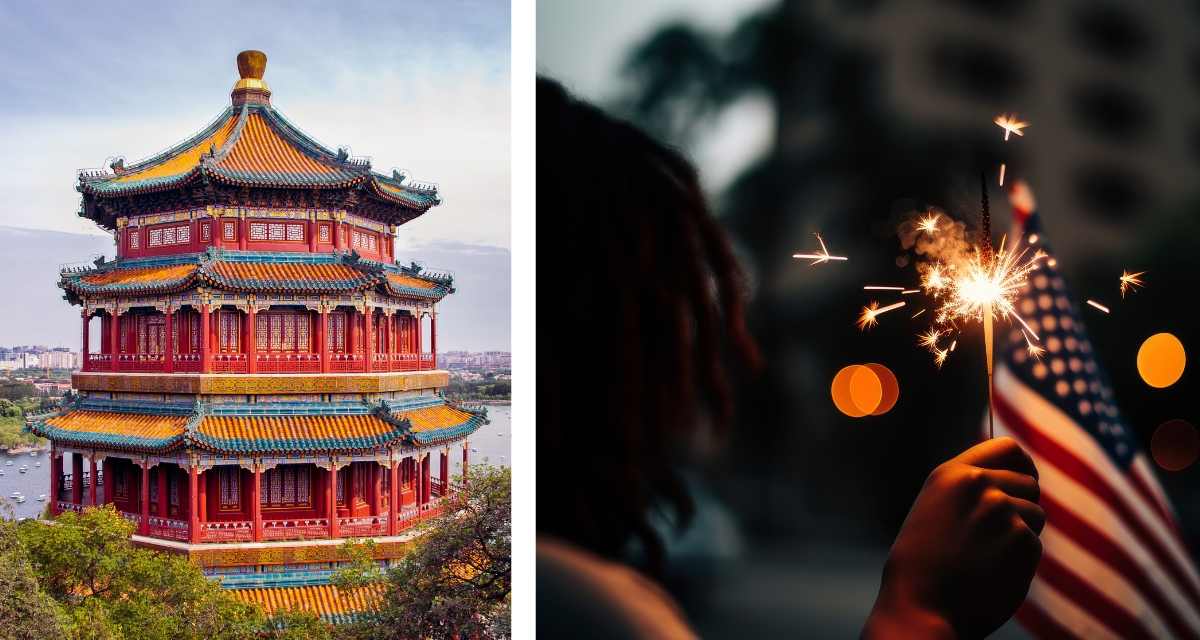
America’s 250th anniversary will take place on July 4, 2026. For many, this means gathering in the evening to witness dazzling displays of fireworks. Displays will vary, from elaborate stadium shows to family and friends simply lighting Roman candles in the backyard.
But this Fourth of July staple is eight times older than America itself. Its story stretches back more than two thousand years, evolving with each generation before becoming part of America’s biggest celebration.
The earliest sparks of fireworks
While some historians think the earliest adaptations go back to the Middle East or India, the general consensus credits an accidental discovery in China around the first century B.C.
As the story goes, roasted bamboo exploded with a bang due to its hollow air pockets, becoming a natural firecracker of sorts. They became a go-to tool for warding off wild animals and evil spirits.
Then, between 600 and 900 A.D., came the discovery of gunpowder in a supposed alchemical quest for immortality. While the sulfur, charcoal, and potassium nitrate didn’t provide eternal life, it did put on quite a show under extreme heat. The then-novel substance was stuffed into bamboo shoots, and later paper tubes, that were then thrown into the fire to produce a loud blast. And voila, the first fireworks were born.
Of course, as The Smithsonian explains, a fireworks show in 800 A.D. would likely feel rudimentary compared to what we have today. There was nothing blasted into the air, no added colors. But still, there was plenty enough excitement to quickly become a tradition for celebration and entertainment.
Firecrackers were also experimented with on the battlefield. At first, they were attached to arrows and aimed at enemy targets, acting as crude bombs. Eventually, Chinese artillerymen learned how to fire them into the air, giving us the world’s first rocket cannons. This technology would eventually lead to the aerial displays we are accustomed to today.
Fireworks make their way around the world
By the 13th and 14th centuries, both fireworks and gunpowder were spreading throughout Europe and Arabia. And with them, the limitless potential for beauty and destruction.
During this time, a job in fireworks was just about as dangerous as a job in the military. Before the show, the audience would be greeted by a hype man, essentially, who would tell jokes to the crowd while wearing leaves to protect themselves from incoming sparks. This earned them the moniker of “green men.” However, no amount of leaves could truly save them from becoming injured or killed when the detonations malfunctioned.
As they staked claim in the New World, Europeans brought their knowledge and appreciation of this illuminating art form with them. As legend has it, Captain John Smith, said to be saved from execution by Pocahontas, set off the first display in Jamestown in 1608.
A celebration written into history
Even though fireworks were regularly used by this time for military victories, they might not have been so closely linked with Independence Day had it not been for a letter John Adams wrote to his wife.
On July 2, 1776, two days before the Declaration of Independence was signed, Adams wrote that the most “memorable day in the history of America,” would be celebrated annually. Therefore, it “ought to be solemnized with pomp and parade… bonfires and illuminations [fireworks]… from one end of this continent to the other, from this time forward forevermore.”
Just as Adams wished, the following year fireworks commemorated America’s first anniversary as its own country, and continued to do so over two centuries later. It wouldn’t be until the 1830s that we got multicolored explosions, though.
Funny enough, civilians getting carried away with fireworks is also etched into American history. According to History.com, Rhode Island officials banned the “mischievous use of pyrotechnics” in 1731 thanks to too many firecracker-related pranks. Later, the Society for the Suppression of Unnecessary Noise, which included Mark Twain and Thomas Edison, aggressively lobbied against firecrackers and noisy celebrations near hospitals and schools to protect public health, via the “Safe and Sane Fourth” campaign.
Every time you enjoy fireworks, be it for the Fourth of July, New Year’s, a home run for your favorite team, or (safely and legally) at the place you call home for funsies, you are experiencing 2000 years’ worth of history. They’re a miracle of science that’s outlasted dynasties, crossed oceans, and become part of celebrations around the world. And even after all these years, it still invokes us with wonder and excitement. If that’s not magic…I don’t know what is.