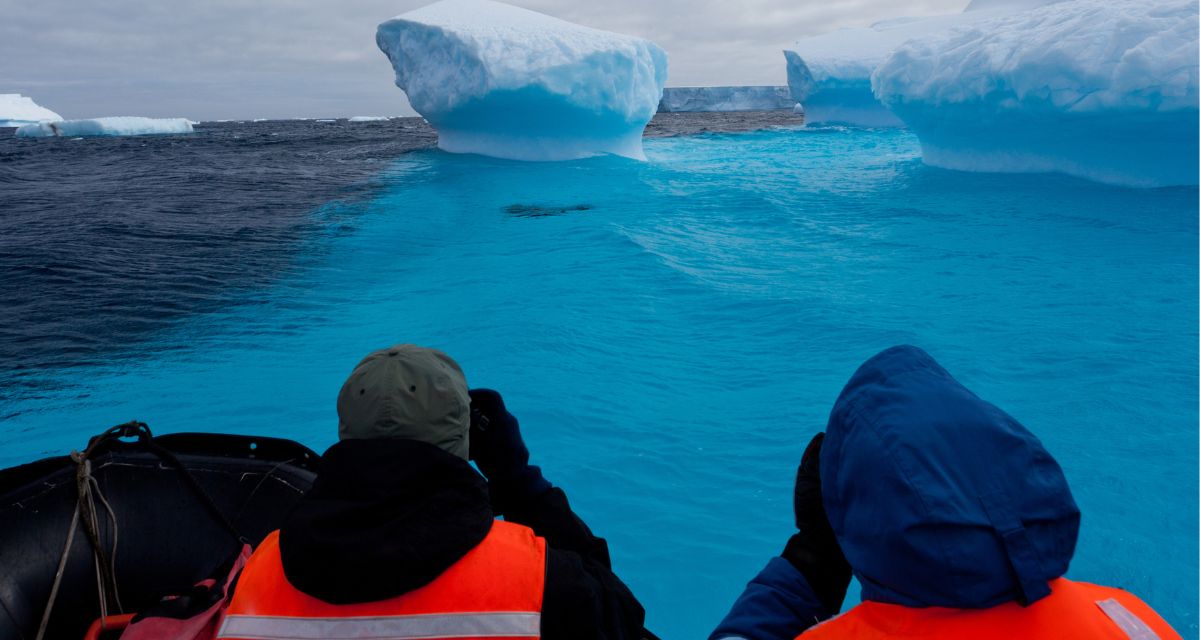
Antarctica has no permanent residents or Indigenous populations. The only people who live there do so temporarily, either to conduct research or to serve as support staff. And yet, even in the most isolated place in the world, an accent could be forming.
At least, that was the conclusion of a 2019 study in which 11 participants, known as “the winterers,” were recorded saying common, everyday words every few weeks. The group consisted of eight Brits, one American, one German, and one Icelandic participant. Most of the words were ones they used regularly in daily life and contained vowel sounds known to vary across English accents, including “food,” “coffee,” “hid,” and “airflow.”
The researchers found that, over their six-month stay, the winterers began shifting their vowel pronunciations, gradually sounding more similar to one another.
How the Antarctic accent came to be
Part of this phenomenon has to do with accommodation, a linguistic term describing how we adjust our speech to be as clear as possible to the person we are speaking to, often adopting their pronunciation. That person, in turn, instinctively does the same, and a new dialect can begin to take shape, often through what’s known as a vowel merger. Vowel mergers occur when two distinct vowel sounds merge into one, causing words that historically sounded different to be pronounced identically (think: “Mary,” “marry,” and “merry”—which once had slightly different pronunciations).
The study’s researchers also found that the “ou” vowel sound (as in “sew,” “flow,” and “code”) began “fronting,” meaning it was pronounced farther forward in the mouth. This finding was particularly interesting because none of the speakers’ native accents featured this trait, suggesting it did not arise from accommodation. In other words, they developed it spontaneously.
Scientists call this linguistic innovation, the process by which social interaction, technology, and cultural shifts create new language patterns. Slang falls into this category.

Why you won’t be seeing an Antarctic accent anytime soon
There are, however, a few caveats. For one, Jonathan Harrington, a professor of phonetics and speech and an author of the study, told the BBC that the accent shift was “very subtle” and couldn’t technically be heard. Instead, researchers observed the change in recorded acoustic waves.
Second, Harrington noted that “for accents to develop to the point where they are noticeable, it really takes a generational change.” Considering that people stay in Antarctica for only six months at most, any accent that forms is likely short-lived.
The bigger takeaway
Still, this experiment provides larger insight into how new accents, dialects, and even languages develop when communities grow in isolation. It also helps explain why American English has diverged so much from British English.
And if you really want to sound Antarctic, it’s all in the slang, apparently. Here are a few examples of words known among those who live on “the ice” (as dwellers call it, rather than Antarctica), courtesy of Bernadette Hince’s The Antarctic Dictionary and the Cool Antarctica website:
Dingle
A sunny, bright, and clear day.
Fod Plod
Picking up rubbish or debris to keep the airfield and base safe.
Big Eye
Insomnia caused by a lack of sunlight disrupting one’s circadian rhythms.
Toasty
Brain fog caused by perpetual darkness, as well as low temperatures and discombobulating altitudes. The term can also be used for other general misdemeanors committed around camp.
Ice Shock
As one Antarctica-based blogger put it, this is what happens when “you get back to the rest of the world and realize that no matter how insane Antarctica is, the real world is FAR nuttier, and that you can no longer function in it.”
Greenout
A riff on “whiteout.” As The Antarctic Dictionary defines it, “greenout” is “the overwhelming sensation induced by seeing and smelling trees and other plants after spending time in Antarctic regions.”
Beaker
Scientist. There are also nicknames for specialists, including “fuelies” (in charge of fueling equipment) and “wasties” (who deal with, well, waste).
City Mice/Country Mice
Personnel who work at main research stations, as opposed to crews who move among different camps across the continent.
Freshies
Shipments of fresh fruits and vegetables that provide a welcome culinary respite for those on the ice.
Poppy
Alcohol served over Antarctic ice, which makes a satisfying popping sound as it releases long-pressurized gas.
All of this goes to show that even at the very edges of the world, humans will continue to reshape the way they connect with one another.