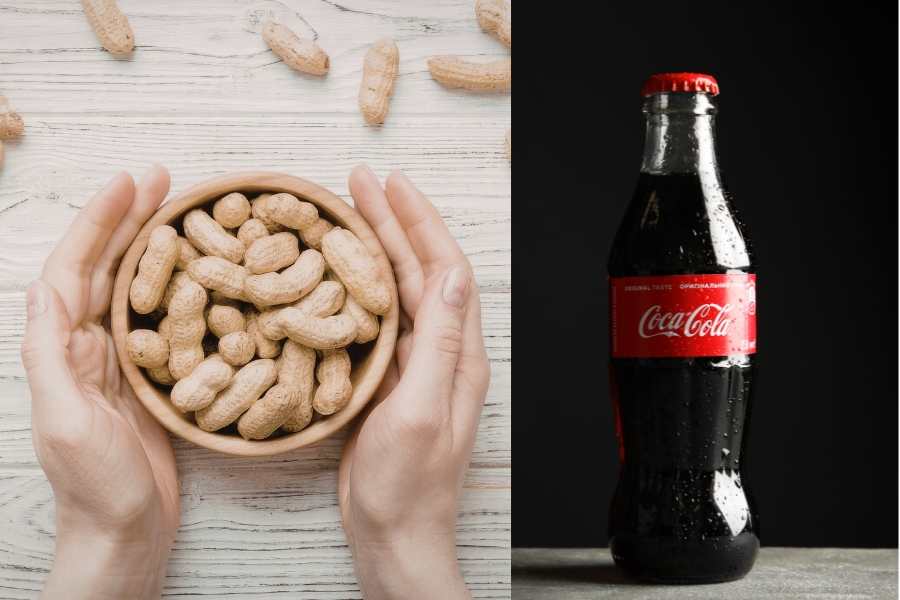
Have you ever seen someone pour a snack pack of peanuts into a bottle of Coca-Cola? If so, you may have memories of relatives from the Southern United States. If not, you may be wondering why on Earth someone would do such a thing.
An X user from Japan shared a photo of a glass with peanuts floating atop what appears to be cola, writing (auto-translated from Japanese):
“About 30 years ago, I read in a Haruki Murakami essay that in America, it’s popular to drink cola with peanuts in it. I was like, ‘Huh,’ and a long time has passed since then, but I finally tried it. What the hell is this? It’s ridiculously delicious, damn it. It’s on a level where I won’t want to drink cola any other way anymore.”
Are peanuts and Coke really an American tradition?
Apparently, this “American” tradition has been gaining traction in Japan, with people sharing their experiences on social media. But many Americans may be surprised to see Coke with peanuts described as a “popular” combo. It’s not really a common or widespread snack choice. For some, however, it’s a flash from the past.
“Southern kids did this all the time,” wrote one commenter. “Our folks would buy us an ice cold Coke in a bottle and a bag of peanuts, we’d drink some Coke, then funnel in some peanuts. Delicious and fun.”
“I learned this from my father, but it was Dr Pepper. He was stationed in Texas when he was in the Army. That’s where he learned about it.”
“My very southern high school AP US History teacher swore by peanuts and Coke but was adamant that the only way to do it was in the little glass bottles that you only really now see at weddings and other functions. Not sure if there’s science to back that up.”
According to a few commenters, the combo also became popular in parts of Norway after people emigrated to the U.S. and then brought the idea back to Norway with them.
Where did peanuts and Coke come from?
How did it get started? According to The Local Palette, which explores the food culture of the South, the combo was known as “farmer’s Coke” and was a workingman’s beverage:
“Its fizzy refreshment bore sweet and salty satisfactions that could be savored during a work break. Some trace it back to the early decades of the twentieth century when ‘dope wagons’ roamed the grounds of textile mills before the advent of the vending machine. These food and beverage carts sold bottles of ‘dope,’ a nickname for Coca-Cola that was perhaps a reference to the days when the popular soda contained trace amounts of cocaine.“
For farmers, pouring the peanuts into the soda bottle made sense. For one, it kept them from touching the nuts with dirty hands. It also meant they could eat and drink with just one hand.
There are multiple variations on the theme. Many people insist on taking a few sips from a bottle of Coke and then dumping the nuts straight into the bottle. Some say it has to be Mexican Coke, since it uses sugar instead of corn syrup. Others swear by RC Cola or Dr. Pepper instead of Coke. People disagree on whether the peanuts should be roasted or boiled.
Why peanuts and Coke make such a delicious combination
Sweet and salty is generally known to be an irresistible combination of flavors, so there’s that. But according to X user’s Aakash Gupta’s analysis, the chemistry that happens when you drop the nuts into the soda provides another layer of flavor:
“Coca-Cola sits at pH 2.5, roughly the same acidity as stomach acid. When you drop roasted peanuts into that, the phosphoric acid partially denatures the surface proteins on the nut, releasing free glutamate. You’re generating umami in real time inside the glass.
The salt on the peanuts suppresses bitter taste receptors on your tongue, which amplifies your perception of sweetness without adding a single gram of sugar. Coca-Cola already has 39g of sugar per can. Your brain registers it as even sweeter because the salt is clearing the noise from competing flavor signals.
Then carbonation does two things. CO2 dissolved in liquid forms carbonic acid, which triggers pain receptors (TRPA1), not taste receptors. That mild irritation resets your palate between sips so you never get flavor fatigue. Every sip hits like the first. Second, the bubbles physically agitate the peanut surface, accelerating the protein breakdown and glutamate release. The longer the peanuts sit, the more umami you extract.
The fat content seals it. Peanuts are 49% fat by weight. Fat is the only macronutrient that activates CD36 receptors, which your brain interprets as richness and satisfaction. Mix that with sugar, salt, acid, umami, and carbonation and you’ve accidentally triggered every major reward pathway in the human taste system simultaneously.“
Sounds fancy. Perhaps it’s worth a try. If nothing else, the trend is creating some fun intercultural exchanges with our fellow humans on the other side of the world.