Costco has figured out how to do many things right. From offering killer bargains for shoppers to treating its employees well, it has become a highly sought-after place to work.
Redditor BazingaBeeKay shared exactly what they earn as a Costco cashier who also does forklift work:
“I make 32.90 an hour while cashiering, and 33.90 an hour while driving a forklift in the morning. 1.5x on Sundays. It takes about 5 years of full time at Costco to get to top out pay though. My biweekly paychecks are about $1850 after taxes and 13% in my Roth/401k.”
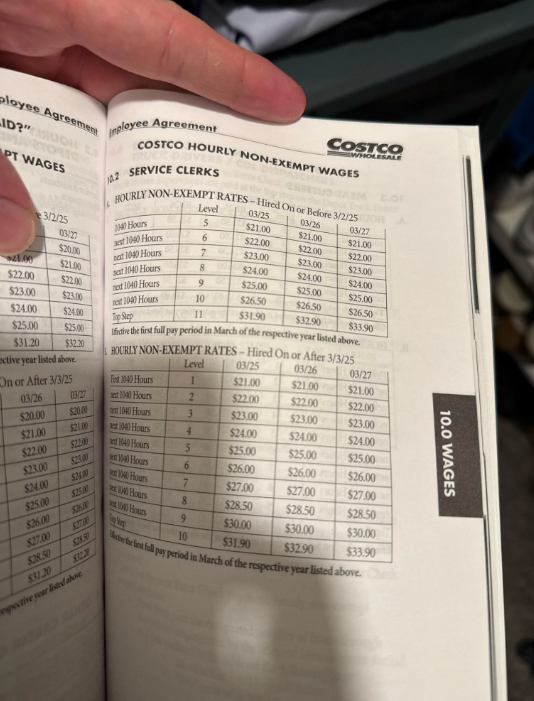
They also shared a photo of what appears to be a Costco employee handbook, with a chart showing hourly wages for cashiers:
Costco cashier pay chart. Photo credit: BazingaBeeKay/Reddit
People respond to Costco’s wages
The hourly wages range from $21 to $33.90, an impressive amount that shocked many Redditors who were unaware of Costco’s pay scale:
“Ok, I have said how Aldi pays their cashiers well, but Costco just puts them to shame.”
“That’s awesome. No wonder Costco employees always seem happy to be there 😀.”
“wtf… I’m paid worse at a carrier I have been doing for 18+ years and had to go to college for. That’s awesome for you! 👍”
“Detached viewpoint: I work in the mortgage industry and process a lot of loans. I estimate we see at least 5x (possibly 10x) as many Costco employees buying homes compared to Walmart or grocery store employees. TBF, maybe it’s regional, or because those other retailers’ employees already own homes, but to me, it’s interesting. Feels like it says something about employees who feel competitively and adequately paid.”
Some also noted that while the chart may be accurate, wages likely “vary greatly based on state, withholdings, other deductions, etc.”
Costco’s coveted positions
Others noted that becoming a cashier at Costco requires starting lower on the job title totem pole:
“Responders to other Costco questions have made it clear that new employees start on carts (bring back shopping carts) or assistant to a cashier.”
“I know a lot of people apply but very few get the opportunity. The cashiers at my local Costco are long term employees.”
“Those positions are impossible as EVERYONE is trying to get it and they always promote within. Great pay, benefits, retirement they all stay there and rarely have turnover.”
Jobs at Costco are highly coveted, and Costco cashiers have largely positive ratings on Glassdoor. One path that seems to work is seasonal employment:
“At our local Costco, the best time to apply is during the holidays. Start out as holiday help then transition to part time then to full time.”
“This is how half the employees I know got started. Just prove your worth during the seasonal employment.”
In a small village in Pwani, a district on Tanzania’s coast, a massive dance party is coming to a close. For the past two hours, locals have paraded through the village streets, singing and beating ngombe drums; now, in a large clearing, a woman named Sheilla motions for everyone to sit facing a large projector screen. A film premiere is about to begin.
It’s an unusual way to kick off a film about gender bias, inequality, early marriage, and other barriers that prevent girls from accessing education in Tanzania. But in Pwani and beyond, local organizations supported by Malala Fund and funded by Pura are finding creative, culturally relevant ways like this one to capture people’s interest.
The film ends and Sheilla, the Communications and Partnership Lead for Media for Development and Advocacy (MEDEA), stands in front of the crowd once again, asking the audience to reflect: What did you think about the film? How did it relate to your own experience? What can we learn?
Sheilla explains that, once the community sees the film, “It brings out conversations within themselves, reflective conversations.” The resonance and immediate action create a ripple effect of change.
MEDEA Screening Audience in Tanzania. Captured by James Roh for Pura
Across Tanzania, gender-based violence often forces adolescent girls out of the classroom. This and other barriers — including child marriage, poverty, conflict, and discrimination — prevent girls from completing their education around the world.
Sheilla and her team are using film and radio programs to address the challenges girls face in their communities. MEDEA’s ultimate goal is to affirm education as a fundamental right for everyone, and to ensure that every member of a community understands how girls’ education contributes to a stronger whole and how to be an ally for their sisters, daughters, granddaughters, friends, nieces, and girlfriends.
Sheilla’s story is one of many that inspired Heart on Fire, a new fragrance from the Pura x Malala Fund Collection that blends the warm, earthy spices of Tanzania with a playful, joyful twist. Here’s how Pura is using scent as a tool to connect the world and inspire action.
A partnership focused on local impact, on a global mission
Pura, a fragrance company that recognizes education as both freedom and a human right, has partnered with Malala Fund since 2022. In order to defend every girl’s right to access and complete 12 years of education, Malala Fund partners with local organizations in countries where the educational barriers are the greatest. They invest in locally-led solutions because they know that those who are closest to the problems are best equipped to solve and build durable solutions, like MEDEA, which works with communities to challenge discrimination against girls and change beliefs about their education.
But local initiatives can thrive and scale more powerfully with global support, which is why Pura is using their own superpower, the power of scent, to connect people around the world with the women and girls in these local communities.
The Pura x Malala Fund Collection incorporates ingredients naturally found in Tanzania, Nigeria, Pakistan, and Brazil: countries where Malala Fund operates to address systemic education barriers. Eight percent of net revenue from the Pura x Malala Fund Collection will be donated to Malala Fund directly, but beyond financial support, the Collection is also a love letter to each unique community, blending notes like lemon, jasmine, cedarwood, and clove to transport people, ignite their senses, and help them draw inspiration and hope from the global movement for girls’ education. Through scent, people can connect to the courage, joy, and tenacity of girls and local leaders, all while uniting in a shared commitment to education: the belief that supporting girls’ rights in one community benefits all of us, everywhere.
You’ve already met Sheilla. Now see how Naiara and Mama Habiba are building unique solutions to ensure every girl can learn freely and dare to dream.
Naiara Leite is reimagining what’s possible in Brazil
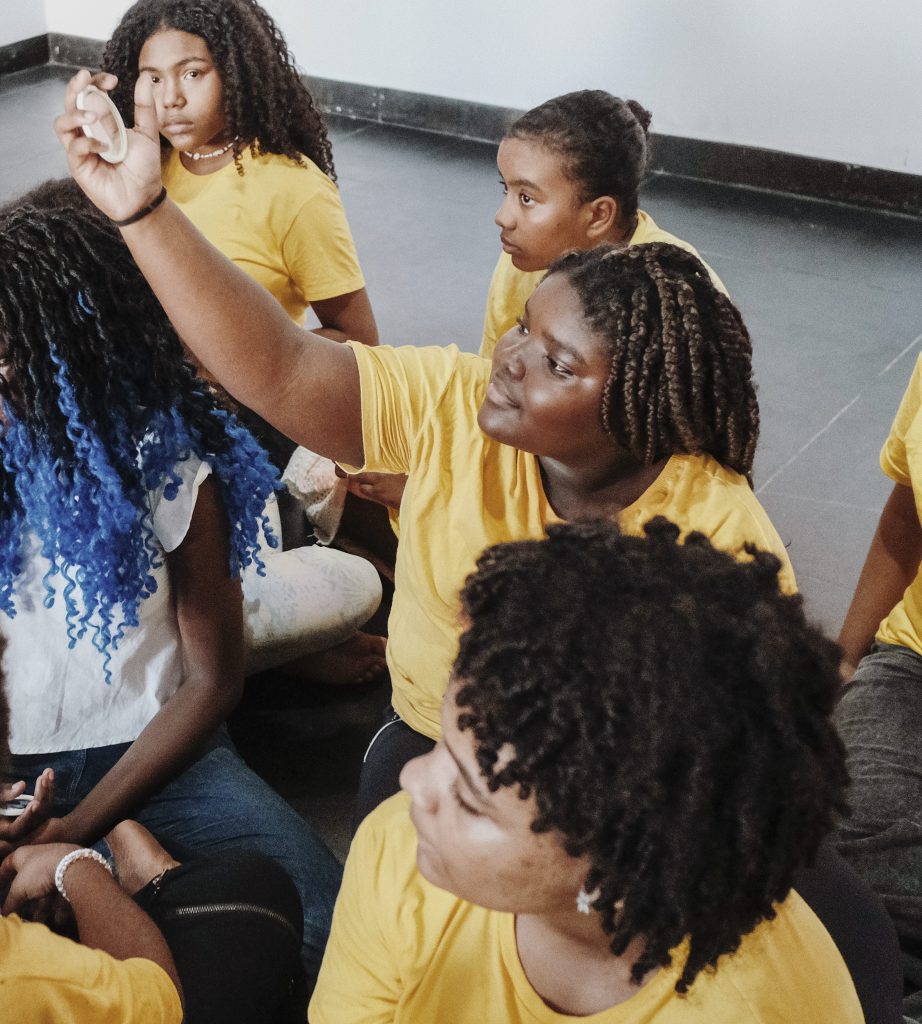
Julia with Odara in Brazil. Captured by Luisa Dorr for Pura
In Brazil, where pear trees and coconut plantations cover the Northeastern Coast, girls like ten-year-old Julia experience a different kind of educational barrier than girls in Tanzania. Too often, racial discrimination contributes to high dropout rates among Black, quilombola and Indigenous girls in the country.
“In the logic of Brazilian society, Black people don’t need to study,” says Naiara Leite, Executive Coordinator of Odara, a women-led organization and Malala Fund partner. Bahia, the state where Odara is based, was once one of the largest slave-receiving territories in the Americas, and because of that history, deeply-ingrained, anti-Black prejudice is still widespread. “Our role and the image constructed around us is one of manual labor,” Naiara says.
But education can change that. In 2020, with assistance from a Malala Fund grant, Odara launched its first initiative for improving school completion rates among Black, quilombola, and Indigenous girls: “Ayomidê Odara”. The young girls mentored under the program, including Julia, are known as the Ayomidês. And like the Pura x Malala Fund Collection’s Brazil: Breath of Courage scent, the Ayomidês are fierce, determined, and bursting with energy.
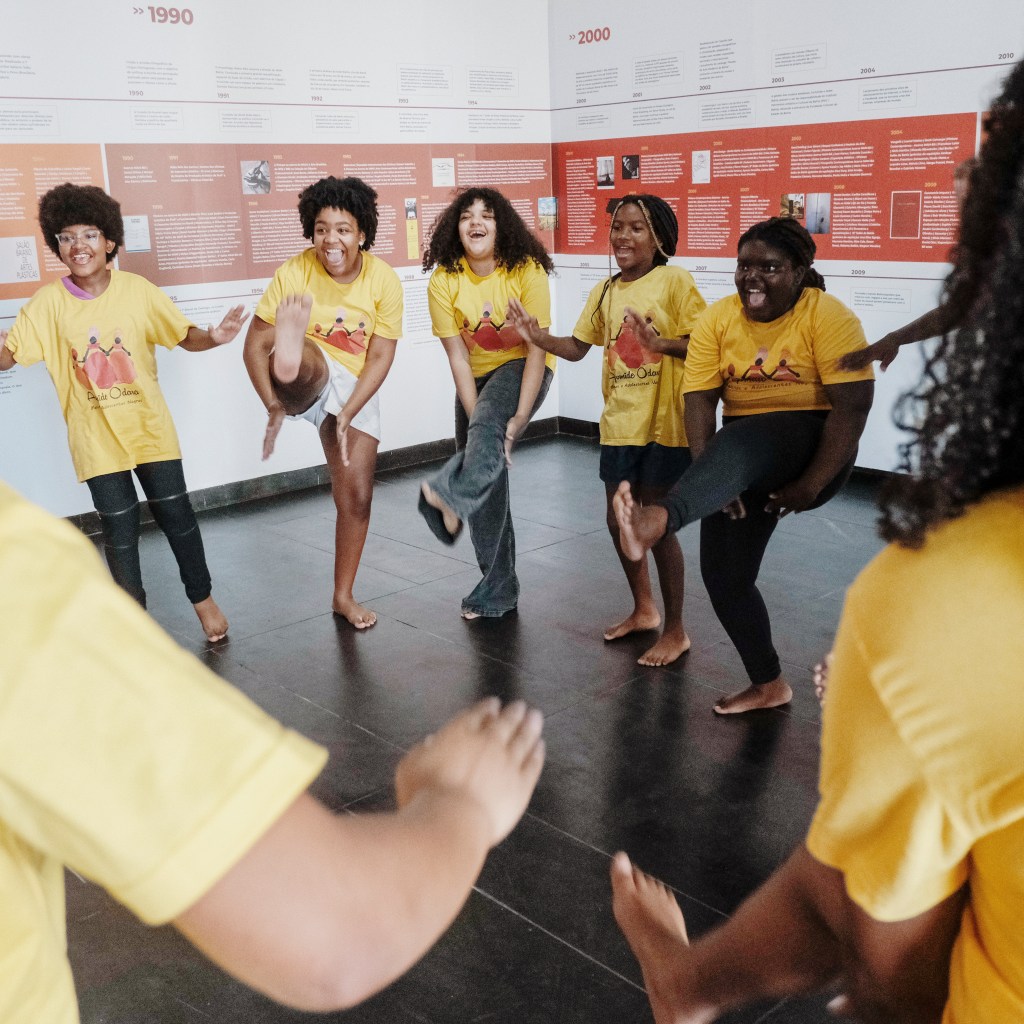
Ayomidês with Odara in Brazil. Captured by Luisa Dorr for Pura
Ayomidês take part in weekly educational sessions where they explore subjects like education and ethnic-racial relations. The girls are encouraged to find their own voices by producing Instagram lives, social media videos, and by participating in public panels. Already, the Ayomidês are rewriting the narrative on what’s possible for Afro-Brazilian girls to achieve. One of the earliest Ayomidês, a young woman named Debora, is now a communications intern. Another former Ayomidê, Francine, works at UNICEF, helping train the next generation of adolescent leaders. And Julia has already set her sights on becoming a math teacher or a model.
“These are generations of Black women who did not have access to a school,” Naiara says. “These are generations of Black women robbed daily of their dreams. And we’re telling them that they could be the generation in their family to write a new story.”
Mama Habiba is reframing the conversation in Nigeria
Centre for Girls' Education, Nigeria. Captured by James Roh for Pura
In Mama Habiba’s home country of Nigeria, the scents of starfruit, ylang ylang and pineapple, all incorporated into the Pura x Malala Collection’s “Nigeria: Hope for Tomorrow,” can be found throughout the vibrant markets. Like these native scents, Mama Habiba says that the Nigerian girls are also bright and passionate, but too often they are forced to leave school long before their potential fully blooms.
“Some of these schools are very far, and there is an issue of quality, too,” Mama Habiba says. “Most parents find out when their children are in school, the girls are not learning. So why allow them to continue?”
When girls drop out of secondary school, marriage is often the alternative. In Nigeria, one in three girls is married before the age of 18. When this happens, girls are unable to fulfill their potential, and their families and communities lose out on the social, health and economic benefits.
Completing secondary school delays marriage, and according to UNESCO, educated girls become women who raise healthier children, lift their families out of poverty and contribute to more peaceful, resilient communities.
Centre for Girls’ Education, Nigeria. Captured by James Roh for Pura
To encourage young girls to stay in school, the Centre for Girls’ Education, a nonprofit in Nigeria founded by Mama Habiba and supported by Malala Fund and Pura, has pioneered an initiative that’s similar to the Ayomidê workshops in Brazil: safe spaces. Here, girls meet regularly to learn literacy, numeracy, and other issues like reproductive health. These safe spaces also provide an opportunity for the girls to role-play and learn to advocate for themselves, develop their self-image, and practice conversations with others about their values, education being one of them. In safe spaces, Mama Habiba says, girls start to understand “who she is, and that she is a girl who has value. She has the right to negotiate with her parents on what she really feels or wants.”
“When girls are educated, they can unlock so many opportunities,” Mama Habiba says. “It will help the economy of the country. It will boost so many opportunities for the country. If they are given the opportunity, I think the sky is not the limit. It is the starting point for every girl.”
From parades, film screenings to safe spaces and educational programs, girls and local leaders are working hard to strengthen the quality, safety and accessibility of education and overcome systemic challenges. They are encouraging courageous behavior and reminding us all that education is freedom.
Experience the Pura x Malala Fund Collection here, and connect with the stories of real girls leading change across the globe.
Sometimes you have to spend money to save money, and people who live a budget-conscious, frugal lifestyle have perfectly mastered how to do it. In a Reddit post, member jul_on_ice posed the question: “What’s one small upgrade (under $50) that saved you more money than you expected?” They continued, “Talking about small wins that compounded…
In a Reddit post, member jul_on_ice posed the question: “What’s one small upgrade (under $50) that saved you more money than you expected?”
They continued, “Talking about small wins that compounded over time over one thing that made a drastic difference. Frugality is often about not spending but sometimes investments can pay off. Maybe something that made work easier. Made life better. Made you more comfortable. Or something bought once that replaced lots of things you once had to spend on.”
Fellow frugal people had lots of money saving hacks to share. These are 35 things that frugal people spent less than $50 on that have saved them lots of money.
“Vacuum sealer. I’m single and most shopping/recipes are four or five meals for me. Often I would have food waste because I no longer wanted the food after the third meal. Now I cook, have the leftovers I want, and vacuum seal the rest in portions. Keeps the food fresh and saves room in my freezer.” —mercfan3
“Don’t rent the modem/router combo from Comcast. Just buy your own.” —Dove_of_Doves
“A couple of incredibly mundane purchases that I should have made years earlier: having extra sets of measuring spoons (~ $3 per set) makes cooking so much easier; a digital cooking thermometer (~ $15); and a tire inflator that plugs into the car’s cigarette lighter ($35) so I can top up the tires at home, rather than trying to find a place with a working air hose. ETA: A french press ($20) and electric kettle ($25). Have used the same french press for more than a decade, and get better tasting coffee without buying filters or K-cups. An electric kettle is surprisingly useful.” —Taggart3629
“$9 3-cup rice cooker.” —CeleronHubbard
“Popsicle molds. I live in the desert and we eat so many popsicles. Making them myself has saved money and they’re healthier.” —Adventurous-Fig-5179
“Dropped cable, kept internet only. Pay for separate Netflix and Disney and all total we save $35 a month over the cable bundle. We did not watch 90% of the channels included. Definite win for us.” —GarudaMamie
“Adding an over-the-air antenna. Is a great addition to cutting that “cable tv” cord. It is much easier than you think.” —williamtrose367
“We got a renter friendly bidet and it has saved us SO MUCH in toilet paper usage.” —Specific_Wait_8006
“We went with cloth diapers when the kids were little it saved us a bunch and kept a bunch of garbage out of the landfill. Once they were potty trained we were able to sell a lot of them.” —Responsible-Charge27
“Maybe not a quantifiable dollar amount of a change, but I switched my mindset from “Unitaskers are bad” to “Unitaskers are acceptable if they do the 1 thing better than anything else”. Example: Those plastic pulled pork meat claw things are not better than a fork for the task of shredding meat, but a good mandolin slicer is much faster and probably safer overall than a knife, and rice cookers can cook rice exceptionally well, even if that’s all they do.” —Ryutso
“Needles and threads. You can fix anything material with small rips or tears. I’ve extended the life of clothes, bags, and kids stuffed animals by years.” —baldbutthairy
“I know this sounds crazy, but realizing I could buy more than one of something (e.g. bath mats, reading glasses, chargers, etc.) I had to really work on changing my thinking around this due to past financial challenges.” SomeTangerine1184
“Second hand slow cooker. Money saving meals made from cheap tinned foods: daal, chilli, casserole, soups.” —Ambitious_Ad1844
“Anything like this is usually an inexpensive household repair that I waited too long to do. Replacing loose door handles, fixing a leaky faucet, repairing the drip line from my A/C. Little cheap things that just made my life… better.” —gogomom
“My aeropress has been a ridiculously good investment. It’s much more portable than a french press. I have it with me now while I’m travelling and I can access a good cup of coffee using the hotel kettle.” —mrjasong
“I am a freezie human and nowhere is that more apparent than on airplanes. So I had this ‘warm fuzzy’ vest for wearing on the plane with a tougher outer fabric and a soft fleecy inner. I paid a seamstress to add an invisible zipper to one of the seams on the inside of the vest and now the gap in between the fleece inner fabric and the tougher outer fabric is what in the 1920s would be called a ‘passthrough pocket’ or modern hunters might call it a ‘game pocket’. But you know what else? It’s now my personal item and I wear it on the plane, Scott-e-Vest style, but cheaper. And now because of that, I can fly more budget airlines because I have less luggage-as-in-bags.” —heinfamousj
“The jury is still out, but I recently made the switch to rechargeable AA batteries. I’m optimistic this will save me money as I use AAs in my camera flashes and go through a lot of them. It’s not a purchase, but rather a process that I think is going to help a lot. I put everything on my 2% cash back credit card and pay it off at the end of the month. Recently, to get a better handle on my daily spending, I decided on what my monthly credit card bill goal should be. Divide that number by 30 and I get my daily spending goal. I then created a spreadsheet and track how much I spend each day and have a column with a running total for over/under. It’s motivating to look and see ‘Hey, I’m $XXX under budget so far for the month.’ The daily goal is high enough to account for things like gas in my truck, haircuts and groceries.” —No_Blueberry_8454
“Yearly paper planner. No more missed rendez-vous or deadlines, no more late fees. I tried going digital, but it doesn’t work for my ADHD brain. I just snooze the reminders and forget about it. Until it’s too late. So I went back to paper, and it’s worth the $12-ish per year to me.” —Duck__Holliday
“Bought a dead battery Dyson vacuum on Facebook market. Did the Ryobi battery upgrade. Got cheap 8ah Ryobi battery off ebay. Got a cheap Ryobi battery Charger off facebook market. Total all was about $50-60 and it works great.” —antsam9
“Dying my hair at my hairdresser rather than at home. No more stains from the home dye. No wrecked towels, clothing or hair.” —JoyCrazy
“If you drink a lot of soda or sparkling water, a Soda Stream can help you save. Just the CO2 canisters comes out to about $0.11 for 12 ounces vs paying about $0.50 per can of store bought soda. What gets you are the syrups… that can bring the price up to $0.40 ish per 12 ounces. So to be extra frugal, you could make your own fruit syrups and skip the store-bought stuff. Make a simple syrup (one part sugar, one part water; boil on the stove) and add lemon or lime or orange juice or whatever… I’m sure there are recipes all over the internet. And boom, homemade La Croix. It’s an investment to start, but saves over time.” —Drooly_Cat_1103
“Somewhat location dependent but if you are in a dry climate like me and rely on humidifiers running 24/7, buy a cheap water distiller on Amazon (I think mine was like $60 but close enough, you might even find one under 50 if you look/wait for a sale). Distilled water gets pricey, but not using distilled water will junk up your humidifier with minerals which is both a bitch to clean and can eventually cause problems with the function. Save yourself the trouble. Also useful for steam cleaners, mixing your own cleaning sprays from concentrates, misting bottles, etc. At least if you have hard water, anything where you are repeatedly putting a lot through a very small line, distilled is preferred to prevent mineral buildup.” —ilanallama85
“I got a Walmart+ membership (got it for $49, it renews at half off the $99 at anniversary). I get free shipping, so when I need something small (like shampoo), I don’t need to run to the store. I’ve used Walmart+ so much more than I ever used Amazon Prime. It costs less, and I find I buy less random crap with Walmart+ than Prime.” —sbinjax
“Three inexpensive manual coffee makers: Bialetti Moka Express pot, Bodum French Press, and V60 pour over. Bought all 3, virtually new, at the thrift shop for under 20 total about 5 years ago. The Bialetti makes an espresso-like cup, the Bodum is rich and strong, and the V60 makes a softer, smoother cup of coffee.” —zeitness
“Not sure this will ever meaningfully ‘pay out’ on the investment, but a timer switch for the bathroom fan. I have ADHD and benefit from as many “set it and forget it” items as I can possibly get. Now I can set the fan, have a shower, walk away, and it’ll turn itself off after a decent airing-out, and I don’t end up walking by the bathroom 4 hours later like ‘how long has the fan been on??’ Less electricity used, less wear and tear on the fan, less conditioned air lost. Is it more savings than the amount I spent? Probably not for a long time. But it feels better!” —Kitchen-Owl-7323
“A shutoff valve to go above the shower heads in my kids’ bathroom’s so I can limit the flow. We have high water pressure and my kids universally put the faucets at max flow. I used the valves to cut the flow in half. The water pressure is still great but now they use half the water and the hot water now lasts through all six of our showers. I haven’t calculated the savings but I know we are using much less energy in water heating and much less water.” —nottherealme1220
“A $30.00 pair of very high quality sharp scissors bought at a sewing machine store 20 years ago freed me forever from paying for haircuts. One YouTube video showed me how to trim & maintain – done. My brother bought a clipper set for $20.00 at the same time and does his own cuts. All that money gets plunked into savings!” —VulcanGreeting
“i switched from some fancy expensive work boots id been wearing to some 18 dollar shoes with 10 dollar insoles i got at walmart. i added the extra insoles on top of the existing ones for extra comfort. this saved me however how much i would have spent for my foot pain that was nearing bad enough to warrant medical attention. these are seriously the most comfortable shoes i have ever owned, i even wear them outside of work, on hikes, just going out on a wet day. over a year in and the extra insoles might need replaced in a few months but the shoes and their original insoles (the ones on bottom) are holding up perfectly. I’m in a better mood at work now too.” —cccameronnn
This article originally appeared last year. It has been updated.
Americans have saving money on their minds. According to a 2025 Vanguard survey, 75% of Americans didn’t save as much money as they intended to that year. Additionally, 84% of Americans included a financial goal in their 2026 New Year’s resolutions. But less than half of Americans are actually saving money. A 2025 Pew Research…
Americans have saving money on their minds. According to a 2025 Vanguard survey, 75% of Americans didn’t save as much money as they intended to that year. Additionally, 84% of Americans included a financial goal in their 2026 New Year’s resolutions.
But less than half of Americans are actually saving money. A 2025 Pew Research poll found that just 47% said they were able to put money away.
One method for saving money is to adopt a frugal lifestyle. However, not all frugal “hacks” are effective money-savers, as frugal people on Reddit have shared.
“I see a lot of advice about extreme couponing, driving across town to save a tiny amount on gas or groceries, and spending hours chasing the absolute lowest price on everything,” one person explained, adding that they tried doing some things to no avail.
They added, “It just wasn’t worth the time or mental energy. I’d spend 30–45 minutes planning to save a few dollars, while ignoring bigger expenses (housing, food habits, and recurring subscriptions), that actually moved the needle.”
More frugal people shared the money-saving hacks they tried that ultimately weren’t worth it. From gas to food and DIY repairs, these are the things frugal people wouldn’t recommend trying to save money on:
Household and repairs
“Not every DIY is cheaper. It often only is cheaper if you need something that cannot be mass-produced. And even then, buying the materials is often more expensive than modifying an existing product.” – discolored_rat_hat
“Our rule of thumb is if you can fubar it 3x and still save significant money try it. If you’re going to lose money if you aren’t perfect buy it or hire someone. For example a bathroom remodel was quoted at 42k. We priced out the things needed at 5k, that meant if we (we mostly being my exceptionally handy husband, I just design and paint) messed up we could try 8 times and still be ahead. He did a beautiful job and it was just about 6K all in. The dishwasher broke. The part that was probably but not for sure the problem was 150. A new dishwasher was 400. We bought a new dishwasher. It’s worked out great.” – MsLaurieM
“Fixing my car myself ended up with a friend breaking it more. I did replace the battery just fine, but even that took way longer than it was maybe worth.” – greatexpectations23
Gas
“Driving around to find cheaper gas is pretty ridiculous. Like, I get filling up before going near the airport car rental, and not filling up at rest stops if possible, but otherwise just keep an eye out for what on your way. For me, it’s cheaper to fill up in Delaware, but I only do so if I’m down that way shopping. I don’t purposely drive out of my way.” – MissDisplaced
“Driving with windows down to save on gas instead using your car’s AC. The majority of fuel consumed by your car is used to overcome air/wind resistance. The drag created by driving with open windows burns way more fuel than your car’s air conditioning.” – OCsurfishin
“Gas savings is the biggest thing. My car had a 20 gallon tank. Even a 20 cent price difference would only save me $4. If I get gas every other week at most that’s $100 a year. But a 20 cent difference is huge. It’s literally not worth it to try to save a couple cents per gallon.” – no_sight
Food
“Money wise, raising animals like chickens for the eggs, can be a money pit. But it depends on a lot of factors like the money you put to build the coop, the feed you are giving them, the treats, the time you spend taking care of them, etc.. In season, you can sell the extra eggs. But for a few months, it’s possible you don’t have any egg at all. So you need to buy them. Or put a light in the coop. But, you have happy animals and you know your eggs are not coming from a factory.” – Brayongirl
“Baking bread. Although I’m a great cook, I’m not good at making bread. I’ve tried dozens of recipes. I then tried a bread machine. Nope. I’ve accepted defeat. There’s nothing like a good crusty baguette, so I’ll gladly pay $5 and save myself the aggravation and cost of ingredients.” – DareWright
“Making (laundry detergent, yogurt, cheese, whatever) from scratch. If it takes more than 3 steps and/or 2 hours I’ll just use less and/or coupon for it. Between procuring the ingredients/equipment needed, the labor involved with execution and clean up, and then the learning curve of possibly making a sh*tty end product, I’m ok with paying for the convenience of a consistently good product.” – PutNameHere123
“Buying plastic containers for meal prep always resulted in the containers becoming worthless within a year or so due to warping or other things happening. I now use all glass containers and have been using the same containers for well over 4 years.” – greatexpectations23
“Going to three different supermarkets and comparison shopping. In general, I stick with just purchasing what I need at supermarkets that provide a good value. Yes, maybe going across town will save me 40 cents on onions this week. Better that I buy everything at one location and save the time and mental energy.” – pianoman81
Additional expenses
“I stopped buying things because they were ‘on sale’. If it was something I didn’t need often, it was not worth the purchase price. I also stopped buying things I don’t have room for or did not plan to use within the current month. It just was not worth trying to find storage for it.” – tetcheddistress
“Credit card churning. I know it can save money and I did do it for a while but the mental headache wasn’t worth it for me. I just use a single cash back card with another as a backup and use it for everything. Keeps all my spending in one spot to help with budgeting and the mental load decrease is so much nicer.” – OutsideImmediate9074
“Couponing, at least these days, is often not worth it! It encourages you to buy brand name when usually genetic/store brand is cheaper even after coupon, and is generally the same formulation. Most coupons these days are like 35 cents off 2 boxes of $4 cereal meanwhile generics are like $2.50 without a coupon. If you’re brand-loyal that might be a hot take, but our house is fine with generics. Physical coupons have gotten crappier and less frequent, usually in favor of moving to e-coupons. E-coupons are hard to stack and often have restrictions/limits that make them hard to use. The pennysavers in my area have half the number of pages that they used to, and are basically only P&G products and stamp ads lol. The dollar value of the coupons haven’t been changing but everything has been getting more expensive, making them less useful than ever before. The time spent organizing, clipping, and putting together matchups is honestly just not worth it these days. To me, I see couponing as a job. If I’m not making/saving at least minimum wage from it ($8 savings per hour spent clipping/organizing/shopping) it’s not a worthwhile use of my time.” – YouGotToMugatu
According to a YouGov survey, 28% of Americans report that they definitely plan to save more money in 2026. To help them get a jump start, there’s plenty of financial wisdom to glean from people already living a frugal life.
On Reddit, frugal people hyped each other up by sharing the exact amounts of money their best lifestyle changes have saved them.
From food swaps to shopping habits, the amount of money they save is impressive. Here are some of their brag-worthy savings:
Food
“For me it was quitting drinking coffee at coffee shops and making coffee at home. I am saving roughly $1500 each year and I cannot say that I am really missing the barista stuff. Took maybe a week to get used to it. Wild how fast your brain changes when you see the actual numbers.” – St3fanHere
“We quit DoorDash and Uber Eats. We’ve probably saved $10,000 in one year!” – Cultural-Package6900
“Drinking smarter. I now have two drinks at the bar and two at home at $1-$2 a piece. That right there saves me $20 a week.” – WillWork4Cats
“Not eating out. We either eat a hotdog at Sam’s or we take lunch with us. Even going from $8 each week down to $2 makes it $416 down to $104. And occasionally we would treat ourselves to a buffet which added $25 3 or 4 times each year.” – Cute-Consequence-184
“My husband was spending money at convenience stores; Gatorade, breakfast, candy, sodas…he would tell me it was $3 here and there. I had him add up every purchase for an entire month, over multiple months. He was spending $500 a month on these little purchases. He makes good coffee at home now and eats at home. It takes less time to eat at home or grab something than stop at a store and buy it too. He was shocked because it seemed like less than $5 every time. But it adds up.” – heartshapedbox311
“I buy 2L seltzer and make my own Spindrift for 25 cents per bottle and love it more than any other drink I’ve ever had. I use coupons and get free food and make recipes to leverage free food or the cheapest thing I can find in the grocery store. Dozens of delicious original recipes for as little as 50 cents per meal. My favorite is our local Safeway has deals for free turkeys some holidays and huge $4 cans of Hominy and I’ve developed a green Chile turkey posole recipe that includes a whole turkey (or Costco rotisserie chicken) a huge can of Hominy and 3 huge cans of Las Palmas green Chile enchilada sauce with some cheap vegetables that works out to 2 servings per dollar. Pizza is not good for you, but the deals at my local domino’s and little Caesars makes a $6 dinner for 2. Lots of ways to eat for $1-2 per meal, which can save you around $50/day, $1500/month, $20k/ year vs a lot of people’s food budget.” – deproduction
Shopping
“Buying used, especially when it comes to household appliances and furnishings. We got 3 appliances that would have been $6k new for $500 used. People remodel and just want stuff out of their house, so it’s cheap.” – MsCeeLeeLeo
“Getting an e-reader & reading almost exclusively through Libby. Thanks to my library I save over $1000 a year on my ebook habit alone!” – Inside_Training_876
“I went to the thrift store and bought a DVD player for $2.99 and a VHS player for $1.99, gave my kids (3 of them) each $10 to pick out their own videos, and we ended our streaming services, which were coming up for renewal after a promo, and I did not want to pay for Disney+, Max, Hulu, and Netflix anymore. Win all around. We own (instead of paying fees for ‘licensing the right to view’) a ton of movies on DVD/VHS, no ads, watch exactly what we want, and when we buy new videos, monthly expense is never over $20 (I had set that as a condition). Streaming services have become the biggest ripoff of all time, imo. It was fun while it lasted.” – OneLonelyBeastieI-B
Self-care
“Buying a gel nail set on Amazon for around $30 and doing my own nails has saved me around $120 a month for the past year!!!” – christslastpodcast
“Color my own hair $500 a year saved.” – 4travelers
“In 2009 I finally quit smoking after 43 years. Cigarettes just got too expensive. I made a spreadsheet to track the savings and closed it when I broke $20,000.” – Environmental_Log344
“Using a safety razor to shave instead of traditional cartridge razors. If you’re in a profession or the military that requires daily shaving, this will save you a lot of money. I’ve been doing it for about 6 years now and one pack of safety razor blades cost like $10 and can easily last a year. Much better than the cost of cartridge razor blades over time.” – Sigfawn
Household expenses and utilities
“Car work. I’m doing my front brakes today. Was quoted $700 for parts and labor. Just picked up pads, rotors, and misc for $220.” – lurksAtDogs
“Solar heating and I don’t even mean solar panels just the black water pipes in a box on the roof cut out electric bill by more than 60%.” – angako
“I dropped cable and had a guy install a tv antenna that pulls in channels from Chicago and Milwaukee. Saves me about $1800 per year.” – Glass_Procedure7497
“I’m lucky to live in a city with eBike stations and everywhere. They have a veterans program that basically I pay almost nothing as long as I use them for short rides (time wise not distance). I even use them in snowstorms to save $10-$15 bucks a pop.) Probably saved $400-$600 this year easy alone on that.” – WillWork4Cats
“Sweat equity on a home improvement. We had a bonus room situation. We saved probably $40k by doing the flooring, painting, trim, framing, and insulation ourselves.” – fredinNH
“Partner and I put plastic insulation we got free from the city over a plastic skylight in out bathroom. We’ve got electric radiators, and our electric bill went down $100 after doing that, keeping the bathroom at the same temp.” – madwrites