
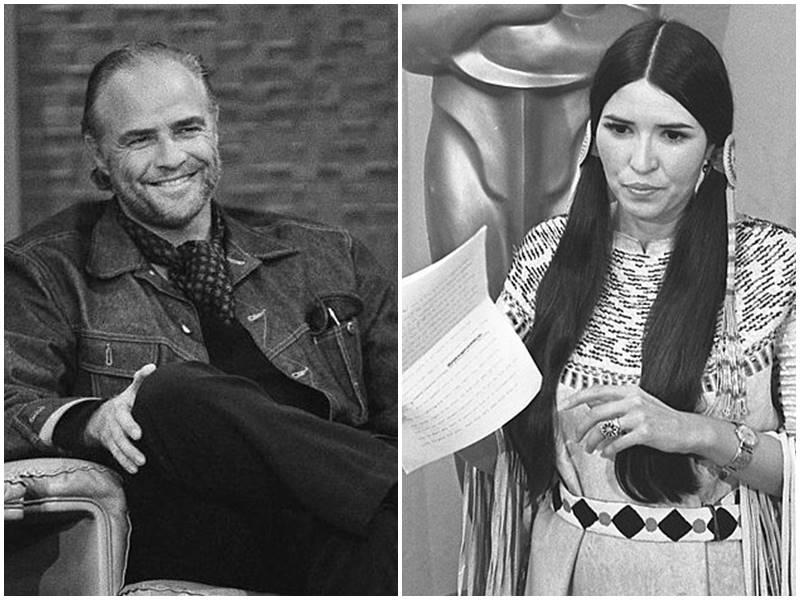
Nearly 50 years after Sacheen Littlefeather endured boos and abusive jokes at the Academy Awards, the Academy of Motion Picture Arts and Sciences is issuing a formal apology. In 1973, Littlefeather refused Marlon Brando’s Best Actor Oscar on his behalf for his iconic role in “The Godfather” at the ceremony to protest the film industry’s treatment of Native Americans.
She explained that Brando “very regretfully cannot accept this very generous award, the reasons for this being … the treatment of American Indians today by the film industry and on television in movie reruns, and also with recent happenings at Wounded Knee.”
Littlefeather is a Native American civil rights activist who was born to a Native American (Apache and Yaqui) father and a European American mother.
The unexpected surprise was greeted with a mixture of applause and boos from the audience and would be the butt of jokes told by presenters, including Clint Eastwood. Littlefeather later said that John Wayne attempted to assault her backstage.
“A lot of people were making money off of that racism of the Hollywood Indian,” Littlefeather told KQED. “Of course, they’re going to boo. They don’t want their evening interrupted.”
The Academy is apologizing for what she endured with “an evening of conversation, reflection, healing, and celebration with Littlefeather” on September 17, 2022, at the Academy Museum of Motion Pictures, it announced on its blog.
“The abuse you endured because of this statement was unwarranted and unjustified,” former Academy president David Rubin wrote in a letter to Littlefeather, CNN reports. “The emotional burden you have lived through and the cost to your own career in our industry are irreparable. For too long the courage you showed has been unacknowledged. For this, we offer both our deepest apologies and our sincere admiration.”
Littlefeather said in a statement that the event is “a dream come true” and joked that “we Indians are very patient people—it’s only been 50 years! We need to keep our sense of humor about this at all times. It’s our method of survival.”
It’s sure to be a cathartic evening for Littlefeather.
“People don’t realize what my experience was. They had absolutely no idea—none—of what my experience was, what I went through,” Littlefeather told the Academy. “And now, I’m here to tell my story the way that it was from my point of view, from my experience.”
“It feels like the sacred circle is completing itself before I go in this life,” Littlefeather, 75, added. “It feels like a big cleanse, if you will, of mind, body, and spirit, and of heart. It feels that the truth will be known. And it feels like the creator is being good to me.”
Brando passed away in 2014 but would probably be excited for Littlefeather’s long overdue apology. Three months after she refused the award on his behalf, he explained his rationale for rejecting the Oscar on “The Dick Cavett Show.” The interview was historic because Brando was known for avoiding the media, it was also far ahead of its time given the climate in Hollywood surrounding people of color in 1973.
“I felt that there was an opportunity,” Brando calmly told Cavett about the awards ceremony. “Since the American Indian hasn’t been able to have his voice heard anywhere in the history of the United States, I felt that it was a marvelous opportunity for an Indian to be able to voice his opinion to 85 million people, I guess that was the number. I felt that he had a right to, in view of what Hollywood has done to him.”
“The Godfather” star then expanded his thoughts on representation to include all people of color.
“I don’t think people realize what the motion picture industry has done to the American Indian, and as a matter of fact, all ethnic groups. All minorities. All non-whites,” he said. “So when someone makes a protest of some kind and says, ‘No, please don’t present the Chinese this way.’ … On this network, you can see silly renditions of human behavior. The leering Filipino houseboy, the wily Japanese or the kook or the gook. The idiot Black man, the stupid Indian. It goes on and on and on, and people actually don’t realize how deeply these people are injured by seeing themselves represented—not the adults, who are already inured to that kind of pain and pressure, but the children. Indian children, seeing Indians represented as savage, as ugly, as nasty, vicious, treacherous, drunken—they grow up only with a negative image of themselves, and it lasts a lifetime.”
Hollywood is still far from ideal when it comes to being truly representative of America at large. But it is miles ahead of where it was in 1973 when the film industry, including some of its biggest stars, was outwardly hostile toward the idea of representation.
The Academy’s public apology should give some closure to Littlefeather and provide hope to countless others. Because when an industry honestly confronts its past mistakes, it makes a promise that it’ll be less likely to commit them in the future.










.jpg)