Renowned psychiatrist debunks the biggest myths about suicide in a candid Reddit AMA
Dr. Tyler Black hopes his answers make a difficult topic a little bit easier to understand.

Probably the biggest would be that suicide behaviour or thinking is only for people with mental illness.
If you or someone you know is struggling, know that there are immediate resources available if you're in a crisis. There are many organizations to become familiar with, including the 988 Suicide and Crisis Lifeline , the Crisis Text Line (text "HOME" to 741741), and the Trevor Project 866-488-7386.
Suicide is one of the hardest topics to discuss.
That's why so many of us have such a difficult time recognizing signs of suicidality or responding to them.
Add to that the myths we're told about suicide ā "just talking about is dangerous," for instance; or that people who are contemplating suicide always show outward signs ā and it becomes even more difficult to navigate. Even as several high-profile celebrity passings, and rising suicide rates re-affirm that the discussion is now more important than ever.
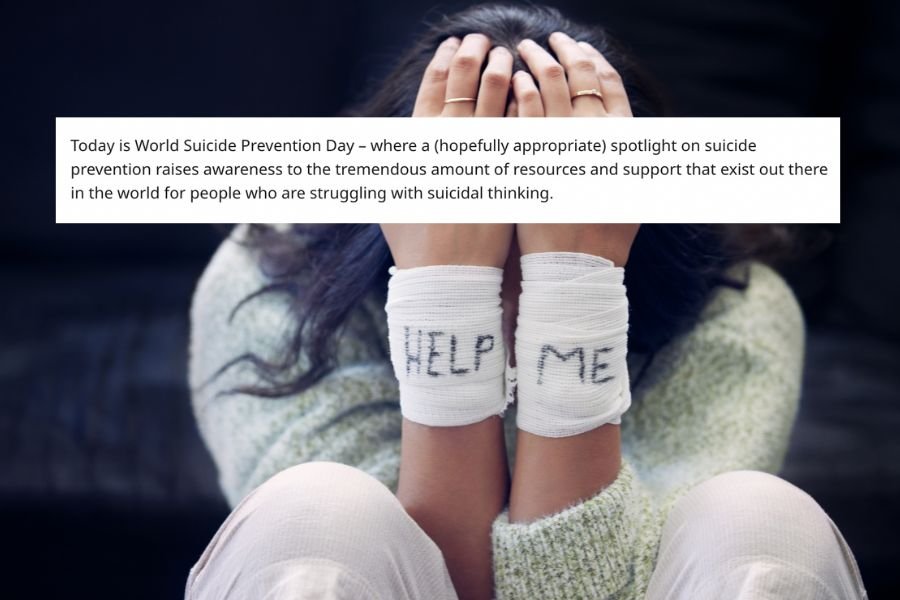
On World Suicide Prevention Day, an expert took to Reddit to make the conversation just a little bit easier.
Dr. Tyler Black is a child and adolescent psychiatrist and the Medical Director of the Child and Adolescent Psychiatric Emergency Department at BC Children's Hospital in Vancouver, where he's worked with thousands of families during his nine-year tenure.
Aside from the work and research he does at the hospital, Black is passionate about educating others about the science of suicide. And because he knows that the world's got questions, he set up an "Ask Me Anything" to give people a chance to further their understanding of suicide in order to reduce its rates.
One question makes it clear we need to rethink how we view suicide.
When one user posed the question of what one misconception Black wants others to stop believing, the doctor dropped some real knowledge that does away with the belief that only those with serious mental health issues become suicidal:
Probably the biggest would be that suicide behaviour or thinking is only for people with mental illness. Risk factors and protective factors don't work like that. Just like all humans are at risk for heart attack (some, very very very low compared to most humans, some very very very high), all of us have various risk factors that push us towards suicidal thinking and protective factors that push us away. Mental illnesses add to our suffering but so do physical illnesses, stressors, bad news, poor sleep, etc etc. There are hundreds of risk and protective factors that all work in different directions to influence suicide risk.
This misconception, Black explained, allows us to ignore risk factors until they're at crisis levels. It also allows us to not think about suicide until a person shows outward dysfunction. But for many people, suicide isn't often predated by a long period of mental illness.
That's why it's so important for us to be aware of the emotional states of our friends and loved ones, check in on them regularly, and make an effort to be there for anyone we care about.
What can you do to help others? Show up.
One of Black's most important points is this: Often, we undervalue the impact we have in others' lives. We think that psychiatrists are the only ones who can help those who may be contemplating suicide, but as Black notes ā mental health professionals are just one piece of the puzzle.
Recognizing that we have the ability to help others, only if it's just by listening, is a powerful way to let those we care about know they're not alone. So if you've been thinking about calling a friend who is struggling, or just saying hi to someone you haven't seen in a while ā now's a good time to reach out. Of course, no one's expecting us to single-handedly change a person's entire outlook on life, but making contact can make a huge difference.
This article originally appeared on 09.11.18

- Here's What Morgan Freeman Had To Say About Racism, And Here's A Guy Explaining What He Got Wrong āŗ
- 5 years ago, historians proved the time 'when men were men' never really existed āŗ
- Guy's wonderful TikTok video destroys the myth that women are more talkative than men - Upworthy āŗ
- āWoman's video before her suicide attempt is a jarring reminder - Upworthy āŗ


a man sitting at a desk with his head on his arms Photo by
Can a warm cup of tea help you sleep better? If you believe it, then yes. Photo by 
A woman is getting angry at her coworker.via
A man with tape over his mouth.via
A husband is angry with his wife. via 
Three women sit on a blanket in the park. 
Two women engaging in a pleasant conversation inside a coffee shop
Two men engaging in a peaceful disagreement.
Resurfaced video of French skier's groin incident has people giving the announcer a gold medal
"The boys took a beating on that one."
Downhill skiing is a sport rife with injuries, but not usually this kind.
A good commentator can make all the difference when watching sports, even when an event goes smoothly. But it's when something goes wrong that great announcers rise to the top. There's no better example of a great announcer in a surprise moment than when French skier Yannick Bertrand took a gate to the groin in a 2007 super-G race.
Competitive skiers fly down runs at incredible speeds, often exceeding 60 mph. Hitting something hard at that speed would definitely hurt, but hitting something hard with a particularly sensitive part of your body would be excruciating. So when Bertrand slammed right into a gate family-jewels-first, his high-pitched scream was unsurprising. What was surprising was the perfect commentary that immediately followed.
This is a clip you really just have to see and hear to fully appreciate:
- YouTube youtu.be
It's unclear who the announcer is, even after multiple Google inquiries, which is unfortunate because that gentleman deserves a medal. The commentary gets better with each repeated viewing, with highlights like:
"The gate the groin for Yannick Bertrand, and you could hear it. And if you're a man, you could feel it."
"Oh, the Frenchman. Oh-ho, monsieurrrrrr."
"The boys took a beating on that one."
"That guy needs a hug."
"Those are the moments that change your life if you're a man, I tell you what."
"When you crash through a gate, when you do it at high rate of speed, it's gonna hurt and it's going to leave a mark in most cases. And in this particular case, not the area where you want to leave a mark."
Imagine watching a man take a hit to the privates at 60 mph and having to make impromptu commentary straddling the line between professionalism and acknowledging the universal reality of what just happened. There are certain things you can't say on network television that you might feel compelled to say. There's a visceral element to this scenario that could easily be taken too far in the commentary, and the inherent humor element could be seen as insensitive and offensive if not handled just right.
The announcer nailed it. 10/10. No notes.
The clip frequently resurfaces during the Winter Olympic Games, though the incident didn't happen during an Olympic event. Yannick Bertrand was competing at the FIS World Cup super-G race in Kvitfjell, Norway in 2007, when the unfortunate accident occurred. Bertrand had competed at the Turin Olympics the year before, however, coming in 24th in the downhill and super-G events.
As painful as the gate to the groin clearly as, Bertrand did not appear to suffer any damage that kept him from the sport. In fact, he continued competing in international downhill and super-G races until 2014.
According to a 2018 study, Alpine skiing is a notoriously dangerous sport with a reported injury rate of 36.7 per 100 World Cup athletes per season. Of course, it's the knees and not the coin purse that are the most common casualty of ski racing, which we saw clearly in U.S. skier Lindsey Vonn's harrowing experiences at the 2026 Olympics. Vonn was competing with a torn ACL and ended up being helicoptered off of the mountain after an ugly crash that did additional damage to her legs, requiring multiple surgeries (though what caused the crash was reportedly unrelated to her ACL tear). Still, she says she has no regrets.
As Bertrand's return to the slopes shows, the risk of injury doesn't stop those who live for the thrill of victory, even when the agony of defeat hits them right in the rocks.