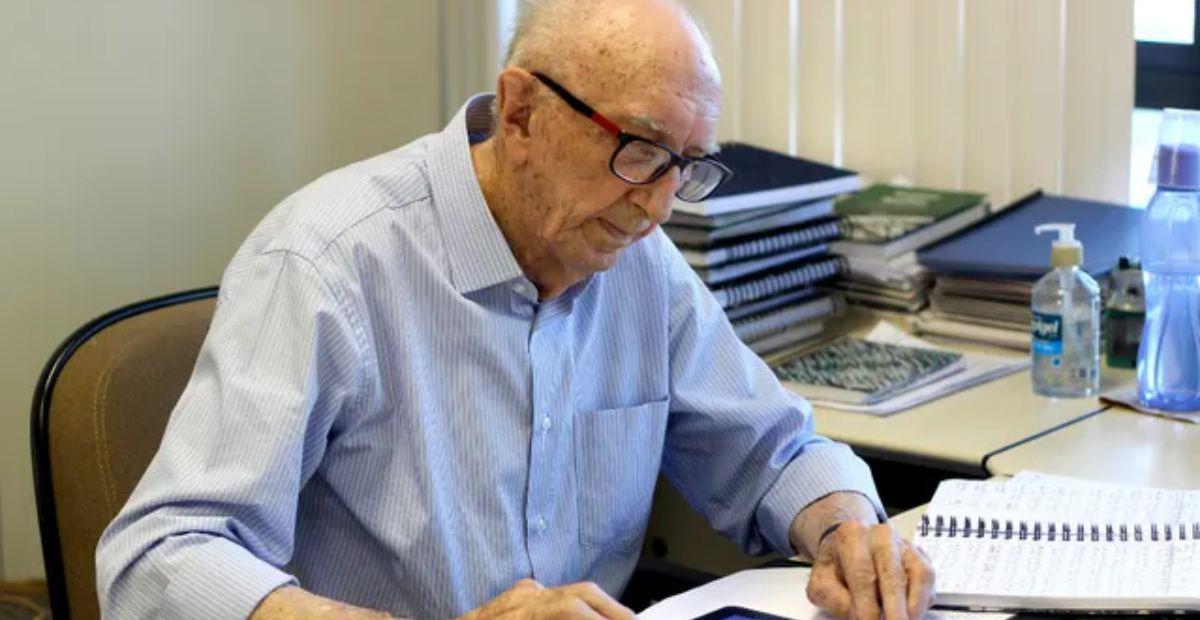
Would you want to work for the same company for most of your life? Usually, after a handful of years, people are ready to move on to something new; it’s a perfectly normal occurrence. But for one Brazilian man it wasn’t. That’s right, there’s a man out in the world who has spent the vast majority of his life not only working, but working for the same company. Guinness World Records shared the story of record breaker Walter Orthmann, who has been working at the same company for 84 years and 9 days, verified on January 6, 2022.
It’s important to note that Orthmann broke his own record, first set in 2019 when he had been working for 81 years and 85 days. Can you imagine?
Orthmann, who turned 100 years old in April 2022, started working for Industrias Renaux S.A. (now known as RenauxView), a textile company based in Santa Catarina, Brazil, in 1938. He was 15.
His family had fallen on tough times and young Walter was tasked with finding a job. Because he was born in Brusque, a small town in Santa Catarina with a large German population, he could speak pretty good German, which made him stand out to his future employer.
“Back in 1938, kids were expected to work to help support the family. As the oldest son of five, my mother took me to find a job at the age of 14,” Orthmann said.
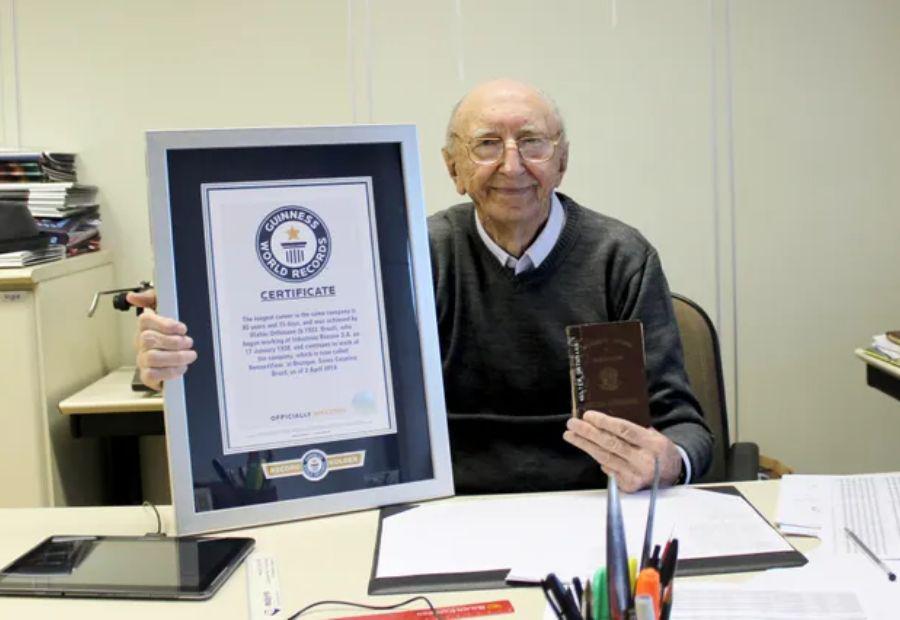
Even though he got a job out of absolute necessity, he was eager to get started. His willingness to learn and prove himself led to him moving swiftly up the ladder at RenauxView. He started as a shipping assistant, then was promoted to a position in sales and eventually became sales manager.
Obviously, Walter Orthmann has seen a lot in his life—not just at his job, where you can imagine a lot has changed since 1937, but also in the world around him. He credits his long tenure at the company to his willingness to adapt with the times.
Interestingly, it seems that Orthmann continues to work because he wants to and not out of any necessity. Why would a 100-year-old man still need to work? He loves what he does and doesn’t really see the point in stopping if he’s still able to do it. Although the idea of working until the age of 100 seems absolutely ludicrous to most of us, some older people like to find ways to keep busy. Personally, gardening sounds like a better option, but if Walter’s happy, I’m happy for him.
“I don’t do much planning, nor care much about tomorrow,” Orthmann said, sharing his belief in remaining in the present. “All I care about is that tomorrow will be another day in which I will wake up, get up, exercise and go to work; you need to get busy with the present, not the past or the future. Here and now is what counts. So, let’s go to work!”

In March 2023, after months of preparation and paperwork, Anita Omary arrived in the United States from her native Afghanistan to build a better life. Once she arrived in Connecticut, however, the experience was anything but easy.
“When I first arrived, everything felt so strange—the weather, the environment, the people,” Omary recalled. Omary had not only left behind her extended family and friends in Afghanistan, she left her career managing child protective cases and supporting refugee communities behind as well. Even more challenging, Anita was five months pregnant at the time, and because her husband was unable to obtain a travel visa, she found herself having to navigate a new language, a different culture, and an unfamiliar country entirely on her own.
“I went through a period of deep disappointment and depression, where I wasn’t able to do much for myself,” Omary said.
Then something incredible happened: Omary met a woman who would become her close friend, offering support that would change her experience as a refugee—and ultimately the trajectory of her entire life.
Understanding the journey
Like Anita Omary, tens of thousands of people come to the United States each year seeking safety from war, political violence, religious persecution, and other threats. Yet escaping danger, unfortunately, is only the first challenge. Once here, immigrant and refugee families must deal with the loss of displacement, while at the same time facing language barriers, adapting to a new culture, and sometimes even facing social stigma and anti-immigrant biases.
Welcoming immigrant and refugee neighbors strengthens the nation and benefits everyone—and according to Anita Omary, small, simple acts of human kindness can make the greatest difference in helping them feel safe, valued, and truly at home.
A warm welcome
Dee and Omary's son, Osman
Anita Omary was receiving prenatal checkups at a woman’s health center in West Haven when she met Dee, a nurse.
“She immediately recognized that I was new, and that I was struggling,” Omary said. “From that moment on, she became my support system.”
Dee started checking in on Omary throughout her pregnancy, both inside the clinic and out.
“She would call me and ask am I okay, am I eating, am I healthy,” Omary said. “She helped me with things I didn’t even realize I needed, like getting an air conditioner for my small, hot room.”
Soon, Dee was helping Omary apply for jobs and taking her on driving lessons every weekend. With her help, Omary landed a job, passed her road test on the first attempt, and even enrolled at the University of New Haven to pursue her master’s degree. Dee and Omary became like family. After Omary’s son, Osman, was born, Dee spent five days in the hospital at her side, bringing her halal food and brushing her hair in the same way Omary’s mother used to. When Omary’s postpartum pain became too great for her to lift Osman’s car seat, Dee accompanied her to his doctor’s appointments and carried the baby for her.
“Her support truly changed my life,” Omary said. “Her motivation, compassion, and support gave me hope. It gave me a sense of stability and confidence. I didn’t feel alone, because of her.”
More than that, the experience gave Omary a new resolve to help other people.
“That experience has deeply shaped the way I give back,” she said. “I want to be that source of encouragement and support for others that my friend was for me.”
Extending the welcome
Omary and Dee at the Martin Luther King, Jr. Vision Awards ceremony at the University of New Haven.
Omary is now flourishing. She currently works as a career development specialist as she continues her Master’s degree. She also, as a member of the Refugee Storytellers Collective, helps advocate for refugee and immigrant families by connecting them with resources—and teaches local communities how to best welcome newcomers.
“Welcoming new families today has many challenges,” Omary said. “One major barrier is access to English classes. Many newcomers, especially those who have just arrived, often put their names on long wait lists and for months there are no available spots.” For women with children, the lack of available childcare makes attending English classes, or working outside the home, especially difficult.
Omary stresses that sometimes small, everyday acts of kindness can make the biggest difference to immigrant and refugee families.
“Welcome is not about big gestures, but about small, consistent acts of care that remind you that you belong,” Omary said. Receiving a compliment on her dress or her son from a stranger in the grocery store was incredibly uplifting during her early days as a newcomer, and Omary remembers how even the smallest gestures of kindness gave her hope that she could thrive and build a new life here.
“I built my new life, but I didn’t do it alone,” Omary said. “Community and kindness were my greatest strengths.”
Are you in? Click here to join the Refugee Advocacy Lab and sign the #WeWillWelcome pledge and complete one small act of welcome in your community. Together, with small, meaningful steps, we can build communities where everyone feels safe.
This article is part of Upworthy’s “The Threads Between U.S.” series that highlights what we have in common thanks to the generous support from the Levi Strauss Foundation, whose grantmaking is committed to creating a culture of belonging.
“I was excited to show my daughters Kerri Strug’s famous one-leg vault…But for some reason I wasn’t as inspired watching it this time. In fact, I felt a little sick.”
In July of 2021, Simone Biles withdrew from the team final in the Tokyo Olympics and subsequently withdrew from the individual all-around finals after getting a case of the “twisties” that had the world talking. She received overwhelming support as well as overwhelming criticism for the move, with some praising her for recognizing her limits and others blasting her for not persevering through whatever she’s dealing with.
Some people pointed to Kerri Strug, who landed on one foot after vaulting with a broken ankle in the 1996 Olympics to help the U.S. win gold, as an example of the kind of sacrifice an athlete should be willing to make for their country.
But was it really? A dad named Byron Heath shared some thoughts about that fateful day in a viral Facebook post that was shared more than 370,000 times in less than a day.
Heath wrote:
“This realization I had about Simone Biles is gonna make some people mad, but oh well.
Yesterday I was excited to show my daughters Kerri Strug’s famous one-leg vault. It was a defining Olympic moment that I watched live as a kid, and my girls watched raptly as Strug fell, and then limped back to leap again.
But for some reason I wasn’t as inspired watching it this time. In fact, I felt a little sick. Maybe being a father and teacher has made me soft, but all I could see was how Kerri Strug looked at her coach, Bela Karolyi, with pleading, terrified eyes, while he shouted back ‘You can do it!’ over and over again.
My daughters didn’t cheer when Strug landed her second vault. Instead they frowned in concern as she collapsed in agony and frantic tears.
‘Why did she jump again if she was hurt?’ one of my girls asked. I made some inane reply about the heart of a champion or Olympic spirit, but in the back of my mind a thought was festering: *She shouldn’t have jumped again*
The more the thought echoed, the stronger my realization became. Coach Karolyi should have gotten his visibly injured athlete medical help immediately! Now that I have two young daughters in gymnastics, I expect their safety to be the coach’s number one priority. Instead, Bela Karolyi told Strug to vault again. And he got what he wanted; a gold medal that was more important to him than his athlete’s health. I’m sure people will say ‘Kerri Strug was a competitor–she WANTED to push through the injury.’ That’s probably true. But since the last Olympics we’ve also learned these athletes were put into positions where they could be systematically abused both emotionally and physically, all while being inundated with ‘win at all costs’ messaging. A teenager under those conditions should have been protected, and told ‘No medal is worth the risk of permanent injury.’ In fact, we now know that Strug’s vault wasn’t even necessary to clinch the gold; the U.S. already had an insurmountable lead.
Kerri Strug only did that vault because Bela couldn't do math and realize that they had already clinched it.
Also as everyone else said she was literally carried off the podium and handed to Larry Nassar. https://t.co/rp3itKPcK2
Nevertheless, Bela Karolyi told her to vault again according to his own recounting of their conversation:
‘I can’t feel my leg,’ Strug told Karolyi.
‘We got to go one more time,’ Karolyi said. ‘Shake it out.’
‘Do I have to do this again?’ Strug asked. ‘Can you, can you?’ Karolyi wanted to know.
‘I don’t know yet,’ said Strug. ‘I will do it. I will, I will.’
The injury forced Strug’s retirement at 18 years old. Dominique Moceanu, a generational talent, also retired from injuries shortly after. They were top gymnasts literally pushed to the breaking point, and then put out to pasture. Coach Karolyi and Larry Nassar (the serial sexual abuser) continued their long careers, while the athletes were treated as a disposable resource.
Today Simone Biles–the greatest gymnast of all time–chose to step back from the competition, citing concerns for mental and physical health. I’ve already seen comments and posts about how Biles ‘failed her country’, ‘quit on us’, or ‘can’t be the greatest if she can’t handle the pressure.’ Those statements are no different than Coach Karolyi telling an injured teen with wide, frightened eyes: ‘We got to go one more time. Shake it out.’
The subtext here is: ‘Our gold medal is more important than your well-being.’
Our athletes shouldn’t have to destroy themselves to meet our standards. If giving empathetic, authentic support to our Olympians means we’ll earn less gold medals, I’m happy to make that trade.
Here’s the message I hope we can send to Simone Biles: You are an outstanding athlete, a true role model, and a powerful woman. Nothing will change that. Please don’t sacrifice your emotional or physical well-being for our entertainment or national pride. We are proud of you for being brave enough to compete, and proud of you for having the wisdom to know when to step back. Your choice makes you an even better example to our daughters than you were before. WE’RE STILL ROOTING FOR YOU!”
Sending love to you @Simone_Biles ?❤️-Team UNITED States of America ??
Many people shared Heath’s sentiment, with comments pouring in thanking him for putting words to what they were feeling.
We’re in a new era where our lens of what’s admirable, what’s strong, and what’s right has shifted. We understand more about the lifelong impact of too many concussions. We have trainers and medics checking on football players after big hits. We are finding a better balance between competitiveness and well-being. We are acknowledging the importance of mental health and physical health.
We are also more aware of how both physical and mental trauma impacts young bodies. Though Kerri Strug pushing through the pain has long been seen as an iconic moment in sports, the adults in the room should have been protecting her, not pushing her through an obvious injury.
And the way this fall of Dominique Moceanu at age 14 was handled is downright shocking by today’s standards. She said she never received an exam for it, even after the competition was over. So wrong.
In our sport, we essentially dive into a pool w/ no water. When you lose your ability to find the ground—which appears to be part of @Simone_Biles decision—-the consequences can be catastrophic. She made the right decision for the team & herself. @bisping
Athletes are not cogs in a wheel, and the desire to win a competition should not trump someone’s well-being. Elite gymnasts already put themselves through grueling physical and mental feats; they wouldn’t be at the top of their sport if they didn’t. But there are limits, and too often in our yearning for a gold medal—or even for a triumphant Olympic story—we push athletes too far.
Now we see some of them pushing back, and knowing what we know now, that’s 100% a good thing.
And no, not the kind of challenging her colleague John McEnroe is known for.
Billie Jean King’s legacy is greater than tennis. Beyond her world No. 1 ranking and whopping 129 singles titles, she’s a trailblazer who refused to stay silent in the face of rampant discrimination. For nearly 50 years, she’s fought relentlessly for gender equality and LGBTQ+ rights in a sport that was—and still is—widely considered to be a “boys club.” It’s fitting in recognition of her groundbreaking contributions to tennis and social justice, that Billie Jean King will receive a star on the Hollywood Walk of Fame on Monday, April 7th in the Sports Entertainment category, becoming the first woman to receive that honor.
Battle of the sexes
Let’s talk numbers for a second: 39 Grand Slam titles. Six-time world #1 ranking. Twenty Wimbledon championships. But for Billie Jean King, these achievements are just the tip of the iceberg. When she began competing professionally in 1959, tennis was a very different sport, especially when it came to equal pay. And by the time King started winning tournaments, it dawned on her just how drastic that inequality was. When she won Rome’s Foro Italico tournament in 1970, the men’s winner, Ilie Nastase, took home $3,500. Billie Jean King, on the other hand? A measly $600. “Everyone thinks women should be thrilled when we get crumbs, and I want women to have the cake, the icing, and the cherry on top, too,” she later commented. In 1973, she threatened to boycott the US Open for unequal pay. That year, the US Open became the first Grand Slam tournament to institute equal prize money. (For Wimbledon, that moment wouldn’t come until 2007—over three decades later—when Venus Williams penned a now-famous op-ed column.)
Still, there was work to be done. In 1973, she faced off against Bobby Riggs in the iconic “Battle of the Sexes,” taking on the 55-year-old former tennis pro who had a penchant for making sexist and misogynistic remarks about female athletes. Staged at the Houston Astrodome, the “Battle of the Sexes” was watched by over 90 million viewers worldwide—all of whom witnessed an absolute beatdown. She defeated Riggs in straight sets. Later, she commented, “I thought it would set us back 50 years if I didn’t win that match…It would ruin the women’s tour and affect all women’s self-esteem.” King would later continue to break boundaries when she became one of the first professional athletes to come out as gay in 1981—a move that could potentially destroy her brand sponsorships and the public’s positive opinion of her. Yet, she lived her truth and continues to be a champion for equal rights to this day.
A force to be reckoned with
The Walk of Fame star ceremony is set for April 7th. Radio personality Ellen K will emcee, with Jamie Lee Curtis and Magic Johnson as guest speakers. When King received the news that she would be honored with a star, she wrote on Facebook, “As a native of Southern California, it is a dream come true.”
This star represents so much and goes beyond tennis or athletic achievement. It’s a true testament to King’s global impact: she founded the Women’s Tennis Association and Women’s Sports Foundation. She received the Presidential Medal of Freedom and has been inducted into many Halls of Fame to name. In 2018, she won the BBC Sports Personality of the Year Lifetime Achievement Award. She also received a Congressional Gold Medal in 2024. And now, her legacy will be further cemented—literally—forever on the Walk of Fame. Here’s to BJK, the athlete, activist, and icon.
Domestic violence survivors are cheering on the winner of the Miss Kansas competition after she stood on stage and called out her abuser who showed up to the pageant.
Before Alexis Smith was chosen from 26 participants in the state competition on June 8, 2024 to represent Kansas in the 2025 Miss America contest, she was asked to speak on stage about her Reclaimed Respect initiative.
“My vision as the next Miss Kansas is to eliminate unhealthy and abusive relationships,” Smith said. “Matter of fact, some of you out in this audience saw me very emotional because my abuser is here today. But that’s not going to stop me from being on this Miss Kansas stage and from representing as the next Miss Kansas. Because I, and my community, deserve healthy relationships. We deserve a domestic [violence] free life.”
Respect Reclaimed is about reclaiming your power and standing firmly in it. On the night of Miss Kansas, my journey took an unexpected turn when someone I have been healing from tried to disrupt my peace. Instead of falling into silence, I chose to live out my vision for a better world. I took back my power—not just for myself, but for my dreams and everyone watching and listening. This isn’t about shunning others; it’s about turning our pain into purpose and channeling it in a way that unifies and uplifts. I’m ready to use my story, tools, and resources to end unhealthy relationships in all forms. My voice and advocacy will empower everyone to reclaim their own power in their own unique way. I might be small in stature, but I stand tall in strength, purpose, and power with hopes of inspiring others to do the same. #fyp#abuse#miss#misskansas#missamerica#pageant#awareness#me#relationship#respect#tiktok
In the video shared on TikTok, the new Miss Kansas wrote, “Respect Reclaimed is about reclaiming your power and standing firmly in it. On the night of Miss Kansas, my journey took an unexpected turn when someone I have been healing from tried to disrupt my peace. Instead of falling into silence, I chose to live out my vision for a better world. I took back my power—not just for myself, but for my dreams and everyone watching and listening.”
She wrote that it wasn’t about shunning anyone, but about “turning our pain into purpose and channeling it in a way that unifies and uplifts.”
“I’m ready to use my story, tools, and resources to end unhealthy relationships in all forms,” she wrote. “My voice and advocacy will empower everyone to reclaim their own power in their own unique way.
I might be small in stature, but I stand tall in strength, purpose, and power with hopes of inspiring others to do the same.”
People who have experienced abuse themselves applauded her advocacy.
“As a victim of domestic violence I applaud you for speaking out!! I watched this 10 times!! I’m still getting bullied by his parents even with a no contact order. I plan on helping women like us as well.”
“WHAT A WOMAN. This is absolutely incredible. From one survivor to another, I am SO SO proud of you for reclaiming this moment for yourself. You will do amazing things “
“Incredibly brave of you. You just made a statement for all women. I appreciate you so much.”
“As an old survivor…I’m so damn PROUD OF YOU!! Love, A Stranger “
“We got to see you ACTIVELY showcasing your platform LIVE IN PERSON! My upmost respect to you Miss Alexis. This is beyond any crown, I cannot wait to watch your journey. As someone who grew up around domestic violence, I have chills watching you. You will always have a supporter in me. You absolutely ate that. “
“YAS GIRL! As a fellow survivor, you are an inspiration and I’m so proud of you for using your voice and showing your strength.”
According to The Wichita Eagle, Smith uses her 19 years of experience as a ventriloquist to teach kids about healthy relationships with puppets as part of her Reclaimed Respect initiative. She also works full-time as a cardiothoracic ICU nurse.
While other kids were playing soccer, young Donovan Carrillo had other dreams. Despite living in the warm and temperate climate of Mexico, Carrillo had a singular vision of grabbing gold at the 2022 Winter Olympics. And now, win or lose, this passionate figure skater has already become a huge success story at the Beijing Winter…
While other kids were playing soccer, young Donovan Carrillo had other dreams. Despite living in the warm and temperate climate of Mexico, Carrillo had a singular vision of grabbing gold at the 2022 Winter Olympics.
And now, win or lose, this passionate figure skater has already become a huge success story at the Beijing Winter Games by becoming the first Mexican to advance to the Olympic free skate final event.
“I always wanted to be at the Olympics,” Carrillo told NBC after his performance. “I used to talk about this dream with people. They were always laughing or telling me that it was impossible for a Mexican to qualify.”
In addition to dealing with the fact that Mexico has no competitive winter sports leagues, Carrillo was often called “a girl” for his interest in figure skating, telling theAssociated Press that “they sometimes even think that to practice an artistic sport, it’s going to affect your (sexual) preferences as a person. I never thought that. I think that’s one of the reasons of why we don’t have many male skaters in my country.”
Donovan Carrillo, who practices in a shopping mall ice rink, is the first skater from Mexico to qualify for the Olympic free skate. ? pic.twitter.com/qZFBl4LVYr
Throughout his pursuit, Carrillo never let the naysaying keep him down. Instead, he became more resourceful, training alongside girls and practicing in the ice rinks of shopping malls. Imagine having to perfect your pirouette while dodging families and amateur hockey players.
Hard work and determination paid off, because Carillo found himself in Beijing, bearing the flag of Mexico at the opening ceremony.
Carrillo’s entire Olympic debut has been an homage to his heritage: blades displaying the green, white and red color of the Mexican flag, a sparkling black and gold costume designed by Mexican fashion designer Edgar Lozzano, and using music from his father’s favorite band, Santana.
“It’s something that I always try to do with my performance, to involve the Mexican culture,” Carrillo told AP.
Donovan Carrillo is the first Mexican in over 30 years to represent Mexico in ice skating at the Winter Olympics LETS GOOOOOOO pic.twitter.com/75w5UTOf6K
Fast forward to Tuesday, Feb 8, 2022 and Carrillo delivered a stunning, career-best, history-making performance in the short program, nailing the quad toe loop and landing an insane triple axel.
The score of 79.69 takes Carrillo to the longer free skate competition, a never-before-seen feat from his country, making the then 22-year-old athlete Mexico’s most successful figure skater in history.
Carrillo might have been pressed with overwhelming obstacles, but he proved to the world that dreams are worth pursuing.
Anyone paying attention would have long ago concluded that LeVar Burton is a national treasure, and President Joe Biden just made it official. Burton, best known for his roles in
Roots, Reading Rainbow, and Star Trek: The Next Generation, was recently awarded the National Humanities Medal. Recognized for his contributions to promoting literacy and advancing the cultural landscape, Burton accepted the prestigious honor during a private ceremony at the White House. As his shipmate, Mr. Worf, might say, “It is a great honor.”
Burton’s wife, Stephanie Cozart Burton, shared her excitement on social media. She posted on X:
“Proud of my hubby ❤️ We just left the Oval Office where President Biden awarded him the medal of Excellence in Humanities for the work he’s done in the field of literature and expression in arts. He’s the best of us. ”
This recognition is just one of many highlights in Burton’s extraordinary career, which spans more than four decades of work in education, film, and television.
Why LeVar Burton’s influence matters
LeVar Burton has made a significant impact on multiple generations. As the host of
Reading Rainbow for 23 years, he encouraged children to explore new ideas through books. The show earned 12 Daytime Emmy Awards and a Peabody Award, becoming a crucial tool for promoting literacy. Fans remember Reading Rainbow fondly, with many crediting Burton for their love of reading.
One
Reddit user,
u/rtsarecool, put Burton among other greats:
“Well deserved! Right up there with the other wholesome greats like Mr. Rogers, and Bob Ross.”
— u/Ortsarecool
LeVar Burton’s warmth, kindness, and commitment to storytelling resonate with people of all ages. He has expanded his influence with
LeVar Burton Reads, a podcast aimed at adults, which has been downloaded more than 25 million times. For many, this podcast serves as a continuation of the magic of Reading Rainbow but is tailored to a more mature audience.
LeVar Burton’s influence extends far beyond his television roles. In addition to his National Humanities Medal, Burton’s accolades include a Grammy Award for his spoken word album
Aftermath, three NAACP Awards, and 13 Emmy Awards. His other achievements include the Fred Rogers Award and the Inamori Prize for Ethics in Entertainment.
One Reddit user,
@SereneVega, summed up Burton’s impact beautifully:
“LeVar Burton, Fred Rogers, and Jim Henson raised American children better than 99% of actual parents. LeVar deserves every accolade and more.”
— @SereneVega
Burton’s dedication to storytelling and education has made him a beloved figure in American culture. As the recipient of the National Humanities Medal, he joins an elite group whose work has expanded the nation’s understanding of literature, history, and the human experience. His lifelong advocacy for literacy will continue to shape future generations, just as it has for decades.
Burton’s trek is far from over
While Burton has received numerous honors, he remains as active as ever in the entertainment and education sectors. His recent launch of the LeVar Burton Book Club and continued podcasting show his commitment to fostering a love for reading and learning in people of all ages.
Whether it’s his work on screen or his commitment to promoting literacy, Burton has inspired millions, proving that one person truly can make the world a better place. His recognition with the National Humanities Medal is a testament to his lifelong passion for education and cultural enrichment. Here’s to many more years of inspiring future generations to take a look—because it’s all in a book.
World championship competitions like the Olympic Games determine the best of the best in every sport. As athletes from around the globe gather to compete, we see the cream of the crop rise to the top, but ultimately only one person or team in each event can claim the coveted gold medal and No. 1 title.
Whether you win a gold, silver or bronze medal, making it onto the podium is an enormous accomplishment; to be among the top three in the world at anything is incredible. But one of the top three medals is considerably less desirable than the other two, and surprisingly, it’s not the third place one.
Objectively speaking, silver is better than bronze, but from a psychological perspective, it’s not. Studies that examined the facial expressions of Olympic medal winners found that athletes who win silver are less happy than those who win bronze. A study of Paralympic medal winners also found that silver medists appeared angrier and sadder than gold medal winners and angrier and more disgusted than bronze medalists.
Why does winning silver so often seem like a disappointment? There are a few theories these studies point to. One is that silver medalists tend toward more “counterfactual thinking”—engaging in thoughts like “I could have gotten gold if I’d only done this or that differently.” Silver medalists tend to look up at what they didn’t achieve and feel like they lost, while bronze medalists tend to look down and be thankful that they’re up on the podium at all.
Another theory is that silver and bronze medal winners often have different expectations coming into the competition. Silver medal winners may expect to get the gold, or at least feel it’s within their reach, so silver feels like they didn’t perform as well as they’d hoped. Bronze medalists, on the other hand, may go in just hoping to do well enough to medal, so getting any medal at all is an achievement unlocked.
Case in point for silver medal disappointment: Team USA’s men’s 4 x 100 medley relay in swimming at the Paris 2024 Olympics. The United States has won the gold medal in that event in every Olympics for the past 64 years, so expectations were extremely high. But China took the gold in a major upset, leaving the US with a silver medal win that felt more like a loss. The more favored you are to win, the harder it is to be happy coming in second place.
I read somewhere that silver medalists are the least happiest because they don’t feel like they won silver, they feel like they lost gold. Gold is the strongest, bronze is the strongest of the weakest, and silver is the weakest of the strongest
Silver medal disappointment can also come from how the medals are doled out in different sports. In a sport like gymnastics, scores are compared over the entire field of finalists and the top three scores win gold, silver and bronze. But in many sports, medals are determined by elimination rounds, which means individuals or teams compete in one-on-one matches until all that’s left is a bronze medal match and a gold medal match. In those sports, you win your match to get the bronze but lose your match to get the silver. So winning a silver medal feels like a loss because in that final match-up, it literally is. For a bronze, though, it’s literally a win.
However, the way silver and bronze medal winners interpret their medal also depends on how close their finishes were. A silver medal winner who came very close to winning gold tends to be less happy than one with a wider margin of loss. It may be ironic that the better a silver medalist does the worse they end up feeling about the outcome, but getting close to gold just intensifies that “I could have won” feeling. Essentially, not reaching your ultimate goal is harder swallow the closer you get to it.
Of course, some silver medalists are thrilled with their standing, and again, being a top three contender in any competition is a huge achievement. That’s why mindset is so important. A winning mindset means giving it your all and doing your best; it doesn’t have to include comparing yourself to others on the podium or being deflated by expectations of winning.
For instance, the expectations on Simone Biles are sky high, and for good reason, but she walked away from her last two individual events in Paris with a silver medal on floor and no medal at all on beam—yet she did so without feeling disappointed.
“”I’ve accomplished way more than my wildest dreams, not just at this Olympics, but in this sport,” Biles told reporters. “So I can’t be mad at my performances. A couple of years ago I didn’t think I’d be back here at an Olympic game. So competing and then walking away with four medals, I’m not mad about it. I’m pretty proud of myself and it’s always so exciting to compete.”
Perhaps winning gold so many times has inoculated Biles to disappointment. On the other hand, being accustomed to winning could easily lead to more of the counterfactual thinking and high expectations that plague silver medalists, but that doesn’t seem to have happened to Biles. In fact, she joyfully celebrated her competitor Rebeca Andrade’s gold medal win right on the podium from her silver medal spot.
Simone Biles and Jordan Chiles showed love to Rebeca Andrade after she won her first gold medal of the Paris Olympics ❤️ pic.twitter.com/feXEvnPyCx
Perhaps her ability to do that comes from having a specific mindset about what constitutes winning.
“A successful competition for me is always going out there and putting 100 percent into whatever I’m doing,” Biles said in 2016. “It’s not always winning. People, I think, mistake that it’s just winning. Sometimes it could be, but for me, it’s hitting the best sets I can, gaining confidence, and having a good time and having fun.”
Wise words that could save some silver medalists from torturing themselves too much, as if second-best in the world somehow isn’t good enough.
Music’s biggest night took place Sunday, February 4 with the 66th Annual GRAMMY Awards. Now, fans have the opportunity to take home a piece of the famed event. Longtime GRAMMY Awards partner Mastercard is using this year’s campaign to shine a light on the environment and the Priceless Planet Coalition (PPC), a forest restoration program…
Music’s biggest night took place Sunday, February 4 with the 66th Annual GRAMMY Awards. Now, fans have the opportunity to take home a piece of the famed event.
Longtime GRAMMY Awards partner Mastercard is using this year’s campaign to shine a light on the environment and the Priceless Planet Coalition (PPC), a forest restoration program with the goal of restoring 100 million trees. Music fans are 1.5 times more likely to take action to help the environment, making the GRAMMY Awards the perfect opportunity to raise awareness.
“Through our GRAMMY Awards campaign, we’ve created an opportunity for our brand, our partners and consumers to come together over shared values, to participate during a moment when we can celebrate our passion for music and our commitment to make meaningful investments to preserve the environment,” says Rustom Dastoor, Executive Vice President of Marketing and Communications, North America at Mastercard.
The campaign kicked off with an inspired self-guided multi-sensory tour at the GRAMMY House presented by Mastercard, where people journeyed through their passion of music and educational experience about Mastercard’s longstanding commitment to tree restoration. Then, this year’s most-nominated GRAMMY artist and a passionate voice for the environment, SZA, led the charge with the debut performance of her new song, Saturn.
Mastercard’s partners are also joining the mission by encouraging people all over the country to participate; Lyft and Sirius XM are both offering ways for consumers to get involved in the Priceless Planet Coalition. To learn more about how you can support these efforts, visit mastercard.com/forceofnature.
While fashion is always a highlight of any GRAMMY Awards event, SZA’s outfit worn during her performance of Saturn was designed to make a statement; made of tree seeds to help spread awareness. Fans can even comment ‘ ’ and tag a friend on Mastercard’s designated post of SZA’s GRAMMY House performance for a chance to win a tree seed from the performance outfit*.
“SZA has a personal passion for sustainability – not just in forest restoration but in the clothes she wears and the platforms and partners she aligns herself with. It was important to us to partner with someone who is not only showing up big at the GRAMMY Awards – as the most GRAMMY-nominated artist this year – but also showing up big for the environment,” says Dastoor.
Due to factors like factory farming, logging, and urban growth, the Earth is losing trees at an alarming rate. According to Earth.org, approximately 10 million hectares of trees are lost each year.
Forests regulate the air we breathe and are highly effective in moderating greenhouse gas emissions. In fact, tropical forests provide up to 30% of the global action needed to stop climate change.
“Planting trees can help improve everything – from air quality to economic opportunity to mental health – and everybody deserves these benefits,” SZA said in a press release about her previous environmental activism.
Guided by Conservation International and World Resources Institute, the PPC employs science-based best practices for the selection, implementation, and long-term monitoring of their restoration efforts.
In addition to their goal to restore 100 million trees, the PPC also works to regrow forests in geographies that represent the greatest global need. This includes areas with the greatest potential for positive impacts on climate, with community and biodiversity goals being prioritized as they set out to restore forestland across the globe.
To learn more about the Priceless Planet Coalition or how you could get involved in forest restoration, visit mastercard.com/forceofnature.
* Additional Sweepstakes Details: No Purch. Nec. Void in Quebec and where prohibited. Mastercard cardholders before 2/4/24, who are U.S. & Canada res 18+ at time/date of entry. Ends 2/10/24. Winners/ARV: $30 USD each. Entry must include a “seedling” emoji and tag a friend. Canadian winners must answer a time-limited skill-testing math question. Odds of winning depend on the total number of entries received. Rules: priceless.com/forceofnature
We all have come to expect awards showacceptance speeches to be filled with heartfelt thanks to others—industry peers, family, spouses, a higher power…and in Jennifer Coolidge’s case, “all the evil gays,” (but that’s another story).
But as Neicy Nash took to the stage to accept her award for Outstanding Supporting Actress in a Limited or Anthology Series or Movie at the Emmys last night, she did something a little different.
She thanked herself.
Granted, Nash, who won the award for her performance as Glenda Cleveland in Netflix’s “Dahmer – Monster: The Jeffrey Dahmer Story,” did thank a higher power, along with showrunner Ryan Murphy, her Dahmer co-star Evan Peters, Netflix, those who voted for her and “her better half,” Jessica Betts.
But what people are really remembering is what she said next:
“And you know who I wanna thank?” Nash asked. “I wanna thank me. For believing in me, and doing what they said I could not do. And I wanna say to myself in front of all you beautiful people: go on, girl, with your bad self. You did that.”
As the audience erupted in applause, Nash took a moment to honor victims of police violence, saying, “I accept this award on behalf of every Black and brown woman who has gone unheard yet over-policed,” she said. “Like Glenda Cleveland. Like Sandra Bland. Like Breonna Taylor,” adding that her it’s her job as an artist “to speak truth to power.”
“And, baby, I’m going to do it ’til the day I die,” Nash concluded, before exclaiming, “Momma, I won!” to her mother in the audience.
It wasn’t long before thousands on social media began hailing the viral moment as an “instant classic,” and praising Nash for, as one person on X put it, “giving a masterclass on how to make the most out of an #Emmys acceptance speech.”
As the beautiful and incomparable @NiecyNash reminds us, always – in all ways – bet on yourself! And forever speak truth to power✌? pic.twitter.com/1OdTMMeEFZ
What’s more, the viral moment grew to be a masterclass in healthy self esteem.
Talking to reporters in a follow-up interview, Nash explained why she felt the need to credit herself, saying “Sometimes you have to encourage what? Yourself.”
“And that’s why it’s not called mama-esteem, them-esteem, us-esteem, it’s called self esteem because don’t nobody got to believe it, but you,” she continued.
Ultimately, Nash hopes her iconic speech becomes a “delicious invitation” for people to believe in themselves.
And that right there is a beautiful takeaway for everyone. We might not all be striving for the life of an award-winning actor, but nearly all of us could be a bit better about hyping ourselves up. May we all have the audacity today to tell ourselves, “you did that.” Whatever it is.