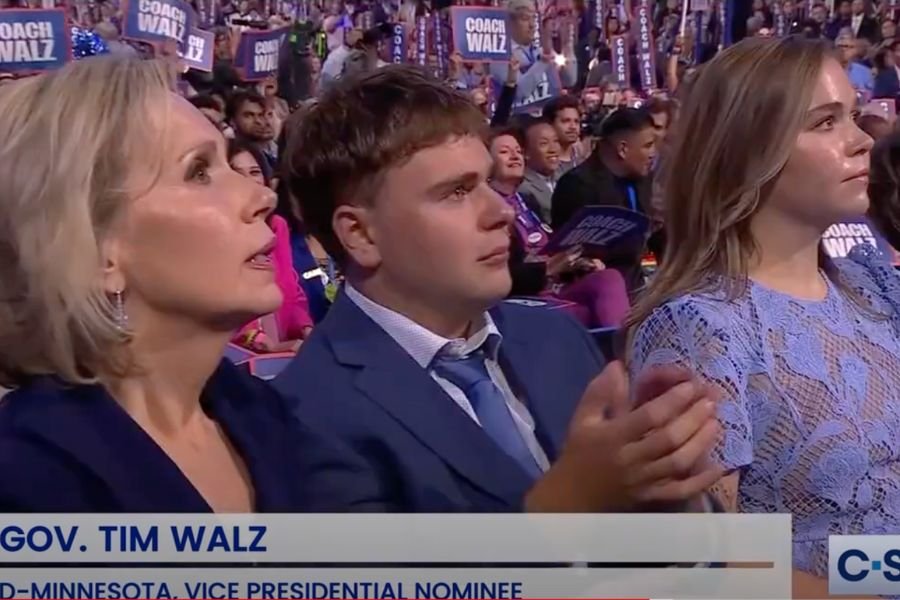
There’s something about seeing someone else overcome with emotions that makes people choke up. Seeing someone’s pure joy, excitement or sadness is almost always a recipe for a moment of genuine human connection, whether it’s watching someone graduate, the birth of a new baby or in this case, watching a proud son react to his father’s speech.
Tim Walz, the Democratic Vice Presidential Candidate is seen giving a moving speech at the DNC where he and Presidential Candidate Kamala Harris are expected to accept their nomination. Walz was in attendance with his wife and children, who watched on as the vice presidential hopeful spoke about the difficulty he and his wife had conceiving children.
Walz explains to a packed venue that he and and wife had to undergo fertility treatments, “And I can remember praying each night for a phone call. The pit in your stomach when the phone would ring and the absolute agony when we heard the treatment hadn’t worked.”
The father of two says it took he and his wife years even though they had access to fertility treatments, sharing that when their daughter was born, they named her Hope. This revelation caused a visible reaction from his daughter who made a heart with her hands before placing one over her heart as she appeared to hold back tears.
Gus, Walz’s 17-year-old son was overcome by emotions when his father says, “Hope, Gus and Gwen, you are my entire world and I love you.” It was this moment that has taken the internet through an emotional journey of its own. The teen stood up with tears streaming as he clapped while shouting to anyone who could hear, “that’s my dad! That’s my dad!”
It’s nearly impossible to look at this moment without the back of your eyes stinging from the emotions radiating from the screen. People on social media are also having a hard time controlling the tears as they watch his emotions overflow for the love and pride he clearly has in his father.
An account that goes by the name The Real Doubledeemuva uploaded the video with her commentary saying, “his son has a nonverbal learning disability and has anxiety and he was in a room full of people just to hear his daddy and as Tim was talking about his family saying how much he loved them and how they got their start due to fertility treatments. That baby stood up out of his chair and was pointing at his daddy and saying ‘that’s my daddy’ and turned around to everybody saying ‘that’s my daddy.’”
People in the comments also shared how emotional it was to see Gus react to his father’s speech while several are ready to do everything in their power to protect the teen.
“Very emotional moment. The way his babies looked at their father in that light. I lost it! Love Gov. Walz,” someone gushes.
“I’m a 52 year old black male from NJ, Gus had me ugly tearing nose running. The love,” one commenter shares.
“When I tell you I was crying right along with Gus. America’s Nephew now,” another person cries.
For one commenter, the tears were a family affair, “this broke me and my husband both. We sat in the living room watching the love that child has for his dad. We were drowning in our own tears. If you didn’t cry too, you don’t have a heart.”
The people have spoken, Gus Walz is now everyone’s nephew and must be protected at all costs. It’s the rule after you make nearly everyone on the internet collectively cry.

A Somali refugee and current resident of Minneapolis, the multimedia artist and activist draws on her lived experiences to create work that explores trauma, displacement, and resilience. But like so many of the guests on Freedom to Thrive, an award-winning podcast produced by the National Immigration Law Center (NILC), Mansour doesn’t want to focus only on trauma; she also wants to celebrate the unexpected beauty she’s found during difficult experiences.
“One of the beautiful things about tragedies is that it activates hearts, and courageous people are born,” she says. For example, Mansour has noticed more Minnesotans than ever are reaching out to help the vulnerable, after the anti-immigrant crackdowns carried out by the Department of Homeland Security. “They are bringing food, they’re bringing extra clothes, they’re walking with people, and it’s just really beautiful.”
Hector Flores, co-founder of the Las Cafeteras and host of Freedom to Thrive, agrees with her. A child of immigrants himself, he has also seen how hope and hardship often live side by side.
Flores comes from a family with mixed status and is highly aware of the challenges immigrants and refugees in his community face, and how they’re affected by people’s misconceptions. “People want to know about trauma all the time, but we’re more than just undocumented,” he says. “We’re artists, singers, creatives … there’s so much richness in the culture.”
At its core, Flores’ comment is exactly what the Freedom to Thrive podcast is all about: Celebrating immigrants as complex, dynamic individuals, and challenging the dominant narrative that too often reduces them to symbols of hardship.
Launched in 2024, Freedom to Thrive explores heritage, resilience, community, and the ways art and comedy can spark social change. Now in its second season, the podcast continues to feature conversations with immigrants, policymakers, artists, musicians, activists, and more. Recent guests have included comedian Mo Amer, Grammy Award-winning singer Lila Downs, and Pulitzer Prize-winning author Viet Thanh Nguyen.
Where the first season focused on individual stories of identity and belonging, Flores says his goal for season two, where he joins as host, is to “take it to the next level” — using storytelling to highlight “the fact that we’re more similar than different.”
One recent podcast episode drives this point home. In December, Flores interviewed Bryan Andrews, a rising country music star and rural Missouri native who frequently uses his platform to speak about issues affecting immigrant families. At the heart of his message and his songwriting, Andrews says, is the idea that small-town Americans and the rest of the country, including immigrants, have more in common than they realize.
“It doesn’t matter where you’re from,” Andrews says on the podcast. “We’re all trying to make a living and we’re tired of getting railroaded by corporate greed or by politicians who don’t care.”
Rural Americans, Andrews says, are often stereotyped as racist and misogynistic but “the overwhelming majority of people in my home town have love in their hearts.” Media stereotypes often amplify differences and divide, he says, but at the end of the day, “we’re all in this together.”
Flores, who was raised in a working-class immigrant neighborhood in East Los Angeles, had similar thoughts. He says he often sees its residents stereotyped as wealthy, consumerist, and status obsessed. “That exists, but that’s not my life, that’s not my community,” he says. Like small-town Americans, people in the city “just want to work hard and take care of their families. We all want the same thing.”
Although the podcast tackles some heavy issues, each episode’s ultimate focus is how personal and collective struggles can be healed through art, driving home a message of hope and resilience:
Mansour’s episode about her experiences in Minnesota is just one of many examples. Flores asks her,
“What gives you hope for the people creating a home here?”
“The love I feel from other Minnesotans. It is trumping any hate we’re experiencing,” she replies.
CTA: Stream all episodes now on the Freedom to ThriveYouTube channel or the website,here.
The podcast has been nominated for a Webby in the “Belonging & Inclusion” category. You can vote for it to win until Thursday, April 16!
This article is part of Upworthy’s “The Threads Between U.S.” series that highlights what we have in common thanks to the generous support from the Levis Strauss Foundation, whose grantmaking is committed to creating a culture of belonging.
Let’s be real: most of us don’t want to pay more taxes than we have to. Even when we know taxes are necessary for public services, we’re not usually enthusiastic about paying more ourselves.
Rick Steves sees it differently. Arguably the original “travel influencer,” Steves has spent decades building a booming business as a global tour guide. In 2019, his company, which he solely owns, generated $100 million in annual revenue. As a longtime Washington state resident, he has enjoyed the perk of paying no state taxes on his personal income. But that’s about to change, and Steves is surprisingly happy about it.
Steves praises the upcoming tax on “fat paychecks”
“A new tax on fat paychecks like mine was just signed into law in my home state — and I like it,” Steves wrote in a Facebook post. “In 2029, Washington state will start collecting a 9.9% tax on income over $1 million. The 8,000,000 Washingtonians whose households make less than a million dollars a year will pay zero under this new tax and enjoy all the benefits of a better-funded state. And for the wealthy (like me and an estimated 30,000 others), every million dollars in taxable income that our households earn after the first million will cost us about $100,000.”
Steves is referring to the so-called “millionaires tax” that Washington Governor Bob Ferguson signed into law after it passed the state legislature in March 2026. Under the new law, Washington residents will pay no taxes on their first $1 million in annual income. Any income above that threshold will be taxed at 9.9%.
Steves addresses Washington’s regressive tax system
“It takes a lot of money to run a state that’s as livable as ours,” Steves continued. “Yet Washington is one of only nine states that don’t currently levy a traditional income tax. Our state is still funded by consumption taxes, such as sales and excise taxes, giving us the second-most regressive tax code in the country. (Only Florida has us beat.) And it’s time for Washington millionaires to pay our fair share.”
Washington Gov. Bob Ferguson signed the so-called 'millionaires tax' into law, enacting a 9.9% income tax on earnings of more than $1 million a year. https://t.co/7IFqu5EGKw
A regressive tax code places a higher burden on lower-income earners. Because Washington doesn’t have a state income tax, it relies on other sources of revenue, such as property and excise taxes, including sales tax.
According to the Washington Department of Revenue, the lowest-income households in the state pay 15.7 percent of their income in excise and property taxes, while the highest-income households pay just 4.4 percent.
He pushed back against the idea that taxing high earners unfairly burdens the wealthy
“As a wealthy person myself, I see this tax as essentially free money for all Washingtonians,” he wrote. “Everybody in my state gains. And speaking from personal experience, I know that anyone who earns enough to be subject to this tax is beyond the point where consuming more adds to their security, their well-being, or even, arguably, their happiness — meaning there will be basically zero human cost.
If you disagree, consider the minuscule impact this tax will have on my state’s millionaires. Now, contrast that with the value of close to $4 billion a year in tax revenue once it’s smartly invested in programs that will help the roughly one-third of Washington households living paycheck to paycheck.”
Senators debated the merits of the bill before it ultimately passed:
“For those who still aren’t convinced,” Steves continued, “here’s a lesson I’ve learned in my travels: Even if you’re motivated only by greed, if you know what’s good for you, you don’t want to be filthy rich in a society with a huge gap between rich and poor. It’s just not a nice place to raise your kids. And remember: Shrouds have no pockets…especially if you’re a multimillionaire with no heart for your neighbors.”
Steves added that it “feels good” to help build a better community for himself and his neighbors. After seeing firsthand the decimation of community programs following previous tax breaks for the wealthy, he began donating a “self-imposed wealth tax” to his local arts center and symphony. He said his $100,000-plus annual donation has brought him “great joy for 15 years and counting,” but has also been “a little lonely.”
Steves said “it just feels right to pay a little extra” as a millionaire earner
He concluded with three big reasons for celebrating his new tax output:
“For me, it’s biblical (‘To whom much is given, much will be required’)… It’s European (after all, societies that are equitably funded are much more ‘content’ than ours)… And — for those of us with a heart for the public good — it’s simply common sense.”
A $1,000,000 annual salary works out to over $19,000 a week before taxes. Photo credit: Canva
Steves received thousands of comments on his post, most praising his attitude:
“You are a wonderful person to have in WA. Bless you and your big huge heart. You may have just helped to change how I felt about it. Kindness lives.”
“You are a good man and our society needs more like you. I am happy to pay my fair share so that all of my fellow Americans can live in dignity. We all should be willing to do that for our countrymen.”
“Thank you Rick Steves! You’re a model of how prosperity need not be soul-killing. I’m proud to share this great state with people like you.”
“It’s so refreshing to hear such positive comments from a millionaire who will actually be affected by the tax. Too often we see or hear that those with money will be escaping having to pay the tax by moving away. You are setting an example of a true patriot and citizen. Thank you for showing us true responsibility!”
“This is how I feel about wealth taxes and you summed it up so nicely. If I’m wealthy and making a high income, I should be happy to pay more taxes to help those who are less wealthy. Wealthy people need to contribute to reducing the rich-poor gap. EVEN the greedy who love their money should realize that reducing the rich-poor gap is good for them. Trickle down economics and tax cuts for the rich have brought us to where we are – too much money and power in the hands of too few; the rich get richer and the poor get poorer; and an unsustainable situation.”
Not all wealthy Washingtonians share Steves’ opinion, of course, but it’s helpful to hear the perspective of someone who will actually be paying the tax when it goes into effect.
An 18-year-old in Michigan is getting attention for a bold move many disgruntled drivers understand, even if they wouldn’t take the same risk.
Ali Chami, who lives near the border of Dearborn Heights and Inkster, had grown tired of navigating the pothole-ridden stretch of Cherry Hill Road during his daily commute. Like many others in the area, the issue had gone from a minor annoyance to an expensive problem.
As reported by WXYZ-TV, he spent more than $600 replacing damaged tires over the past six months. He also saw a friend’s tire pop after hitting one of the same potholes.
At a certain point, the frustration boiled over
So on a Saturday afternoon, instead of waiting for repairs, he decided to act. Chami went to Home Depot, spent about $60 on asphalt, and headed to the road to start filling potholes himself.
He documented the process on TikTok, where his candid commentary quickly struck a chord
“Why is every single road but Cherry Hill getting fixed?” Chami asked in a video. “That s*** is pissing me off. I swear to God. So you want to know what I’m about to do? I’m about to go to Home Depot and I’m about to put some f****** asphalt on the road for all the these potholes.”
Using a simple method, he got to work.
“So pretty much, I just grabbed the cap of the bucket and I just scooped it out and spread it out, and I used it as a pushing point where I could just step on it and flatten it out,” Chami said.
In a follow-up video, he celebrated the effort.
“Yup, wallah, I do this s***,” Chami quipped.
Other drivers passing by seemed to share his sentiment, honking or shouting in support. One driver even called out, “Potholes are getting horrible. I had to change my tire last week.”
Videos go viral
The videos quickly gained traction online, racking up more than 175,000 views and drawing the attention of local officials.
John Danci, a representative from the Dearborn Heights Department of Public Works, acknowledged that the road has been a known issue for years. According to him, the delay is partly due to the complexity of the situation, as the road falls under three jurisdictions: the Wayne County Federal Aid Committee, Dearborn Heights, and Inkster.
“Historically, between Dearborn Heights and the city of Inkster, the funding for a road project like this is much higher relative to our city budgets versus the county that gets a lot of state revenue,” Danci told WXYZ-TV.
Mayor Mo Baydoun also responded, noting that temporary fixes have been attempted but are difficult to maintain in colder temperatures.
“I can tell you that we have patched Cherry Hill a few times already,” Baydoun wrote on Instagram. “Unfortunately, nothing is going to stick with the temperatures continuing to drop. The good news is that the city has been awarded a $2.6 million grant to fix all of Cherry Hill from Gully-Inkster. Project is expected to begin June 1st.”
While officials emphasized that residents should not attempt their own repairs due to safety concerns, Danci acknowledged the impact of Chami’s actions.
“You did something that at least gained a lot of attention,” he told Chami.
Chami, for his part, is not ruling out doing it again.
“If it happens [raises money], then I’ll do it,” he told WXYZ-TV.
Whether or not you agree with Chami’s actions, his feelings are certainly understandable
Yes, taking on road repairs yourself can be dangerous and is not recommended. At the same time, when problems go unresolved for too long, it’s natural to want to be the solution that seemingly will never come on its own.
For many people, it’s not just about fixing the specific issue, but about feeling heard. And in this case, one teenager’s decision did just that, bringing new attention to an issue years in the making.
Evan Edinger moved to London over 13 years ago to study abroad but never planned on staying overseas permanently. His goal was to get his degree, return to the United States, start his career, and make a life for himself. He thought of his time in London as a “temporary adventure.”
But when he finished his degree, he found himself in an unexpected situation: He didn’t want to go back. “The longer I stayed in London,” Edinger shares on his YouTube channel, “the more I began to notice all of the assumptions that I’d grown up believing in America, the things I was brought up to believe were undeniably true and just the way the world worked—it turns out they weren’t true at all.”
One of the benefits of living in another country is seeing your country of origin through different eyes. That perspective can cause you to appreciate some things and question other things. Edinger shares nine realizations he’s had about the U.S. since he left, starting with one of the most quintessentially American realities he found himself questioning.
1. Guns
Edinger grew up in New Jersey and describes it as “quite a blue state,” but he was still immersed in the gun culture that views gun ownership as a fundamental part of being an American.
“I was raised in a very pro-gun household,” Edinger says. “In my family home in America, we had a 12-gauge shotgun, a 10-gauge, a black powder rifle, and a .410 shotgun for the children. My dad would take us out some days to shoot empty cans of beer or play pigeons or sometimes go hunting for pheasants or deer.”
He says the notion of not owning a gun was unthinkable in his upbringing. “The idea that other countries do not allow guns is viewed more like these other countries are missing a fundamental right,” he says.
His ideas about guns have changed dramatically since moving to London and living in a society without ubiquitous access to guns. “Visiting Philadelphia when I was younger was always scary to me because I never knew who had a gun, who wanted to rob me,” Edinger shares. “Visiting New Orleans a couple years ago, I was told by my hotel staff that a few days prior, a tourist was shot and died in the local Popeye’s Chicken because he caught a stray bullet of two people having an argument in the restaurant. So, that’s just something that people just have to deal with. This constant fear of I could just die being caught in a crossfire and there’s nothing I can really do about it because freedom. I’ve pretty much never felt that level of fear in London at all. And that alone was enough to sway my opinion on guns.”
“One thing that’s really drilled into you pretty much every year of American school is that American democracy is the end-all be-all of government and that it is the beacon of freedom other countries look to emulate. Then, once you become an adult and you see how dysfunctional the U.S. government is, you search for anything to feel better about it and usually settle on ‘Well, at least it’s not a third world dictatorship.’”
But those aren’t the only two options. Edinger explains how the parliamentary system in the U.K. is far from perfect, but it tends to be more effective at actually getting things done because lawmakers aren’t constantly stymied by the inherently destructive two-party gridlock we have in the U.S.
“It’s messy, yes, but after 13 years away, I’ve come to the belief that no system of government is perfect,” he says. “But most systems in Western Europe are far more effective than what I grew up believing was the ‘best in the world.’”
3. Walkability and Public Transport
In the U.S., having a car is practically a symbol of freedom, but Edinger says he’s never felt the need to have a car in his 13 years living in London. He says it’s been incredibly freeing to be able to walk and take public transit everywhere, and not just in the city. He’s been able to travel all over Europe, in larger cities and small towns, and the focus on walkable neighborhoods and public transportation is everywhere.
“After having spent some time living in walkable neighborhoods, I would never ever choose to live in a car dependent place ever again,” Edinger says. “It is truly one of the most life-changing parts of living over here. And because I’m always walking everywhere, because I’m always cycling everywhere, it’s so much easier to be healthy and physically fit without even trying.”
4. Food Quality and Price
Europe has different regulations than the U.S., Edinger explains, with an approach that leads to a lot less additives and chemicals being added to foods.
“Europe’s food agency focuses on possibilities and the U.S.’s focuses on probabilities. Is it possible an unnecessary additive could be harmful? Europe prohibits it just to be safe. The US agency, the FDA, they only step in if the probability of it being harmful is high. So, that risk is passed on to the average American consumer.”
Edinger also points out that the ability to walk down to the store to get fresh ingredients regularly makes it a lot easier to eat well. “It’s one of those things where once you experience both, there is no contest. No contest. So, it’s much easier to be healthy in Europe than in America.”
5. Healthcare in the U.S. vs. Europe
“If my health does have issues, I am glad it’s not something that would ever bankrupt me or cause me to ever think about how much it would have to cost me just to be sick,” says Edinger.
Americans often hear horror stories about socialized medicine, but Edinger’s experience with going to the doctor and even going to the hospital have been positive, and barely cost him anything.
The U.S. is an outlier in the world when it comes to healthcare costs. Photo credit: Canva
“There are only two types of people that are against the freeing social safety net that is universal healthcare,” says Edinger. “People that have never experienced socialized healthcare and people that profit from the broken system. That’s it.” Most Americans want it, but “most Americans” is not where the money is.
6. Consumer Protections in the U.S. vs Europe
Edinger shares that he bought a MacBook Pro in 2019 that didn’t work right, and he hadn’t purchased AppleCare because he knew he didn’t have to.
“If you buy a tech product in Europe, you have a reasonable expectation that it should last you at least two years free of defects,” says Edinger. “And if it’s not up to your expectations or breaks down before then, you can demand a return or replacement. This law protects consumers from shady business practices.”
He ended up getting his full money back on the computer due to those consumer protections.
“It’s laws like this where you really begin to notice a pattern that life in Europe is one that gives more rights to the everyday person over giant corporations and shared benefit over private,” says Edinger.
7. Worker Rights
“A quick summary would be 28 days minimum paid holiday, one year paid maternity leave, two weeks paid paternity leave, sick leave, even the right against unlawful termination,” said Edinger. “When working part-time at Urban Outfitters in London, even though I worked less than 20 hours a week, I still got two days paid holiday per month. That’s insane, right? No, that’s just life over here. Meanwhile, I worked five years at a Pizza Hut in New Jersey for over 30 hours per week. Never got a single day of paid vacation.”
Indeed, there’s more than a handful of European countries that guarantee at least a month of paid days off, with some countries actually requiring a certain number of days or weeks off.
Europeans get far more generous paid leave than Americans do. Photo credit: Canva
Edinger points out the irony that he was always taught that the U.S. was for the individual, for individual freedoms. But in his experience, in Europe individuals have more rights than those with money or power, while it’s the opposite in the U.S.
8. Money (Live to work or work to live?)
Edinger says that most things are more affordable in Europe, from groceries to data plans, but Americans do earn higher salaries.
“So if you earn a lot of money and money is your sole defining metric of success, then you can feel a lot more successful in the U.S.,” he says. “But because the culture in Europe is work to live and not live to work, you might find that the stress and cost tradeoffs and quality of life erode the value of that higher salary quite quickly.”
9. On Romanticizing Europe
People often wonder if Americans romanticize Europe too much, and Edinger says the same question used to be asked of Europeans romanticizing America. But now that we have YouTube and social media and a better ability to see the realities of both places, he says what Americans “romanticize” about Europe is really just the things we want and don’t have.
Work-life balance is something a lot of Americans struggle with. Photo credit: Canva
“I think most Americans who are eyeing up Europe are doing so because of the things that America is lacking. Nearly two in three Americans want universal healthcare. Well, America doesn’t offer that. Again, two in three Americans want European style vacation policies. America doesn’t offer that. And 53% of Americans would prefer to live in a walkable neighborhood, but sorry, America doesn’t offer that. The list goes on. If America were an actual democracy, I don’t think many of these people would be having romanticized views of Europe at all because they wouldn’t need to. They could have everything they wanted in the country they were born and raised.”
Of course, every country has its problems and there are certainly downsides to moving abroad. Edinger acknowledges that but says it really boils down to what you value in life. Americans are taught to romanticize the U.S., and leaving it helps you see the reality, what’s good about your country and where it has room for improvement.
“I think the main thing though out of everything that I miss about the U.S. that I can’t really get here is not rights, not freedoms, not anything that’s big on quality of life improvements,” says Edinger. “It’s just Mexican food and good ice cream.”
You can follow Evan Edinger on YouTube for more on his experiences as an American living abroad.
This article originally appeared last year. It has been updated.
There are few things more frustrating than America’s enormous wealth inequality. Consider that the United States has more money held by private citizens than any other country in the world. According to the Federal Reserve, U.S. households hold a total of $160.35 trillion, which is the value of each person’s assets minus their liabilities. However, many Americans are perplexed by the fact that, in a country with such wealth, so many people still struggle to make ends meet.
Although Americans hold the largest amount of privately held wealth in the world, many of us still struggle with financial stress. A recent report found that 68% don’t have enough money to retire, 56% are struggling to keep up with the cost of living, and 45% are worried about their debt levels. A significant reason is that a small number of people hold a large portion of the privately held wealth in the U.S..
Nearly two-thirds of America’s private wealth is held by the top 10% of people, leaving the remaining one-third to be divided among 90% of the population. For reference, the richest man in the world, Elon Musk, is currently worth about $681 billion; a truly mind-numbingly, staggeringly large number.
What if there were a radical way of fixing the problem?
What would happen if America divided its privately held money evenly?
With so many people struggling in America, while a few at the top are unbelievably wealthy, what would happen if the money were magically divided evenly among the 340 million people who live in the United States?
If everyone received a truly equal share of the American pie, every person would receive approximately $471,465. That’s $942,930 per couple and $1.89 million for those with two kids.
That would be a life-changing windfall for a large majority of Americans.
With that chunk of change, the couple could easily pay off the average U.S. mortgage and have plenty of resources to save for a good retirement and send both kids to a decent college or trade school. They’d have no trouble buying groceries and putting food on the table, affording a car, and taking regular vacations.
The billionaire who once had more assets than they knew what to do with, on the other hand, would probably have to move into a middle-class neighborhood.
Of course, beyond just the logistical and ethical hurdles that make a move like this essentially impossible, it might not even be a good idea. Such a drastic redistribution of wealth would be cataclysmic for the economy, as people would have to liquidate their investments to give their assets to others. The sudden increase in wealth for many, without a corresponding increase in goods and services, would lead to incredibly high inflation. The dramatic reconfiguring of the economy would also disincentivize some from working and others from innovating.
Some posit that if everyone were equal, in just a few months, those with wealth-generating skills would immediately begin rising to the top again, while others would fall behind, and in a few generations we’d be right back where we started. Without a deeper, more fundamental change to our system of capitalism, a one-off radical redistribution of wealth wouldn’t stick, most likely.
What programs actually do reduce poverty?
Although it seems that a massive redistribution of wealth isn’t in the cards for many reasons, we do have some evidence from recent history on how programs that give people money can help lift them out of poverty.
Government stimulus programs during the COVID-19 pandemic brought the U.S. poverty level to a record low of 7.8% in 2021. Child poverty was also helped by the American Rescue Plan’s Child Tax credit expansion, which drove child poverty to an all-time low of 5.2%. It’s also worth noting that the trillions in government stimulus had a downside, as it was partially responsible for a historic rise in inflation.
Another popular idea for reducing poverty is providing citizens with a Universal Basic Income. It’s a concept that has been tested in several places, even in America, usually with good results. Experiments have generally shown an increase in health, life satisfaction, and even full-time employment for people who received “free guaranteed money” from UBI.
Finally, there’s philanthropy. Many millionaires and billionaires give a small portion of their wealth to charities, but a select few have pledged to give away the vast majority of their fortune before their lifetime comes to an end. Bill Gates, and Warren Buffett are just two notable examples of billionaires who are set to give away more than $600 billion in the next several decades.
While for many, the notion that there are billionaires while others can hardly get by feels obscene, redistributing America’s wealth is more of a thought experiment than something that would realistically happen. But it highlights an important truth: massive wealth inequality exists in the world’s wealthiest nation. While perfect equality will never exist, that shouldn’t stop us from making targeted efforts to reduce poverty that make a meaningful difference in people’s lives.
This article originally appeared in July. It has been updated.
America has never been a perfect place, but since the Civil War, it has been one where most people bought into the idea of the country and supported the institutions that keep it running. People may disagree on politics and culture, but when America was threatened, whether it was 9/11 or World War II, people came together to fight for the country they love, even though the reasons may have differed.
However, it’d be naive to say that sentiment is still as strong as it once was. Since The Great Recession, many people have felt that the vibes are off in America, and polls and research back those feelings. Right around 2012, when smartphones became ubiquitous, there was a considerable rise in the number of people who felt that America was on the wrong track and that racism and sexism were considerably worse than they were just a year before. There was also a big spike in mental illness.
So what happened in 2012? Did the world suddenly become drastically worse overnight, or had our perceptions been changed?
Other developed countries have experienced similar vibe shifts since 2012, but it has hit America the hardest. Economics blogger Noah Smith explains why this feeling of malaise has hit America so hard, and he illustrates it perfectly in a viral Substack piece called “Social media destroyed one of America’s key advantages.” Smith is an American blogger and commentator on economics and current events and former assistant Professor of Behavioral Finance at Stony Brook University.
In his Substack post, Smith postulates that the technological change hit America the hardest because it punctured our geographical buffers. “A hippie in Oakland and a redneck in the suburbs of Houston both fundamentally felt that they were part of the same unified nation; that nation looked very different to people in each place,” Smith writes. “Californians thought America was California, and Texans thought America was Texas, and this generally allowed America to function.”
When I look out at America's social divisions, I can't help but blame social media for killing our ability to spread out. https://t.co/cDnbMezYFJ
Here’s an excerpt from Smith’s piece. Please check out the entire piece on the Noahpinion Substack.
Like some kind of forcible hive mind out of science fiction, social media suddenly threw every American in one small room with every other American. Decades of hard work spent running away from each other and creating our ideologically fragmented patchwork of geographies went up in smoke overnight, as geography suddenly ceased to mediate the everyday discussion of politics and culture.
The sudden collapse of geographic sorting in political discussion threw all Americans in the same room with each other — and like the characters in Sartre’s No Exit, they discovered that “Hell is other people.” Conservatives suddenly discovered that a lot of Americans despise Christianity or resent White people over the legacy of discrimination. Liberals suddenly remembered that a lot of their countrymen frown on their lifestyles. Every progressive college kid got to see every piece of right-wing fake news that their grandparents were sharing on Facebook (whereas before, these would have been quietly confined to chain emails). Every conservative in a small town got to see Twitter activists denouncing White people. And so on.
It sounds cynical to believe that America was a better place when people were less likely to talk to people with a different worldview, but it may be true. Given how things have gone in the past 15 years, it’s fair to say that putting every American in a proverbial ring to fight it out just makes everyone feel under attack…and the fight never ends.
The problem with the Like button
Another development around the same time that many believe negatively affected the country was the development of the Like button on Facebook. The button made its debut in 2009, and it, along with the share button, which came in 2010, incentivized people to create content that their audience agreed with—creating echo chambers. The buttons also incentivized people to make outrage-provoking posts and create fake stories to go viral and increase advertising revenue.
The positive takeaway from Smith’s geographical sorting theory is that, quite possibly, many people’s perceptions about life in America are wrong because we’re seeing it through the distorted, funhouse mirror of social media that shows us every bad deed in a country of 330 million people and amplifies the voices of the unscrupulous. By pinpointing the moment that America “went to hell,” as author Jonathan Haidt says in an X post, we also have a roadmap to get back to when people had greater faith in America’s institutions and people.
If you were to ask the average American in 2025 whether the United States felt more united or divided, there’s no question the vast majority would say divided. That doesn’t mean that we should be or want to be, but the sense of polarization and division is palpable, the partisan divide feels insurmountable, and many Americans are struggling to find hope in reaching common ground.
But in reality, there is a lot more common ground than we might think. Yes, there are real and important issues that people disagree vehemently on, and those can’t be ignored. But there are some things we actually do agree on that we don’t hear much about.
With videos that share some of the top issues and policies both conservative and liberals agree on, a TikToke account that goes by Common Ground (commonground___) has people thinking about the places we already are united.
The Common Ground HQ website lists eight key things Americans widely agree on with a brief description of what they mean:
1. Ban Congress from Trading Stocks Members of Congress shouldn’t be allowed to profit from the laws they write—it’s time to restore trust and end insider trading in government.
2. Single-Issue Bills for Transparency Each bill should focus on one topic so every law is clear, transparent, and accountable to the American people.
3. Term Limits Fresh leadership keeps our democracy healthy—it’s time to limit career politicians and make room for new voices and ideas.
4. Healthy Food and Consumer Protection Every American deserves access to food free from harmful chemicals and additives that put profits over public health.
5. Ban Corporate Homeownership Billion dollar corporations and hedge funds shouldn’t outbid families for single-family homes—housing should be for people, not profit.
6. End Corporate Welfare Stop billion-dollar companies from using taxpayer-funded programs to cover low wages.
7. Close Billion-Dollar Tax Loopholes We need a tax system that works for working people—not one written by and for the ultra-wealthy.
8. Limit Corporate Lobbying Money shouldn’t speak louder than voters—it’s time to break the grip of corporate lobbying on American democracy.
If most Americans want these things, we have to ask ourselves why our elected representatives aren’t focused on making them happen. After all, isn’t it the role of our elected officials to listen to the voice of the people and create laws that reflect the consensus of the American citizenry? Who does the partisan divide serve, really?
“We’re not here to tear down—we’re here to rebuild,” the Common Ground HQ website states. “To replace outrage with understanding, and division with decency. To bring accountability back to government, fairness back to our economy, and humanity back to our conversations.” The idea is to band together on these specific issues that we’re united on and recognize that we are stronger when we focus on our commonalities.
People appear to be on board with this “united we stand” approach to focusing on issues we generally agree on and want our politicians to do something about. Here’s what commenters are saying:
“Honestly, I think the left and right agree on MOST things big picture, we just think differently on how to achieve those end goals ❤️and that’s ok. If we collaborated more than fought we’d have so many things accomplished!”
“I love this because we really want so many of the same things and it’s so masked.”
“Good job dude. We are more alike than we are led to believe.”
“Honestly, as a very black pilled pessimistic Independent.. this gives me so much hope. I love what you’re doing here.”
Governing hundreds of millions of people with different needs, perspectives, and life circumstances is certainly no simple task. There’s always going to be disagreements and debates over issues and policies. But what if we started focusing more on the things we agree on that aren’t happening than the things we disagree on? It might be worth considering.
You can follow Common Ground on TikTok and visit the HQ website for more info.
The United States feels on edge right now, with passions running high and partisanized rhetoric ramping up in the days following Charlie Kirk’s assassination in Utah. For non-extremists, it’s disheartening to see people on both “the left” and “the right” being painted in sweeping brush strokes filled with vitriol.
Most of us don’t live like this in our everyday lives. Most of us don’t live at extremes and are capable of nuanced thought. We acknowledge that the world’s problems are complex and know that we aren’t always going to agree on every solution. While we may disagree, sometimes vehemently, we don’t paint half of our fellow Americans as the enemy.
Political polarization is out of control. It doesn't have to be this way. Photo credit: Canva
A woman in Utah, Ashley Rankin, was feeling overwhelmed and confused about the state of the country when she decided to make a video plea for compassion and understanding. “While recording, I zoned out for a second and my face perfectly captured how I felt in that moment,” she tells Upworthy. “I dropped the words and thought, rather than telling people to spread love, hope, and compassion, I want to see what they will do, when presented with the opportunity.”
So she overlayed her few-second video with “If you lean left, tell me something you respect about the right. If you lean right, tell me something you respect about the left,” adding, “Let’s spread hope.” She asked viewers to fill her comments with positivity, and in a miraculous flip of the script we so often see online, people delivered exactly what she asked for.
The comments filled up with people leaning one way or the other—sometimes even pretty far to the left or right—expressing their respect and admiration for various characteristics and beliefs of the “other side.” It’s truly a beautiful outpouring that demonstrates how much closer we are than we think:
“I am conservative, but I appreciate the left’s fight for free lunches and universal healthcare. I don’t believe anyone should starve or be denied medical care because they can’t afford it.”
“Left here: I respect how the right heavily advocates for the farm and rural communities. We really do need to send more resources out to them and respect our farmers more.”
“Lean right – love the passion of the left and how they always want to speak up for the smallest person in the room.”
“Straight blue voter here. I do appreciate the conservative principle of fiscal responsibility for the govt. We may disagree how our tax dollars are spent, but I don’t disagree that govt is wasteful.”
“More conservative, but I love how the left advocates for preserving our earth, mental health, and resources for those who NEED them.”
“As a Democrat I appreciate republicans patriotism and love for country and support for our troops and veterans. I just wish their representatives would vote to support those things that most of their constituents want to support.”
“I’m more right than left, but I respect the left for their belief that you don’t have to be a traditional family to have family values. I actually agree with that.”
“Leftist here I live in a deeply conservative, rural area. Whenever I’m in need, there’s help. Fresh baked bread randomly, the mechanic giving me free advice/discounts, fresh farm eggs cheaper than the store “
“I’m mostly conservative. I appreciated the level of anger and ongoing fight regarding the undoing of roe v wade.”
“Extremely left here, I appreciate how fiercely the right stands up for the working people; farmers, etc. I also am with them on getting violent criminals off the streets.”
“I’m conservative. I do truly respect that the people on the left wanting gun control have good hearts and genuinely want the gun violence to end.”
“Dear Left-leaning people, Thank you for your fight for immigration rights. I may not 100% agree with how we get there, but, everyone deserves the right to come into the country and to have a chance for a better life.”
“By far the BEST comment section I’ve ever seen. I lean left heavily but I’ve always admired how persistent Republicans are at pushing legislation and the change they want to see.”
Perhaps surprisingly, perhaps not, there was a ton of love for John McCain and Barack Obama coming from opposite sides of the aisle in the comments.
“My family was always conservative, but everyone voted for Obama twice. Sometimes we have to accept that labels are for soup cans and vote for the person better qualified to lead.”
“I’m a lifelong Democrat. I really loved John McCain! I thought he was such a well-rounded example of a true American patriot!”
“I lean more right, but Obama was the last president I felt like we all respected.”
“I don’t ‘lean’ left: I am left. However, I think John McCain also conducted himself with so much integrity. I think he tried to do a good job and actually cared about the people in this country.”
“I am very Liberal and Canadian BUT when John McCain defended Obama against Muslim/ Arab attacks at his town halls…. I literally cried.”
“I lean right, but I think the last time we had any dignity in politics, and I felt secure as a nation was when President Obama was in office. I think he’s an incredible leader, and he was the last time I trusted the person in power.”
“I respect how John McCain stood up for Obama at one of his rallies and how he silenced the boos during his concession speech. Truly miss that kind of politics. Where we could disagree on issues but didn’t tear other down.”
Mostly, though, people were just relieved and delighted to see how genuinely kind and heartfelt the comments were.
“This comment section glued a tiny piece of my heart back together.”
“These comments are not what I expected to see. It gives me hope that we are not as divided as politicians and media wants us to believe.”
“Reading all these comments makes me realize that we should be fighting extremists (both left and right) instead of each other.”
“This is the most mature comment section I’ve seen. This is the dialogue I want to see. It’s easy to speak to each other when we do it in a respectful way rather than resorting to name-calling and oppressing others.”
We really do have more in common than the online discourse and political rhetoric from many politicians would have us believe. Social media algorithms may reward extremism, but videos like this and the responses they’re receiving are far more indicative of the reality most of us live in. Rankin’s video has accumulated over 10,000 comments and they are overwhelmingly positive.
“I posted the short video hoping a few people would have genuine and respectful words, but was not expecting much,” Rankin says. “I had NO idea the impact it would have on me and so many others. The comments were exactly what my weary heart needed. I’m finally proud to be an American again.”
What I’m going to share here may well be futile, and many people who need to hear this message and take it to heart probably won’t. But America is at a precipice we’ve been hurtling toward for years, and if we don’t do something now to slow the momentum, I fear we’ll soon find ourselves plummeting over a proverbial cliff, one and all. It’s worth an attempt to pull us back from the brink.
We all know that political polarization in the U.S. is reaching a fever pitch. What many people don’t seem to recognize is how they individually play a role in it, especially those who are adamant that the “other side” is to blame for the division. As a lifelong political independent, it’s been terrifying to watch my fellow Americans become more and more entrenched in hyper-partisanship, seemingly unaware of how they themselves are contributing to the problem, simply by allowing themselves to be pulled further into the partisan binary.
Democrats say Republicans are the problem. Republicans say Democrats are the problem. The vast majority of us absentmindedly use black-and-white ideological terminology that line up with our political parties to describe our fellow Americans—liberal or conservative, left or right, red or blue—as if 342 million people fit neatly into two political/ideological boxes. As a result, many Americans have found a home and an identity in those boxes, and unfortunately, some have built them into fortresses from which to shoot at the other side—figuratively and literally.
But no matter how people feel about one box or the other, neither of them is really the problem that brought us here. The problem is the premise that they are built on, which is that there are two opposing sides in the first place. It was inevitable that partisanship in a two-party system would eventually lead to an intractable division featuring extreme, binary thinking pushed by those who benefit from that polarization. The “other side” isn’t just different, it’s depraved. The “other side” isn’t just misguided, it’s malicious. The “other side” isn’t just wrong, it’s evil. This kind of thinking is a feature, not a bug.
George Washington tried to warn us about the perils of partisanship. Giphy
George Washington tried to warn us about this in 1796 when he said that the “spirit of party” was America’s “worst enemy” and would eventually lead us to our demise. We’re right there, right now. Partisanship has been fully weaponized by those seeking and wielding power, pitting Americans against Americans, convincing them that the “other side” isn’t just wrong, but evil. (“But the other side really is evil!” you might be thinking. Thank you for proving the point. The “other side” says exactly the same thing.) The walls of those political and ideological boxes have gotten so high and so thick that we’ve lost the ability to see one another’s humanity.
Many things have gone into how we got here, of course, and there’s plenty of blame to be tossed around. But instead of finger pointing when we talk about our polarization problem, what if we were to look inward and own our own individual part in it, whatever that might be?
I would love to invite every American of every persuasion to take a pause, zoom out, and honestly engage with these self-reflection questions:
Do I tend to label people as liberal/left or conservative/right based on what I know about their beliefs?
Do I assume a certain political party affiliation based on what someone looks like/how they dress/where they live?
Do I describe states and cities as “blue” or “red” and make judgments about those places based on those labels?
Do I use generalized terms like “the left” or “the right” to describe large swaths of the American population?
Does the media I watch or listen to speak in those binary terms? Is one used positively and one used negatively?
Do I check multiple sources to find what’s true before I react or form an opinion about something I see on social media?
Do I seek out a variety of commentary to genuinely try to understand different perspectives?
Do I contact my legislators when I want to see a change in policy, or do I just argue with people on social media about it?
Do I recognize when people are debating in an effort to seek truth and when they’re using rhetorical tricks to “win” an argument?
Am I spending more time engaging with people online than I am in real life?
Do I pay more attention to the extreme voices on the political spectrum than to the moderate ones?
Am I aware of how social media algorithms affect what I see and am exposed to?
Do I see how the extreme element of the “side” I most align with is being used to paint my political persuasion in a negative light?
Do I see how the same thing is being done with the extreme element on the other “side”?
Do I acknowledge when someone from my “side” shares misinformation? Do I call it out?
There''s b.s. all over the political spectrum. Giphy
Do I think of a large portion of my fellow Americans as enemies or adversaries? Why do I view them that way?
Do I want to see my fellow Americans as enemies or adversaries? How can I see them differently?
Am I suggesting we stop using labels like left/right, liberal/conservative, etc. altogether? As much as possible, yes. These labels barely help us understand one another anymore—most often they are used to stereotype people or to take one person’s objectionable action and ascribe it to the entire “side.” So much of our current situation is a result of the extreme generalization of Americans into two groups, when in reality, very few people actually think, believe, live, and act within the confines of however those group labels are defined. Most of us know this intellectually, of course, but it’s so easy to be pulled by language to one extreme or the other in a polarized political climate, especially via social media.
That polarization is purposeful, by the way. Giving people a political identity and an “other side” to fight against is one of the easiest ways to gain political power. Unfortunately, it’s also playing with fire. (And if you think only one party does it, think again. It’s just much easier to spot when it’s done by people we disagree with.)
We can’t solve our problems using the same means by which they were created. We can’t change the politics that weaponizes partisanship if we ourselves are furthering and fueling it with partisanized thinking and rhetoric. We can’t respond to political and ideological extremism with more extremism, even if we think our extremism is justified. Literally every extremist thinks their extremism is justified. Black-and-white, us vs. them thinking is extremism. It’s becoming so common, we’re getting numb to it.
None of us is immune here—this stuff is designed to tap our most primal instincts—but we have to fight it in ourselves. When we feel a push or pull toward binary extremes (which is easily mistaken for believing we’re on the righteous side of things) we can consciously pull ourselves back to a place where we see one another’s humanity before everything else.
I’m not both-sidesing here or implying that there aren’t any legitimate issues with any particular party/side/ideology. What I’m saying is that partisanized discourse has become a zero sum game and too many Americans are willingly being used as pawns in it. While we can’t control what other people do, we can reflect on the part we as individuals play and dedicate ourselves to being part of the solution instead of contributing to the problem.
Of course, stepping away from political labels and partisanzied discourse won’t instantly solve all of our issues as a nation. But if enough Americans refuse to play the partisan game and reject the binary rhetoric of left/right, liberal/conservative, red/blue, Democrat/Republican, perhaps we can help prevent the U.S. from plunging into the dark, dangerous chasm we’ve found ourselves at the brink of.