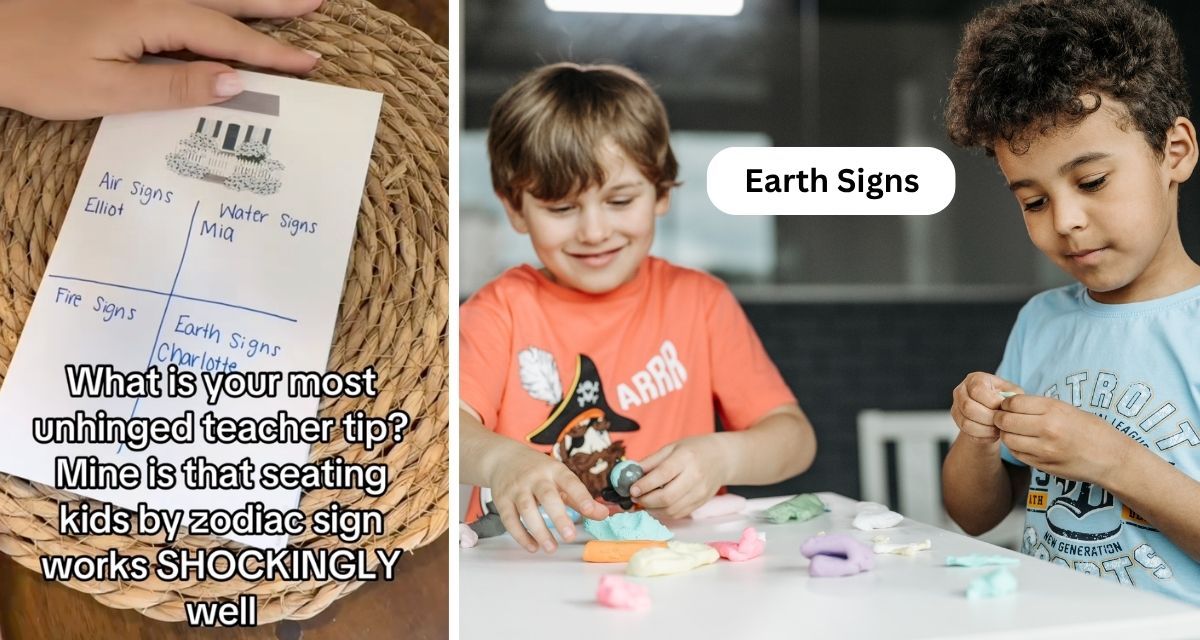
Kathryn Prouse started teaching third grade in Connecticut in 2020 and felt herself “overthinking everything.” But figuring out where to seat her students, whom she hadn’t even met yet, felt particularly “daunting.”
That’s when her astrologically-minded friend jokingly suggested that Prouse group her kids by zodiac sign. Little did she know that a suggestion made in jest would become the classroom hack of a lifetime.
The zodiac-based seating chart
Knowing that the extent of her zodiac knowledge was, as she told Upworthy, “pretty much the same as every teenager who spent the 2010s on Tumblr—think an astrology coffee-table book you might find at Urban Outfitters,” she decided to keep the method as simple as possible.
So, she grouped the kids according to the four elements their sun signs belong to. For those who don’t know:
- Earth signs = Taurus, Virgo, and Capricorn. Key characteristics: grounded, practical, and hardworking.
- Fire signs = Aries, Leo, and Sagittarius. Key characteristics: bold, passionate, and energetic.
- Water signs = Cancer, Scorpio, and Pisces. Key characteristics: emotional, sensitive, and empathetic.
- Air signs = Gemini, Libra, and Aquarius. Key characteristics: intellectual, curious, and social.
Some things seemed to check out
And much to Prouse’s surprise, some patterns kept popping up.
The Earth sign table always seemed to finish first and ask for more challenging work. Meanwhile, emotions were always running high at the Water sign table.
Maintaining focus at the Air sign table was also a challenge, as these kids were “a little dreamy and easily distracted.” And while kiddos at the Fire sign table seemed to “argue constantly,” they also fiercely loved their little group.
In the comments on her TikTok video, other educators shared similar experiences
“I worked at an alternative jr high where the majority of them were placed there for bad behavior. I checked once. It was over half fire signs. Not one earth sign out of almost 40 kids. It was like 30% water signs after that and one or two air signs. It was crazy.”
“Last year I had majority Aries (it was a rough year). Year before I had majority Pisces! (It was an emotional year).”
“I had a room filled with Capricorns one year, and it was amazing. They were all 4 going on 40.”
The bigger takeaway has nothing to do with astrology
Since this little social experiment in 2020, Prouse has tweaked her process a bit. For starters, she now tries to bring one student from each element to a table to balance out personalities. She also uses the zodiac seating chart merely as a “jumping-off point” to get to know her students’ individual quirks and needs better during the first month of the school year.
No longer a nervous first-time teacher, Prouse says that having a “starting point”—regardless of what that looks like—is what matters most.
“The zodiac signs aren’t really the important part,” Prouse said. “The important part is what comes next: learning who these kids are, building relationships with them, understanding what they need, and letting that information guide the decisions I make in my classroom.”
“Of course,” she admitted, “every once in a while, you look up and see your Virgo student meticulously organizing their school supplies while your Leo is demanding to be the line leader, and you think, ‘Yep. That tracks.‘”
Maybe that’s part of why astrology has such a lasting pull for so many adults, too. Sometimes we all need a starting point—a framework that helps us make sense of ourselves and the people around us. The real magic, as Prouse discovered, comes from what we do with that information.