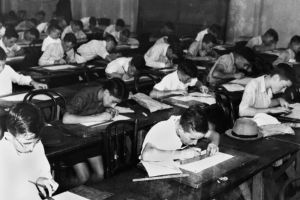
School has changed a lot since many parents were young. And it’s not just the technology. Though many kids now do most of their assignments on a school-issued laptop, while we were lucky to play a few minutes of The Oregon Trail on an Apple IIc, there’s more to it than that.
School is different in ways many of us can’t quite put our fingers on.
Educator and content creator points out hidden reason school feels ‘off’
Jamie Ruffner is an educator, former teacher, and education content creator with a social media audience of over 60,000. In an Instagram Reel, she explored a question she’s been hearing a lot from teachers and parents alike.
“Why does school feel so off lately?” she asked in the video. “How is it possible it’s changed this much since we were kids?”
“You really wanna know?” she said, playing two roles in the sketch. “I went down a rabbit hole. In 1983, a report, federally funded, mind you, called ‘A Nation at Risk.’”
Ruffner explained that the report said schools were failing and pointed to falling SAT scores as one major red flag. Its findings sparked a national panic about the state of public schools.
Commissioned by President Ronald Reagan’s Department of Education in 1983, the final report cited a “rising tide of mediocrity” and claimed that U.S. students were falling behind their international peers. It recommended higher academic standards, longer school days, and improved teaching techniques, among other suggestions for improving student performance.
“The government panicked and decided we needed more testing, more core academics, and less of everything else,” Ruffner said.
That’s part of the reason modern public schools often offer fewer shop, home economics, and art classes than they did decades ago. Though the report did not directly lead to these cuts, it helped usher in a huge national push toward greater academic accountability and standardized testing. Over time, that movement contributed to schools devoting more time to test preparation and core academics, sometimes at the expense of recess, the arts, and practical life skills. The accountability movement the report helped inspire later took shape in policies like No Child Left Behind and Race to the Top.
But the story has a major twist: the report wasn’t all that accurate.
“Later data showed it wasn’t that simple,” Ruffner said. “But by the time it was revealed, the damage was done.”
A Nation at Risk cherry-picked some of its data
In 2018, NPR interviewed two of the original authors of the report, who acknowledged that the commission didn’t necessarily begin its investigation with an open mind.
According to NPR, the people behind the explosive report “started out already alarmed by what they believed was a decline in education, and looked for facts to fit that narrative.”
It’s not that the data was completely wrong, but some of it lacked important context.
For example, NPR outlined how SAT scores had been declining for more than 20 years when the report came out. That much was true. However, more students than ever were graduating from high school and attending college. That meant far more kids than before were taking the SAT, not just the relatively small and academically select group that had taken it in previous decades. The expanding pool of test takers helped explain why average scores were dropping.
That shift toward standardized testing and accountability had a real impact. It’s one of the reasons many students today read fewer full-length books and novels in school, instead reading short passages that mirror what they’ll see on tests. A fundamental part of school that many of us remember—reading the classics—is becoming less common.
Not all bad news
One of the report’s critics is James Guthrie, an education professor at Lynn University. He told NPR that the authors “were hell-bent on proving that schools were bad. They cooked the books to get what they wanted.”
But he also acknowledges that the report, and the media firestorm it created, catapulted education to the forefront of the national conversation. It made people care about schools at a time when there were plenty of other pressing matters. It also helped spur a much bigger investment in the nation’s schools.
“Seldom, maybe never, has a public report been so wrong and done so much good,” he said.
Parents and educators like Ruffner might see it a little differently.
The National Education Association argues that standardized testing is “failing students” and that there are far better ways to measure progress.
“[Performance Based Assessment] allows students more choice in how they can show what they’ve learned, and it allows differentiated instruction for different learning styles,” Molly Malinowski, a first-grade teacher at Lynch Elementary School, told NEA. “Standardized tests don’t allow choice because it’s one-size-fits-all.”
Critics say the approach that A Nation at Risk helped set in motion doesn’t develop well-rounded students who are ready to thrive in the real world. After all, art, play, and learning real-world skills are crucial parts of childhood. How can a longer school day that leaves little room for those activities be anything but counterproductive?
It also drives good teachers out of the profession when they feel stifled by an overemphasis on testing.
Ruffner says many teachers today are simply doing their best: “We’re not defending the system, we’re surviving it.”