Imagine spending your whole life watching people be a little apprehensive around you.
Not cruel, just slightly tense. Unsure how to say hello. Wavering at the edge of a conversation they want to have but don’t know how to start. Awkward gestures. Uncomfortable pauses. For many Deaf parents, that’s the reality of raising a hearing child in a hearing world.
Now imagine the young man dating your daughter sits down across the table, takes a deep breath, and starts to sign. He’s nervous—who could blame him?—and his words come haltingly. The sentences are clearly practiced. But that doesn’t matter. He’s signing from the heart, and he’s eager to use your language to ask the most important question of all: for your blessing to marry her.
It’s a beautiful moment. And 7.3 million people have now watched it happen.
The reaction is the story
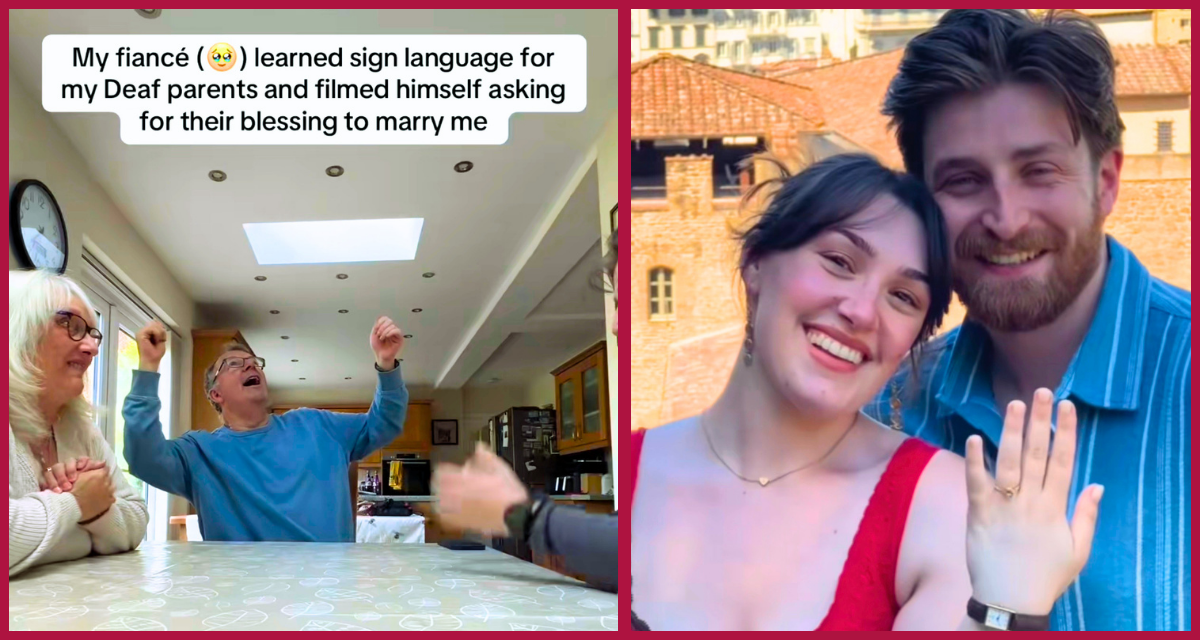
In a TikTok posted by his now-fiancée Emma that’s racked up 1.6 million likes, Matt asks her Deaf parents for their blessing entirely in sign language. Notice that Matt doesn’t lean on a translator. He doesn’t ask them to carry the burden of lip-reading. In return, Emma’s parents watch closely as he signs from the heart.
“I have a serious question for you both,” he begins in British Sign Language (BSL). “I want to ask for your permission to ask Emma to marry me.”
Then he waits. His hands aren’t quite steady, and Emma’s dad notices, teasing Matt for being nervous the way dads do.
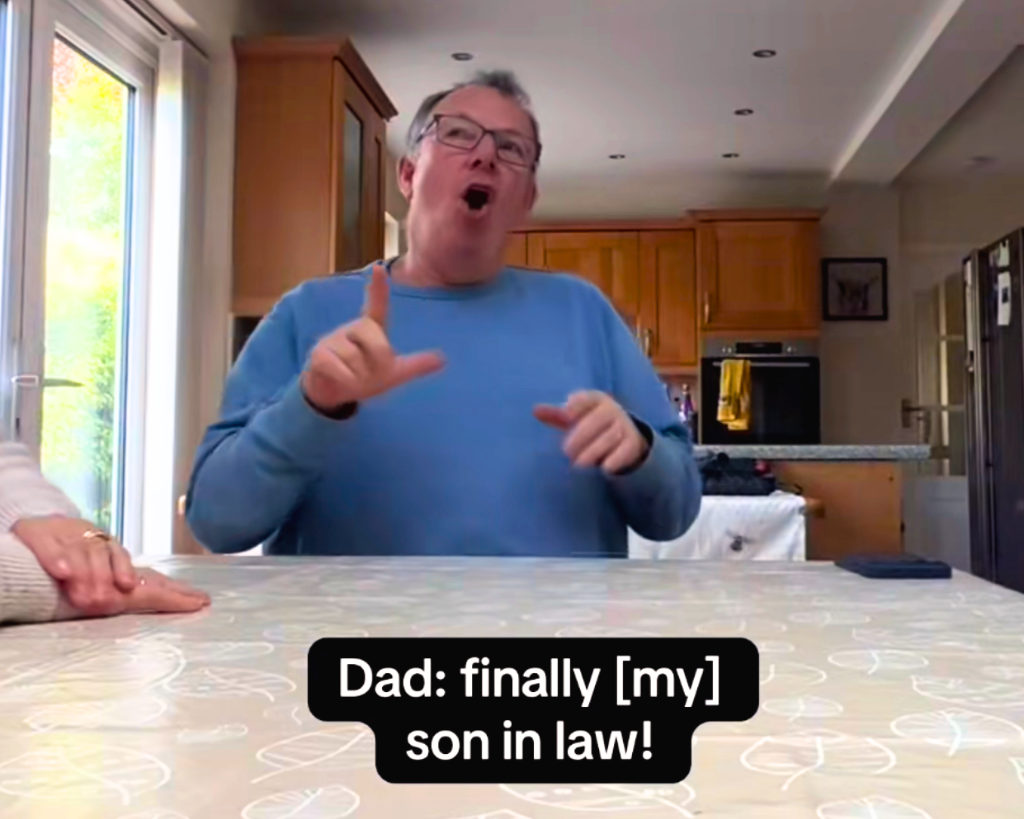
But they don’t make him wait long. The moment he asks, her mom lights up: “Yes! Fabulous! Come here, I’ve been waiting for this!” Her dad is just as thrilled: “Mazel tov! Finally, my son-in-law!”
When Matt asks if they want to see the ring, the answer is another instant yes. He carefully opens the box. “Oh, that’s lovely,” her mom signs. “It’s exactly what Emma wants.”
Then comes the detail that took the video from sweet to unforgettable: inside the ring, Matt had “I love you” engraved in sign language.
This moment clearly means the world to Emma’s parents. Their faces shift from surprise to jubilation, and you realize how beautiful it is to witness two parents finally being met in the language that’s theirs.
‘And that’s her why’
Emma’s caption says it all: “I’ve had friends too scared to speak to my parents, and now I have a FIANCÉ who learned sign language for them.”
That’s the truth underneath the tears, hugs, and repeated signs of “I love you.” Usually, it’s Deaf people who carry the weight of bridging the gap between their world and the hearing one: reading lips, writing notes, learning to speak aloud, and always waiting for someone else to make the effort. Matt flipped that. He put in the work and taught himself the basics before walking into the biggest conversation of his life. He met Emma’s parents on their turf, not his.
Emma is a CODA—a child of Deaf adults—so she grew up moving between two worlds: hearing and Deaf. For her, a partner who learns to sign is choosing to belong to her whole family, not just part of it.
Below her video, the comments lit up with more than 12,000 well-wishers.
“Marry him twice,” one person wrote. “As a girl mom, this is the type of man I PRAY my daughter brings home. Congrats, girl!”
“Just realized I was smiling like a goof through this whole interaction,” another person wrote.
And one more, simply: “And that’s her why.”
Showing up in someone’s language
For hearing people, the barrier to learning sign language is low. But the payoff can be life-changing.
Deaf creator Chrissy Marshall once described the amount of road-mapping and organizing she puts into her everyday life, just to interact with hearing people.
“Think about it. ASL interpreters don’t just magically show up,” she said in a TikTok video. “I’m never simply ‘showing up.’ I have to plan and decide how I’m going to comfortably access that environment.”
For an average social event with hearing people, Marshall plans weeks or months ahead. Some days, she might decide to use “caption glasses“—wearable devices that show real-time subtitles within her field of vision—or turn on live captioning on her phone. Great for connection, not so much for spontaneity. Now her ability to communicate depends on outlets and battery life. The devices die. The charge runs out. So Marshall plans for the moment she loses power and, with it, her connection to the hearing world. She checks whether a venue has outlets. She carries expensive backup chargers everywhere she goes. And that’s just the tech.
Socializing is a logistical headache, too. “Who is there? Will there be lights so I can see? How many people will be speaking?” Marshall asked. “The more people there are, the less I’ll be able to follow. I’m constantly thinking about all of these things before I go anywhere. Is it worth it?”
Is it worth it? She’s not the only one asking that question.
Somewhere between 500,000 and 1 million people in the United States use American Sign Language (ASL) as their main language. That’s roughly 2.8% of the country’s adult population. And that number is growing: ASL is now the third most-studied language at U.S. colleges, behind only Spanish and French. Meanwhile, on social media platforms like TikTok, the hashtag #asl continues to garner billions of views as people like Chrissy Marshall bravely share their stories.
One thing worth clarifying
Here’s a surprise: there’s no universal sign language. Emma’s family is British, so they sign in BSL, which is as different from ASL as English is from Spanish.
However, when it comes to love, the signs for “love” and “I love you” look quite similar in American and British sign language.
First, there’s the standalone “ILY” sign, made with one hand (🤟). The sign combines the letters I, L, and Y—hence the name—and it carries a wide emotional spectrum, conveying warmth, solidarity, “love ya,” support, goodbye, and even Deaf pride. It’s an iconic sign; you can flash it across a room to a loved one or while taking a fun photo.
Signing I / LOVE / YOU as a full sentence feels different. It’s more deliberate and personal. Here’s how it works: point to yourself for I, cross both hands over your chest for LOVE, then point to the other person for YOU. If “ILY” is the symbol of love, signing “I love you” is the act of saying it.
For Matt, the “I love you” engraved in BSL inside that ring means more than words. It’s a heartfelt gesture meant just for Emma and her parents, written in the language of their family.
The part worth getting right
If you’re already Googling how to sign “hello,” well done! Love the enthusiasm. But you should know: learning a few signs isn’t the same as being fluent, and the best place to start is with Deaf teachers and Deaf-led platforms.
Take Gallaudet University’s ASL Connect, for example. It’s a tremendous hub of resources, created by the world’s only university built specifically for Deaf and hard-of-hearing students. Its catalog—vocabulary organized by topic, free video demonstrations of signs you can watch and practice, paid online courses taught by Gallaudet instructors, and content rooted in Deaf culture, not just vocabulary drills—was built entirely by Deaf scholars, and it’s a great way to learn ASL and Deaf studies online.
Also worth a visit: Gallaudet’s library of VL2 Storybook Apps, where children’s stories are told in both ASL and English. Kids can watch tales told in ASL or read them in English, then switch whenever they want. Take Count with Us! A Nursery Rhyme Book, for example, a delightful story that brings numbers and animals to life through glorious illustrations. It’s packed with more than 42 vocabulary words, both signed and fingerspelled, through interactive videos. And it’s not just ASL. There are stories offered in many other languages, each paired with its own sign language: Dutch/Dutch Sign Language (DSL), Norwegian Sign Language (NSL), Japanese Sign Language (JSL), Arabic/Saudi Sign Language (SSL), and Spanish/Lengua de Señas Peruana (LSP), just to name a few.
Curious about sign language? Whether it’s your first time or you’re picking it back up, try one of these resources, listed by the Ohio School for the Deaf, one of the oldest continuously operating public Deaf schools in the U.S.: Sign School, The ASL App, ASL eBooks & Resources for Deaf Kids, ASLCORE, Why Sign, and SignOn.
Because the real lesson here isn’t about a ring, or even a proposal. It’s about the infinite possibilities that open up whenever someone decides another person’s language is worth learning.
For years, Emma’s parents navigated a world designed for the hearing: strangers they couldn’t talk with, pharmacists behind thick plexiglass with their lips hidden behind masks, and customer service departments that demanded they “just give us a call.” Then one day, a nervous young man named Matt sat down at their dining room table and started signing, asking for their blessing.
Emma’s viral video ends with a short clip: red-tiled roofs and Cathedral of Santa Maria del Fiore in the background as the couple stands together. Emma raises her left hand and flashes the ring, the one engraved with a simple promise: “I love you” in BSL.