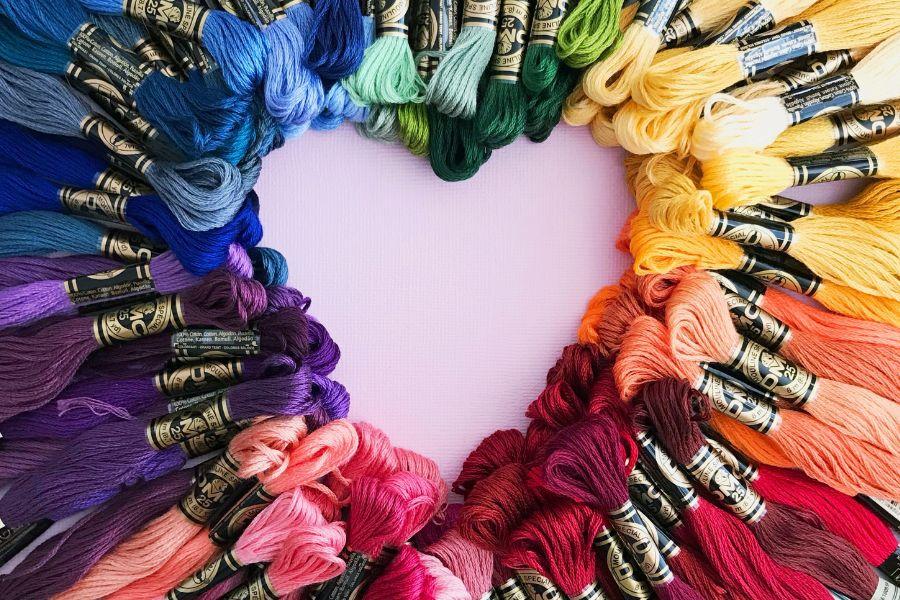
Few things bring people together more beautifully than art. Whether it’s music, sculpture, paint or fabric, the arts are a way for us to express ourselves, our cultures and our common humanity.
But rarely do we witness one singular piece of art truly encapsulating the creativity of our human family.
At first glance, the dress created for the Red Dress project is quite obviously stunning. It looks as though it could be worn by a royal, though a royal from where? The style, colors and patterns of the dress don’t shout any particular country or culture; in fact, we can point to different elements of it and say it looks like it belongs on any continent.
One dress, 51 countries, 14 years in the making
There’s a reason for that. The dress is made out of 87 pieces of burgundy silk dupion, which have spent the past 14 years being sent around the world to be embroidered by 380 people from 51 countries: a truly global, multicultural creation.
Of those 380 embroiderers, 141 were commissioned artisans who were paid for their work and receive a portion of all ongoing exhibition fees. The rest were volunteers who contributed their stitches at events in various countries. The vast majority of embroiderers were women; approximately 97% identified as female.
British textile artist Kirstie Macleod conceived the project in 2009 as “an investigation into identity, with a desire to connect with women from the around without borders and boundaries.” The basic design started as a sketch on the back of a napkin and has grown into a tangible garment that is not only a gorgeous work of art but a platform for women around the world and from all walks of life to express themselves and have their voices heard.
What the women stitched into the dress
As shared on the project’s website:
“Embroiderers include female refugees from Palestine and Syria, women seeking asylum in the UK from Iraq, China, Nigeria and Namibia, victims of war in Kosovo, Rwanda, and DR Congo; impoverished women in South Africa, Mexico, and Egypt; individuals in Kenya, Japan, Turkey, Sweden, Peru, Czech Republic, Dubai, Afghanistan, Australia, Argentina, Switzerland, Canada, Tobago, Vietnam, Estonia, USA, Russia, Pakistan, Wales, Colombia and England, students from Montenegro, Brazil, Malta, Singapore, Eritrea, Norway, Poland, Finland, Ireland, Romania and Hong Kong as well as upmarket embroidery studios in India and Saudi Arabia.”
On Instagram, Kirstie Macleod shared a panel of the dress that was embroidered by two women in Kosovo, who shared some of their reflections on their experiences in the war there.
They stitched words into the birds they embroidered:
“Better one winter in your own country than a hundred springs away.”
“The greatest wealth is to live content with little.”
“Freedom has come. Love yourself first.”
“Love all. Trust some. Hate none.”
“A winter is a winter. Be nice, everyone.”
“We live in peace now.”
The creation of the dress began in 2009 and was completed in 2023, earning a place in the Guinness World Records 2026 as the largest collaborative embroidery project. Each woman embroidered a piece of her own story into the dress, which contains millions of stitches. From established professional artisans to first-time embroiderers, the women were encouraged to share something that expressed their personal identities as well as their cultures. Some used traditional embroidery styles that had been practiced for hundreds of years where they are from. Others stitched in meaningful elements of their life stories. Some of the women are also using textile work to rebuild their lives and earn a consistent living.
The dress is still traveling the world
The dress continues to tour museums and galleries around the world, and in 2026 was invited to be displayed at the United Nations in Geneva by the Human Rights Division of the UK Mission. The photos showing women of various ages and ethnicities wearing the dress are made all the more moving knowing the history of how and by whom it was made.
Absolutely stunning. What a wonderful idea to connect women in a way that lets them share their stories and showcases and beautifully honors them.
If the dress has inspired you, Macleod’s 2025 book The Red Dress: Conversations in Stitch goes deeper into the project and the stories of the women behind it: a fitting companion to one of the most remarkable collaborative art projects ever undertaken.
This article originally appeared four years ago. It has been updated.