Legendary Japanese writer-director Akira Kurosawa may not be a familiar name to many in the United States, but his movies have inspired some of the most important American films ever made.
Kurosawa’s 1954 epic The Seven Samurai was later remade as an American Western, The Magnificent Seven (1960). Kurosawa’s Samurai classic Yojimbo (1961) would serve as the basis for Clint Eastwood’s A Fistful of Dollars (1964), and The Hidden Fortress (1958) was a huge inspiration for George Lucas’s Star Wars (1977) (later renamed Star Wars: Episode IV — A New Hope).
Although Star Wars isn’t an outright remake of The Hidden Fortress, it bears a lot of similarities. The Hidden Fortress tells the story of two greedy, bumbling peasants, Tahei and Matashichi, who get swept up in a general Rokurota’s campaign to rescue a headstrong princess and bring her back home across enemy lines. At the end of the film, Rokurota has a sword duel with a former student, Tadokoro, and spares his life.
“The one thing that really struck me about Hidden Fortress and intrigued me was the fact that the story was told from the two lowest characters,” Lucas recalled. “I decided that that would be a nice way to tell the Star Wars story, which is to take the two lowliest characters, as Kurosawa did, and tell the story from their point of view, which in the Star Wars case is the two droids. That was the strongest influence, actually.”
Lucas also admits that in early drafts of Star Wars, there were more parallels with Princess Leia having a closer relationship with the old general, Obi-Wan Kenobi. “The fact that there was a princess trying to get through enemy lines and everything, I think was more of a coincidence than anything else because in my film the princess is more a stand-and-fight kind of princess,” Lucas continues. “In the beginning, in some of the first drafts, I had a little bit more of her and a Jedi, an older Jedi, trying to escape, and that sort of thing, but then it evolved.”
Here are six of the biggest similarities between The Hidden Fortress and Star Wars:
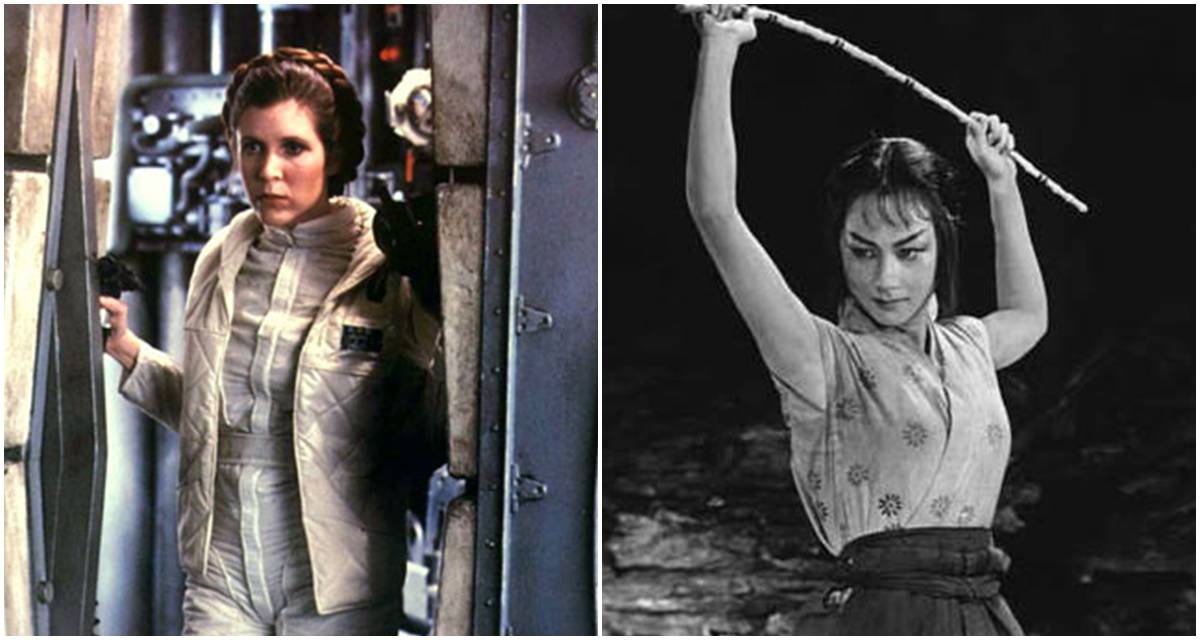
Princess Leia / Princess Yuki
Both princesses had to be rescued from their respective groups of evil-doers who killed their people, whether it’s the Galactic Empire or the Yamana clan. They also share similar personalities; rather than being damsels in distress, they are both smart, confident, and capable leaders of their rebellions.
Obi-Wan Kenobi / Rokurota Makabe
Both films feature old, brave generals who must conceal their true identities and have a climactic duel with an old foe. The difference is that Kenobi, the student of Darth Vader, is killed by the Sith Lord. Rokurota faces his former student, Hyoe Tadokoro, and comes away victorious.
In The Hidden Fortress, Rokurota is played by Toshiro Mifune, who was the lead in many of Kurosawa’s biggest pictures, including The Seven Samurai, Rashomon (1950), Yojimbo, and Throne of Blood (1957). Lucas approached Mifune to play Kenobi, and when he turned him down, he offered him the role of Darth Vader.
“I heard from my father that he was offered the role of Obi-Wan Kenobi, but he was concerned about how the film would look and that it would cheapen the image of samurai, on which George Lucas had based a lot of the character and fighting style,” Mika Mifune told The Guardian in 2015. “At the time, sci-fi movies still looked quite cheap as the effects were not advanced, and he had a lot of samurai pride,” Mika said. “So then, there was talk about him taking the Darth Vader role as his face would be covered, but in the end, he turned that down too.”
Droids / Matashichi and Tahei
The beginning of Star Wars is told from the perspective of droids R2-D2 and C-3PO, who jettison the rebel Blockade Runner in time to avoid capture by the Empire. They are separated by an argument and reunite when they encounter Luke Skywalker and Kenobi, eventually joining them to help save the princess. In The Hidden Fortress, the movie begins with Tahei and Matashichi, who, after a fight and a separation, reunite and unwittingly become involved in Rokurota’s mission to smuggle Yuki through enemy territory.
Cinematic style
One of the most noticeable editing techniques the films share is the use of wipes to transition between scenes, whether it’s a slow fade across the screen or the clockwise-motion wipe. These types of transitions were common in earlier, low-budget serial films.
Similar crests
The crests of the Yamana clan, the Galactic Empire, and the First Order look surprisingly similar.
Star Wars is a wonderful tribute to Kurosawa’s films, and Lucas’s obvious passion for his films helped raise awareness of the director’s work. Lucas even helped raise money and got an executive producer credit on his 1980 film Kagemusha. However, Kurosawa was far from the only inspiration for Star Wars. One can also point to other works, including Frank Herbert’s Dune novels and Joseph Campbell’s The Hero of a Thousand Faces. Luke Skywalker’s character arc in Star Wars traces back thousands of years to the hero’s journey, a specific plot device used in works such as The Epic of Gilgamesh and The Odyssey.
“There’s a book written and a theory among writers that there are only 32 plots and that it’s all the same 32 plots retold,” Lucas says. “In a way, I’m not sure that’s exactly true, but once you get into writing stories or reading stories or studying the whole issue of stories, you find out that most stories are repeated over and over again.”