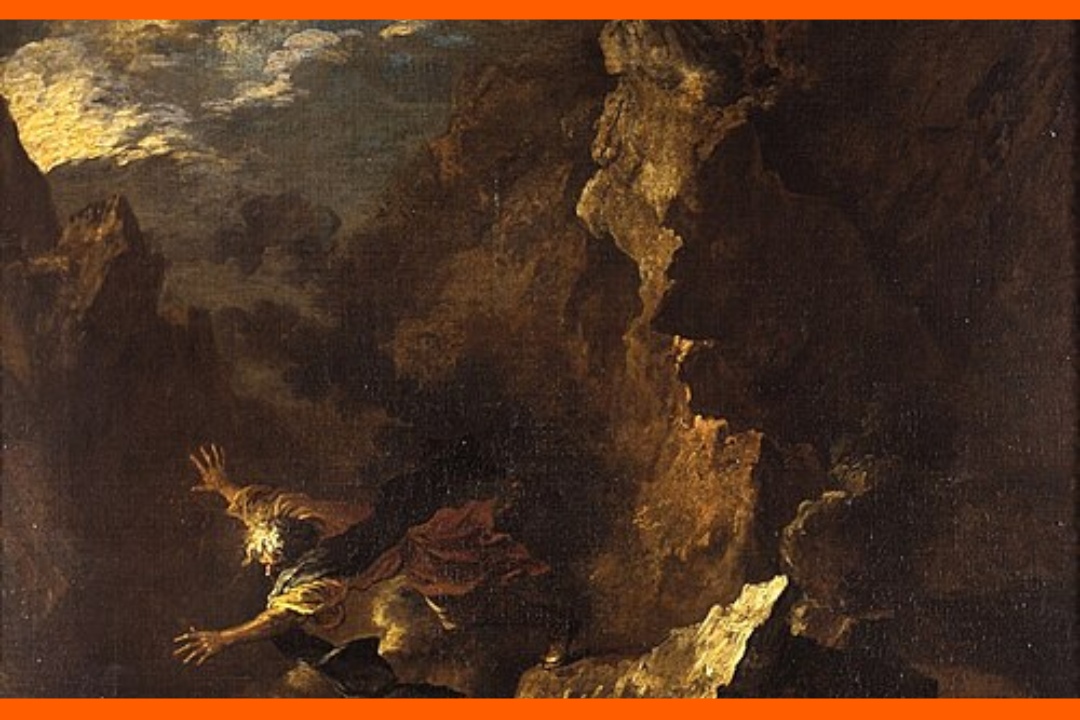
Before there was Plato, Aristotle, or even Socrates, there was a group of Greek philosophers who imparted their wisdom onto others in the early 5th century BCE. One such scholar was Empedocles, who was said to have been influential and unique in many ways. (And that’s not just because, as rumor had it, he thrust himself into an active volcano as a sacrifice.) His use of hexameter verse, an impactful writing style which helped turn his philosophical thoughts into poetry, was especially appreciated by writers.
So when researchers in Cairo uncovered 30 unpublished poetic verses approximately 2,000 years after they were written, many took note. Until this discovery, much of his reputation had been built on the backs of historians who came after him. Finding actual additional verses from his work has been downright mind-blowing for many.
An enormous finding
In a paper edited by scientific editor Stephanie Baum for University de Liege, they share that a “2,000-year-old papyrus fragment, discovered in the archives of the French Institute of Oriental Archaeology in Cairo, reveals 30 previously unpublished verses by Empedocles, a pre-Socratic philosopher of the fifth century BCE. This discovery offers researchers direct access to a body of thought previously known only through quotations from later authors.”
The article also eloquently notes what a huge achievement this is by comparing it to the hypothetical discovery of a more modern writer. “To grasp the significance of such a discovery, the authors offer an illuminating analogy: Imagine that in a few centuries’ time, all that remains of Victor Hugo are excerpts from Les Misérables in school textbooks, the musical Notre-Dame de Paris, and the program for a performance of the play Hernani. The discovery of a few pages from an original edition of Hugo’s work would then be a momentous event.”
Love and strife
Empedocles and his work were incredibly impactful. Britannica states that, “Although strongly influenced by Parmenides, who emphasized the unity of all things, Empedocles assumed instead that all matter was composed of four essential ingredients, fire, air, water, and earth, and that nothing either comes into being or is destroyed but that things are merely transformed, depending on the ratio of basic substances to one another.”

These ideas, centered around the basic elements, also helped shape his belief that the human struggle is centered around “love and strife.” “Like Heraclitus, he believed that two forces, Love and Strife, interact to bring together and to separate the four substances. Strife makes each of these elements withdraw itself from the others; Love makes them mingle together. The real world is at a stage in which neither force dominates.”
A famous quote thought to be attributed to Empedocles says, “The force that unites the elements to become all things is Love, also called Aphrodite; Love brings together dissimilar elements into a unity, to become a composite thing. Love is the same force that human beings find at work in themselves whenever they feel joy, love, and peace. Strife, on the other hand, is the force responsible for the dissolution of the one back into its many, the four elements of which it was composed”.
A predecessor to many great thinkers
Philosophy professor Graham Blackbourn, of the School of Philosophy and Economic Science in Edinburgh, is one of many who speak at length on the topic of Empedocles. On a podcast, he shared just how influential his work was.
“Many scholars think that Empedocles was the source of Plato’s myth of the soul’s journey in his dialogue Phaedrus, in addition to some of the themes in his Symposium, including Diotima’s teaching on love. Aristotle referenced Empedocles more often in his writings than anyone other than Plato himself.
So what do we know of Empedocles’ thinking?
Until recently, it was thought that Empedocles wrote two very different books, or poems, since he composed in hexameter verse. One poem was called “On Nature,” a bizarre but essentially materialist account of the evolution of the cosmos. The other was called “Purifications,” concerning religious ideas and practices which it was thought were rather at odds with Empedocles’s materialist cosmology. Neither poem was preserved in its entirety, being known only from quotations in later writings.”
Where can we find these uncovered verses?
Edited by Nathan Carlig, Alain Martin, and Olivier Primavesi, the works are translated with commentary in L’Empédocle du Caire.
The Liege University site directly confirms “It was at the French Institute of Oriental Archaeology in Cairo (IFAO) that Nathan Carlig, a papyrologist at the University of Liège, identified papyrus P.Fouad inv. 218 as an unknown fragment of the Physica, the great poem by the philosopher Empedocles of Agrigentum.”
While the text is not readily available (just yet), the university site gives a bit of insight into what the verses reveal. “The text that has come to light deals with the theory of particle effluvia and sensory perceptions, particularly vision.”
Furthermore, they explain how much the new verses seem to have influenced philosophers who came after him. “Analysis of the text has revealed unexpected connections, including the probable direct source of a passage by Plutarch (2nd century), as well as a dialogue by Plato and a text by Theophrastus, a disciple of Aristotle, both from the 4th century BCE.”