Pretty much every elementary school student on Earth learns the names and order of the planets in our solar system. They label worksheets, color activity sheets, and build models. We teach them songs and mnemonic devices to help them remember the order of the planets by their distance from the Sun.
But when we see the planets neatly lined up, we don’t get a clear picture of the distances between them. And as a CGP Grey video illustrates, one of the most interesting things about the distances between planets isn’t how far apart they are from each other, but how close they all are to Mercury.
Or at least, how close they are to Mercury most of the time. The distances between the planets vary due to the speed and shape of their orbits. But as Grey’s “You Learned the Solar System Wrong” video illustrates, the planet that is closest to every other planet most often is Mercury.
Yep, every single planet in our solar system. It feels counterintuitive, but the math checks out.
Mercury, the “mostest closest” planet
“Planets are not humans queuing for coffee but rather spheroids scattered in space, always in motion,” says CGP Grey. “Not in simple circles, either, but ellipses at untidy angles.”
He explains that because of differences in their orbits, there’s no clear answer to the question of which planet is closest to another, because it changes all the time. The better question is, “Which planet is closest most often?”

Planets don’t actually line up like this. Photo credit: Canva
Mercury. It’s always Mercury. And it comes down to its small orbit.
“Mercury’s small orbit means he never goes as far away as the other planets with their bigger orbits,” CGP Grey says. “The orbital math that shows Mercury is the mostest closest to Jupiter is the same for all the planets and everything that orbits the Sun.”
Mercury is the social butterfly of planets
People were delighted to learn this fun fact and shared some clever comments:
“Mercury must be a really good friend, he’s got so many friends but he makes time for them all.”
“This is why Mercury was the messenger, he was able to reach every God.”
“Mercury is that one kid who has ties with the seniors.”
“All other planets are in some toxic relationship: constantly shifting between being super intimate and escaping as far as they can from each other. And Mercury is that one guy who’s not very close, but always within reach, if you ever need him.”
“Mercury is like that kid in school who knows EVERYone.”
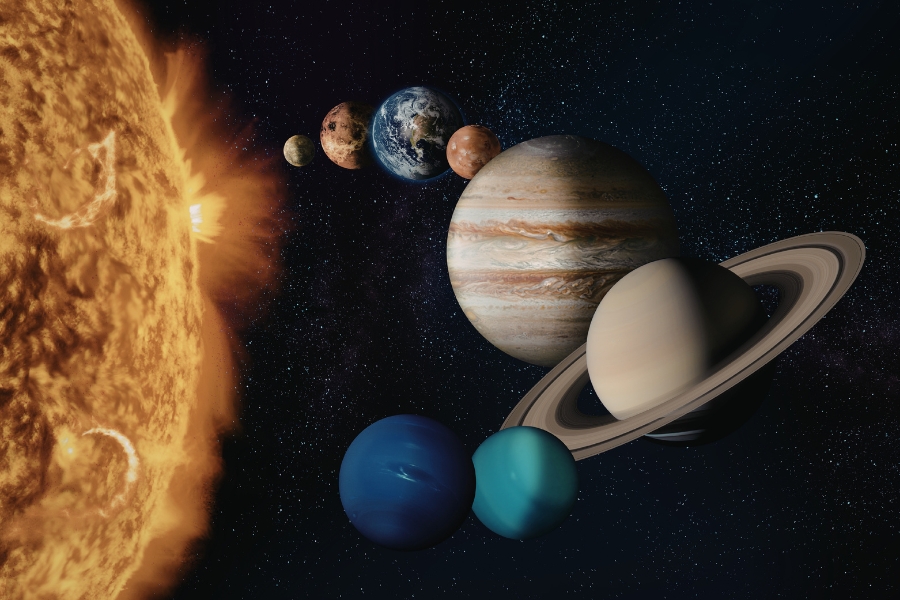
It’s impossible to fit all the planets into one image with their proper distances. Photo credit: Canva
“Mercury is just the little brother that everyone loves.”
“This is so delightfully appropriate for the planet named after the messenger of the gods. Who else can pass notes between them better but the mostest closest?”
“Mercury is that hot (literally) playboy who steals everybody’s heart, from girls to guys, young to old.”
Mercury does seem to get around, doesn’t it? It’s even the closest to Pluto, the poor, no-longer-a-planet outcast of our solar system.

Mercury is special. – Photo credit: Image credit: Canva
More fun facts about Mercury
It is rather wee. When Pluto was downgraded, Mercury claimed the title of smallest planet. It’s approximately one-third the size of Earth.
It is extreme. Daytime temperatures can reach 800 degrees Fahrenheit (430 degrees Celsius), and nighttime temperatures can drop to negative 290 degrees Fahrenheit (minus 180 degrees Celsius). A 1,000-degree swing is wild.
It has major magnetic tornadoes. According to NASA, “Though Mercury’s magnetic field at the surface has just 1% the strength of Earth’s, it interacts with the magnetic field of the solar wind to sometimes create intense magnetic tornadoes that funnel the fast, hot solar wind plasma down to the surface of the planet.”
It’s so metal. Mercury has a metallic core that takes up about 85% of its radius.
It is moonless. Mercury and Venus have no moons. Every other planet in our solar system has at least one.
Mercury, the “mostest closest” of all the planets, truly is special.
In a small village in Pwani, a district on Tanzania’s coast, a massive dance party is coming to a close. For the past two hours, locals have paraded through the village streets, singing and beating ngombe drums; now, in a large clearing, a woman named Sheilla motions for everyone to sit facing a large projector screen. A film premiere is about to begin.
It’s an unusual way to kick off a film about gender bias, inequality, early marriage, and other barriers that prevent girls from accessing education in Tanzania. But in Pwani and beyond, local organizations supported by Malala Fund and funded by Pura are finding creative, culturally relevant ways like this one to capture people’s interest.
The film ends and Sheilla, the Communications and Partnership Lead for Media for Development and Advocacy (MEDEA), stands in front of the crowd once again, asking the audience to reflect: What did you think about the film? How did it relate to your own experience? What can we learn?
Sheilla explains that, once the community sees the film, “It brings out conversations within themselves, reflective conversations.” The resonance and immediate action create a ripple effect of change.
MEDEA Screening Audience in Tanzania. Captured by James Roh for Pura
Across Tanzania, gender-based violence often forces adolescent girls out of the classroom. This and other barriers — including child marriage, poverty, conflict, and discrimination — prevent girls from completing their education around the world.
Sheilla and her team are using film and radio programs to address the challenges girls face in their communities. MEDEA’s ultimate goal is to affirm education as a fundamental right for everyone, and to ensure that every member of a community understands how girls’ education contributes to a stronger whole and how to be an ally for their sisters, daughters, granddaughters, friends, nieces, and girlfriends.
Sheilla’s story is one of many that inspired Heart on Fire, a new fragrance from the Pura x Malala Fund Collection that blends the warm, earthy spices of Tanzania with a playful, joyful twist. Here’s how Pura is using scent as a tool to connect the world and inspire action.
A partnership focused on local impact, on a global mission
Pura, a fragrance company that recognizes education as both freedom and a human right, has partnered with Malala Fund since 2022. In order to defend every girl’s right to access and complete 12 years of education, Malala Fund partners with local organizations in countries where the educational barriers are the greatest. They invest in locally-led solutions because they know that those who are closest to the problems are best equipped to solve and build durable solutions, like MEDEA, which works with communities to challenge discrimination against girls and change beliefs about their education.
But local initiatives can thrive and scale more powerfully with global support, which is why Pura is using their own superpower, the power of scent, to connect people around the world with the women and girls in these local communities.
The Pura x Malala Fund Collection incorporates ingredients naturally found in Tanzania, Nigeria, Pakistan, and Brazil: countries where Malala Fund operates to address systemic education barriers. Eight percent of net revenue from the Pura x Malala Fund Collection will be donated to Malala Fund directly, but beyond financial support, the Collection is also a love letter to each unique community, blending notes like lemon, jasmine, cedarwood, and clove to transport people, ignite their senses, and help them draw inspiration and hope from the global movement for girls’ education. Through scent, people can connect to the courage, joy, and tenacity of girls and local leaders, all while uniting in a shared commitment to education: the belief that supporting girls’ rights in one community benefits all of us, everywhere.
You’ve already met Sheilla. Now see how Naiara and Mama Habiba are building unique solutions to ensure every girl can learn freely and dare to dream.
Naiara Leite is reimagining what’s possible in Brazil
Julia with Odara in Brazil. Captured by Luisa Dorr for Pura
In Brazil, where pear trees and coconut plantations cover the Northeastern Coast, girls like ten-year-old Julia experience a different kind of educational barrier than girls in Tanzania. Too often, racial discrimination contributes to high dropout rates among Black, quilombola and Indigenous girls in the country.
“In the logic of Brazilian society, Black people don’t need to study,” says Naiara Leite, Executive Coordinator of Odara, a women-led organization and Malala Fund partner. Bahia, the state where Odara is based, was once one of the largest slave-receiving territories in the Americas, and because of that history, deeply-ingrained, anti-Black prejudice is still widespread. “Our role and the image constructed around us is one of manual labor,” Naiara says.
But education can change that. In 2020, with assistance from a Malala Fund grant, Odara launched its first initiative for improving school completion rates among Black, quilombola, and Indigenous girls: “Ayomidê Odara”. The young girls mentored under the program, including Julia, are known as the Ayomidês. And like the Pura x Malala Fund Collection’s Brazil: Breath of Courage scent, the Ayomidês are fierce, determined, and bursting with energy.
Ayomidês with Odara in Brazil. Captured by Luisa Dorr for Pura
Ayomidês take part in weekly educational sessions where they explore subjects like education and ethnic-racial relations. The girls are encouraged to find their own voices by producing Instagram lives, social media videos, and by participating in public panels. Already, the Ayomidês are rewriting the narrative on what’s possible for Afro-Brazilian girls to achieve. One of the earliest Ayomidês, a young woman named Debora, is now a communications intern. Another former Ayomidê, Francine, works at UNICEF, helping train the next generation of adolescent leaders. And Julia has already set her sights on becoming a math teacher or a model.
“These are generations of Black women who did not have access to a school,” Naiara says. “These are generations of Black women robbed daily of their dreams. And we’re telling them that they could be the generation in their family to write a new story.”
Mama Habiba is reframing the conversation in Nigeria
Centre for Girls' Education, Nigeria. Captured by James Roh for Pura
In Mama Habiba’s home country of Nigeria, the scents of starfruit, ylang ylang and pineapple, all incorporated into the Pura x Malala Collection’s “Nigeria: Hope for Tomorrow,” can be found throughout the vibrant markets. Like these native scents, Mama Habiba says that the Nigerian girls are also bright and passionate, but too often they are forced to leave school long before their potential fully blooms.
“Some of these schools are very far, and there is an issue of quality, too,” Mama Habiba says. “Most parents find out when their children are in school, the girls are not learning. So why allow them to continue?”
When girls drop out of secondary school, marriage is often the alternative. In Nigeria, one in three girls is married before the age of 18. When this happens, girls are unable to fulfill their potential, and their families and communities lose out on the social, health and economic benefits.
Completing secondary school delays marriage, and according to UNESCO, educated girls become women who raise healthier children, lift their families out of poverty and contribute to more peaceful, resilient communities.
Centre for Girls’ Education, Nigeria. Captured by James Roh for Pura
To encourage young girls to stay in school, the Centre for Girls’ Education, a nonprofit in Nigeria founded by Mama Habiba and supported by Malala Fund and Pura, has pioneered an initiative that’s similar to the Ayomidê workshops in Brazil: safe spaces. Here, girls meet regularly to learn literacy, numeracy, and other issues like reproductive health. These safe spaces also provide an opportunity for the girls to role-play and learn to advocate for themselves, develop their self-image, and practice conversations with others about their values, education being one of them. In safe spaces, Mama Habiba says, girls start to understand “who she is, and that she is a girl who has value. She has the right to negotiate with her parents on what she really feels or wants.”
“When girls are educated, they can unlock so many opportunities,” Mama Habiba says. “It will help the economy of the country. It will boost so many opportunities for the country. If they are given the opportunity, I think the sky is not the limit. It is the starting point for every girl.”
From parades, film screenings to safe spaces and educational programs, girls and local leaders are working hard to strengthen the quality, safety and accessibility of education and overcome systemic challenges. They are encouraging courageous behavior and reminding us all that education is freedom.
Experience the Pura x Malala Fund Collection here, and connect with the stories of real girls leading change across the globe.
The simple ritual of going outside to welcome nightfall can be extremely relaxing. Of course, this has been done since the dawn of time. However, the practice of “dusking” has recently regained popularity and has become a trend for people looking to boost their mental well-being. The Dutch have been doing this for ages. In…
The simple ritual of going outside to welcome nightfall can be extremely relaxing. Of course, this has been done since the dawn of time. However, the practice of “dusking” has recently regained popularity and has become a trend for people looking to boost their mental well-being.
The Dutch have been doing this for ages. In the Netherlands, dusking is referred to as “schemeren,” which translates to “be dusky, to be in twilight.” It’s the idea of letting the lights turn off while the starry night envelops the day. Watching the color of the sky subtly fade can do wonders for a busy mind.
In a piece for The Guardian, writer Rachel Dixon describes her time at the Dark Skies “dusking event” in the United Kingdom in February 2026. “The darkening sky is faintly illuminated by a sharp sliver of crescent moon and the first stars. Bats are swooping in search of supper, an owl is softly hooting, and the dark outline of a ruined castle looms beyond the walls.”
She explains how this ritual has resurged, writing, “The custom had all but died out until it was revived by Dutch poet and author Marjolijn van Heemstra a few years ago. Now she is encouraging other countries to adopt dusking, running events in Ireland, Germany, and here in Yorkshire.”
Dixon shares that van Heemstra also spoke at the event she attended. “Dusking is about looking at one point and seeing it fade. Don’t look around too much; focus. Trees are very good – they rise up for a moment and then fade away,” van Heemstra eloquently said.
Not only is the concept beautiful, but it can also do wonders for anxiety and spark the imagination.
In Country & Townhouse, Digital Editor Ellie Smith notes that dusking intentionally forces a pause, writing, “In today’s non-stop hustle culture, it’s rare that we sit and do nothing. But intentional moments of pause can offer many benefits for our mental wellbeing—studies show mindfulness can reduce stress and anxiety, boost sleep quality, and develop better self-acceptance.”
She also shares the concept of choosing nothing at all. “The Dutch are well-versed in the art of doing nothing: niksen, which translates as ‘doing nothing without purpose,’ is another wellness concept entrenched in their culture which went viral in 2019 as a way to combat burnout.”
Smith cites van Heemstra once more while describing someone who says they read their interior magazines at night. “When she can’t see the images sharply, she told me, her imagination takes over and populates the interiors with strange shapes and presences. In a blurred sketch, you invent your own boundaries, and there is dialogue between inner and outer worlds.”
On a Facebook post about the North York Moors dusking event, many commenters were eager to share their thoughts. One explains, “Dusking is a ritual and modern practice that involves consciously observing the transition from day to night. It is seen as a form of ‘slow living’ or resistance to the 24-hour economy, where one consciously stops working and waits to turn on the lights until it is truly dark.”
Another admits they already loved the concept without knowing it had a name, writing, “Love dusking. Although I didn’t know it had a name!”
As spring approaches, gardeners begin planning what they want to plant and when. Often, they starting seeds indoors rather than outside. Usually, seeds are planted in trays or small cups and nurtured into seedlings before being transplanted outdoors once the danger of frost has passed.
Seed starts require space, though, and not everyone has it in abundance. That’s why a “revolutionary” method of starting seeds using recycled packaging materials has people excited. Using the “seed snail” or “seed sushi” method, you can grow far more seedlings in a much smaller area than with traditional trays or cups.
When you start seeds, they need to be spaced far enough apart that their roots don’t get entangled, which is why traditional seed starter trays have small compartments. The seed snail keeps seedlings’ roots separate while allowing them to grow in a compact space.
Benedict Vanheems, author of GrowVeg: The Beginner’s Guide to Easy Vegetable Gardening, demonstrates how to make the seed snail using different kinds of packaging materials. However, he says bubble wrap is his “absolute favorite.”
“This, with its air pockets, helps to create a slightly sturdier roll so it sits firmer,” Vanheems says in a YouTube clip. “And the air pockets will also help to insulate the roots from swings in temperature, which our seedlings will much prefer. Bubble wrap is flexible, retains moisture well, and can be reused time and again.”
Bubble wrap isn’t an obvious gardening tool, but it’s useful. Photo credit: Canva
However, he acknowledges concerns people may have about microplastics and offers a solution. First, he cuts the bubble wrap into long strips about three inches wide. Next, he cuts a strip of baking parchment twice as wide. He then folds the parchment in half and wraps it over both sides of the bubble wrap. This ensures the soil never touches the plastic while still providing the temperature-regulation benefits of the bubble wrap.
Vanheems adds water to the potting mix to make it very moist. Depending on the size of the seeds you plan to use, you’ll cover the strip of packaging with between 1/2 inch and 2 inches of soil. Pat the soil down fairly firmly, and leave an inch or two uncovered at the end.
After you roll up the “snail,” use painter’s or masking tape to secure it. Then it’s ready for you to add your seeds according to the individual seed instructions. Vanheems doesn’t recommend sowing the seeds before rolling, as they can get moved around and dislodged. He also gives tips for retaining moisture in the snail rolls, from misting or light watering to keeping them covered with clear plastic.
Traditional seed trays take up more space than a seed snail. Photo credit: Canva
Vanheems showed what the seedlings looked like once they had developed roots and shoots. This method allows long, deep roots to grow, making it easy to separate the plants after unrolling the snail.
Some seedlings may need more soil added to the roll once their roots begin to grow. Simply unroll the snail, sprinkle more soil over the roots, and reroll. Easy peasy. The main thing to watch with the snail is that it stays moist, since it uses less soil per seedling than traditional trays.
Both amateurs and pros are loving the idea in the YouTube video comments:
“Your method is a LOT cheaper than buying these expensive plastic containers in the DIY garden market that barely survive one year in the garden. I surely will give it a try. Thank you!”
“I just ran across these a few days ago and I’ve already got a bunch of them going! This is going to be a game changer! I’m using disposable shower caps to cover the ones that need it – they’re infinitely reusable as long as you don’t break the elastic.”
Once your seedlings grow large enough, you can transplant them. Photo credit: Canva
“I tried this ‘seed snail’ method with my Sweet Peas last week and I’m officially a convert! The vertical root growth is incredible, but the real win for me was the space saving—I fit twice as many under my grow lights than I usually do. If you’re tight on indoor space, this is a total game-changer. Great tutorial!”
“I’ve been wondering how to go about growing a large number of native plant plugs without having to buy more plastic. Using this technique I’m going to stretch my supplies to grow even more seeds in a single season. Thank you so much for the tip. You weren’t kidding when you said it would change the way you do things. I’m officially converted.”
“A little advice from an old nurseryman, when handling tiny seedlings, it is much safer to handle them by their leaves, not the stems. Even a finger can damage a very sensitive seedling stem and can cause damping off that will kill the seedling. The seed snail idea is brilliant and I will start using it myself. It has several advantages but the best for me is the unrolling and the easy removal of the seedlings without damage to their root systems. Thank you!”
There’s nothing more exhausting than having a dry cough that won’t go away. Some viruses, such as RSV, can cause a lingering cough for weeks after the infection is over. Most people try cough suppressants and lozenges to make themselves more comfortable. Still, there’s one ancient remedy most people don’t know about that research suggests can work quickly: marshmallow root (Althaea officinalis).
“The natural marshmallow root or plant has been shown to decrease throat irritation and coughing,” said Dr. Bayo Curry-Winchell, a family medicine physician and TED Talk speaker, according to The Huffington Post. “The soothing effect comes from the plant’s natural coating, called mucilaginous, which is a sticky gelatin substance that might help reduce a cough.”
However, that doesn’t mean you should pop a few extra-large marshmallows in your mouth or down a few teaspoons of marshmallow ice cream topping, as the woman in the TikTok video below suggests. Companies that make the sweet confection stopped using marshmallow root decades ago.
“Store-bought marshmallows, which contain sugar, water, and gelatin, do not [reduce coughing],” Dr. Sood clarified on TikTok. “But marshmallow root, which has been used since ancient times, does have medicinal uses and can soothe your throat and suppress your cough. This was previously an ingredient in marshmallows but has now been replaced with sugar. The reason it helps is it builds protective coat in your mouth and throat, and there is research to support.”
Why marshmallow root is so great at soothing coughs
Marshmallow root is effective at soothing a dry, painful cough due to the mucilag, a sap-like substance it produces. When ingested, the mucilage coats the mucosa, or the lining of the body’s inner passages, soothing them like a balm.
Multiple studies have found that marshmallow root, when used as a cough syrup or lozenge, provides rapid symptom relief. It has also been shown to reduce cough reflex sensitivity and throat irritation.
There are many different ways to take marshmallow root if you have a cough that won’t go away. You can make marshmallow root tea by using the root as loose-leaf tea, pouring boiling water over it, and letting it steep for 10 minutes. You can also mix marshmallow root powder with water or juice to make a drink.
This may be the first time you’ve heard of using marshmallow root to soothe a hacking cough, but its medicinal use dates back to ancient Egypt, where it grew in swamps and bogs.
In the 1800s, the French took the marshmallow plant, mixed its sap with rose water and egg white meringue, and dropped the mixture into candy molds. This marked the birth of the marshmallow you love and cook over campfires today. Over the years, marshmallows became increasingly popular, so manufacturers ditched the root sap in favor of gelatin and corn syrup, which were more readily available.
Marshmallow root is a great example of how, even as scientific advancements have drastically changed how people approach health, some ancient remedies have stood the test of time.